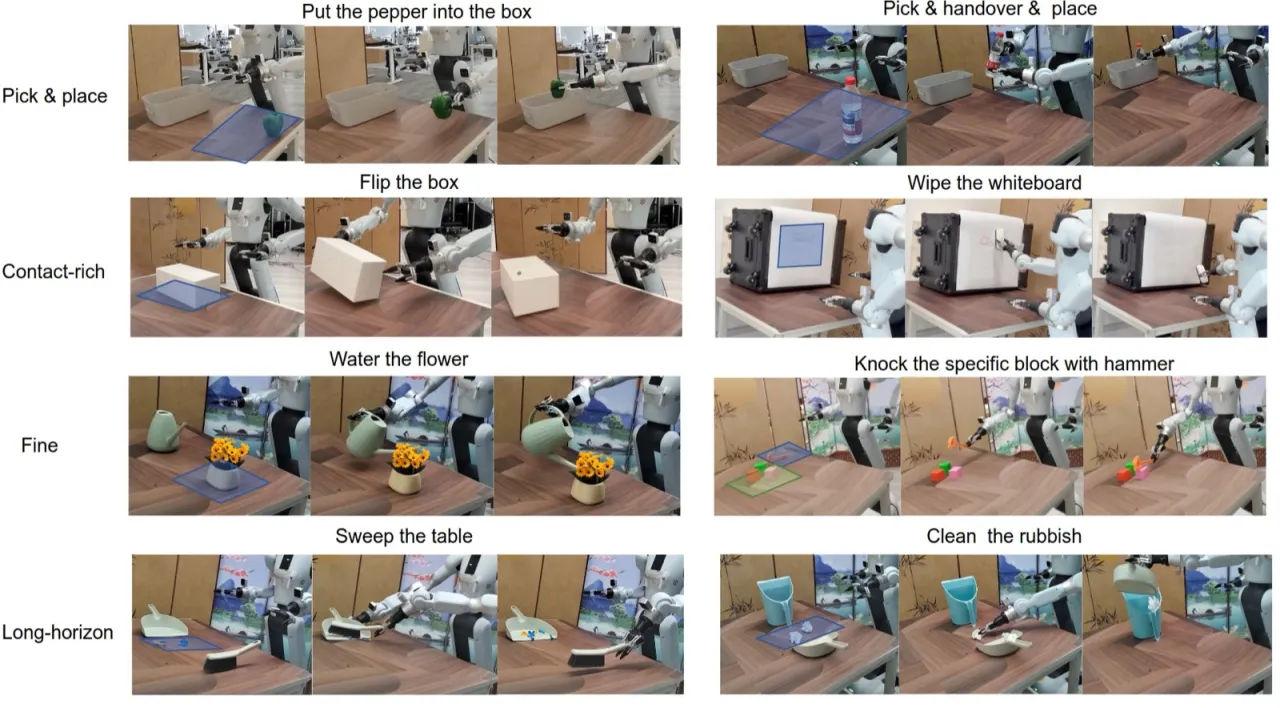
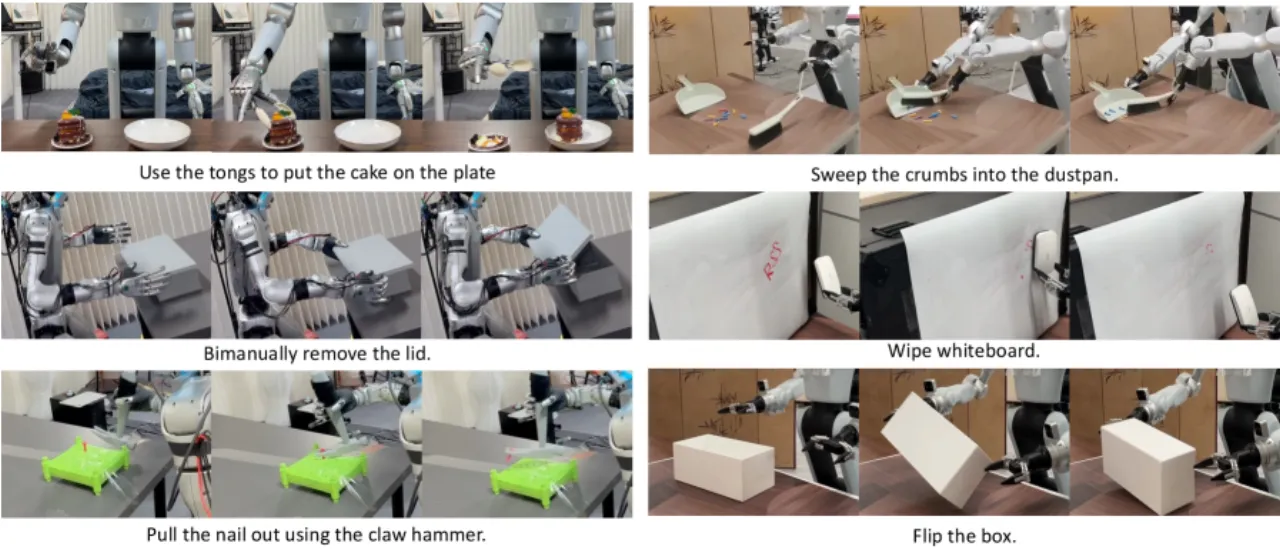
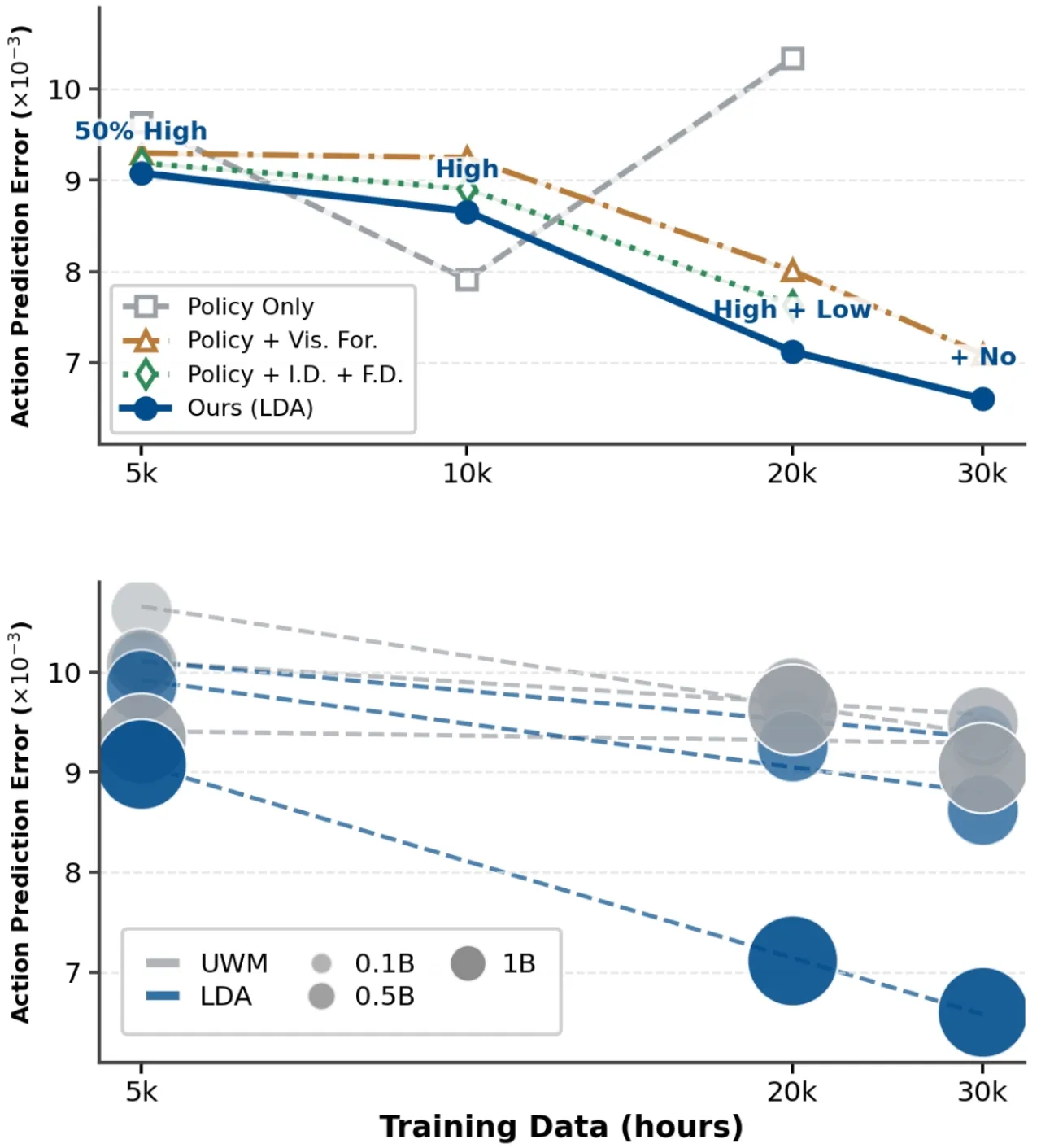
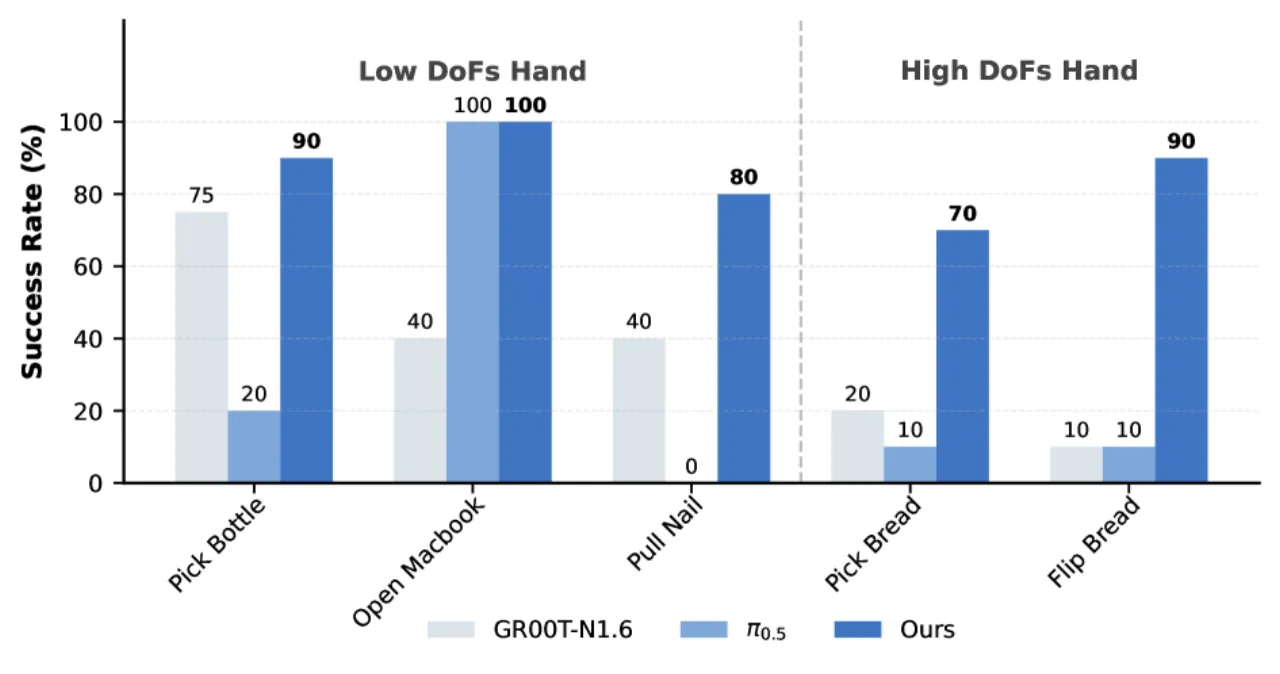
LDA-1B 提出一个统一世界模型框架,对策略学习、前向动力学、逆向动力学与视觉预测四类目标进行联合训练,使模型能够从异质具身数据(人类视频、低质量轨迹、高质量轨迹)中充分汲取知识,在真实机器人抓取、灵巧手操作和长视野任务中均超越 π0.5 和 GR00T-N1.6 等现有方法。LDA-1B proposes a unified world model framework that jointly trains four objectives — policy learning, forward dynamics, inverse dynamics and visual forecasting — so that the model can fully absorb knowledge from heterogeneous embodied data (human video, low-quality trajectories, high-quality trajectories), surpassing existing methods such as π0.5 and GR00T-N1.6 on real-robot grasping, dexterous-hand manipulation and long-horizon tasks.
现有机器人基础模型主要依赖行为克隆(behavior cloning),无法充分利用异质具身数据中蕴含的可迁移动力学知识;统一世界模型(Unified World Model)虽然有潜力,却受限于"coarse data usage and fragmented datasets"。如何将数十万小时的人类视频、低质量轨迹与高质量机器人轨迹统一纳入训练,是提升可扩展性的核心挑战。Existing robot foundation models rely primarily on behavior cloning, which fails to exploit the transferable dynamics knowledge embedded in heterogeneous embodied data; the Unified World Model is promising yet constrained by "coarse data usage and fragmented datasets". Unifying hundreds of thousands of hours of human video, low-quality trajectories and high-quality robot trajectories into a single training recipe is the core challenge for scalability.
"Existing methods primarily rely on behavior cloning, which discards transferable dynamics knowledge embedded in heterogeneous embodied data."
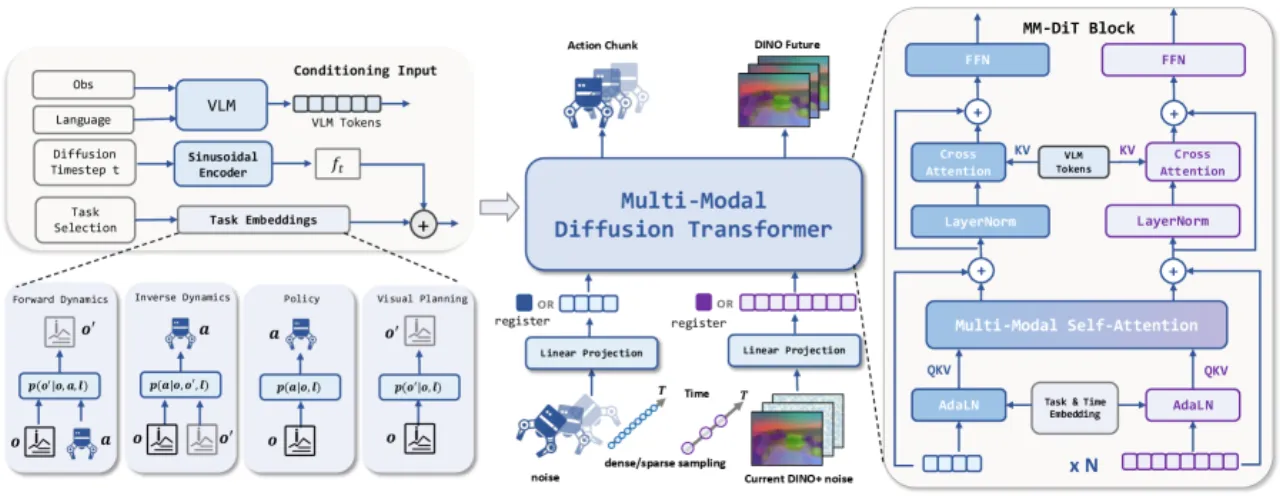
LDA-1B 的核心是一个多模态扩散 Transformer(MM-DiT),对动作序列与未来视觉 latent 联合去噪,配合通用具身数据摄取(Universal Embodied Data Ingestion)框架,将不同质量与模态的数据统一分配训练目标。At the core of LDA-1B is a multimodal diffusion Transformer (MM-DiT) that jointly denoises the action sequence and the future visual latent, paired with a Universal Embodied Data Ingestion framework that assigns training objectives to data of differing quality and modality.
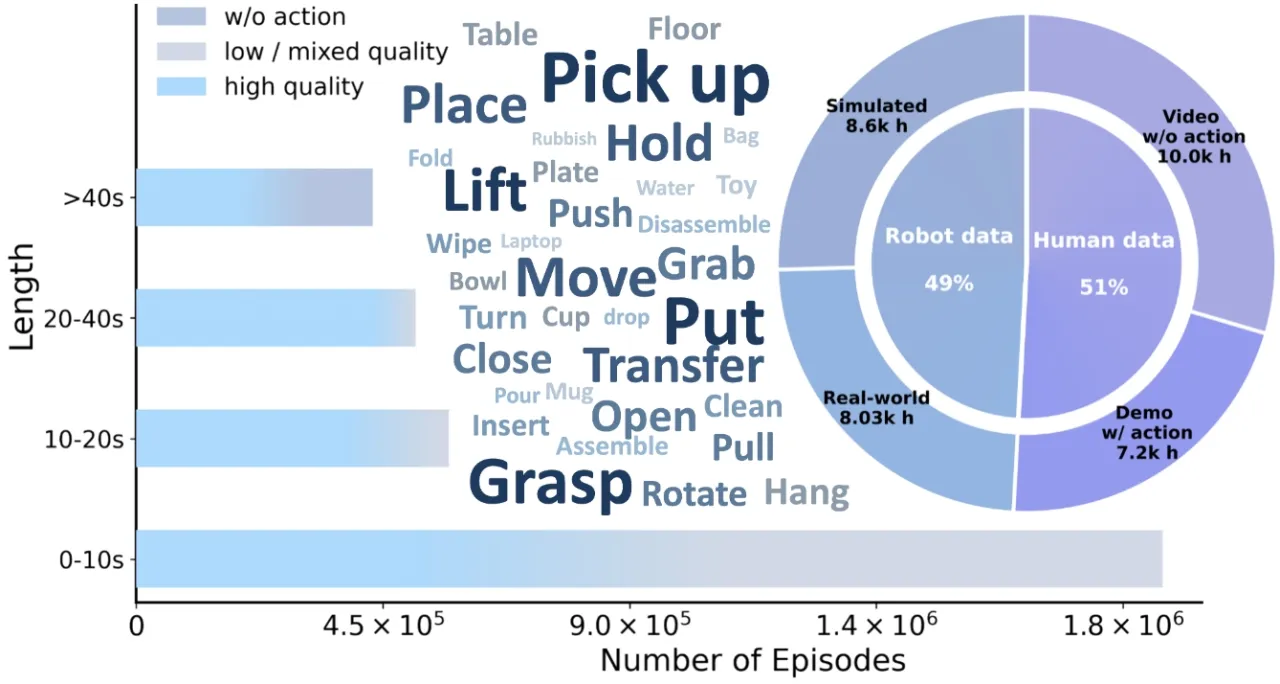
框架将异质数据划分为三个角色:无动作人类视频监督视觉预测(visual forecasting);低质量轨迹提供动力学监督;高质量轨迹同时支持策略学习与动力学学习。Register token 充当缺失模态的占位符,使模型能在统一架构下处理不完整输入。此外,论文构建了 EI-30k 数据集——8,030 小时真实机器人数据 + 8,600 小时仿真数据 + 7,200 小时有动作人类示范 + 10,000 小时无动作人类视频,总计超 30,000 小时,全部以 LeRobot 格式标准化并手动对齐末端执行器坐标系。The framework assigns heterogeneous data to three roles: action-free human video supervises visual forecasting; low-quality trajectories provide dynamics supervision; high-quality trajectories support both policy learning and dynamics learning. Register tokens serve as placeholders for missing modalities, letting the model handle incomplete inputs within a unified architecture. The paper further builds the EI-30k dataset — 8,030 hours of real-robot data + 8,600 hours of simulation data + 7,200 hours of action-labeled human demonstrations + 10,000 hours of action-free human video, more than 30,000 hours in total, all standardized in the LeRobot format with manually aligned end-effector coordinate frames.
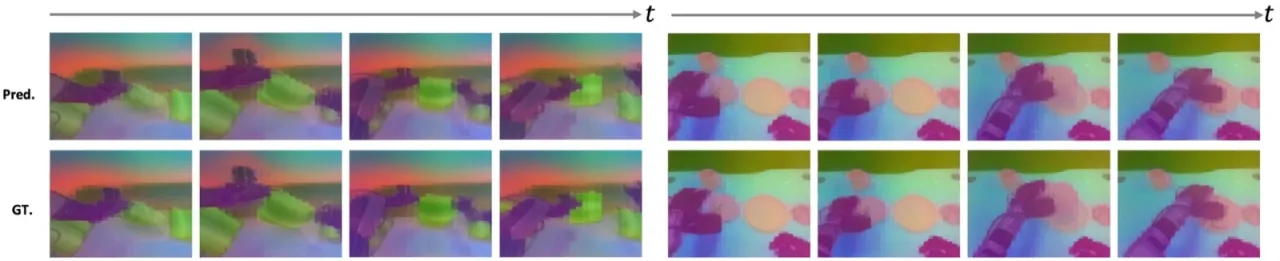
与像素空间 VAE 不同,LDA-1B 采用 DINO 特征作为视觉预测目标,"reduce redundant appearance modeling"并避免"entangling appearance, geometry, and dynamics at low-level feature granularity"。仿真实验显示,从 VAE 切换到 DINO 表示使成功率从 20.0% 大幅提升至 55.4%。Unlike pixel-space VAEs, LDA-1B takes DINO features as the visual forecasting target, to "reduce redundant appearance modeling" and to avoid "entangling appearance, geometry, and dynamics at low-level feature granularity". In simulation, switching from the VAE to the DINO representation raises the success rate from 20.0% to 55.4%.
在仿真(RoboCasa-GR1)和真实机器人(Galbot G1 夹爪 + Unitree G1 灵巧手)上与 GR00T-N1.6、GR00T-EI10k、UWM-1B、π0.5 进行对比;采用少样本微调(few-shot fine-tuning)评估迁移效率。LDA-1B is compared with GR00T-N1.6, GR00T-EI10k, UWM-1B and π0.5 in simulation (RoboCasa-GR1) and on real robots (Galbot G1 gripper + Unitree G1 dexterous hand); few-shot fine-tuning is used to assess transfer efficiency.
| 模型Model | 成功率(Success Rate)Success Rate |
|---|---|
| UWM-1B | 19.3% |
| GR00T-N1.6 | 47.6% |
| GR00T-EI10k | 51.3% |
| LDA-1B(本文)LDA-1B (ours) | 55.4% |
消融实验显示,将视觉 latent 从 VAE 替换为 DINO 是最关键的设计选择,成功率从 20.0% 跃升至 55.4%。Ablations show that replacing the VAE visual latent with DINO is the single most critical design choice, lifting the success rate from 20.0% to 55.4%.
| 测试条件Test Condition | LDA-1B 成功率LDA-1B Success Rate |
|---|---|
| 未见物体 / 背景Unseen objects / backgrounds | 60% |
| 分布外(OOD)位置Out-of-distribution (OOD) positions | 40% |
在两项泛化测试中 LDA-1B 均显著超越基线模型。LDA-1B significantly outperforms the baselines on both generalization tests.
在低质量轨迹加入后,LDA-1B 性能提升 10 个百分点;而 π0.5 在同等条件下下降 10–20 个百分点,验证了通用数据摄取框架对低质量数据的有效利用能力。Once low-quality trajectories are added, LDA-1B improves by 10 percentage points, whereas π0.5 under the same conditions drops by 10–20 percentage points, confirming that the universal data ingestion framework makes effective use of low-quality data.
余弦相似度分析(gradient cosine similarity)显示,四项训练目标在 400k 步后梯度方向高度一致,表明联合训练没有导致目标冲突。A gradient cosine similarity analysis shows that the four training objectives keep highly consistent gradient directions after 400k steps, indicating that joint training causes no objective conflict.
模型依赖冻结的 DINO 视觉编码器(DINOv3-ViT-s),预训练阶段视觉表示不参与更新,"reliance on fixed DINO visual features … may constrain generalization to new visual perspectives"。未来工作计划联合学习视觉表示与潜在动力学。The model relies on a frozen DINO visual encoder (DINOv3-ViT-s), and the visual representation is not updated during pre-training: "reliance on fixed DINO visual features … may constrain generalization to new visual perspectives". Future work plans to learn the visual representation jointly with the latent dynamics.
EI-30k 数据集及训练任务主要使用第一人称(head-mounted 或 wrist)视角,"predominantly egocentric camera viewpoints … may constrain generalization to new visual perspectives",对第三人称视角场景的泛化尚未充分验证。The EI-30k dataset and the training tasks mainly use first-person (head-mounted or wrist) viewpoints — "predominantly egocentric camera viewpoints … may constrain generalization to new visual perspectives" — so generalization to third-person viewpoints has not been fully validated.
预训练需要 48 块 H800 GPU 共 4,608 GPU 小时。虽然推理时只需单次前向传播,但大规模预训练的资源门槛仍较高,限制了社区复现的便利性。(此条为设计推断,论文未单独列出。)Pre-training requires 48 H800 GPUs for a total of 4,608 GPU hours. Although inference needs only a single forward pass, the resource barrier of large-scale pre-training remains high and limits convenient reproduction by the community. (This item is an inferred remark, not listed separately in the paper.)