Latent Policy Steering with Embodiment-Agnostic Pretrained World Models
利用光流预训练形态无关世界模型,通过隐空间引导大幅提升少样本机器人操作策略Pretraining an embodiment-agnostic world model with optical flow, and steering the policy in latent space to greatly improve few-demonstration robot manipulation
Yiqi Wang, Mrinal Verghese, Jeff Schneider · Carnegie Mellon University · 2025
机器人视觉运动策略对大规模特定形态训练数据的依赖严重制约了其实际部署。本文提出 Latent Policy Steering (LPS):
以光流(optical flow)作为形态无关的动作表征,在多形态跨域数据上预训练世界模型,再通过少量目标形态演示进行微调;
推理时借助世界模型对多条行动规划进行隐空间评估,引导 diffusion policy 选择最优动作。
真实场景下,LPS 以 30–50 条演示即实现相对行为克隆基线 70% 的相对提升。Robot visuomotor policies depend on large-scale embodiment-specific training data, which severely limits their practical deployment. This paper proposes Latent Policy Steering (LPS): it takes optical flow as an embodiment-agnostic action representation, pretrains a world model on cross-domain multi-embodiment data, and then fine-tunes it with a small number of target-embodiment demonstrations; at inference time the world model evaluates multiple action plans in latent space, steering the diffusion policy toward the best action. In the real world, LPS attains a 70% relative improvement over the behavior cloning baseline with only 30–50 demonstrations.
arXiv 2025机器人操作Robot manipulationRobomimic + 真实 FrankaRobomimic + real Franka📄 arXiv:2507.13340PDF
latent policy steeringworld modeloptical flowembodiment-agnosticdiffusion policybehavior cloningrobot manipulation跨形态迁移cross-embodiment transfer
01动机Motivation
收集特定机器人形态的大规模演示数据成本高昂,而现有跨形态数据集因动作空间不一致、形态差异大,难以被直接利用。
如何从已有多形态数据中提炼可迁移的"技能先验",以极少量目标形态演示即可大幅提升策略性能,是本文的核心出发点。Collecting large-scale demonstration data for one specific robot embodiment is expensive, while existing cross-embodiment datasets are hard to use directly because their action spaces are inconsistent and their embodiments differ greatly. How to distill a transferable “skill prior” from existing multi-embodiment data, so that a very small number of target-embodiment demonstrations already improves policy performance substantially, is the core starting point of this paper.
"Skills performed across different embodiments produce visual similarities in motions that can be captured using off-the-shelf action representations such as optical flow."
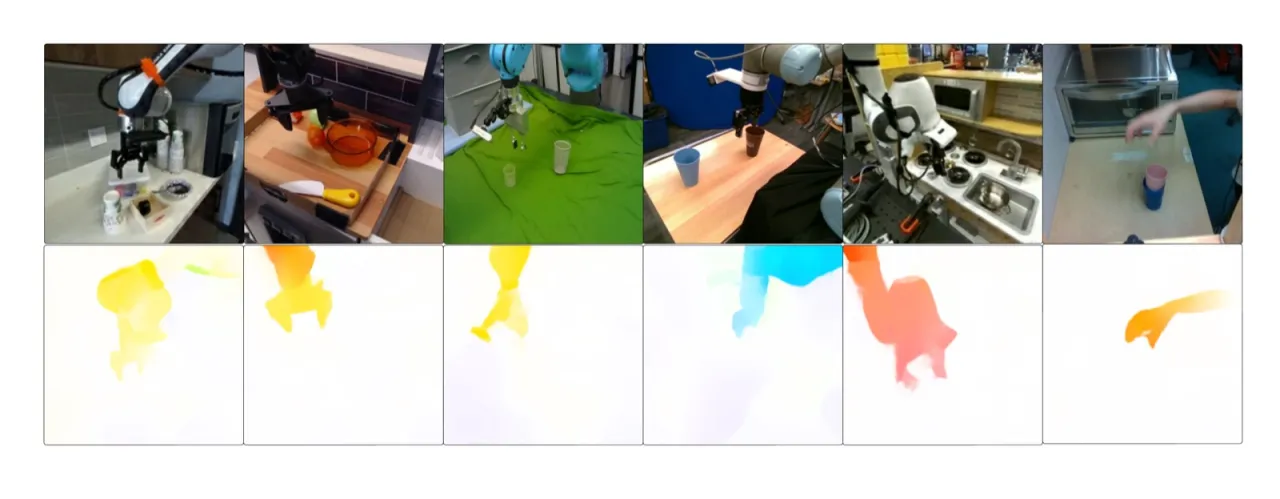
图 1:光流作为形态无关的动作表征。
不同机器人手臂(IIWA、UR5e、Kinova3、Franka)执行"抓取杯子"时,
光流向量在视觉空间中呈现高度相似的模式——物体与末端执行器周围的流场形态接近,
即使机械结构完全不同。这一观察是 LPS 方法的核心动机。Figure 1: Optical flow as an embodiment-agnostic action representation. When different robot arms (IIWA, UR5e, Kinova3, Franka) perform “grasp the cup”, the optical flow vectors show highly similar patterns in visual space — the flow fields around the object and the end-effector are close in shape, even though the mechanical structures are completely different. This observation is the core motivation of LPS.
70%真实场景相对提升 (30–50 条演示)Real-world relative gain (30–50 demonstrations)
44%真实场景相对提升 (60–100 条演示)Real-world relative gain (60–100 demonstrations)
10.6%Robomimic 仿真平均 相对提升Average relative gain on Robomimic simulation
4 tasks真实 Franka 机器人 操作任务评估Manipulation tasks evaluated on a real Franka robot
02方法Method
LPS 分三步:① 以光流为动作表征在多形态数据上预训练视觉世界模型;
② 用少量目标形态演示微调世界模型并训练 Robust Value Function;
③ 推理时对 diffusion policy 采样的多条动作规划进行隐空间评估,选取价值最高的计划执行。LPS proceeds in three steps: ① pretrain a visual world model on multi-embodiment data with optical flow as the action representation; ② fine-tune the world model with a few target-embodiment demonstrations and train a Robust Value Function; ③ at inference time, evaluate in latent space the multiple action plans sampled from the diffusion policy and execute the plan with the highest value.
Flow-as-Action:形态无关的世界模型预训练Flow-as-Action: embodiment-agnostic world model pretraining
传统世界模型以具体机器人动作(如关节角度或末端位姿)为条件,无法直接跨形态迁移。
LPS 将光流替换为动作输入:卷积编码器将光流场压缩为 n 维向量(n 等于目标形态的动作空间维度),
迫使网络捕获与形态无关的显著运动特征,同时抑制噪声和形态差异。
该设计使预训练数据可来自任意机器人甚至人类演示。Conventional world models are conditioned on concrete robot actions (such as joint angles or end-effector poses) and therefore cannot transfer across embodiments directly. LPS replaces the action input with optical flow: a convolutional encoder compresses the flow field into an n-dimensional vector (n equals the action-space dimension of the target embodiment), forcing the network to capture salient embodiment-agnostic motion features while suppressing noise and embodiment differences. This design lets the pretraining data come from any robot, or even from human demonstrations.
目标形态微调与 Robust Value FunctionTarget-embodiment fine-tuning and the Robust Value Function
在获得少量目标形态(如 Franka)演示后,将光流编码器替换为归一化的机器人真实动作,
同时联合训练世界模型与价值函数。
价值函数需处理 distribution shift 问题——推理时策略访问的状态可能偏离训练分布。
为此,作者设计了Robust Value Function,同时在专家演示状态和策略访问状态上训练,
并引入 cosine similarity 奖励惩罚偏离专家轨迹的行为:Once a small number of target-embodiment (e.g. Franka) demonstrations are available, the optical flow encoder is replaced by normalized real robot actions, and the world model and the value function are trained jointly. The value function must cope with the distribution shift problem — at inference time the states visited by the policy may deviate from the training distribution. To this end the authors design a Robust Value Function that is trained on both expert demonstration states and policy-visited states, and introduce a cosine similarity reward that penalizes behavior deviating from expert trajectories:
其中 st:t+h 为专家隐状态序列,st:t+h′ 为策略在世界模型中展开的状态。
该奖励促使价值函数在 out-of-distribution 状态下仍能给出保守估计,避免高估偏差。Here st:t+h is the expert latent state sequence and st:t+h′ is the sequence rolled out by the policy inside the world model. This reward makes the value function stay conservative in out-of-distribution states, avoiding overestimation bias.
推理时隐空间策略引导(Latent Policy Steering)Inference-time steering in latent space (Latent Policy Steering)
给定当前观测,从 diffusion policy 采样 B 条候选动作规划,规划长度为 h。
世界模型将每条规划在隐空间中前向展开,得到未来隐状态序列,
再由价值函数以加权平均(未来时刻权重更大)计算规划级价值。
执行价值最高的规划前 1 步后重新规划,实现滚动决策。Given the current observation, B candidate action plans of length h are sampled from the diffusion policy. The world model rolls each plan forward in latent space to obtain the future latent state sequence, and the value function then computes a plan-level value as a weighted average (later timesteps carry larger weights). The first 1 step of the highest-value plan is executed before replanning, yielding receding-horizon decision making.
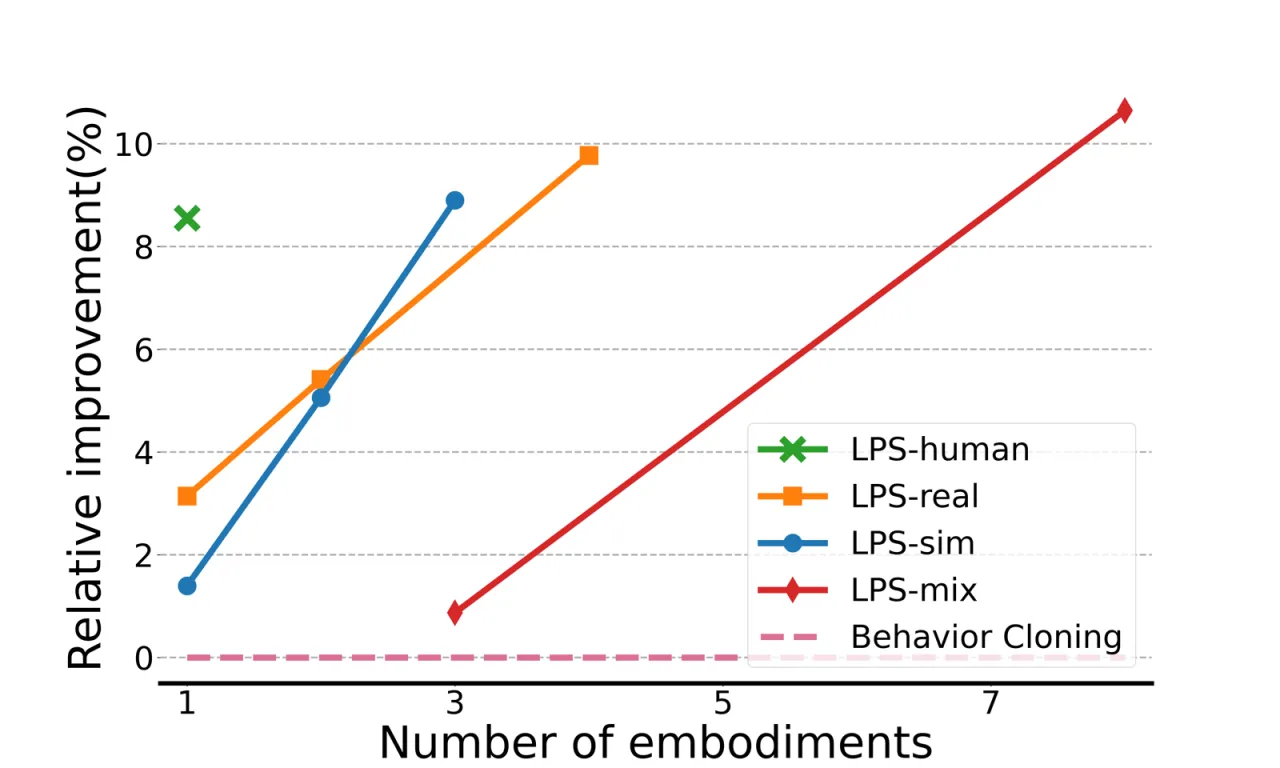
图 3:形态数量对性能的影响(Embodiment Scaling)。
在 Robomimic 上评估不同预训练形态组合(IIWA、UR5e、Kinova3)对 Franka 目标策略的提升效果。
随着预训练混合数据中形态种类增加,LPS 性能稳步提升,验证了多形态预训练的可扩展性。Figure 3: effect of the number of embodiments on performance (Embodiment Scaling). Different pretraining embodiment combinations (IIWA, UR5e, Kinova3) are evaluated on Robomimic for their gain on the Franka target policy. As the number of embodiment types in the pretraining mixture grows, LPS performance improves steadily, confirming the scalability of multi-embodiment pretraining.
03实验Experiments
实验在两个场景下评估:① Robomimic 仿真(Lift / Can / Square / Transport),
预训练使用 IIWA、UR5e、Kinova3 三种形态,目标形态为 Franka;
② 真实 Franka 机器人上的 4 个操作任务。
基线为行为克隆(BC),对比方法为 LPS-mix(使用混合多形态预训练数据)。Experiments are evaluated in two settings: ① Robomimic simulation (Lift / Can / Square / Transport), pretrained on the three embodiments IIWA, UR5e and Kinova3 with Franka as the target embodiment; ② 4 manipulation tasks on a real Franka robot. The baseline is behavior cloning (BC) and the compared method is LPS-mix (using the mixed multi-embodiment pretraining data).
真实世界实验(Table I)Real-world experiments (Table I)
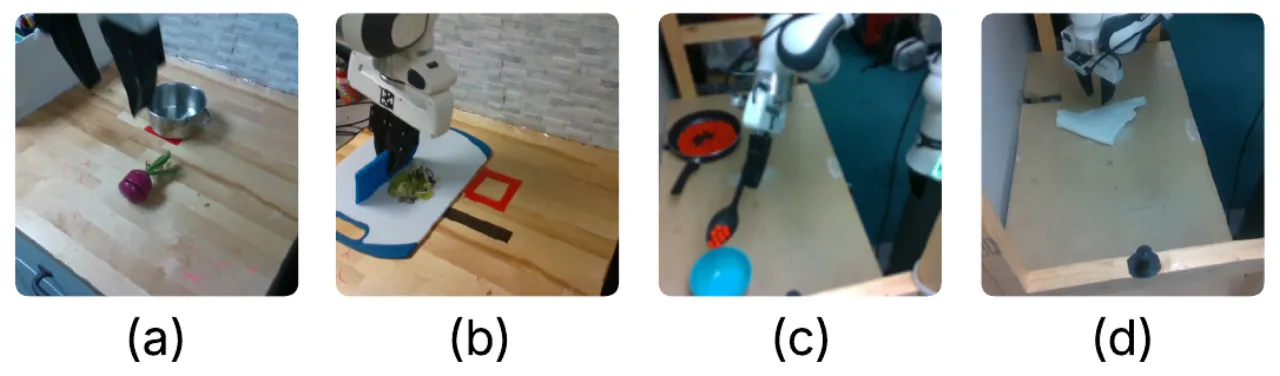
图 2:真实世界实验任务。
四个任务:(a) Put-radish-in-pot,(b) Sweep-salad-off-the-board,
(c) Scoop-beads-with-spoon,(d) Fold-towel-to-triangle。
每任务评测 20 次。Figure 2: real-world experimental tasks. Four tasks: (a) Put-radish-in-pot, (b) Sweep-salad-off-the-board, (c) Scoop-beads-with-spoon, (d) Fold-towel-to-triangle. Each task is evaluated over 20 trials.
任务Task
BC(30–50 条演示)BC (30–50 demonstrations)
LPS-mix(30–50 条)LPS-mix (30–50)
BC(60–100 条演示)BC (60–100 demonstrations)
LPS-mix(60–100 条)LPS-mix (60–100)
Put-radish-in-pot
7/20
11/20
13/20
19/20
Sweep-salad
4/20
6/20
6/20
11/20
Scoop-beads
6/20
10/20
13/20
16/20
Fold-towel
0/20
2/20
9/20
13/20
平均Average
21.2%
36.2%
51.2%
73.8%
在 30–50 条演示下,LPS-mix 相对 BC 实现 70% 相对提升(21.2% → 36.2%);
60–100 条演示下实现 44% 相对提升(51.2% → 73.8%)。With 30–50 demonstrations, LPS-mix attains a 70% relative improvement over BC (21.2% → 36.2%); with 60–100 demonstrations it attains a 44% relative improvement (51.2% → 73.8%).
四个任务平均实现 10.6% 相对提升,预训练数据大部分来自真实世界场景而非仿真。Averaged over the four tasks it attains a 10.6% relative improvement, even though most of the pretraining data comes from real-world scenes rather than simulation.
消融实验Ablations
光流 vs. EEF 动作(Table III):
以光流预训练的世界模型(LPS-sim flow,均值 62.4%)优于以末端位姿(EEF)预训练版本(59.1%),
在 Square 任务上差距最显著(52.4% vs. 45.3%),验证了光流作为形态无关表征的优越性。Optical flow vs. EEF actions (Table III): the world model pretrained with optical flow (LPS-sim flow, mean 62.4%) outperforms the version pretrained with end-effector poses (EEF) (59.1%), with the largest gap on the Square task (52.4% vs. 45.3%), confirming the superiority of optical flow as an embodiment-agnostic representation.
价值函数设计(Table IV,100 条演示无预训练):
完整 LPS(均值 68.7%)优于 LPS-vanilla(65.2%)和 LPS-bootstrap(64.3%),
而 BC 基线为 62.9%。分布偏移惩罚项对最终性能贡献最大。Value function design (Table IV, 100 demonstrations, no pretraining): the full LPS (mean 68.7%) outperforms LPS-vanilla (65.2%) and LPS-bootstrap (64.3%), while the BC baseline reaches 62.9%. The distribution shift penalty term contributes the most to the final performance.
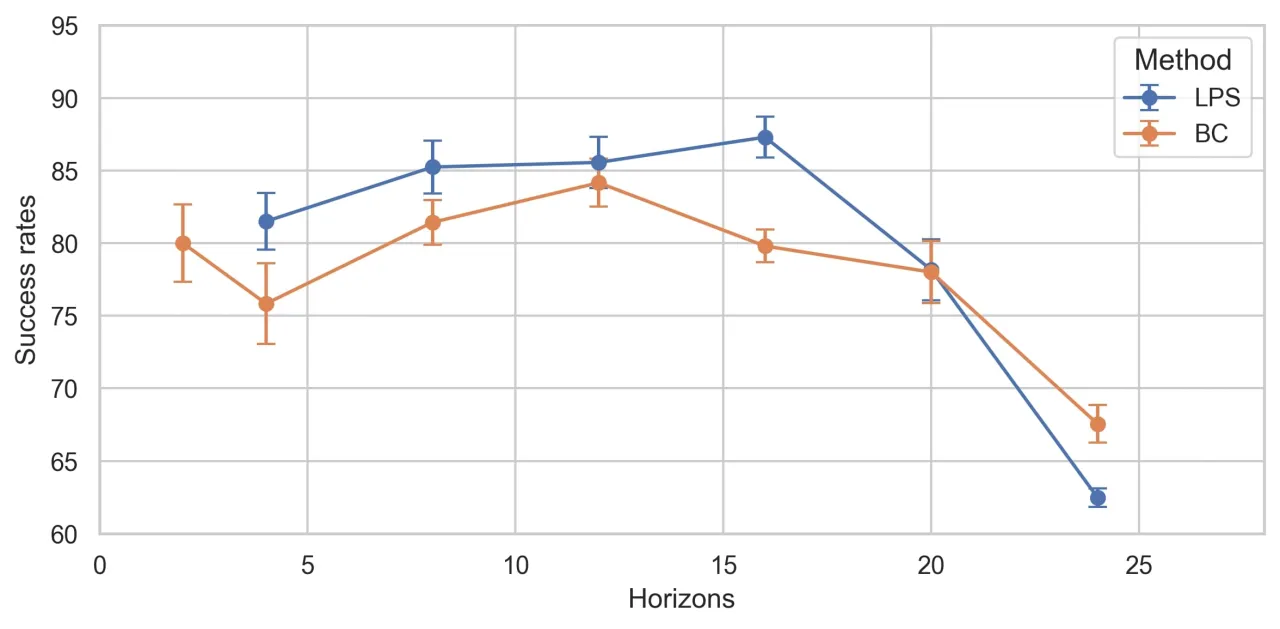
图 4:不同规划 horizon 下的 LPS 性能。
在 horizon 4–16 范围内,LPS 持续优于 BC 基线;
horizon 24 时性能下降,原因是更长的 rollout 导致 cosine similarity 奖励信号噪声累积。Figure 4: LPS performance under different planning horizons. Over the horizon range 4–16, LPS consistently outperforms the BC baseline; at horizon 24 performance drops, because a longer rollout accumulates noise in the cosine similarity reward signal.
04局限性Limitations
Note:以下局限性均为论文作者明确陈述(stated)。All limitations below are explicitly stated by the authors of the paper (stated).
光流在遮挡场景下失效Optical flow fails under occlusion
光流无法可靠捕捉遮挡情况下的运动,例如机器人手臂遮住目标物体时,
流场噪声大幅增加,导致形态无关表征质量下降,进而影响世界模型预训练效果。Optical flow cannot reliably capture motion under occlusion. When the robot arm occludes the target object, for instance, flow-field noise grows substantially, which degrades the quality of the embodiment-agnostic representation and in turn the effectiveness of world model pretraining.
光流具有视角依赖性Optical flow is viewpoint-dependent
相同技能从不同摄像机角度观测会产生截然不同的光流模式,
限制了多视角或移动平台场景下的泛化能力。
此外,相机本身运动(如移动机器人)会引入额外的全局光流噪声。The same skill observed from different camera angles produces markedly different optical flow patterns, which limits generalization in multi-view or mobile-platform settings. Moreover, motion of the camera itself (e.g. on a mobile robot) introduces additional global optical flow noise.
依赖多模态策略(Multimodal Policy)Reliance on a multimodal policy (Multimodal Policy)
LPS 需要策略能够生成多条多样化的候选动作规划(如 diffusion policy),
在少量演示场景下单模态策略(unimodal policy)的多样性不足,
隐空间引导的改进效果极为有限。LPS requires a policy able to generate multiple diverse candidate action plans (such as a diffusion policy). In the few-demonstration regime a unimodal policy lacks diversity, and the gain from latent steering is extremely limited.
规划 Horizon 过长导致性能退化An overly long planning horizon degrades performance
如图 4 所示,horizon 超过 16 步后,由于 distribution shift 奖励信号的累积误差,
价值估计精度下降,LPS 性能出现退化,需谨慎选择规划长度超参数。As Figure 4 shows, beyond a horizon of 16 steps the accumulated error of the distribution shift reward signal lowers the accuracy of value estimation, so LPS performance degrades; the planning-length hyperparameter must be chosen with care.