LAPA(Latent Action Pretraining for general Action models)利用 VQ-VAE 从无动作标注的互联网视频中自动发现离散 latent action,在无需机器人遥操作数据的情况下预训练 VLA 模型,最终通过小规模有标注数据微调映射到真实机器人指令,显著超越现有最优方法 OpenVLA,同时实现约 30× 的预训练效率提升。LAPA (Latent Action Pretraining for general Action models) uses a VQ-VAE to automatically discover discrete latent actions from action-free internet videos, pretraining a VLA model without any robot teleoperation data, and finally finetunes on a small amount of labeled data to map those actions onto real robot commands, clearly surpassing the previous state of the art OpenVLA while achieving roughly a 30× gain in pretraining efficiency.
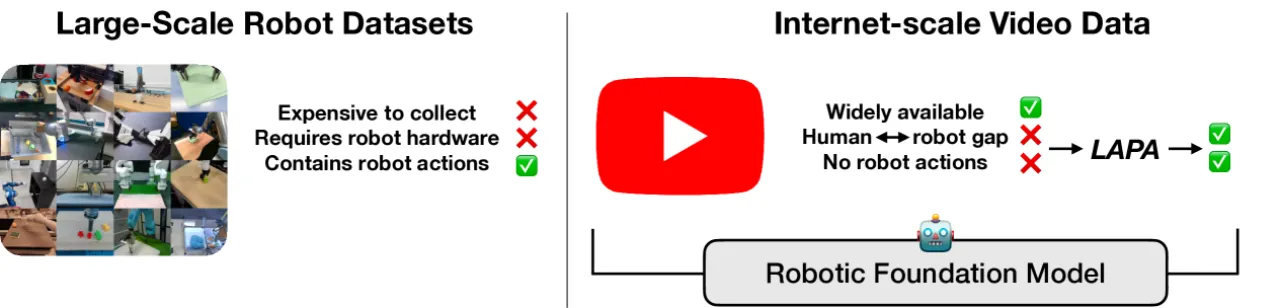
现有 Vision-Language-Action (VLA) 模型的预训练依赖于机器人遥操作收集的有标注动作数据, 这使得可用数据规模极为有限。互联网上存在海量的人类操作视频(如 YouTube、Something-Something 等), 却因缺少机器人动作标签而无法直接用于 VLA 预训练。 如何利用这些无标注视频数据,是扩展机器人基础模型的核心瓶颈。Pretraining existing Vision-Language-Action (VLA) models relies on labeled action data collected by robot teleoperation, which keeps the amount of usable data extremely limited. The internet holds vast numbers of human manipulation videos (e.g. YouTube, Something-Something), yet they cannot be used directly for VLA pretraining because they carry no robot action labels. Exploiting such unlabeled video data is the central bottleneck for scaling robot foundation models.
"We introduce LAPA, an unsupervised method for pretraining Vision-Language-Action (VLA) models without ground-truth robot action labels."
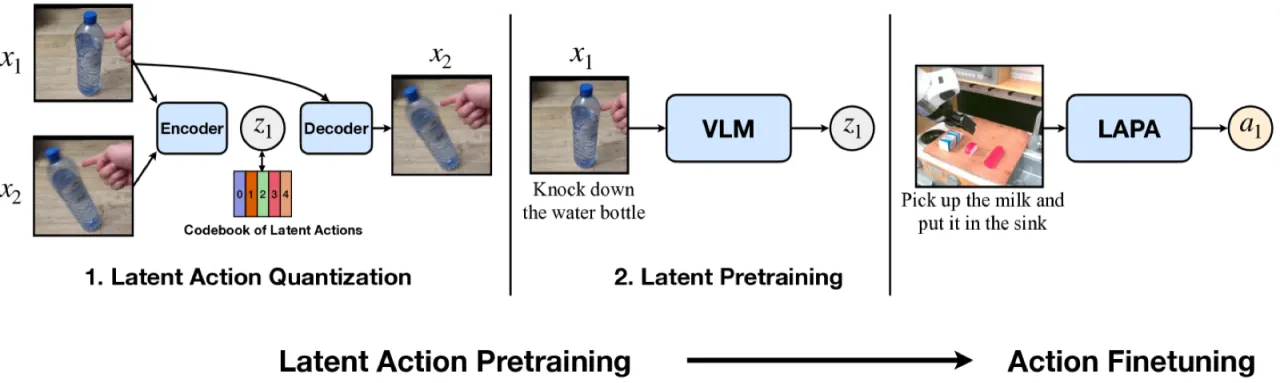
LAPA 将预训练分为三个阶段:首先用 VQ-VAE 从视频帧对中学习离散 latent action; 接着让 VLM 从视频观测和语言指令中预测这些 latent action(行为克隆); 最后在小规模有标注机器人数据上微调,将 latent action 映射为真实机器人指令。LAPA splits pretraining into three stages: first a VQ-VAE learns discrete latent actions from pairs of video frames; next a VLM learns to predict these latent actions from video observations and language instructions (behavior cloning); finally the model is finetuned on a small amount of labeled robot data, mapping latent actions onto real robot commands.
编码器采用 C-ViViT 架构,输入当前帧与未来帧(间隔 H 步),通过 cross-attention 提取"帧间变化", 输出离散 latent action token zt(词表大小 KL,默认 84=4096 种)。 解码器在给定 zt 和当前帧的条件下重建未来帧。 为防止梯度塌缩,使用 NSVQ(Normalized Straight-Through Vector Quantization)替代标准 VQ。 整个过程完全自监督,无需任何动作标注。The encoder adopts a C-ViViT architecture: it takes the current frame and a future frame (H steps apart) and extracts the "inter-frame change" through cross-attention, producing discrete latent action tokens zt (vocabulary size KL, 84=4096 entries by default). Conditioned on zt and the current frame, the decoder reconstructs the future frame. To prevent gradient collapse, NSVQ (Normalized Straight-Through Vector Quantization) is used instead of standard VQ. The entire process is fully self-supervised and needs no action labels at all.
以预训练 VLM(7B 参数)为骨干,冻结视觉编码器,对语言模型参数进行行为克隆训练: 给定视频帧序列和语言任务描述,预测对应的 latent action token 序列。 训练数据可以是任意无标注视频(如 Open-X Embodiment 数据集或 Something-Something V2 人类视频), 无需机器人遥操作数据。A pretrained VLM (7B parameters) serves as the backbone: the vision encoder is frozen while the language model parameters are trained by behavior cloning — given a sequence of video frames and a language task description, the model predicts the corresponding sequence of latent action tokens. The training data can be any unlabeled video (such as the Open-X Embodiment dataset or Something-Something V2 human videos); no robot teleoperation data is required.
仅需少量有标注的机器人演示数据:移除 latent action head,替换为任务专用 action head, 微调模型将学到的 latent 表征映射到真实机器人端效器动作。 由于 Stage 2 已学到丰富的视觉-语言-动作表征,Stage 3 收敛快、所需数据量少。Only a small amount of labeled robot demonstration data is needed: the latent action head is removed and replaced by a task-specific action head, and the model is finetuned to map the learned latent representations onto real robot end-effector actions. Because Stage 2 has already learned rich vision-language-action representations, Stage 3 converges fast and needs little data.
评估在三个基准上进行:Language Table 仿真、SIMPLER 仿真(Open-X 子集)、 以及真实世界桌面操作(pick、cover、knock 三类任务,共 54 次 rollout)。 对比基线包括 Scratch、UniPi、VPT、ActionVLA、OpenVLA 等。Evaluation is carried out on three benchmarks: the Language Table simulator, the SIMPLER simulator (a subset of Open-X), and real-world tabletop manipulation (pick, cover and knock, three task types, 54 rollouts in total). Baselines include Scratch, UniPi, VPT, ActionVLA and OpenVLA.
| 模型Model | In-Domain Seen | In-Domain Unseen | Cross-Task Seen | Cross-Task Unseen | Cross-Env Seen | Cross-Env Unseen |
|---|---|---|---|---|---|---|
| Scratch | 15.6±9.2 | 15.2±8.3 | 27.2±13.6 | 22.4±11.0 | 15.6±9.2 | 15.2±8.3 |
| UniPi | 22.0±12.5 | 13.2±7.7 | 20.8±12.0 | 16.0±9.1 | 13.6±8.6 | 12.0±7.5 |
| VPT | 44.0±7.5 | 32.8±4.6 | 72.0±6.8 | 60.8±6.6 | 18.0±7.7 | 18.4±9.7 |
| LAPA | 62.0±8.7 | 49.6±9.5 | 73.2±6.8 | 54.8±9.1 | 33.6±12.7 | 29.6±12.0 |
| ActionVLA | 77.0±3.5 | 58.8±6.6 | 77.0±3.5 | 58.8±6.6 | 64.8±5.2 | 54.0±7.0 |
LAPA 在 In-Domain Seen 上从 Scratch 的 15.6% 提升至 62.0%,Cross-Env Seen 从 15.6% 提升至 33.6%, 显示出跨环境泛化能力。ActionVLA 使用有标注动作数据预训练,作为上界参考。LAPA lifts In-Domain Seen from 15.6% for Scratch to 62.0%, and Cross-Env Seen from 15.6% to 33.6%, showing cross-environment generalization. ActionVLA is pretrained with labeled action data and serves as an upper-bound reference.
| 模型Model | Seen Obj. Unseen Combo | Unseen Obj. | Unseen Instr. | 平均 AVGAverage AVG |
|---|---|---|---|---|
| Scratch | 18.0 | 20.3 | 25.4 | 21.2 |
| ActionVLA (Bridge) | 38.3 | 31.8 | 27.7 | 32.6 |
| OpenVLA (Bridge) | 35.6 | 34.6 | 22.1 | 30.8 |
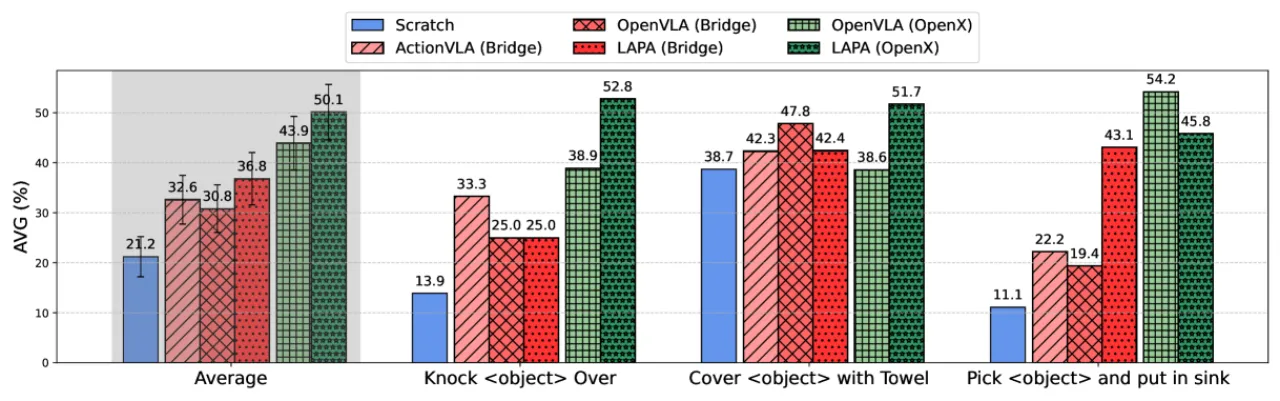
| LAPA (Bridge) | 43.4 | 31.4 | 35.6 | 36.8 |
| OpenVLA (Open-X) | 46.2 | 42.1 | 43.4 | 43.9 |
| LAPA (Open-X) | 57.8 | 43.9 | 48.5 | 50.1 |
| LAPA (Human Videos) | 36.5 | 37.4 | 28.1 | 34.0 |
LAPA 使用 Something-Something V2(人类手部操作视频,无机器人数据)进行预训练后, 在真实机器人任务上仍能超越 OpenVLA (Bridge) 的平均成功率(34.0% vs. 30.8%), 证明 latent action 空间可跨体态迁移(embodiment transfer)。After pretraining on Something-Something V2 (human hand manipulation videos, no robot data), LAPA still surpasses the average success rate of OpenVLA (Bridge) on real robot tasks (34.0% vs. 30.8%), showing that the latent action space transfers across embodiments.
论文明确指出:"LAPA underperforms compared to action pretraining when it comes to fine-grained motion generation tasks like grasping." 在需要精确末端执行器控制的抓取任务中,LAPA 与使用有标注动作数据预训练的 ActionVLA 相比仍有差距, 例如在 pick-and-place 任务中 OpenVLA 在部分精细抓取场景优于 LAPA。The paper states explicitly: "LAPA underperforms compared to action pretraining when it comes to fine-grained motion generation tasks like grasping." On grasping tasks that require precise end-effector control, LAPA still lags behind ActionVLA, which is pretrained with labeled action data; for instance, OpenVLA outperforms LAPA in some fine-grained grasping settings of pick-and-place tasks.
"Similar to prior VLAs, LAPA also encounters latency challenges during real-time inference." 作为基于大型语言模型的 VLA,LAPA 继承了 VLA 家族共有的推理速度瓶颈, 尚未针对在线控制进行专门优化。"Similar to prior VLAs, LAPA also encounters latency challenges during real-time inference." As a VLA built on a large language model, LAPA inherits the inference-speed bottleneck shared by the VLA family, and has not yet been specifically optimized for online control.
当前实验主要集中于桌面操作场景。论文指出尚未探索 LAPA 在导航、自动驾驶等其他 机器人应用领域("beyond manipulation videos, such as those from self-driving cars, navigation") 的适用性,这些场景的泛化能力有待验证。The current experiments focus mainly on tabletop manipulation. The paper notes that the applicability of LAPA to other robotic domains such as navigation and autonomous driving ("beyond manipulation videos, such as those from self-driving cars, navigation") remains unexplored, and generalization in those settings has yet to be verified.