HPT: Scaling Proprioceptive-Visual Learning with Heterogeneous Pre-trained Transformers
异构预训练 Transformer:统一多形态机器人的本体感知与视觉策略学习Heterogeneous Pre-trained Transformers: unifying proprioceptive and visual policy learning across robot embodiments
Lirui Wang · Xinlei Chen · Jialiang Zhao · Kaiming He | MIT · Meta FAIR
HPT 提出一种模块化 Transformer 策略架构,通过形态专属的 stem 将不同机器人的本体感知信息与视觉观测对齐为固定长度的 token 序列,然后送入共享的大型 trunk 中学习跨形态的通用表征。在 52 个数据集、超过 270k 条轨迹上预训练后,HPT 在迁移至未见任务时性能提升超过 20%,并在实际机器人操作中显著超越从头训练的基线。HPT proposes a modular Transformer policy architecture in which embodiment-specific stems align the proprioceptive signals and visual observations of different robots into fixed-length token sequences, which are then fed into a shared large trunk that learns representations general across embodiments. After pre-training on 52 datasets and more than 270k trajectories, HPT improves performance by over 20% when transferred to unseen tasks, and clearly surpasses train-from-scratch baselines on real robot manipulation.
机器人学习领域面临一个核心挑战:不同机器人形态(embodiment)拥有各异的硬件结构、传感器配置和动作空间,导致现有方法通常为特定形态和任务单独收集数据、单独训练模型,难以实现跨形态的知识复用和泛化。Robot learning faces a core challenge: different robot embodiments have distinct hardware structures, sensor configurations and action spaces, so existing methods typically collect data and train models separately for each specific embodiment and task, which makes cross-embodiment knowledge reuse and generalization hard to achieve.
"We want to pre-train task-agnostic and embodiment-agnostic foundational models that can map raw sensor signals from individual embodiments into a shared latent space."
现有的大规模机器人数据集(如 Open-X-Embodiment)汇集了多种形态,但由于形态异质性(heterogeneity),简单地将所有数据混合训练往往效果不佳。本文的核心问题是:能否设计一种通用预训练框架,使得跨形态、跨任务的数据能够真正互补,而非相互干扰?Existing large-scale robot datasets (such as Open-X-Embodiment) aggregate many embodiments, but because of embodiment heterogeneity, naively mixing all the data for training often works poorly. The central question of this paper is: can a general pre-training framework be designed so that cross-embodiment, cross-task data genuinely complement rather than interfere with one another?
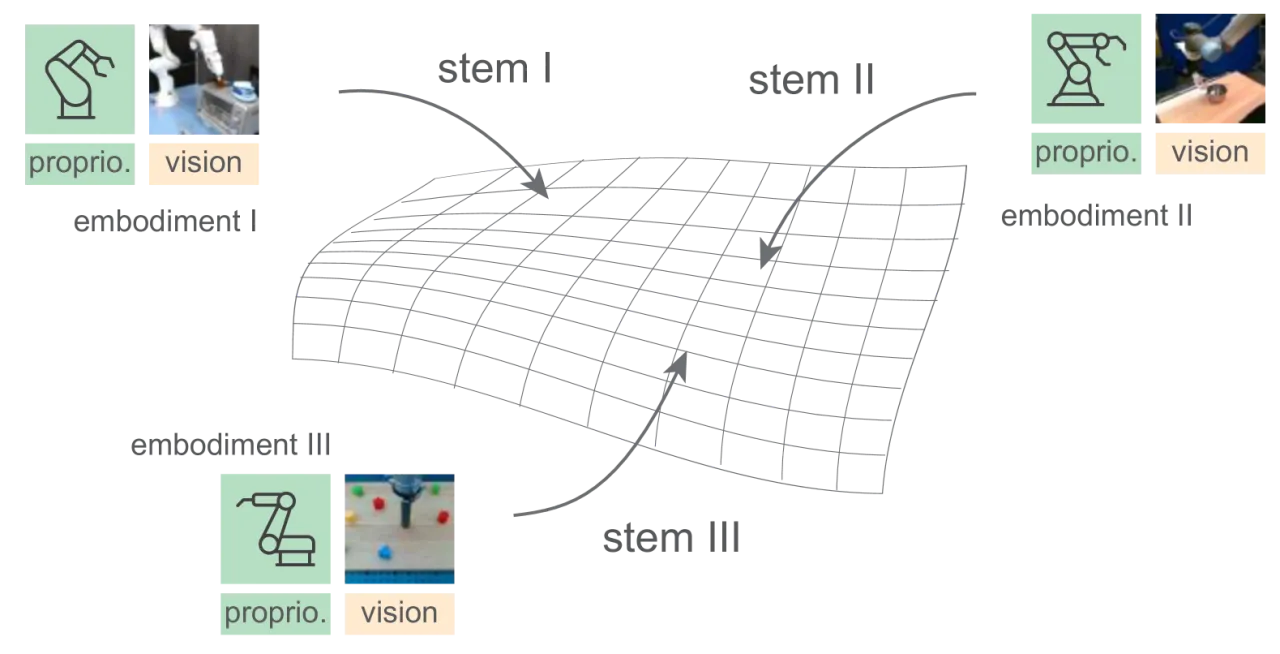
Figure 1:HPT 异构预训练概念图。 不同机器人形态(双臂机器人、单臂操作臂、手部、人类示教等)各自经过形态专属的 tokenizer(stem),将本体感知信息和视觉观测映射为统一格式的 token 序列,再输入共享的 Transformer trunk 学习通用表征。形态多样性越高、数据规模越大,trunk 获益越多。Figure 1: the HPT heterogeneous pre-training concept. Different robot embodiments (bimanual robots, single-arm manipulators, hands, human demonstrations, etc.) each pass through an embodiment-specific tokenizer (stem) that maps proprioceptive signals and visual observations into token sequences of a unified format, which are then fed into a shared Transformer trunk to learn general representations. The higher the embodiment diversity and the larger the data scale, the more the trunk benefits.
>20%未见任务成功率提升success-rate gain on unseen tasks
52预训练数据集数量pre-training datasets
1.1BHPT-Huge 参数量HPT-Huge parameter count
270k预训练轨迹数量pre-training trajectories
02方法Method
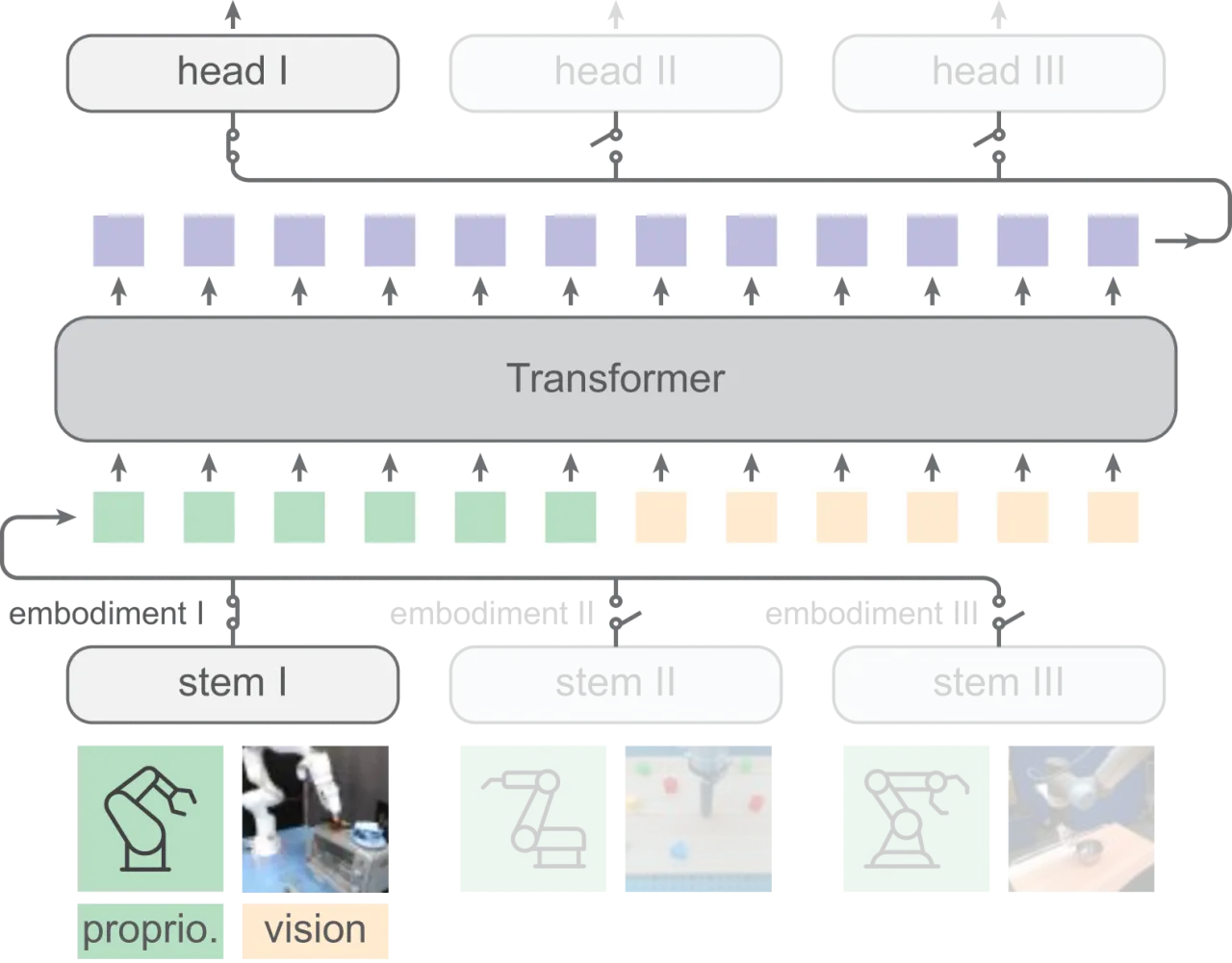
HPT 将策略神经网络拆分为三个模块:形态专属的 stem(输入对齐层)、可共享的大型 trunk(Transformer 主干)、以及任务专属的 head(动作输出层)。预训练阶段共享 trunk,迁移时仅微调 head 或全部参数。HPT splits the policy network into three modules: an embodiment-specific stem (input alignment layer), a shareable large trunk (Transformer backbone), and a task-specific head (action output layer). The trunk is shared during pre-training; at transfer time only the head, or all parameters, are fine-tuned.
Figure 2:HPT 整体架构。 每种机器人形态配有独立的 stem 和 head(switch 机制按当前数据集激活对应的 stem/head),所有形态共享同一个 trunk。stem 将视觉和本体感知观测分别映射为各 16 个 token,拼接后输入 trunk;trunk 输出经池化后由 head 解码为动作序列。这一设计使得 trunk 能够在异构数据上协同学习,而不同形态的 IO 差异由 stem/head 吸收。Figure 2: the overall HPT architecture. Each robot embodiment is equipped with its own stem and head (a switch mechanism activates the matching stem/head according to the current dataset), while all embodiments share one trunk. The stem maps visual and proprioceptive observations into 16 tokens each; after concatenation they enter the trunk, and the pooled trunk output is decoded by the head into an action sequence. This design lets the trunk learn jointly on heterogeneous data, while the IO differences across embodiments are absorbed by the stem/head.
Stem:本体感知与视觉 Token 化Stem: proprioceptive and visual tokenization
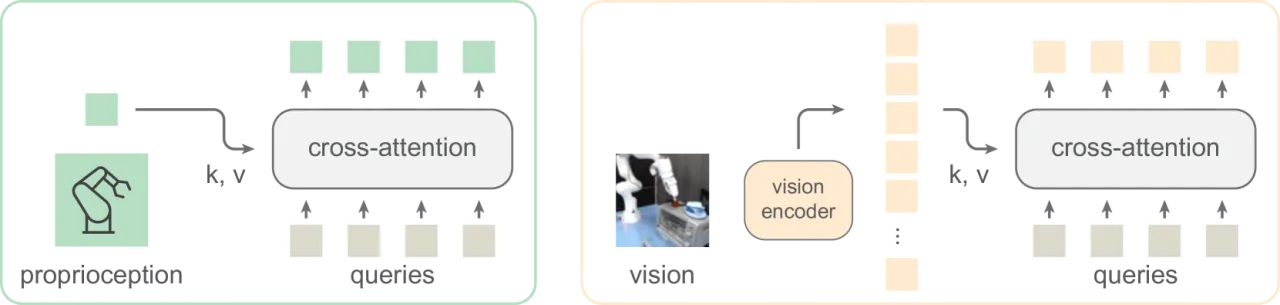
对于形态 k,proprioceptive tokenizer 将任意维度的本体感知序列(关节角度、末端位姿等)映射为 Np=16 个固定维度 token:先用 MLP 映射到特征空间,再施加 sinusoidal 位置编码,通过 cross-attention 将特征压缩到 16 个可学习 query token 上。Vision tokenizer 则先用冻结的 ResNet-18 提取图像特征,再同样通过 attention 映射到 16 个 token。两组 token 拼接后形成 32 个输入 token 送入 trunk。For embodiment k, the proprioceptive tokenizer maps a proprioceptive sequence of arbitrary dimension (joint angles, end-effector poses, etc.) into Np=16 tokens of fixed dimension: an MLP first projects it into a feature space, sinusoidal positional encoding is then applied, and cross-attention compresses the features onto 16 learnable query tokens. The vision tokenizer first extracts image features with a frozen ResNet-18, then likewise maps them to 16 tokens through attention. The two groups of tokens are concatenated into the 32 input tokens fed to the trunk.
Figure 3:Stem 架构细节。 左侧为本体感知 tokenizer(MLP + sinusoidal PE + cross-attention → 16 tokens),右侧为视觉 tokenizer(冻结 ResNet-18 特征 + cross-attention → 16 tokens)。两者输出拼接后送入 trunk。每种形态的 stem 参数独立,但结构相同。Figure 3: stem architecture in detail. Left: the proprioceptive tokenizer (MLP + sinusoidal PE + cross-attention → 16 tokens). Right: the vision tokenizer (frozen ResNet-18 features + cross-attention → 16 tokens). The two outputs are concatenated and fed to the trunk. The stem parameters are independent for each embodiment, but the structure is identical.
Trunk:共享 Transformer 主干Trunk: the shared Transformer backbone
Trunk 是标准的 Transformer encoder,提供五种规格的参数量:The trunk is a standard Transformer encoder, provided in five parameter-count configurations:
规格Size
参数量Params
深度Depth
宽度Width
HPT-Small
3.1M
—
—
HPT-Base
12.6M
—
—
HPT-Large
50.5M
—
—
HPT-XL
226.8M
—
—
HPT-Huge
1.1B
—
—
预训练阶段,trunk 对所有数据集共享权重,通过 switch 机制在同一个 batch 中激活不同形态的 stem/head 对,实现真正的异构联合训练。迁移时,trunk 初始化来自预训练权重,head 重新初始化后再端到端微调。During pre-training the trunk shares weights across all datasets, and a switch mechanism activates the stem/head pairs of different embodiments within the same batch, realizing genuinely heterogeneous joint training. At transfer time the trunk is initialized from the pre-trained weights, while the head is re-initialized before end-to-end fine-tuning.
实验在仿真和真实机器人两条线上展开:仿真使用 Meta-world、RoboMimic、Fleet-Tools 和 Simpler(Google EDR 机器人)基准;真实机器人实验在接触丰富型操作任务上与多个基线对比。The experiments unfold along two lines, simulation and real robots: simulation uses the Meta-world, RoboMimic, Fleet-Tools and Simpler (Google EDR robot) benchmarks, while the real-robot experiments compare against several baselines on contact-rich manipulation tasks.
仿真迁移学习Transfer learning in simulation
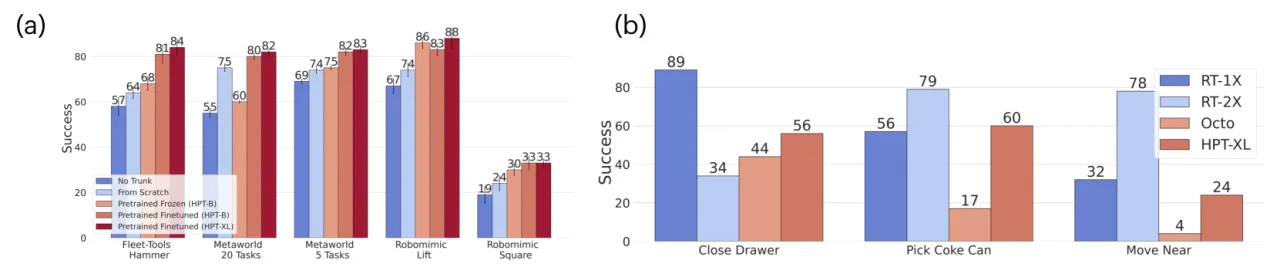
在 Meta-world、RoboMimic、Fleet-Tools 三个仿真基准上,HPT 预训练权重经微调后相比从头训练的基线,在未见任务上成功率平均提升超过 20%。在 Simpler 基准上,HPT-Base 与 Octo、RT1-X、RT2-X 表现相当,验证了跨形态预训练的迁移能力。On the three simulation benchmarks Meta-world, RoboMimic and Fleet-Tools, HPT pre-trained weights after fine-tuning raise the average success rate by more than 20% on unseen tasks compared with train-from-scratch baselines. On the Simpler benchmark, HPT-Base performs on par with Octo, RT1-X and RT2-X, confirming the transferability of cross-embodiment pre-training.
仿真基准结果(Figure 10)。 左:Meta-world、RoboMimic、Fleet-Tools 上 HPT 不同规格 vs. 基线的成功率对比;右:Simpler 基准上与 Octo、RT1-X、RT2-X 的比较。HPT 在大多数任务上超越从头训练的策略。Simulation benchmark results (Figure 10). Left: success-rate comparison of HPT at different sizes vs. the baselines on Meta-world, RoboMimic and Fleet-Tools. Right: comparison with Octo, RT1-X and RT2-X on the Simpler benchmark. HPT surpasses train-from-scratch policies on most tasks.
真实机器人实验Real-robot experiments
在真实机器人操作任务上(Sweep Leftover 等接触丰富型任务),HPT 显著优于从头训练的基线:On real-robot manipulation tasks (contact-rich tasks such as Sweep Leftover), HPT clearly outperforms train-from-scratch baselines:
方法Method
Sweep Leftover 成功率Sweep Leftover success rate
From Scratch(无本体感知)From Scratch (without proprioception)
26.7±3.3%
From Scratch(含本体感知)From Scratch (with proprioception)
43.3±3.8%
R3M
50.0±3.0%
No Prop. Finetuned(HPT,无本体感知微调)No Prop. Finetuned (HPT, fine-tuned without proprioception)
63.3±2.6%
HPT-Base Finetuned
70.0±3.0%
HPT-XL Finetuned
76.7±3.3%
Figure 12:真实机器人迁移学习结果。 HPT 在多个形态和任务上均显著超越 From Scratch 基线,尤其在接触丰富型操作(如 Sweep Leftover)上,HPT-XL 比从头训练提升约 33 个百分点。Figure 12: real-robot transfer learning results. HPT clearly surpasses the From Scratch baseline across multiple embodiments and tasks; in particular, on contact-rich manipulation (such as Sweep Leftover) HPT-XL improves over training from scratch by about 33 percentage points.
实验表明 HPT 呈现出良好的 scaling 特性:The experiments show that HPT exhibits favorable scaling behavior:
数据规模:从 16k 轨迹扩展到 270k 轨迹,验证集 loss 持续下降,模型持续受益于更多数据。Data scale: going from 16k trajectories to 270k trajectories, the validation loss keeps decreasing and the model keeps benefiting from more data.
模型规模:从 HPT-Small(3.1M)扩展到 HPT-Huge(1.1B),性能随参数量增长单调提升。Model scale: going from HPT-Small (3.1M) to HPT-Huge (1.1B), performance improves monotonically with parameter count.
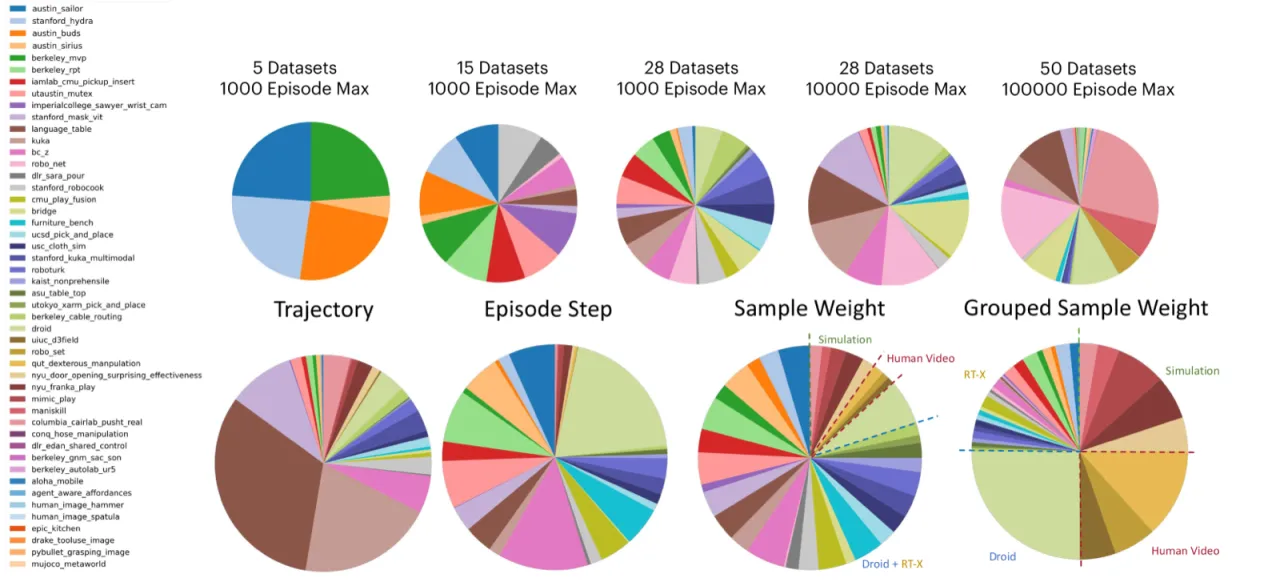
数据多样性:加入仿真数据集和人类视频数据进行联合预训练,进一步提升下游任务迁移效果。Data diversity: adding simulation datasets and human video data to the joint pre-training further improves downstream task transfer.
本体感知对齐:消融实验显示,仅使用视觉而不加入本体感知信息会导致成功率明显下降(No Prop. Finetuned vs. HPT-Base:63.3% vs. 70.0%),表明本体感知 token 化是 HPT 的关键设计。Proprioception alignment: ablations show that using vision alone without proprioceptive input markedly lowers the success rate (No Prop. Finetuned vs. HPT-Base: 63.3% vs. 70.0%), indicating that proprioceptive tokenization is a key design of HPT.
04局限性Limitations
Note:以下局限性均为论文作者在原文中明确陈述(stated)。All limitations below are explicitly stated by the authors in the paper.
数据集平衡策略过于简单The dataset balancing strategy is too simple
"Embodiment splits in balanced dataset mixture are rather simple"——目前的数据集混合策略仅做了粗粒度的形态平衡,没有针对任务难度、数据质量或分布偏移进行更精细的采样调度,可能导致某些形态或任务被欠采样。"Embodiment splits in balanced dataset mixture are rather simple" — the current dataset mixing strategy only performs coarse-grained embodiment balancing, without a finer sampling schedule for task difficulty, data quality or distribution shift, which may leave certain embodiments or tasks under-sampled.
数据质量过滤不足Insufficient data quality filtering
"Data filtering to ensure quality is under-explored"——当前预训练直接使用原始数据集,未对低质量、噪声较大的轨迹进行过滤,而数据质量对预训练效果影响显著。"Data filtering to ensure quality is under-explored" — the current pre-training uses the raw datasets directly, without filtering out low-quality or noisy trajectories, even though data quality has a marked effect on pre-training.
"Heterogeneous pre-training can converge slowly"——由于不同形态的梯度可能相互冲突,trunk 的联合优化比单一形态训练收敛更慢,在大规模设置下计算成本显著增加。"Heterogeneous pre-training can converge slowly" — because gradients from different embodiments may conflict, joint optimization of the trunk converges more slowly than single-embodiment training, and the compute cost increases markedly in the large-scale setting.
任务可靠性仍有不足Task reliability is still inadequate
"Policies still do not offer very high reliability on tested tasks (typically below 90%)"——即使是最大的 HPT-XL,在真实机器人任务上最高成功率仅约 76.7%,距离工业级可靠性(>90%)仍有较大差距。"Policies still do not offer very high reliability on tested tasks (typically below 90%)" — even the largest HPT-XL reaches a top success rate of only about 76.7% on real-robot tasks, still far from industrial-grade reliability (>90%).
评测范围受限Limited evaluation scope
实验主要集中在"short-horizon manipulation tasks with fixed embodiment",未涉及长时序任务、移动操作、或多臂协作等更复杂场景,泛化边界尚不清晰。The experiments concentrate mainly on "short-horizon manipulation tasks with fixed embodiment", and do not cover more complex settings such as long-horizon tasks, mobile manipulation or multi-arm collaboration, so the boundary of generalization remains unclear.