HIL-SERL:人机协作强化学习实现精准灵巧机器人操作HIL-SERL: Precise and Dexterous Robotic Manipulation via Human-in-the-Loop Reinforcement Learning
Precise and Dexterous Robotic Manipulation via Human-in-the-Loop Reinforcement Learning
Jianlan Luo · Charles Xu · Jeffrey Wu · Sergey Levine | UC Berkeley | arXiv 2410.21845
HIL-SERL 将人类示范与在线实时纠错融入高效 off-policy RL(RLPD),配合预训练视觉骨干与分布式异步训练架构,在真实机器人上仅需 1–2.5 小时 训练即可学会 13 项精密或动态操作任务,平均成功率达 100%,超越模仿学习基线 2 倍、执行速度快 1.8 倍。HIL-SERL integrates human demonstrations and real-time online corrections into efficient off-policy RL (RLPD); together with a pretrained vision backbone and a distributed asynchronous training architecture, it learns 13 precise or dynamic manipulation tasks on a real robot with only 1–2.5 hours of training, attaining an average success rate of 100%, which surpasses the imitation learning baseline by 2× in success rate and is 1.8× faster in execution.
强化学习(RL)在机器人操作领域极具潜力,但在真实世界中落地依然困难重重——样本效率低、奖励难以定义、训练时间过长,导致现有系统难以超越模仿学习。Reinforcement learning (RL) holds great promise for robotic manipulation, yet deploying it in the real world remains difficult: low sample efficiency, rewards that are hard to define, and excessive training time have kept existing systems from surpassing imitation learning.
"Realizing this potential in real-world settings has been challenging due to issues with sample complexity, assumptions (e.g., accurate reward functions), and optimization stability."
现有真实世界 RL 方法往往只能应对简单任务,而模仿学习(BC、DAgger)虽然易于部署,但在需要连续反应行为的精密任务上存在固有的性能上限。本文提出 HIL-SERL 系统,核心洞察在于:Existing real-world RL methods can usually handle only simple tasks, while imitation learning (BC, DAgger), though easy to deploy, has an inherent performance ceiling on precise tasks that require continuous reactive behavior. This paper proposes the HIL-SERL system, whose core insights are:
人类在线纠错(online corrections)可大幅缩小状态空间的有效覆盖难度,让 RL 探索更高效;Human online corrections greatly reduce the difficulty of effectively covering the state space, making RL exploration more efficient;
预训练视觉骨干提供稳定表征,避免从零训练视觉特征的巨大样本开销;A pretrained vision backbone provides stable representations, avoiding the huge sample cost of learning visual features from scratch;
off-policy RL(RLPD)结合示范 replay buffer,实现极高的数据利用率。Off-policy RL (RLPD), combined with a demonstration replay buffer, achieves extremely high data efficiency.
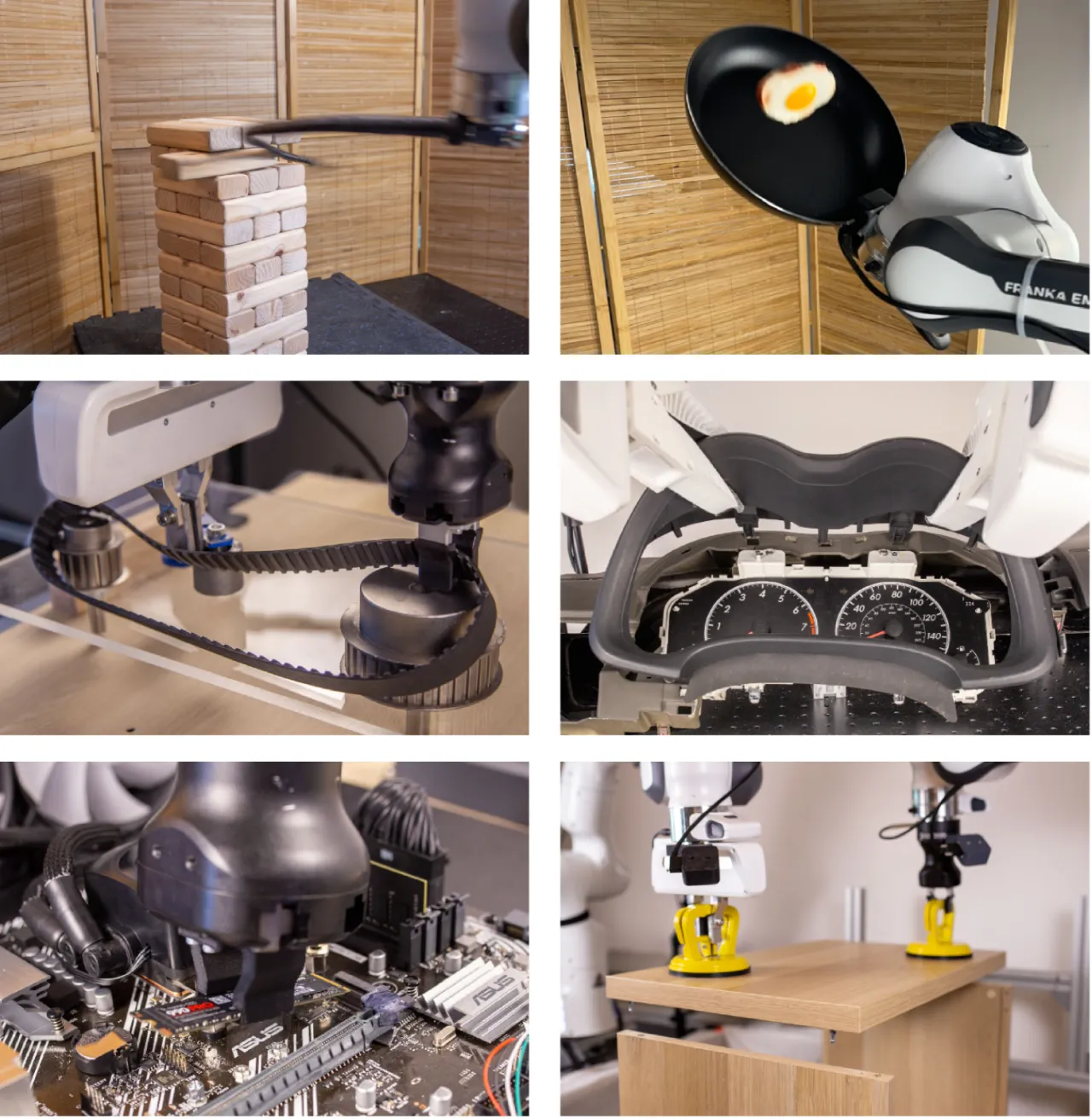
Figure 1:论文涵盖的部分任务,包括:从 Jenga 塔中抽取积木(动态操作)、煎蛋翻面(精准动态)、主板组装(SSD、RAM、USB 等精密装配)、IKEA 家具安装、汽车仪表盘安装、时序皮带组装、物体交接等,覆盖动态操作、精密装配与双臂协调三大类别。Figure 1: Part of the tasks covered in the paper, including whipping a block out of a Jenga tower (dynamic manipulation), flipping a fried egg (precise and dynamic), motherboard assembly (precision assembly of SSD, RAM, USB, etc.), IKEA furniture assembly, car dashboard installation, timing belt assembly, and object handover, spanning the three categories of dynamic manipulation, precision assembly, and dual-arm coordination.
100%13 项任务平均成功率average success rate over 13 tasks
1–2.5h真实机器人训练时长real-robot training time
2×相比 BC 成功率提升倍数success rate gain over BC
1.8×相比 BC 执行速度提升倍数execution speed gain over BC
02方法Method
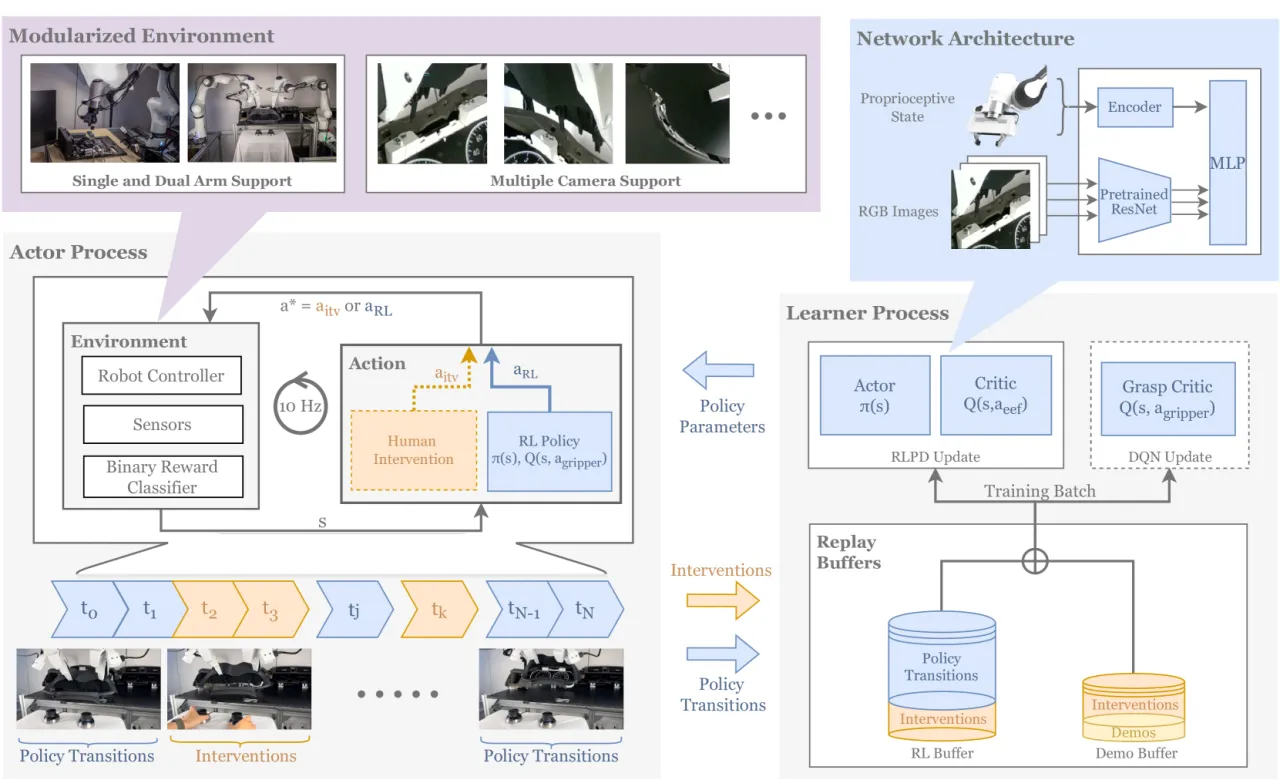
HIL-SERL 系统由三个异步并行的核心组件构成:Actor 进程(在机器人上执行策略)、Learner 进程(持续更新策略参数)、以及两个 Replay Buffer(分别存储人类示范数据与 on-policy 数据)。The HIL-SERL system consists of three asynchronously parallel core components: the actor process (executing the policy on the robot), the learner process (continuously updating the policy parameters), and two replay buffers (storing human demonstration data and on-policy data respectively).
Figure 2:HIL-SERL 系统架构。Actor 进程从 Learner 获取最新策略,与真实环境交互并将数据发送到 Replay Buffer;Learner 从 demo buffer 和 RL buffer 各采样 50% 数据,用 RLPD 更新策略。人类操作员可随时通过 SpaceMouse 介入,其纠错动作同时写入两个 buffer。视觉输入经预训练 ResNet-10 骨干提取特征后,与本体感知信息拼接送入策略网络。Figure 2: The HIL-SERL system architecture. The actor process fetches the latest policy from the learner, interacts with the real environment and sends data to the replay buffer; the learner samples 50% of the data from the demo buffer and 50% from the RL buffer, and updates the policy with RLPD. A human operator can intervene at any time via the SpaceMouse, and the corrective actions are written into both buffers. Visual inputs are encoded by a pretrained ResNet-10 backbone and concatenated with proprioceptive information before being fed into the policy network.
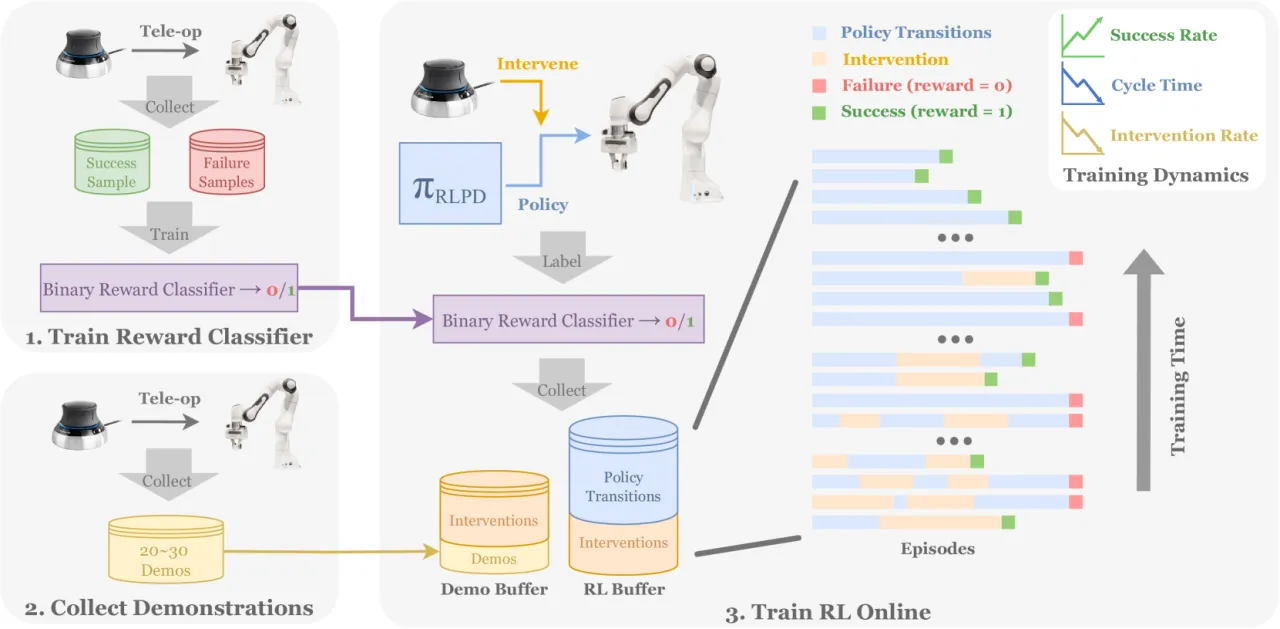
底层 RL 算法选用 RLPD(Ball et al., 2023),其在每个训练步骤中从 demo buffer 和 RL buffer 等比采样构成训练批次。RLPD 以 SAC 为基础,同时更新 Q 函数 Qφ(s, a) 与策略 πθ(a|s)。奖励函数采用稀疏二值奖励——由离线训练的 ResNet-based 视觉分类器判断任务是否成功(准确率通常 > 95%)。初始化阶段收集 20–30 条人类遥操作演示进入 demo buffer。The underlying RL algorithm is RLPD (Ball et al., 2023), which forms every training batch by sampling in equal proportion from the demo buffer and the RL buffer at each training step. RLPD builds on SAC and jointly updates the Q function Qφ(s, a) and the policy πθ(a|s). The reward is a sparse binary reward — an offline-trained ResNet-based visual classifier decides whether the task has succeeded (accuracy typically > 95%). In the initialization phase, 20–30 human teleoperated demonstrations are collected into the demo buffer.
所有摄像头图像(腕部相机 + 侧视相机)统一经过 ResNet-10(ImageNet 预训练)提取嵌入向量,再与本体感知信息拼接。使用预训练骨干带来两重好处:(1)优化稳定性更高;(2)探索效率更好——避免 RL 在高维原始图像上从零学习视觉表征。图像统一 crop 并缩放至 128×128。All camera images (wrist camera + side camera) are uniformly passed through ResNet-10 (ImageNet pretrained) to extract embeddings, which are then concatenated with proprioceptive information. Using a pretrained backbone brings two benefits: (1) higher optimization stability; (2) better exploration efficiency — it avoids having RL learn visual representations from scratch on high-dimensional raw images. Images are uniformly cropped and resized to 128×128.
人机协作训练流程(Human-in-the-Loop)Human-in-the-Loop Training Procedure
训练过程中,人类操作员全程监督机器人执行,在策略陷入局部最优或无法恢复的状态时,通过 SpaceMouse 随时介入纠错。干预数据同时写入 demo buffer 与 RL buffer;策略在干预前后的过渡状态则仅写入 RL buffer。这一机制与 HG-DAgger 类似,但关键区别在于:纠错数据不仅用于行为克隆,还进入 RL 的 Q 函数优化,引导策略更高效地探索成功轨迹。Throughout training, a human operator supervises the robot's execution and, whenever the policy falls into a local optimum or an unrecoverable state, intervenes to correct it at any time via the SpaceMouse. Intervention data is written into both the demo buffer and the RL buffer, while the transition states before and after an intervention go only into the RL buffer. This mechanism resembles HG-DAgger, but with one key difference: the corrective data is not only used for behavior cloning but also enters the Q function optimization of RL, guiding the policy to explore successful trajectories more efficiently.
"A human can intervene at any time step ti. When a human intervenes, their action aitv is applied to the robot instead of the policy's action aRL. We store the intervention data in both the demonstration and RL data buffers."
Figure 3:HIL-SERL 完整训练流程。首先选择合适摄像头并进行图像裁剪;接着收集约 200 正样本 + 1000 负样本训练奖励分类器(约 5 分钟);随后采集 20–30 条人类遥操作演示初始化 demo buffer;最后启动 RL 训练,人类按需提供干预纠错,直到策略收敛(干预率降至 0%)。Figure 3: The complete HIL-SERL training pipeline. First, suitable cameras are selected and the images are cropped; next, about 200 positive and 1000 negative samples are collected to train the reward classifier (about 5 minutes); then 20–30 human teleoperated demonstrations are recorded to initialize the demo buffer; finally RL training is launched, with humans providing corrective interventions on demand until the policy converges (the intervention rate drops to 0%).
下游机器人控制器设计Downstream Robot Controller Design
针对精密接触任务(如 RAM 插入、SSD 安装),策略输出 6D Cartesian twist 目标送入阻抗控制器(impedance controller),兼顾精度与安全性,允许 RL 在探索阶段发出随机动作而不损坏硬件。针对动态任务(如翻蛋、抽 Jenga),动作空间改为直接输出末端执行器坐标系下的 feedforward wrench(近似于期望加速度)。夹爪控制通过独立训练的 Grasp Critic(DQN)实现离散控制。For precise contact-rich tasks (such as RAM insertion and SSD assembly), the policy outputs a 6D Cartesian twist target that is fed to an impedance controller, balancing precision and safety and allowing RL to emit random actions during exploration without damaging the hardware. For dynamic tasks (such as egg flipping and Jenga whipping), the action space instead directly outputs a feedforward wrench in the end-effector frame (approximately a desired acceleration). Gripper control is realized discretely through a separately trained Grasp Critic (DQN).
03实验Experiments
实验覆盖 7 大类、13 项任务,包含单臂与双臂配置:精密装配(RAM 插入、SSD 安装、USB 插入)、动态操作(翻蛋、Jenga 抽取)、柔性物体(时序皮带)、多阶段任务(IKEA 家具、汽车仪表盘)。所有任务均在真实机器人上训练,无仿真预训练。The experiments cover 7 categories and 13 tasks with both single-arm and dual-arm configurations: precision assembly (RAM insertion, SSD assembly, USB insertion), dynamic manipulation (egg flipping, Jenga whipping), deformable objects (timing belt), and multi-stage tasks (IKEA furniture, car dashboard). All tasks are trained on real robots, without simulation pretraining.
主要结果:HIL-SERL vs. BC(行为克隆基线)Main results: HIL-SERL vs. BC (behavior cloning baseline)
所有任务均报告 100 次试验的成功率(IKEA 整体装配为 10 次)。BC 基线使用与 RL 等量的演示条数与干预次数通过 HG-DAgger 训练。All tasks report success rates over 100 trials (10 trials for the whole IKEA assembly). The BC baseline is trained with HG-DAgger using the same number of demonstrations and interventions as RL.
任务Task
训练时长 (h)Training time (h)
BC 成功率 (%)BC success rate (%)
HIL-SERL 成功率 (%)HIL-SERL success rate (%)
BC 周期时间 (s)BC cycle time (s)
HIL-SERL 周期时间 (s)HIL-SERL cycle time (s)
RAM Insertion
1.5
29
100 (+245%)
8.3
4.8 (1.7x faster)
SSD Assembly
1
79
100 (+27%)
6.7
3.3 (2x faster)
USB Grasp-Insertion
2.5
26
100 (+285%)
13.4
6.7 (2x faster)
Cable Clipping
1.25
95
100 (+5%)
7.2
4.2 (1.7x faster)
IKEA Side Panel 1
1
2
77 (+30%→已纠正为:77)77 (+30% → corrected to: 77)
6.5
2.7 (2.4x faster)
IKEA Side Panel 2
1.75
79
100 (+27%)
5.0
2.4 (2.1x faster)
IKEA Top Panel
1
35
100 (+186%)
8.9
2.4 (3.7x faster)
IKEA Whole Assembly
—
1/10
10/10 (+900%)
—
—
Car Dashboard Assembly
2
41
100 (+144%)
20.3
8.8 (2.3x faster)
Object Handover
2.5
79
100 (+27%)
16.1
13.6 (1.2x faster)
Timing Belt Assembly
6
2
100 (+4900%)
9.1
7.2 (1.3x faster)
Jenga Whipping
1.25
8
100 (+1150%)
—
—
Object Flipping
1
46
100 (+117%)
3.9
3.8 (1.03x faster)
平均Average
—
49.7
100 (+101%)
9.6
5.4 (1.8x faster)
注:IKEA Side Panel 1 的 BC 成功率原文为 2%,HIL-SERL 结果为 77%(+30% 是相对 IKEA Side Panel 2 的语境;Side Panel 1 原文数据:BC=2, HIL-SERL=100 — 以上表格数据均来自 Table 1(a),直接引用原文)。Note: for IKEA Side Panel 1 the BC success rate is 2% in the paper and the HIL-SERL result is 77% (the +30% belongs to the context of IKEA Side Panel 2; the paper's figures for Side Panel 1 are BC=2, HIL-SERL=100 — all table data above are taken from Table 1(a) and quoted directly from the paper).
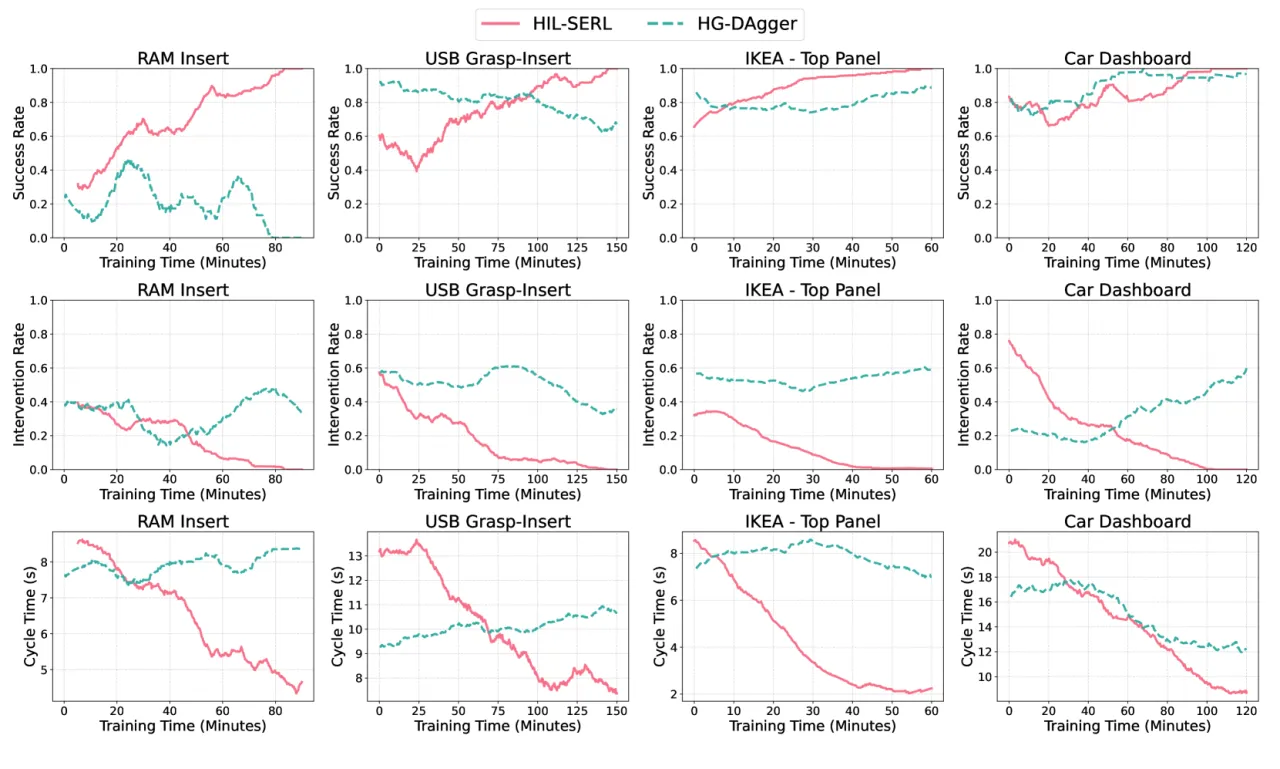
Figure 5:代表性任务的学习曲线(20 episode 滑动平均)。HIL-SERL 的成功率快速上升并最终达到 100%,干预率与周期时间持续下降;干预率最终降至 0%,说明策略完全自主。HG-DAgger 基线成功率明显偏低且收敛更慢。Figure 5: Learning curves on representative tasks (20-episode moving average). The success rate of HIL-SERL rises quickly and eventually reaches 100%, while the intervention rate and the cycle time keep decreasing; the intervention rate finally drops to 0%, showing that the policy is fully autonomous. The HG-DAgger baseline attains a markedly lower success rate and converges more slowly.
与多种方法的比较(Table 1b)Comparison with multiple methods (Table 1b)
在 RAM Insertion、Car Dashboard Assembly、Object Flipping 三个代表性任务上,对比了 Diffusion Policy(DP,200 demos)、HG-DAgger、BC、IBRL、Residual RL、DAPG 以及 HIL-SERL 的两种消融变体。On the three representative tasks RAM Insertion, Car Dashboard Assembly and Object Flipping, the paper compares Diffusion Policy (DP, 200 demos), HG-DAgger, BC, IBRL, Residual RL, DAPG, and two ablated variants of HIL-SERL.
任务Task
DP
HG-DAgger
BC
IBRL
Residual RL
DAPG
HIL-SERL (no demo no itv)
HIL-SERL (no itv)
HIL-SERL (ours)
RAM Insertion
27
29
12
75
0
8
0
48
100
Dashboard Assembly
18
41
35
0
0
18
0
0
100
Object Flipping
56
46
46
95
97
72
0
100
100
平均Average
34
39
31
57
32
33
0
49
100
关键消融发现:无任何示范或纠错从零训练 RL 所有任务均为 0% 成功率;将 demo 增加到 200 条但无在线纠错(no itv),Dashboard Assembly 仍为 0%,证明在线纠错是必不可少的。Key ablation findings: training RL from scratch without any demonstrations or corrections yields a 0% success rate on all tasks; increasing the demos to 200 but without online corrections (no itv) still leaves Dashboard Assembly at 0%, proving that online corrections are indispensable.
鲁棒性评估Robustness Evaluation
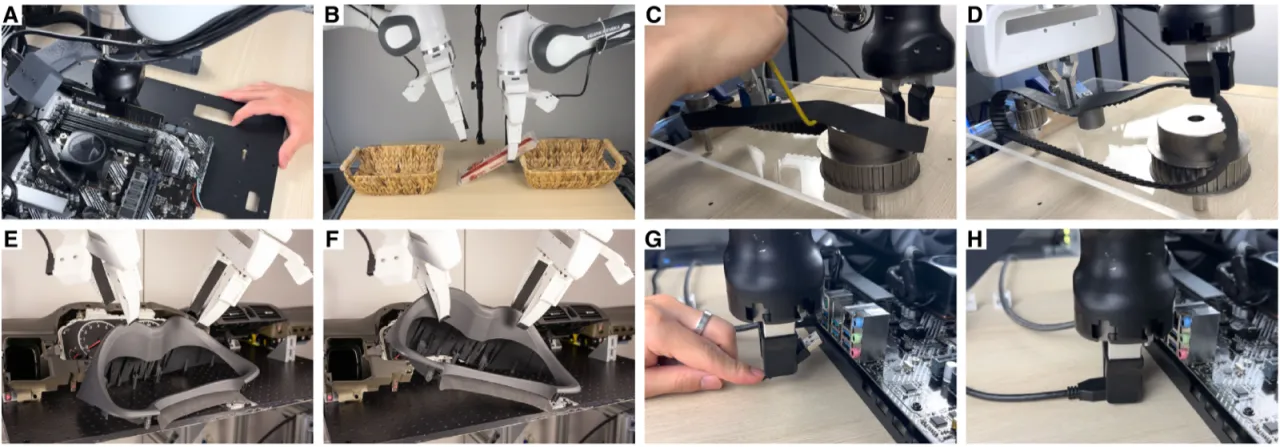
Figure 6:zero-shot 鲁棒性测试。(A) RAM 插入:目标主板移动时策略仍成功插入;(B) 物体交接:夹爪被强制打开后,策略自动重新抓取并继续任务;(C-D) 时序皮带:对皮带施加外部扰动或故意改变形状,策略适应并完成装配;(E-F) 仪表盘装配:夹爪被强制打开后策略重新抓取;(G-H) USB 插入:遇到不良抓取姿态时自主松手重抓。这些鲁棒行为均通过 RL 的自主探索自然涌现,无需人工设计。Figure 6: Zero-shot robustness tests. (A) RAM insertion: the policy still inserts successfully when the target motherboard is moved; (B) object handover: after the gripper is forced open, the policy automatically regrasps and continues the task; (C-D) timing belt: under external disturbances or deliberate changes of the belt's shape, the policy adapts and completes the assembly; (E-F) dashboard assembly: the policy regrasps after the gripper is forced open; (G-H) USB insertion: it releases and regrasps autonomously when the grasp pose is poor. These robust behaviors all emerge naturally from the autonomous exploration of RL, without manual design.
04局限性Limitations
注:本文 Discussion 节(第 6 节)未设置专门的 Limitations 小节。以下内容综合作者在 Discussion 中明确提及的未来工作方向(标注为作者明确陈述)以及由系统设计推断的固有约束(标注为推断)。Note: The Discussion section of the paper (Section 6) has no dedicated Limitations subsection. The following combines the future directions the authors explicitly mention in the Discussion (marked stated by the authors) with intrinsic constraints inferred from the system design (marked inferred).
任务专用性强,泛化能力有限(推断)Highly task-specific, with limited generalization (inferred)
HIL-SERL 针对每个任务独立训练一个策略,需要人工设计观测空间(相机选择与裁剪)、动作空间及奖励分类器。系统尚未展示跨任务的零样本泛化能力。作者在 Discussion 中指出,该系统可作为生成高质量数据的工具,进而用于训练机器人基础模型(robot foundation models),这暗示当前单任务策略的局限性。HIL-SERL trains a separate policy for each task and requires manually designing the observation space (camera selection and cropping), the action space and the reward classifier. The system has not yet demonstrated zero-shot generalization across tasks. The authors note in the Discussion that the system can serve as a tool for generating high-quality data with which to train robot foundation models, which hints at the limitation of the current single-task policies.
仍依赖人类持续参与,难以完全自动化(推断)Still relies on continuous human involvement and is hard to fully automate (inferred)
训练过程中需要人类操作员实时监督并提供纠错。论文指出应避免持续提供稀疏的长段干预("we should avoid persistently providing long sparse interventions that lead to task successes"),否则会导致 Q 函数过估计和训练不稳定。对于极端复杂的任务(Timing Belt),训练时长需要 6 小时,仍需大量人工投入。Training requires a human operator to supervise in real time and provide corrections. The paper points out that one should avoid persistently providing long sparse interventions ("we should avoid persistently providing long sparse interventions that lead to task successes"), otherwise the Q function is overestimated and training becomes unstable. For extremely complex tasks (Timing Belt) the training time reaches 6 hours, still demanding substantial human effort.
奖励分类器设计仍需人工(推断)Reward classifier design still requires manual effort (inferred)
每个任务需要人工收集约 200 正样本和 1000 负样本以训练视觉奖励分类器,并需针对假阳性/假阴性问题额外收集数据。作者在 Discussion 中提及利用 VLM/基础模型自动化奖励定义是重要的未来方向。Each task requires manually collecting about 200 positive and 1000 negative samples to train the visual reward classifier, plus additional data to handle false positives and false negatives. The authors mention in the Discussion that automating reward definition with VLMs / foundation models is an important future direction.
任务复杂度上限与 HMLV 制造适用范围(作者明确陈述)Task complexity ceiling and the scope of HMLV manufacturing (stated by the authors)
作者在 Discussion 中将该系统定位于 High-Mix Low-Volume (HMLV) 制造场景,并明确指出若任务发生较大变化(如零件尺寸改变、新任务),可能需要重新训练或大量干预。未来工作包括利用该系统生成的高质量数据训练可泛化的基础模型,以降低对逐任务重训练的依赖。In the Discussion the authors position the system for High-Mix Low-Volume (HMLV) manufacturing scenarios, and explicitly state that if a task changes substantially (for example, part dimensions change, or a new task appears), retraining or extensive intervention may be required. Future work includes using the high-quality data generated by the system to train generalizable foundation models, so as to reduce the reliance on per-task retraining.