HBVLA: Pushing 1-Bit Post-Training Quantization for Vision-Language-Action Models
将 VLA 模型极限压缩至 1.08 bit,性能损失低至 5%,赋能边缘机器人部署Compressing VLA models to 1.08 bit with performance loss as low as 5%, enabling deployment on edge robots
Xin Yan, Zhenglin Wan, Feiyang Ye, Xingrui Yu, Hangyu Du, Yang You, Ivor Tsang
大型 Vision-Language-Action(VLA)模型在机器人上部署代价极高。HBVLA 提出一套专为 VLA 定制的 1-bit post-training quantization 框架:通过 policy-aware rectified Hessian 识别动作生成关键权重,再结合稀疏正交变换与 Haar 域混合量化,将 OpenVLA-OFT 压缩至 1.08 bit 仍保留 90.3% 性能(LIBERO),CogACT 在 SIMPLER 上保留 93.6%,实机验证效果接近全精度。Large Vision-Language-Action (VLA) models are extremely expensive to deploy on robots. HBVLA proposes a 1-bit post-training quantization framework tailored to VLA: a policy-aware rectified Hessian identifies the weights critical to action generation, and a sparse orthogonal transform combined with hybrid Haar-domain quantization compresses OpenVLA-OFT to 1.08 bit while retaining 90.3% of its performance (LIBERO); CogACT retains 93.6% on SIMPLER, and real-robot trials come close to full precision.
arXiv 2602.13710提交 2026-02-14Submitted 2026-02-141.08 bit · PTQ · VLA📄 arXiv:2602.13710PDF
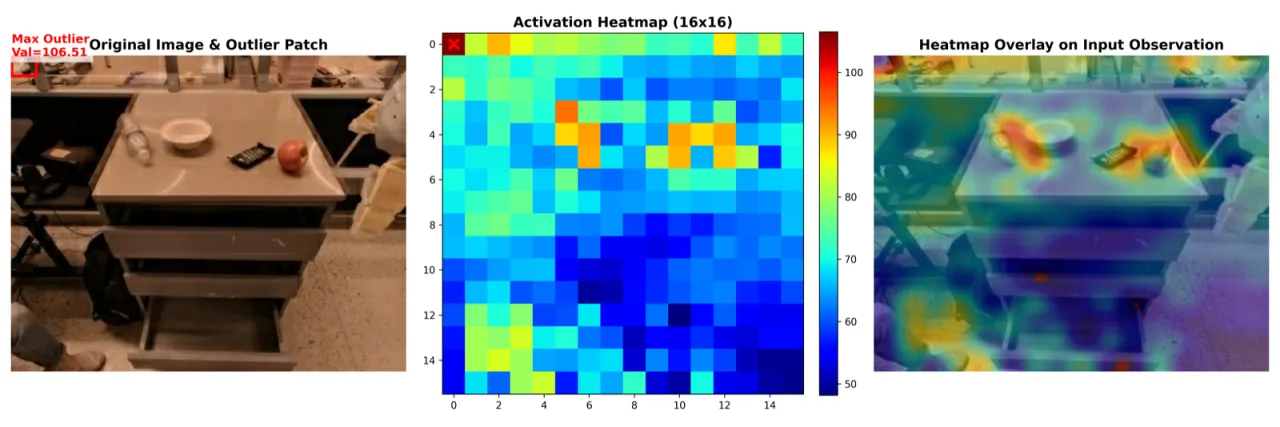
VLA 模型参数量庞大,难以在资源受限的机器人平台(如移动底座、嵌入式控制器)上实时部署。现有 LLM 二值化方法(BiLLM、BiVLM、HBLLM 等)在 VLA 场景下性能严重下滑,根源在于两类 VLA 特有问题:一是微小量化误差在闭环物理执行中被接触动力学放大、沿长视野任务累积,导致灾难性失败;二是视觉激活存在"双主导"现象(background outliers + visual token 不均衡),遮蔽了任务关键信号。VLA models have enormous parameter counts, which makes real-time deployment on resource-constrained robot platforms (mobile bases, embedded controllers) difficult. Existing LLM binarization methods (BiLLM, BiVLM, HBLLM, etc.) degrade severely in VLA settings, and the root cause lies in two problems specific to VLA: first, minute quantization errors are amplified by contact dynamics during closed-loop physical execution and accumulate along long-horizon tasks, leading to catastrophic failures; second, visual activations exhibit a "dual dominance" phenomenon (background outliers plus visual token imbalance) that masks task-critical signals.
"Even subtle quantization-induced action deviations can be amplified by contact dynamics and compound over long-horizon execution, leading to catastrophic failures such as unstable grasps or large trajectory drift."
图 1:背景区域极端激活幅值示意(左)、原始激活热图(中)及模型注意力与任务关键目标的偏差叠加图(右)。"Dual Dominance"现象直观展示:背景 outlier 与视觉 token 不均衡共同影响量化质量。Figure 1: Extreme activation magnitudes in background regions (left), the raw activation heat map (middle), and an overlay of the deviation between model attention and task-critical targets (right). The "Dual Dominance" phenomenon is shown directly: background outliers and visual token imbalance jointly degrade quantization quality.
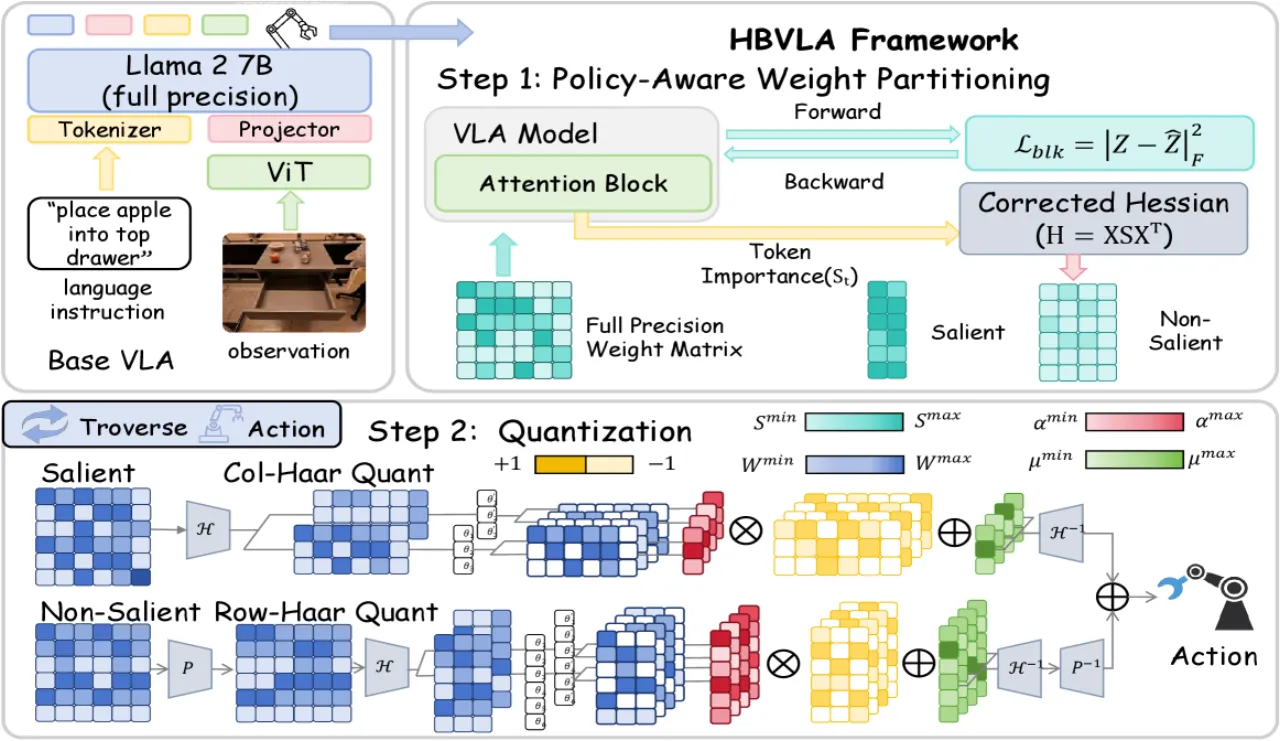
HBVLA 分三阶段解决 VLA 二值化难题:① Policy-Aware Weight Partitioning(权重显著性分区);② Sparse Orthogonal Transform(稀疏正交变换);③ Hybrid Haar Domain Quantization(混合 Haar 域量化)。整体目标是最小化量化前后 VLA 动作输出的 KL 散度,而非仅拟合权重本身。HBVLA solves VLA binarization in three stages: Policy-Aware Weight Partitioning; Sparse Orthogonal Transform; and Hybrid Haar Domain Quantization. The overall objective is to minimize the KL divergence between the VLA action outputs before and after quantization, rather than merely fitting the weights themselves.
图 2:HBVLA 流程总览。左侧:block-wise gradient probe 沿 action pathway 反向传播,推导每个 token 对动作生成的重要性分数 st,构建 policy-aware rectified Hessian;右侧:针对显著权重与非显著权重分别采用列/行方向 Haar 变换量化后求和重建。Figure 2: Overview of the HBVLA pipeline. Left: a block-wise gradient probe backpropagates along the action pathway to derive an importance score st for each token with respect to action generation, building the policy-aware rectified Hessian. Right: salient and non-salient weights are quantized with column-wise and row-wise Haar transforms respectively, then summed for reconstruction.
Policy-Aware Rectified Hessian
传统 Hessian 度量将所有 token 同等对待。HBVLA 引入 policy-aware rectified Hessian:
对每个 token 计算其对动作生成路径的梯度贡献作为重要性权重 st,并将其加权到 Hessian 矩阵中:
Conventional Hessian metrics treat all tokens equally. HBVLA introduces a policy-aware rectified Hessian: for every token it computes the gradient contribution along the action-generation pathway as an importance weight st, and folds that weight into the Hessian matrix:
H̃ = X·S·Xᵀ = Σt=1..N st · xtxᵀt
基于 H̃,权重矩阵被分为显著子集(salient,保留高保真量化)与非显著子集(non-salient,极限压缩)。Based on H̃, the weight matrix is split into a salient subset (kept at high-fidelity quantization) and a non-salient subset (compressed to the extreme).
Sparse Orthogonal Transform + Hybrid Haar Quantization
非显著权重通过稀疏正交变换(置换矩阵 + Haar 变换)优化权重几何结构,使高频能量最小化,再以 row-wise Haar 变换 + shared-mean 二值化完成量化。显著权重则采用 column-wise Haar 变换对残差进行高保真重建。两部分求和得到最终量化层。Non-salient weights go through a sparse orthogonal transform (permutation matrix + Haar transform) that reshapes the weight geometry so that high-frequency energy is minimized, and are then quantized by a row-wise Haar transform plus shared-mean binarization. Salient weights instead use a column-wise Haar transform to reconstruct the residual at high fidelity. Summing the two parts gives the final quantized layer.
置换策略通过贪心 pairing-and-chaining 算法选择,使 Haar 域中间态信息熵最低,解决多模态权重异质性(multimodal weight heterogeneity)问题。The permutation strategy is chosen by a greedy pairing-and-chaining algorithm that minimizes the information entropy of the intermediate state in the Haar domain, addressing multimodal weight heterogeneity.
提取高 H̃ 分数权重列Extract weight columns with high H̃ scores
Column-wise Haar 变换Column-wise Haar transform
残差高保真重建High-fidelity residual reconstruction
03实验 ExperimentsExperiments
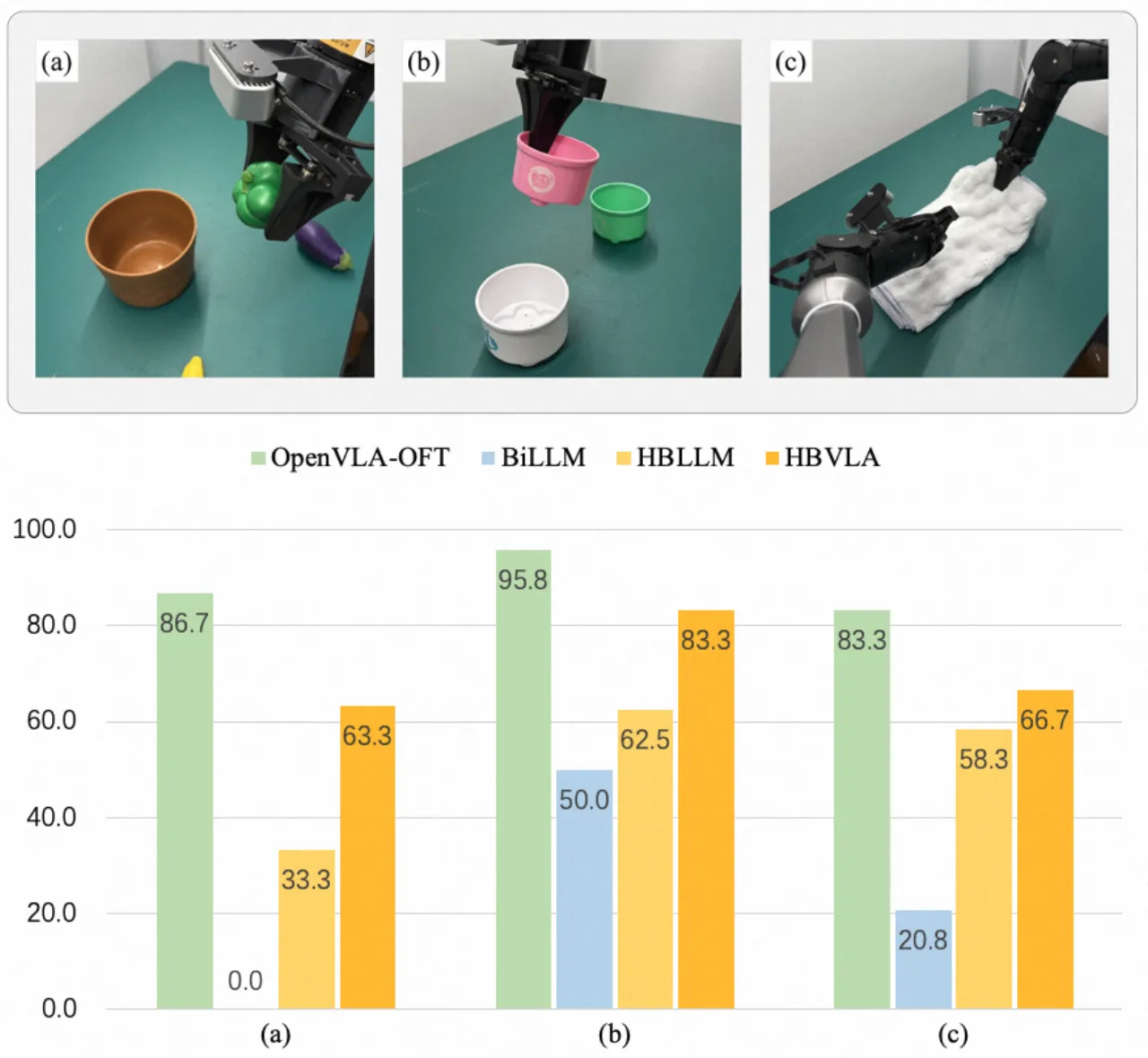
在三个基准上评估 HBVLA:LIBERO(OpenVLA / OpenVLA-OFT,四个子任务)、SIMPLER(CogACT,Visual Matching + Variant Aggregation)、以及 Mobile ALOHA 真实机器人实验。基线方法:BiLLM、BiVLM、HBLLM。量化位宽均为 1.08 bit。HBVLA is evaluated on three benchmarks: LIBERO (OpenVLA / OpenVLA-OFT, four sub-tasks), SIMPLER (CogACT, Visual Matching + Variant Aggregation), and real-robot experiments on Mobile ALOHA. Baselines: BiLLM, BiVLM, HBLLM. The quantization bit-width is 1.08 bit throughout.
实机验证:Mobile ALOHAReal-robot validation: Mobile ALOHA
图 3:Mobile ALOHA 三项操作任务(Pick and Place、Sequenced Instruction、Flexible Folding)的成功率对比。HBVLA 与全精度模型性能接近,远优于 BiLLM 和 HBLLM 基线。Figure 3: Success-rate comparison on three Mobile ALOHA manipulation tasks (Pick and Place, Sequenced Instruction, Flexible Folding). HBVLA performs close to the full-precision model and far better than the BiLLM and HBLLM baselines.
消融分析:组件敏感性Ablation: component sensitivity
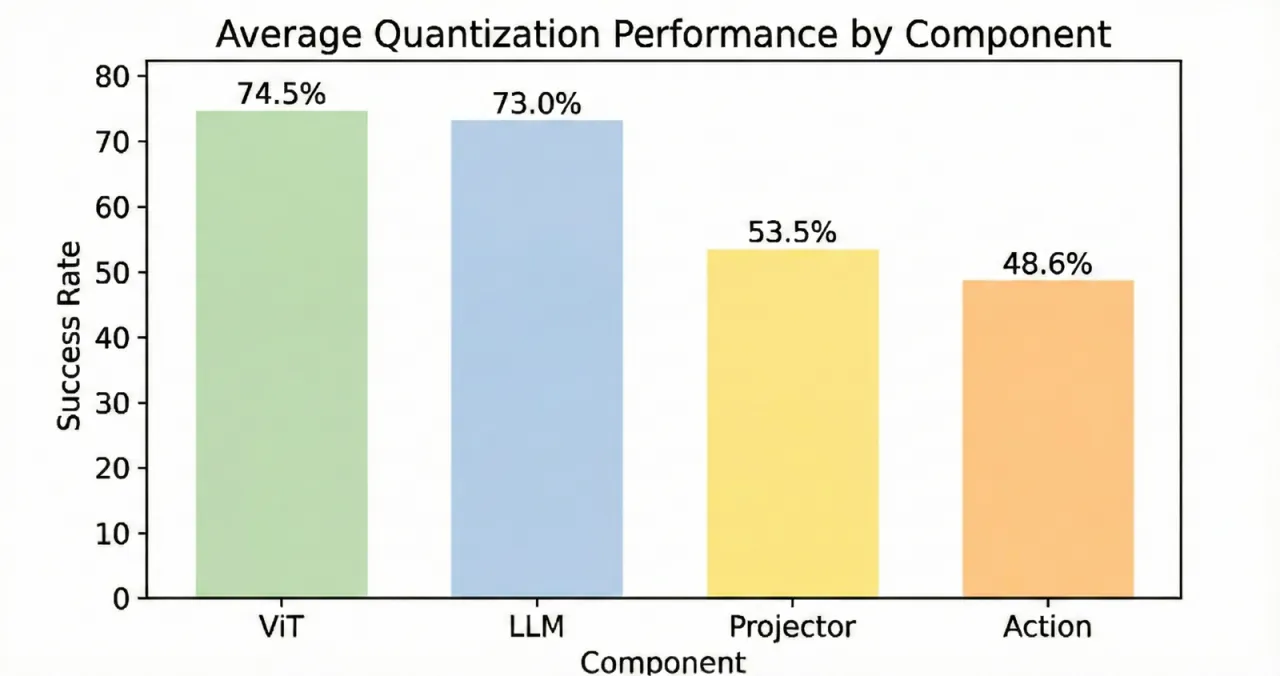
图 4:各组件对量化的敏感性分析。Vision encoder 对量化最鲁棒;projector 与 action head 对量化最敏感;language model 居中。这一发现指导了 HBVLA 的分区策略——对敏感组件优先分配更多显著权重预算。Figure 4: Sensitivity of each component to quantization. The vision encoder is the most robust to quantization; the projector and the action head are the most sensitive; the language model sits in between. This finding guides HBVLA's partitioning strategy — sensitive components are given a larger salient-weight budget first.
消融同时验证了 policy-aware Hessian 相对标准 Hessian 的优越性:在 Visual Matching 上错误率从 12.5% 降至 10.3%,在 Variant Aggregation 上从 13.4% 降至 12.1%。The ablation also confirms that the policy-aware Hessian beats the standard Hessian: the error rate falls from 12.5% to 10.3% on Visual Matching, and from 13.4% to 12.1% on Variant Aggregation.
04局限性 LimitationsLimitations
Note:论文未设置独立 Limitations 章节。以下条目综合论文正文表述(标注"stated")与方法设计推断(标注"inferred")。Note: The paper has no dedicated Limitations section. The items below combine statements made in the paper's main text (marked "stated") with inferences drawn from the method design (marked "inferred").
闭环累积误差难以完全消除(stated)Closed-loop error accumulation cannot be fully eliminated (stated)
论文明确指出:"Even subtle quantization-induced action deviations can be amplified by contact dynamics and compound over long-horizon execution"。尽管 HBVLA 大幅缩小差距,但 1-bit 量化在超长视野任务(如 LIBERO-Long)仍有约 -6.8% 的性能损失,极端精密操作场景下风险依然存在。The paper states explicitly: "Even subtle quantization-induced action deviations can be amplified by contact dynamics and compound over long-horizon execution". Although HBVLA narrows the gap considerably, 1-bit quantization still costs about -6.8% on very-long-horizon tasks (e.g. LIBERO-Long), so the risk persists in extremely precise manipulation scenarios.
特定任务子项仍有明显退化(stated)Noticeable degradation remains on certain sub-tasks (stated)
在 SIMPLER Variant Aggregation 的 "Place Apple" 子任务中,HBVLA 仅取得 24.9%(全精度 46.6%,降幅 -21.7%),远差于其他子任务的表现。说明 1-bit 量化对需要高精度空间推理的任务仍存在瓶颈。On the "Place Apple" sub-task of SIMPLER Variant Aggregation, HBVLA reaches only 24.9% (full precision 46.6%, a drop of -21.7%), far below its performance on the other sub-tasks. This shows that 1-bit quantization still hits a bottleneck on tasks requiring high-precision spatial reasoning.
PTQ 校准数据依赖与域外泛化(inferred)Dependence on PTQ calibration data and out-of-domain generalization (inferred)
Policy-aware Hessian 的构建需要在特定任务数据上进行 block-wise gradient backpropagation,意味着最优量化配置与任务/环境分布绑定,跨域泛化能力未经充分评估。Building the policy-aware Hessian requires block-wise gradient backpropagation on task-specific data, which means the optimal quantization configuration is tied to the task/environment distribution; cross-domain generalization is not thoroughly evaluated.
论文聚焦于精度保留,未提供量化后模型在真实硬件上的推理延迟、内存占用或功耗数据,难以评估实际部署收益。The paper focuses on accuracy retention and provides no inference latency, memory footprint or power consumption for the quantized model on real hardware, making the practical deployment benefit hard to assess.