Green-VLA:面向通用机器人的分阶段视觉-语言-动作模型Green-VLA: Staged Vision-Language-Action Model for Generalist Robots
Green-VLA: Staged Vision-Language-Action Model for Generalist Robots
I. Apanasevich, M. Artemyev, R. Babakyan, P. Fedotova, D. Grankin, E. Kupryashin, A. Misailidi, D. Nerus, A. Nutalapati, G. Sidorov 等 (通讯:A. Postnikov)I. Apanasevich, M. Artemyev, R. Babakyan, P. Fedotova, D. Grankin, E. Kupryashin, A. Misailidi, D. Nerus, A. Nutalapati, G. Sidorov et al. (corresponding author: A. Postnikov)
Green-VLA 提出一套五阶段课程式训练框架,通过统一动作空间与强化学习对齐,将大规模视觉-语言模型转化为可跨机器人本体泛化的操控策略。该系统在 3,000+ 小时演示数据上训练,并在双臂桌面清理、电商货架拣选及人形机器人操控等多项真实任务中达到业界领先水平。Green-VLA proposes a five-stage curriculum training framework that turns a large-scale vision-language model into a manipulation policy able to generalize across robot embodiments, by way of a unified action space and reinforcement learning alignment. The system is trained on 3,000+ hours of demonstration data and attains state-of-the-art performance on real-world tasks such as bimanual tabletop tidying, e-commerce shelf picking and humanoid manipulation.
当前 VLA 研究过于依赖简单的数据扩展,而忽视了真实部署中的根本障碍:数据异构性、数据质量参差不齐,以及 behavior cloning 的内在局限。Current VLA research leans too heavily on naive data scaling while overlooking the fundamental obstacles of real deployment: data heterogeneity, uneven data quality, and the intrinsic limits of behavior cloning.
"robotic datasets are inherently heterogeneous in terms of observations, action spaces, and sampling rates" ——数据层面的异构使得跨机器人泛化极为困难。— Heterogeneity at the data level makes cross-robot generalization extremely difficult.
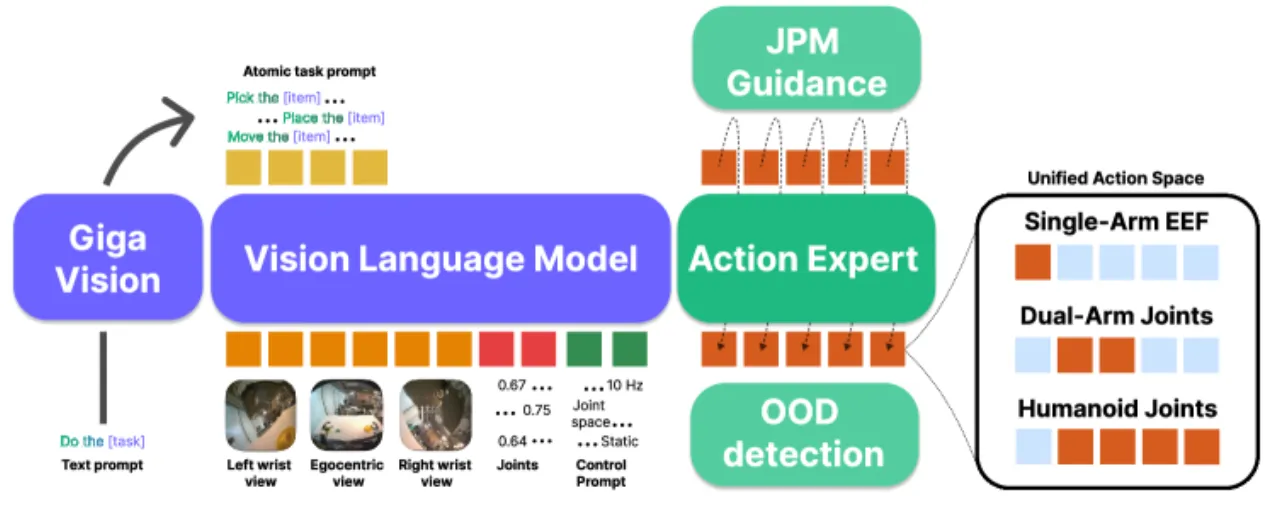
图1:Green-VLA 整体架构。 多模态视觉-语言模型将指令、相机视角与本体感知编码为 token,输入 flow-matching 动作专家。高层任务规划器将用户目标分解为子任务,并利用 episode 结束检测、OOD 检测及基于 JPM 的精确目标点引导信号,实现跨机器人本体的安全、指令忠实执行。Figure 1: Overall architecture of Green-VLA. A multimodal vision-language model encodes the instruction, camera views and proprioception into tokens that feed a flow-matching action expert. A high-level task planner decomposes the user goal into subtasks and uses episode-termination detection, OOD detection and JPM-based precise target-point guidance to achieve safe, instruction-faithful execution across robot embodiments.
3,000+小时演示数据 (R0 训练)hours of demonstration data (R0 training)
真实机器人数据中大量轨迹存在抖动、模糊帧、执行不一致及场景多样性不足等问题,导致直接扩展数据量收益递减。A large share of trajectories in real robot data suffer from jitter, blurry frames, inconsistent execution and insufficient scene diversity, so simply scaling up the amount of data yields diminishing returns.
问题二:Behavior Cloning 的瓶颈Problem 2: the bottleneck of behavior cloning
"the predominant training paradigm remains behavior cloning (BC)…this approach quickly saturates and fails to align policies to long-horizon objectives."
问题三:异构动作空间Problem 3: heterogeneous action spaces
不同机器人本体(人形、移动操作臂、固定臂)具有不同的动作维度与语义,简单 zero-padding 会"destroys positive transfer"。Different robot embodiments (humanoids, mobile manipulators, fixed arms) have different action dimensions and semantics, and naive zero-padding "destroys positive transfer".
核心主张Core claim
Green-VLA 的方案是"beyond data scaling by emphasizing quality alignment, action unification, and reinforcement learning refinement"。The answer offered by Green-VLA is to go "beyond data scaling by emphasizing quality alignment, action unification, and reinforcement learning refinement".
02方法Method
Green-VLA 由五个递进训练阶段、统一动作空间设计、DataQA 数据质量管线、时序对齐、OOD 检测,以及 JPM 精确目标引导等核心组件构成。Green-VLA is built from five progressive training stages, a unified action-space design, the DataQA data-quality pipeline, temporal alignment, OOD detection, and JPM-based precise target guidance.
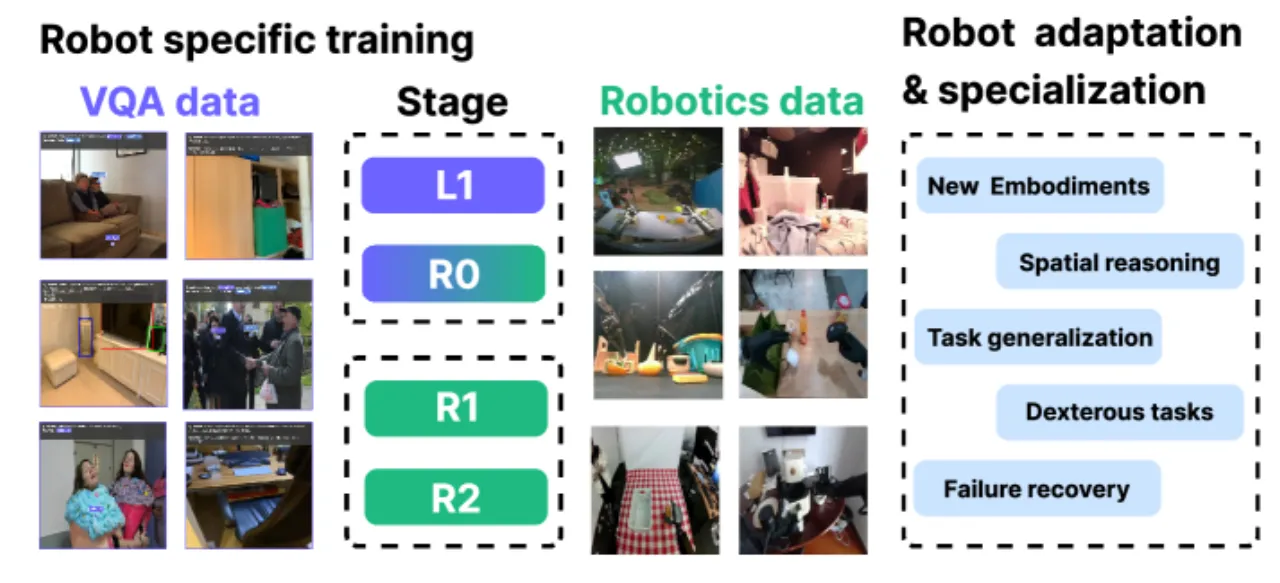
图2:Green-VLA 分阶段训练策略。 机器人专属训练阶段依次利用 VQA 与机器人数据,支持新本体适配与专化、空间推理、任务泛化、灵巧操控和失败恢复。Figure 2: The staged training strategy of Green-VLA. The robot-specific training stages successively exploit VQA data and robot data, supporting adaptation and specialization to new embodiments, spatial reasoning, task generalization, dexterous manipulation and failure recovery.
Green-VLA 定义统一动作空间 𝒜u ⊂ ℝ64,使每个索引范围在所有机器人上具有一致的物理语义,避免零填充破坏迁移学习。掩码 BC 目标函数为:Green-VLA defines a unified action space 𝒜u ⊂ ℝ64, so that every index range carries consistent physical semantics across all robots and zero-padding no longer breaks transfer learning. The masked BC objective is:
ℒuni(θ) = 𝔼[‖me ⊙ (πθ(xte, ce) − Φe(ate))‖²₂]
其中 me 标记有效 slot,消除无效维度上的虚假梯度。动态本体提示(dynamic embodiment prompting)将机器人结构信息(手臂数、手部类型、关节/笛卡尔空间、移动/固定等)编码为条件输入。Here me marks the valid slots, removing spurious gradients on invalid dimensions. Dynamic embodiment prompting encodes the structural information of the robot (number of arms, hand type, joint vs. Cartesian space, mobile vs. fixed, and so on) as conditioning input.
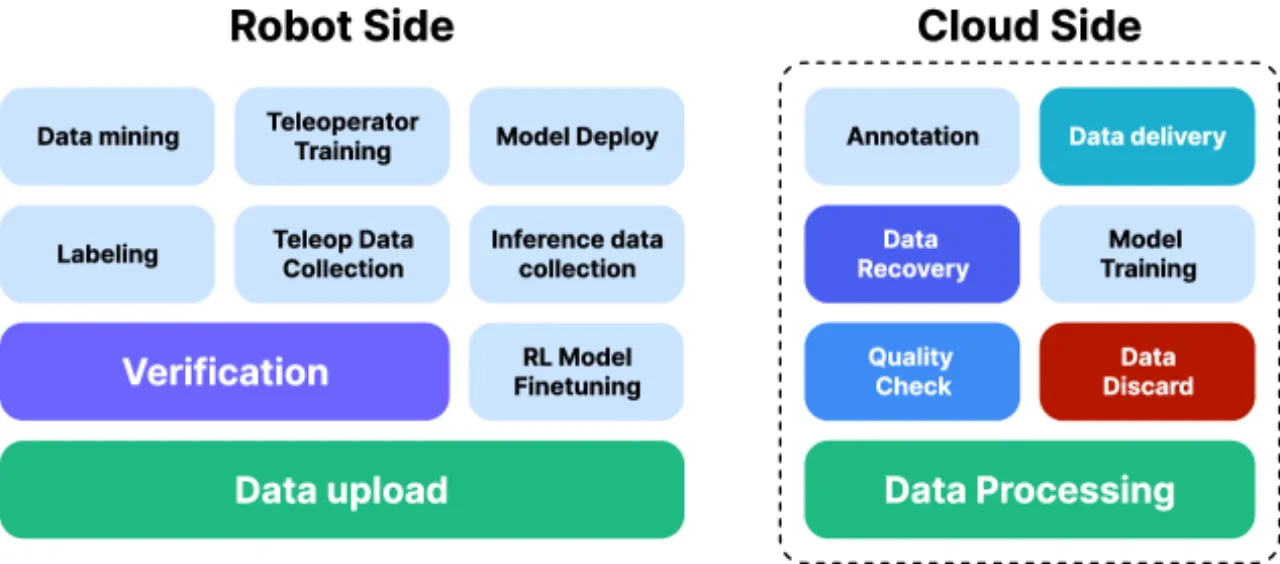
图5:DataQA 数据管线。 融合机器人端遥操作、云端数据核验、开源数据集挖掘与模型训练的迭代闭环,支持基于 RL 微调和真实机器人部署反馈的持续迭代。Figure 5: The DataQA data pipeline. It fuses on-robot teleoperation, cloud-side data verification, open-source dataset mining and model training into an iterative closed loop, supporting continual iteration driven by RL fine-tuning and real-robot deployment feedback.
DataQA 数据质量管线The DataQA data-quality pipeline
通过四项质量指标对原始轨迹进行自动筛选:Raw trajectories are filtered automatically by four quality metrics:
Jitter (J):抖动分数,衡量运动不连续性Jitter (J): a jitter score measuring motion discontinuity
Sharpness (S):基于 Laplacian 的图像清晰度估计Sharpness (S): Laplacian-based estimate of image sharpness
Diversity (D):DINOv3 特征在时序上的方差(场景多样性)Diversity (D): temporal variance of DINOv3 features (scene diversity)
State variance (σ²):机器人状态协方差的 Frobenius 范数State variance (σ²): Frobenius norm of the robot state covariance
时序尺度条件化Temporal-scale conditioning
使用基于光流幅值的重采样对轨迹进行速度归一化,并通过速度因子 v∈[0,1] 进行 RMS 风格调制:Trajectories are speed-normalized by resampling based on optical-flow magnitude, then modulated in RMS style through a speed factor v∈[0,1]:
h̃t = RMSNorm(ht), ĥt = γ(v)h̃t + β(v)
使同一模型能同时表征精细操控和较快粗动作。This lets one and the same model represent both fine-grained manipulation and faster, coarser motions.
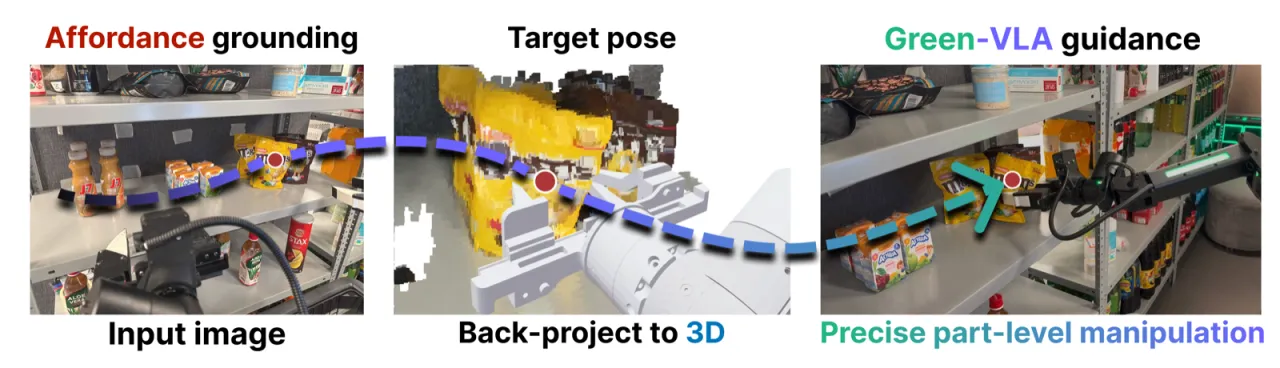
图10:JPM(Joint Prediction Module)精确目标引导。 首先在 2D 图像中定位可供性点,然后通过摄像头几何将其提升到 3D 空间,以初始化 Green-VLA 的目标引导。适用于视觉密集场景下的精细物体区分。Figure 10: JPM (Joint Prediction Module) precise target guidance. An affordance point is first localized in the 2D image and then lifted into 3D space through camera geometry, initializing the target guidance of Green-VLA. It suits fine-grained object discrimination in visually dense scenes.
OOD 检测与修正OOD detection and correction
使用在训练集机器人状态上拟合的高斯混合模型(GMM):ptrain(s) = ∑k ϕk 𝒩(s|μk, Σk),当 ptrain(s) 低于阈值 τood 时,将预测动作修正回训练分布方向。A Gaussian mixture model (GMM) fitted on the robot states of the training set is used: ptrain(s) = ∑k φk 𝒩(s|μk, Σk); when ptrain(s) drops below the threshold τood, the predicted action is corrected back toward the training distribution.
R2:强化学习对齐R2: reinforcement learning alignment
采用两种互补的 RL 方法:Two complementary RL methods are adopted:
轨迹优化(Native Fine-tuning):使用 Implicit Q-Learning(IQL)期望损失,迭代地以 Q 函数梯度精炼轨迹:a ← a + η∇aQ(s,a)/‖∇aQ(s,a)‖Trajectory optimization (native fine-tuning): using the expectile loss of Implicit Q-Learning (IQL), trajectories are refined iteratively along the gradient of the Q function: a ← a + η∇aQ(s,a)/‖∇aQ(s,a)‖
源分布优化(PARL 风格):训练独立 actor 采样能改善 flow-matching 策略的噪声,生成的动作受约束靠近训练集分布。Source-distribution optimization (PARL style): a separate actor is trained to sample noise that improves the flow-matching policy, with the generated actions constrained to stay close to the training distribution.
03实验Experiments
实验涵盖真实机器人与仿真环境多个 benchmark,对比 π0、GR00T N1、WALL-OSS、AgiBot GO-1 等多项基线,验证了分阶段训练和 RL 对齐的有效性。The experiments cover several benchmarks on real robots and in simulation, comparing against baselines such as π0, GR00T N1, WALL-OSS and AgiBot GO-1, and validate the effectiveness of staged training and RL alignment.
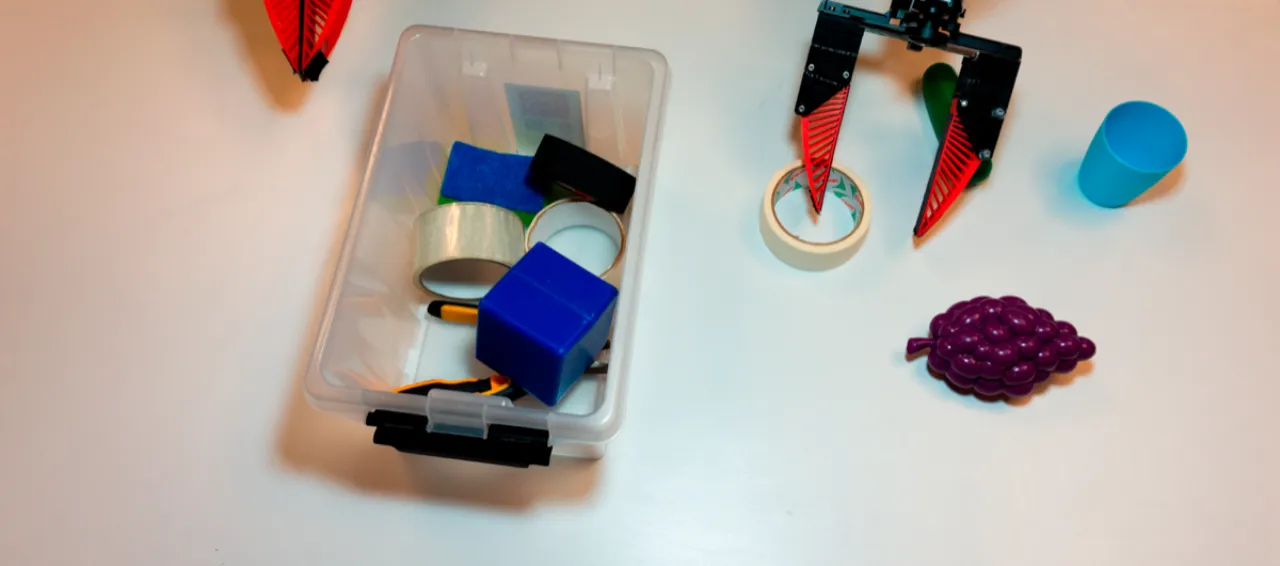
图9:ALOHA 实验设置。 测试"拾取胶带"、"拾取螺丝刀"、"拾取钳子"和桌面清理等任务场景。Green-VLA 在所有物品类别上均大幅超越竞争基线。Figure 9: The ALOHA experimental setup. Task scenarios include "pick up the tape", "pick up the screwdrivers", "pick up the pliers" and tabletop tidying. Green-VLA outperforms the competing baselines by a wide margin on every item category.
方法Method
Tape
Screwdrivers
Pliers
First Item SR
AVG Time
π0
46.3%
29.7%
31.8%
35.6%
2m59s
GR00T N1
38.9%
35.4%
29.5%
33.2%
>5m
WALL-OSS
27.4%
14.2%
27.3%
12.1%
>5m
AgiBot GO-1
57.8%
48.6%
33.2%
38.4%
3m57s
Green-VLA (R0)
83.1%
52.1%
63.7%
69.5%
1m35s
SimplerEnv 仿真基准SimplerEnv simulation benchmark
在 Google Robot(Visual Matching 任务)和 WidowX 两个仿真设置下与多个基线对比:Comparison against several baselines under two simulation setups, Google Robot (Visual Matching tasks) and WidowX:
图11:电商货架拣选 Top-1 成功率(%)。 对比有/无 JPM 引导时 Green-VLA 在域内粗粒度(品牌/类别)、域内 SKU(精确变体)和域外(未见 SKU/包装)三个场景下的表现。Higher is better。Figure 11: Top-1 success rate (%) for e-commerce shelf picking. Green-VLA with and without JPM guidance is compared in three settings: in-domain coarse-grained (brand/category), in-domain SKU (exact variant) and out-of-domain (unseen SKU/packaging). Higher is better.
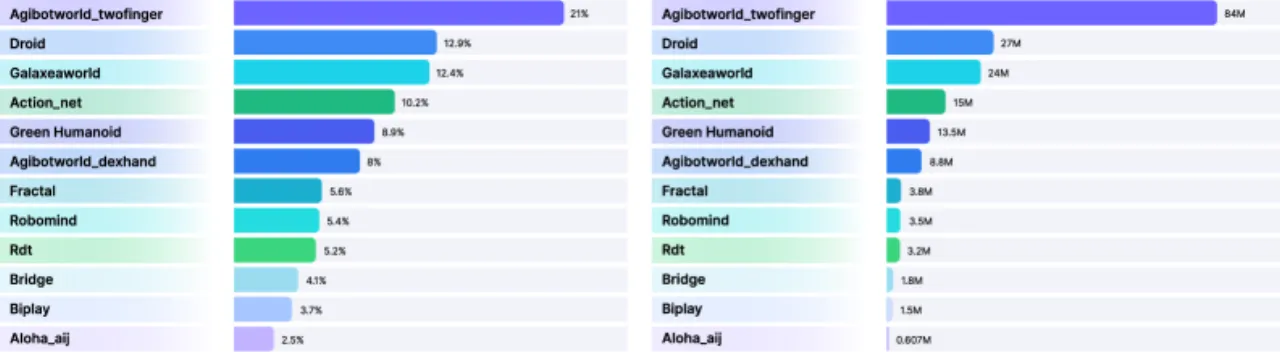
图4:R0 阶段数据集采样分布。 左:各数据集采样率;右:每数据集样本帧数。语料库包含大规模开放数据集(AgibotWorld、DROID、Galaxea 等)与内部采集的人形及灵巧手数据。Figure 4: Dataset sampling distribution of stage R0. Left: the sampling rate of each dataset; right: the number of sample frames per dataset. The corpus contains large-scale open datasets (AgibotWorld, DROID, Galaxea and others) together with in-house humanoid and dexterous-hand data.
在 CALVIN ABC→D 基准上,R2 RL 对齐在长程一致性和组合任务成功率上取得实质性改善,优于 π0 和 Flower 基线。WidowX 拣选成功率从 R1 的 89.6% 提升至 R2 的 94.6%(Pick Success),任务成功率从 72.9% 提升至 80.5%。On the CALVIN ABC→D benchmark, R2 RL alignment brings substantial improvements in long-horizon consistency and compositional task success rate, outperforming the π0 and Flower baselines. The WidowX picking success rate rises from 89.6% at R1 to 94.6% at R2 (pick success), and the task success rate from 72.9% to 80.5%.
人形机器人任务Humanoid robot tasks
在人形机器人(Green Robot)的指令条件操控任务上,系统支持:拾取、放置、递交物品给用户、水果分拣,以及完整桌面清理序列,域内平均成功率约 85%,域外约 78%。高层任务规划器可将"将苹果和橙子分拣到篮子中"等复杂指令自动分解为子任务并逐一执行。On instruction-conditioned manipulation tasks with the humanoid robot (Green Robot), the system supports picking, placing, handing objects to the user, fruit sorting, and a complete tabletop tidying sequence, with an average in-domain success rate of about 85% and about 78% out of domain. The high-level task planner can automatically decompose complex instructions such as "sort the apples and oranges into the basket" into subtasks and execute them one by one.
04局限性Limitations
说明: 论文未设独立的 Limitations 章节。以下第1条为作者在正文中明确指出(stated),其余各条为从系统设计中推断(inferred)。Note: The paper has no standalone Limitations section. Item 1 below is explicitly pointed out by the authors in the main text (stated); the remaining items are inferred from the system design (inferred).
性能依赖 retargeting 保真度与数据集覆盖度(stated)Performance depends on retargeting fidelity and dataset coverage (stated)
"Green-VLA's performance still depends on retargeting fidelity, residual dataset bias, and adequate coverage of dexterous skills." 当数据集偏差较大或目标技能覆盖不足时,泛化能力下降。When dataset bias is large or the target skills are insufficiently covered, generalization degrades.
需要扩展多语言指令跟随(stated)Multilingual instruction following needs to be extended (stated)
作者明确指出未来工作需"extending multilingual instruction following",当前版本对非英语指令的支持有限。The authors state explicitly that future work needs "extending multilingual instruction following"; the current version has limited support for non-English instructions.
快速推理与实时控制的耦合尚待加强(stated)The coupling between fast reasoning and real-time control still needs strengthening (stated)
论文提到需要"strengthening the coupling between fast reasoning and real-time control",暗示当前 VLM 推理速度在高频控制场景中可能成为瓶颈。The paper mentions the need for "strengthening the coupling between fast reasoning and real-time control", implying that the current VLM inference speed may become a bottleneck in high-frequency control scenarios.
RL 微调依赖离线数据与奖励信号质量(inferred)RL fine-tuning depends on offline data and on the quality of the reward signal (inferred)
R2 阶段采用离线 IQL 和轨迹优化,其效果受限于训练集的覆盖范围和 Q 函数估计的准确性。论文指出需"integrating online data collection with safety-aware RL to further reduce failure modes"。Stage R2 adopts offline IQL and trajectory optimization, so its effect is limited by the coverage of the training set and by the accuracy of the Q-function estimate. The paper notes the need for "integrating online data collection with safety-aware RL to further reduce failure modes".
JPM 模块依赖相机标定与深度信息(inferred)The JPM module depends on camera calibration and depth information (inferred)
JPM 将 2D 可供性点通过摄像头几何提升到 3D,并求解逆运动学。该流程对相机内外参精度和深度估计质量敏感,在无结构/遮挡环境中可能失效。JPM lifts 2D affordance points into 3D through camera geometry and then solves inverse kinematics. This pipeline is sensitive to the accuracy of the camera intrinsics and extrinsics and to the quality of depth estimation, and may fail in unstructured or occluded environments.