现有 VLA 模型在推理泛化与高精度动作执行之间存在根本性矛盾。本文提出两个互补贡献:
ERIQ(6,052 条具身推理问答,覆盖四个推理维度)用于系统量化该瓶颈,
FACT(基于 flow matching 的动作分词器)将连续动作离散化同时保留高保真轨迹重建能力。
整合后的 GenieReasoner 在真实机器人任务中超越连续与离散动作基线。Existing VLA models face a fundamental tension between reasoning generalization and high-precision action execution. This paper makes two complementary contributions: ERIQ (6,052 embodied reasoning question-answer pairs spanning four reasoning dimensions), which systematically quantifies this bottleneck, and FACT (a flow-matching-based action tokenizer), which discretizes continuous actions while preserving high-fidelity trajectory reconstruction. The integrated GenieReasoner outperforms both continuous and discrete action baselines on real-robot tasks.
通用机器人需要在开放世界环境中同时做到广泛泛化与高精度动作执行——这一组合对现有
Vision-Language-Action(VLA)模型而言仍是重大挑战。General-purpose robots must deliver broad generalization and high-precision action execution at the same time in open-world environments — a combination that remains a major challenge for existing Vision-Language-Action (VLA) models.
"models optimized for strong reasoning capabilities tend to exhibit reduced action precision,
while those achieving high-fidelity execution often demonstrate limited generalization."
具体而言,现有方案存在三层缺陷:Concretely, existing approaches suffer from three levels of deficiency:
语义泛化不足:大型 VLM 提供语言理解,但具身推理(空间感知、任务规划、错误恢复)仍薄弱,导致机器人在分布外场景下行为脆弱。Insufficient semantic generalization: Large VLMs supply language understanding, but embodied reasoning (spatial perception, task planning, error recovery) remains weak, leaving robots brittle in out-of-distribution scenes.
动作精度损失:现有离散动作分词器(均匀分箱或 VQ-VAE)在量化过程中丢失轨迹精细结构,重建误差较大。Loss of action precision: Existing discrete action tokenizers (uniform binning or VQ-VAE) discard the fine structure of trajectories during quantization, incurring large reconstruction error.
优化冲突:将连续动作头直接附加到 VLM 主干时,推理目标与动作预测目标相互干扰,难以联合优化。Optimization conflict: When a continuous action head is attached directly to the VLM backbone, the reasoning objective and the action-prediction objective interfere with each other, making joint optimization difficult.
为定量解耦这一瓶颈,作者构建了 ERIQ(Embodied Reasoning Intelligence Quotient)——
一个包含 6,052 条具身问答对的大规模基准,跨四个推理维度评测 VLM,
并证明具身推理能力与端到端 VLA 泛化性能之间存在显著正相关。To disentangle this bottleneck quantitatively, the authors build ERIQ (Embodied Reasoning Intelligence Quotient) — a large-scale benchmark of 6,052 embodied question-answer pairs that evaluates VLMs across four reasoning dimensions, and show a significant positive correlation between embodied reasoning ability and end-to-end VLA generalization performance.
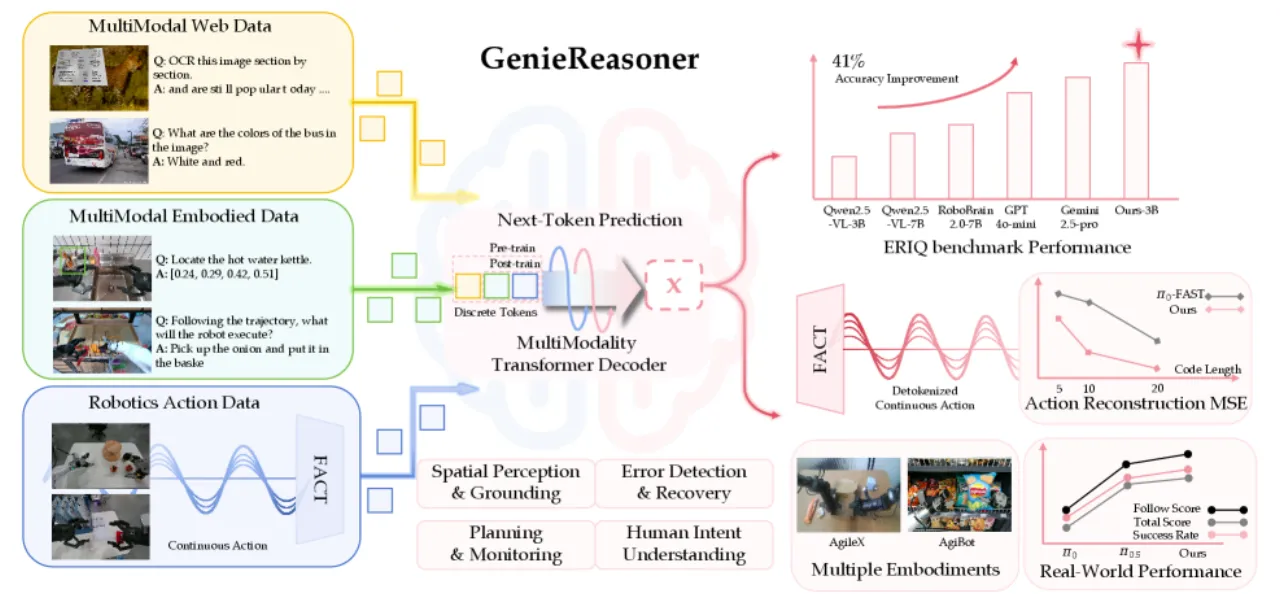
图1:GenieReasoner 系统概览。
左侧展示统一架构将推理与控制结合;中部显示 FACT 分词器基于 flow matching 实现高保真轨迹重建;
右侧对比性能——GenieReasoner 在 ERIQ 上比基线提升 41% 准确率,重建 MSE 低于 π₀-FAST。Figure 1: Overview of the GenieReasoner system. Left: the unified architecture couples reasoning with control. Middle: the FACT tokenizer achieves high-fidelity trajectory reconstruction based on flow matching. Right: performance comparison — GenieReasoner improves accuracy on ERIQ by 41% over the baseline, with reconstruction MSE lower than that of π₀-FAST.
82.72%GenieReasoner-3B 在 ERIQ 上的平均准确率Average accuracy of GenieReasoner-3B on ERIQ
58.64%基线 Qwen2.5-VL-3B 在 ERIQ 上的平均准确率Average accuracy of the Qwen2.5-VL-3B baseline on ERIQ
10×FACT 轨迹重建误差低于 FAST+ 的幅度(相同码长)Factor by which FACT's trajectory reconstruction error is lower than FAST+ (same code length)
02方法Method
本文提出三个互补模块:ERIQ(评估框架)、FACT(动作分词器)
与 GenieReasoner(统一模型),共同构成从诊断到执行的完整框架。The paper proposes three complementary modules — ERIQ (evaluation framework), FACT (action tokenizer) and GenieReasoner (unified model) — which together form a complete framework from diagnosis to execution.
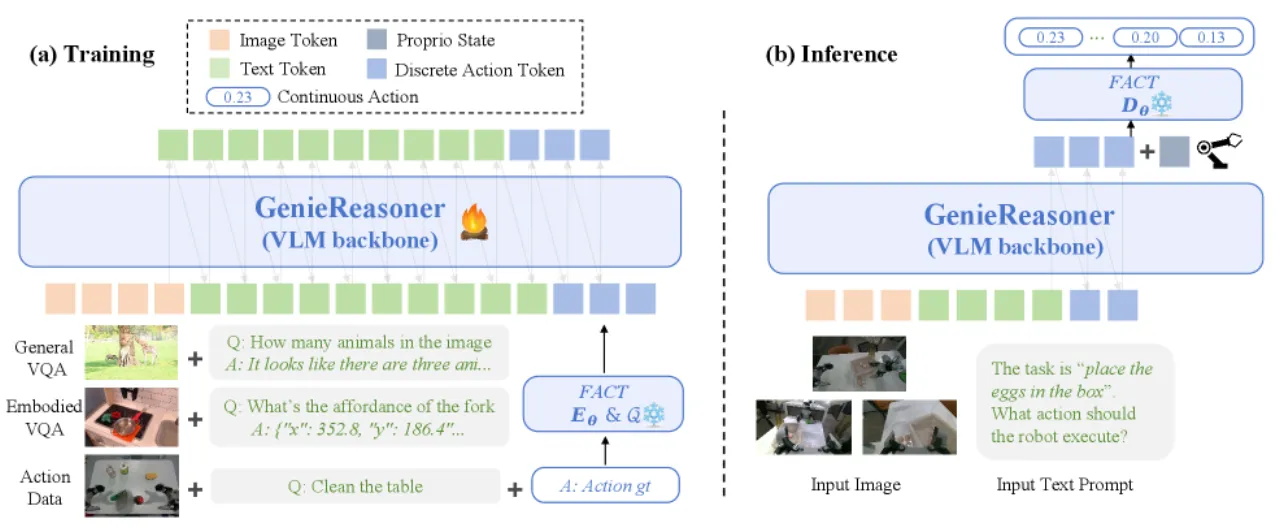
图4:GenieReasoner 系统架构。
(a) 训练流程:VLM 主干联合优化 VLM 推理目标与离散动作预测目标,FACT 编码器将连续动作块转换为离散码;
(b) 推理流程:模型预测离散码序列,FACT 解码器通过 ODE 积分将其还原为连续控制信号。Figure 4: GenieReasoner system architecture. (a) Training pipeline: the VLM backbone jointly optimizes the VLM reasoning objective and the discrete action-prediction objective, while the FACT encoder converts continuous action chunks into discrete codes. (b) Inference pipeline: the model predicts a sequence of discrete codes, and the FACT decoder restores them to continuous control signals through ODE integration.
ERIQ:具身推理智商基准ERIQ: An Embodied Reasoning Intelligence Quotient Benchmark
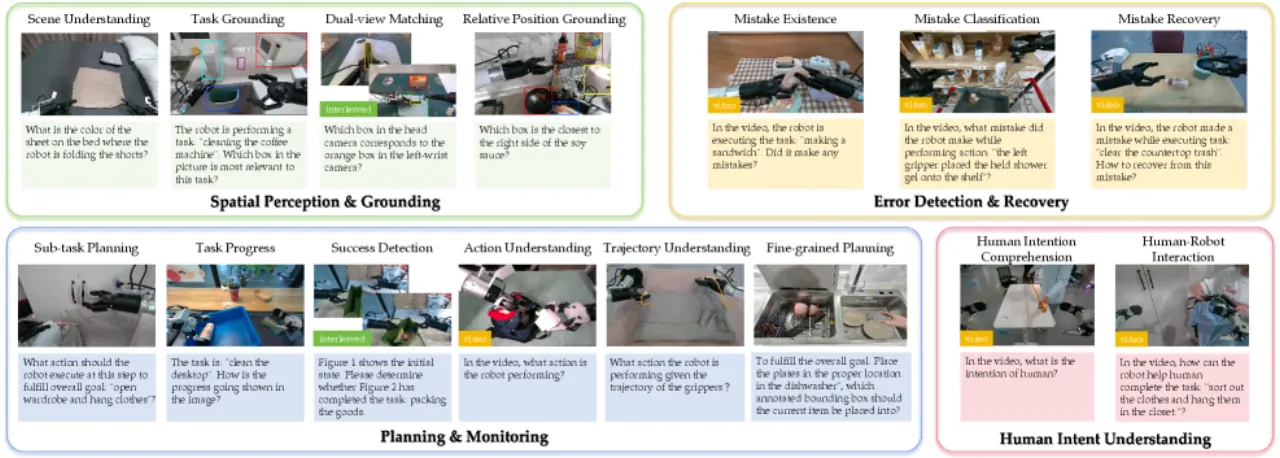
ERIQ 包含 6,052 条标准化多选问答对,覆盖四个具身推理维度,
共 15 个细粒度子任务:ERIQ contains 6,052 standardized multiple-choice question-answer pairs covering four embodied reasoning dimensions and 15 fine-grained subtasks in total:
通过将推理与运动执行解耦,ERIQ 能够系统性评测 VLM 的具身推理短板,
并揭示推理能力与端到端 VLA 泛化之间的强正相关关系。By decoupling reasoning from motion execution, ERIQ can systematically evaluate the embodied reasoning weaknesses of VLMs and reveal the strong positive correlation between reasoning ability and end-to-end VLA generalization.
图2:ERIQ 基准示例。
展示四个主要具身推理维度下的样本问答对,涵盖从空间感知到人类意图理解的多样化推理挑战。Figure 2: ERIQ benchmark examples. Sample question-answer pairs from the four main embodied reasoning dimensions, covering diverse reasoning challenges from spatial perception to human intent understanding.
FACT:基于 Flow Matching 的动作分词器FACT: A Flow-Matching-Based Action Tokenizer
FACT(Flow-matching-based Action tokenizer for Control Tasks)结合 VQ-VAE 离散化与 flow matching 解码,
实现连续动作的无损压缩与高保真还原:FACT (Flow-matching-based Action tokenizer for Control Tasks) combines VQ-VAE discretization with flow-matching decoding, achieving lossless compression and high-fidelity restoration of continuous actions:
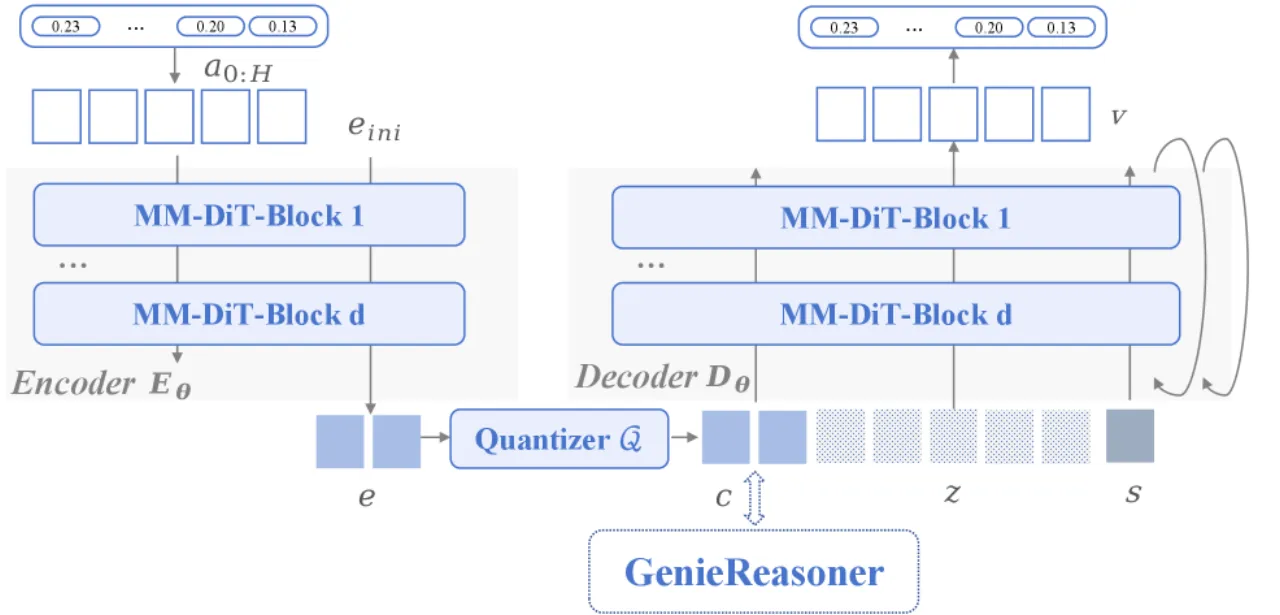
编码器:通过 zero-initialized queries 将动作块映射到潜在表示
e = ℰ_θ(a_{0:H}, e_{ini}),在时间维度(L≤H)和空间维度(D≤S)进行压缩。
比特量化器通过 c = sign(e) 将连续嵌入转换为二值离散码。Encoder: zero-initialized queries map an action chunk to a latent representation e = ℰ_θ(a_{0:H}, e_{ini}), compressing along both the temporal dimension (L≤H) and the spatial dimension (D≤S). A bit quantizer turns the continuous embedding into binary discrete codes via c = sign(e).
解码器(Rectified Flow):学习从高斯噪声到动作分布的速度场。
线性插值定义为 a^(t) = (1−t)z + ta, t ∈ [0,1],通过 ODE 积分重建平滑轨迹。Decoder (Rectified Flow): learns the velocity field from Gaussian noise to the action distribution. The linear interpolation is defined as a^(t) = (1−t)z + ta, t ∈ [0,1], and smooth trajectories are reconstructed through ODE integration.
训练目标:三重损失联合优化——熵损失(最大化码本利用率)、
承诺损失(保持连续嵌入接近量化值)、flow-matching 目标
MSE of (a−z) − 𝒟_θ(a^(t), c, t)。Training objective: a triple loss is optimized jointly — an entropy loss (maximizing codebook utilization), a commitment loss (keeping continuous embeddings close to their quantized values) and the flow-matching objective MSE of (a−z) − 𝒟_θ(a^(t), c, t).
图5:FACT 动作分词器架构。
VQ-encoder 将机器人动作离散化为紧凑的 token 序列;
flow-matching decoder 从量化 token 与高斯噪声出发,通过速度场积分重建平滑连续轨迹。Figure 5: FACT action tokenizer architecture. The VQ-encoder discretizes robot actions into a compact token sequence; the flow-matching decoder starts from the quantized tokens and Gaussian noise and reconstructs smooth continuous trajectories by integrating the velocity field.
GenieReasoner:统一推理-动作模型GenieReasoner: A Unified Reasoning-Action Model
GenieReasoner 将 VLM 主干(3B 参数规模)与 FACT 分词器统一训练。
训练阶段,VLM 在多模态数据上同时优化推理目标与离散动作预测目标;
推理阶段,模型自回归地预测离散码序列,FACT 解码器实时还原为连续控制信号,
避免了连续头与推理目标之间的优化冲突。GenieReasoner trains the VLM backbone (3B parameter scale) and the FACT tokenizer in a unified manner. During training, the VLM optimizes the reasoning objective and the discrete action-prediction objective simultaneously on multimodal data; at inference, the model autoregressively predicts a sequence of discrete codes that the FACT decoder restores to continuous control signals in real time, avoiding the optimization conflict between a continuous head and the reasoning objective.
专有数据:AgiBot World 平台提供的轨迹数据、定位标注、子任务规划数据及场景理解数据Proprietary data: trajectory data, grounding annotations, subtask planning data and scene understanding data provided by the AgiBot World platform
03实验Experiments
实验分三部分:ERIQ 基准评测、FACT 轨迹重建对比、以及真实机器人任务验证。
基线包括连续动作模型 π₀、π₀.₅、GR00T 以及离散动作模型 π₀-FAST。The experiments have three parts: ERIQ benchmark evaluation, FACT trajectory reconstruction comparison, and real-robot task validation. Baselines include the continuous-action models π₀, π₀.₅ and GR00T as well as the discrete-action model π₀-FAST.
ERIQ 基准结果ERIQ Benchmark Results
GenieReasoner-3B 在 ERIQ 上取得 82.72% 平均准确率,
远超 Qwen2.5-VL-3B 基线的 58.64%,提升约 41%。
各维度详细结果如下:GenieReasoner-3B attains 82.72% average accuracy on ERIQ, far ahead of the 58.64% of the Qwen2.5-VL-3B baseline — an improvement of about 41%. Detailed per-dimension results are listed below:
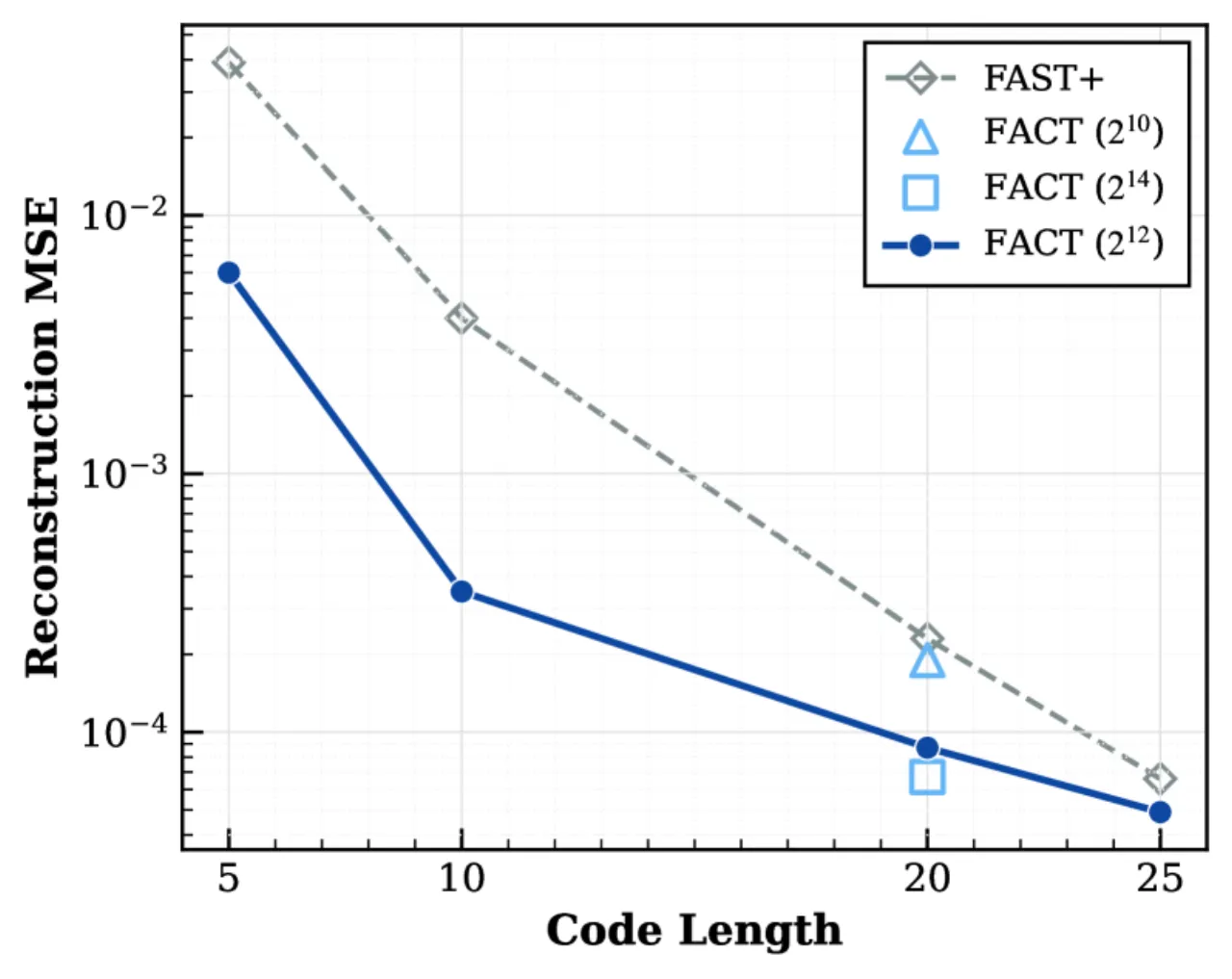
图7:FACT vs FAST+ 重建 MSE 对比(不同码长)。
在相同压缩码长下,FACT 的均方误差显著低于 FAST+ 基线,
"often outperforming FAST+ by an entire order of magnitude"(常达一个数量级的差距)。Figure 7: FACT vs FAST+ reconstruction MSE (across code lengths). At the same compressed code length, the mean squared error of FACT is markedly lower than the FAST+ baseline, "often outperforming FAST+ by an entire order of magnitude".
真实机器人任务结果Real-Robot Task Results
在真实机器人评测中,GenieReasoner 在以下五个复杂度设置下的语言跟随(language following)指标
与完整任务成功率(full task success rate,含抓取与物体操作)两项指标上均优于所有基线(π₀、π₀.₅、GR00T、π₀-FAST),
并在综合加权性能上取得最高分。In real-robot evaluation, GenieReasoner outperforms all baselines (π₀, π₀.₅, GR00T, π₀-FAST) on both the language-following metric and the full task success rate (including grasping and object manipulation) under the following five complexity settings, and attains the highest overall weighted performance.
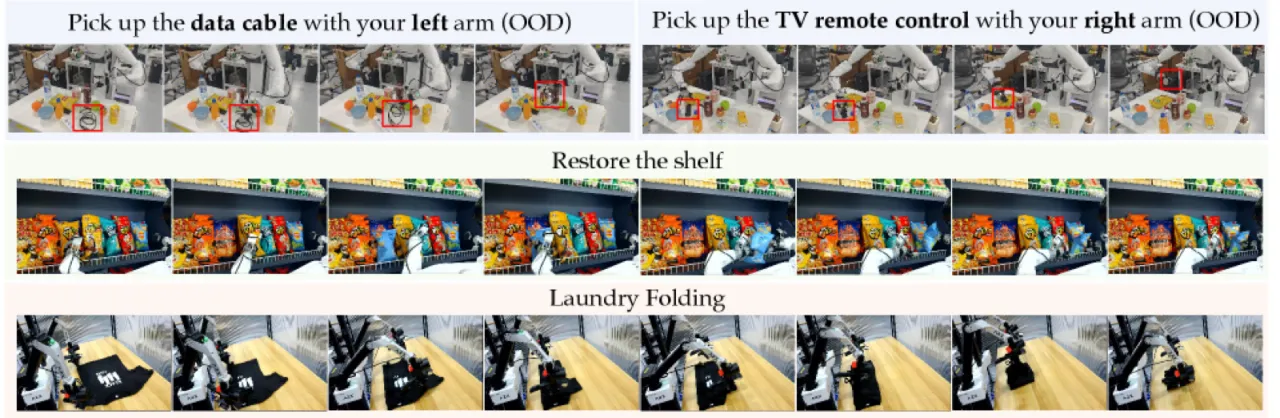
图11:真实机器人多样化操作任务可视化。
包括细粒度 OOD 操作(Unseen Object、Color Variation)、长时序语义任务以及可变形物体处理(Spatial/Pose Variation),
展示了 GenieReasoner 在多种真实场景下的泛化能力。Figure 11: Visualization of diverse real-robot manipulation tasks. These include fine-grained OOD manipulation (Unseen Object, Color Variation), long-horizon semantic tasks and deformable-object handling (Spatial/Pose Variation), demonstrating GenieReasoner's generalization across a variety of real-world scenes.
消融实验Ablation Studies
作者通过消融实验验证了两个核心设计选择:Ablation studies verify two core design choices:
ERIQ 数据的作用:将具身推理数据加入训练后,VLA 任务的泛化性能显著提升,
印证了论文的核心假设——具身推理能力与动作泛化之间存在因果关联,而非仅相关。The role of ERIQ data: adding embodied reasoning data to training markedly improves generalization on VLA tasks, corroborating the core hypothesis of the paper — that embodied reasoning ability and action generalization are causally linked rather than merely correlated.
FACT vs. 其他分词器:与均匀分箱和传统 VQ-VAE 相比,
FACT 的 flow matching 解码器在相同码本大小下显著降低重建误差,
为下游精确执行奠定基础。FACT vs. other tokenizers: compared with uniform binning and conventional VQ-VAE, the flow-matching decoder of FACT markedly reduces reconstruction error at the same codebook size, laying the foundation for precise downstream execution.
04局限性Limitations
说明:论文未设专门的 Limitations 章节。
以下条目:前两条为作者在结论中明确提及的未来工作方向(stated);
后两条为从方法设计推断的潜在局限(inferred)。Note:The paper has no dedicated Limitations section. Of the items below, the first two are future-work directions explicitly mentioned by the authors in the conclusion (stated); the last two are potential limitations inferred from the method design (inferred).
Chain-of-Thought 与动作生成的深层协同尚待探索(stated)Deeper synergy between Chain-of-Thought and action generation remains to be explored (stated)
作者明确指出,未来工作将探索 "deeper synergies between Chain-of-Thought reasoning and action generation"。
当前 GenieReasoner 将推理与动作在同一序列空间中预测,但二者的交互机制(例如推理步骤如何动态调整动作码)
尚未深入研究。The authors state explicitly that future work will explore "deeper synergies between Chain-of-Thought reasoning and action generation". GenieReasoner currently predicts reasoning and actions in the same sequence space, but the interaction mechanism between the two (for example, how reasoning steps dynamically adjust action codes) has not been studied in depth.
跨多样化真实环境的泛化与指令跟随鲁棒性(stated)Generalization and instruction-following robustness across diverse real-world environments (stated)
作者计划 "further enhance the system's generalization and instruction-following robustness
across diverse real-world environments",隐含当前模型在分布外场景(极端光照、新型物体、
非结构化指令)下仍存在鲁棒性不足的问题。The authors plan to "further enhance the system's generalization and instruction-following robustness across diverse real-world environments", implying that the current model is still insufficiently robust in out-of-distribution scenes (extreme lighting, novel objects, unstructured instructions).
专有训练数据依赖(inferred)Dependence on proprietary training data (inferred)
GenieReasoner 的训练数据包含 AgiBot World 平台的专有轨迹数据、定位标注等,
这些数据未公开,限制了社区复现与公平对比。ERIQ 基准的构建过程同样依赖内部数据源,
外部研究者难以直接扩展。GenieReasoner's training data includes proprietary trajectory data, grounding annotations and more from the AgiBot World platform; these data are not public, which limits community reproduction and fair comparison. The construction of the ERIQ benchmark likewise relies on internal data sources, making it hard for external researchers to extend it directly.
码长与精度的权衡未被完整刻画(inferred)The trade-off between code length and precision is not fully characterized (inferred)
图7 展示了不同码长下的重建 MSE 对比,但论文未提供端到端任务成功率随码长变化的系统分析,
实践中最优码长选择仍依赖经验调参,缺乏理论指导。Figure 7 compares reconstruction MSE across code lengths, but the paper offers no systematic analysis of how end-to-end task success rate varies with code length; in practice the optimal code length still relies on empirical tuning and lacks theoretical guidance.