GameFactory: Creating New Games with Generative Interactive Videos
跨场景可泛化的动作控制游戏视频生成框架A scene-generalizable framework for action-controlled game video generation
Jiwen Yu · Yiran Qin · Xintao Wang · Pengfei Wan · Di Zhang · Xihui Liu | University of Hong Kong, Kuaishou Technology
GameFactory 提出了一个将预训练视频扩散模型与小规模游戏数据相结合的框架,通过 style-action 解耦与多阶段训练策略,使动作控制能力能够泛化到开放域场景,从而实现跨场景的全新游戏内容生成。GameFactory proposes a framework that couples a pre-trained video diffusion model with small-scale game data; through style-action decoupling and a multi-phase training strategy, it lets action control generalize to open-domain scenes, thereby creating brand-new game content across scenes.
游戏视频生成game video generationvideo diffusionaction controlscene generalizationstyle-action decouplingdomain adapterautoregressive generationGF-Minecraft
01动机 MotivationMotivation
游戏开发是一项极度耗费人力的过程,生成式视频模型具备自主创作游戏内容的潜力。然而现有方法普遍面临两大核心挑战:动作可控性(精准响应键盘与鼠标输入)和场景泛化性(不局限于固定的游戏风格与场景)。Game development is an extremely labor-intensive process, and generative video models have the potential to create game content autonomously. Existing methods, however, generally face two core challenges: action controllability (responding precisely to keyboard and mouse input) and scene generalization (not being confined to a fixed game style and scene).
"Generative videos have the potential to revolutionize game development by autonomously creating new content… GameFactory tackles the critical challenge of scene-generalizable action control, which most existing methods fail to address."
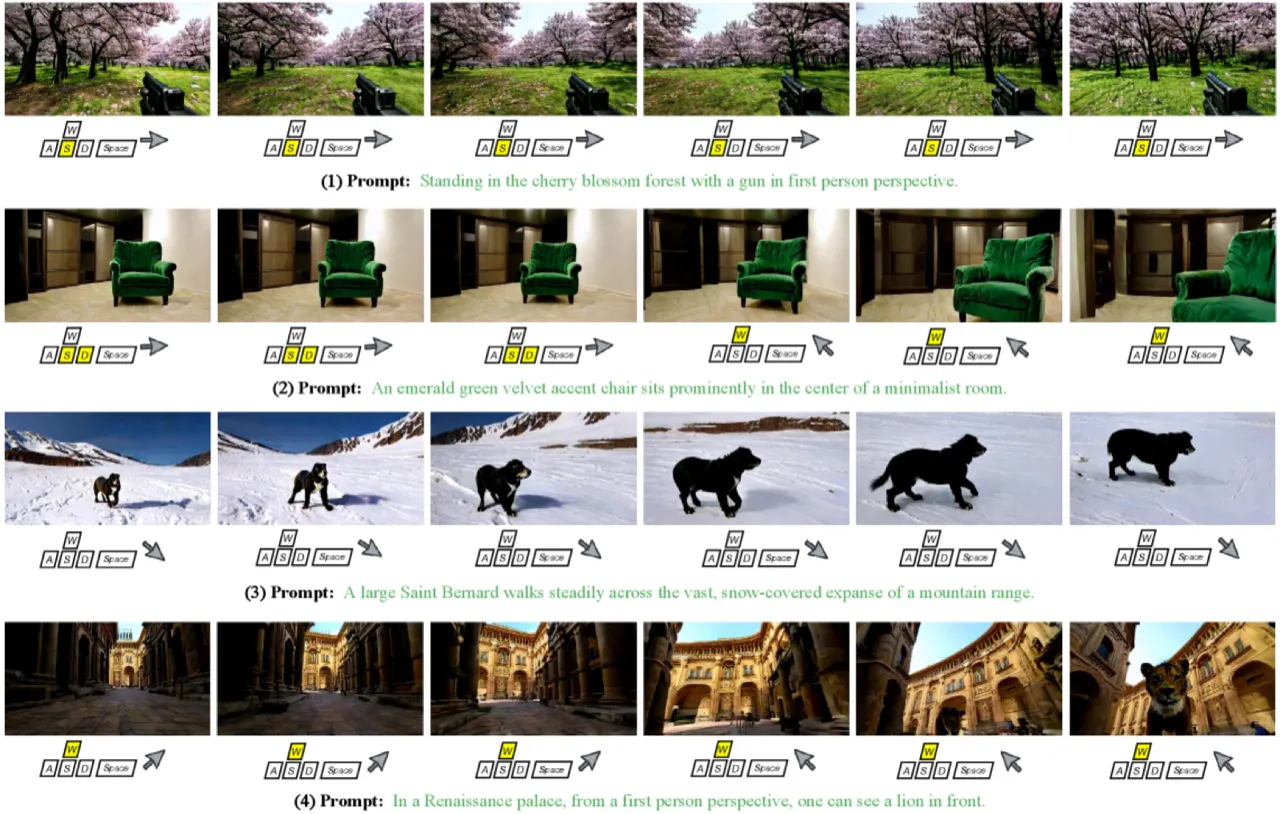
Figure 1(论文原图):GameFactory 在多样化开放域场景(森林、海洋、城市等)中生成动作可控的游戏视频。黄色按钮表示已按下的键盘键位,箭头表示鼠标移动方向。该框架仅在小规模 Minecraft 数据上学习动作控制,却能将控制能力迁移至全新开放域场景,生成全新游戏体验。Figure 1 (from the paper): GameFactory generates action-controllable game videos in diverse open-domain scenes (forest, ocean, city, etc.). Yellow buttons indicate the keyboard keys being pressed, and arrows indicate the direction of mouse movement. The framework learns action control only on small-scale Minecraft data, yet transfers that control to entirely new open-domain scenes and generates brand-new game experiences.
∞自回归无限长度视频生成Autoregressive unlimited-length video generation
现有方法的不足Shortcomings of existing methods
以往的游戏视频生成工作(如 GameNGen、DIAMOND、Genie 等)大多在固定游戏环境下训练,动作控制能力与特定游戏风格深度耦合,无法泛化到新场景。此外,人类采集数据(如 VPT 数据集)存在严重的行为偏差:前进键(W)出现频率高达 50.11%,而后退键仅占 0.32%,导致模型难以学到均匀分布的动作控制能力。Prior work on game video generation (GameNGen, DIAMOND, Genie, etc.) is mostly trained in a fixed game environment, so its action control is deeply coupled with a specific game style and cannot generalize to new scenes. Moreover, human-collected data (such as the VPT dataset) suffers from severe behavioral bias: the forward key (W) occurs with a frequency as high as 50.11%, while the backward key accounts for only 0.32%, making it hard for the model to learn uniformly distributed action control.
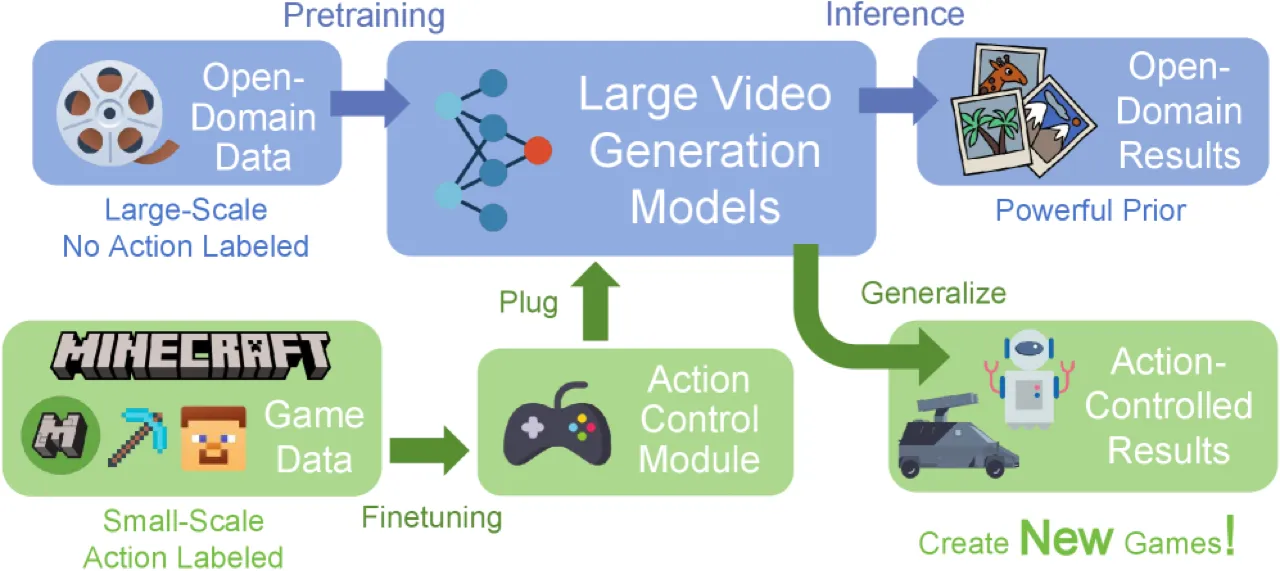
Figure 2(论文原图):GameFactory 的整体方案示意。蓝色上方展示预训练模型在开放域的强大生成能力;绿色下方展示从少量游戏数据中学习动作控制模块,并"插件式"集成到预训练模型中,实现新游戏创建。Figure 2 (from the paper): Overview of the GameFactory scheme. The blue part on top shows the strong open-domain generative capability of the pre-trained model; the green part below shows how an action control module is learned from a small amount of game data and integrated into the pre-trained model in a "plug-in" fashion to create new games.
02方法 MethodMethod
GameFactory 的核心创新在于三个相互配合的模块:动作控制模块(精准处理键盘与鼠标输入)、自回归长视频生成(支持无限长度交互视频)、以及style-action 解耦策略(通过多阶段训练使动作控制脱离游戏风格绑定)。The core innovation of GameFactory lies in three mutually supporting modules: an action control module (handling keyboard and mouse input precisely), autoregressive long-video generation (supporting interactive video of unlimited length), and a style-action decoupling strategy (multi-phase training that frees action control from being bound to the game style).
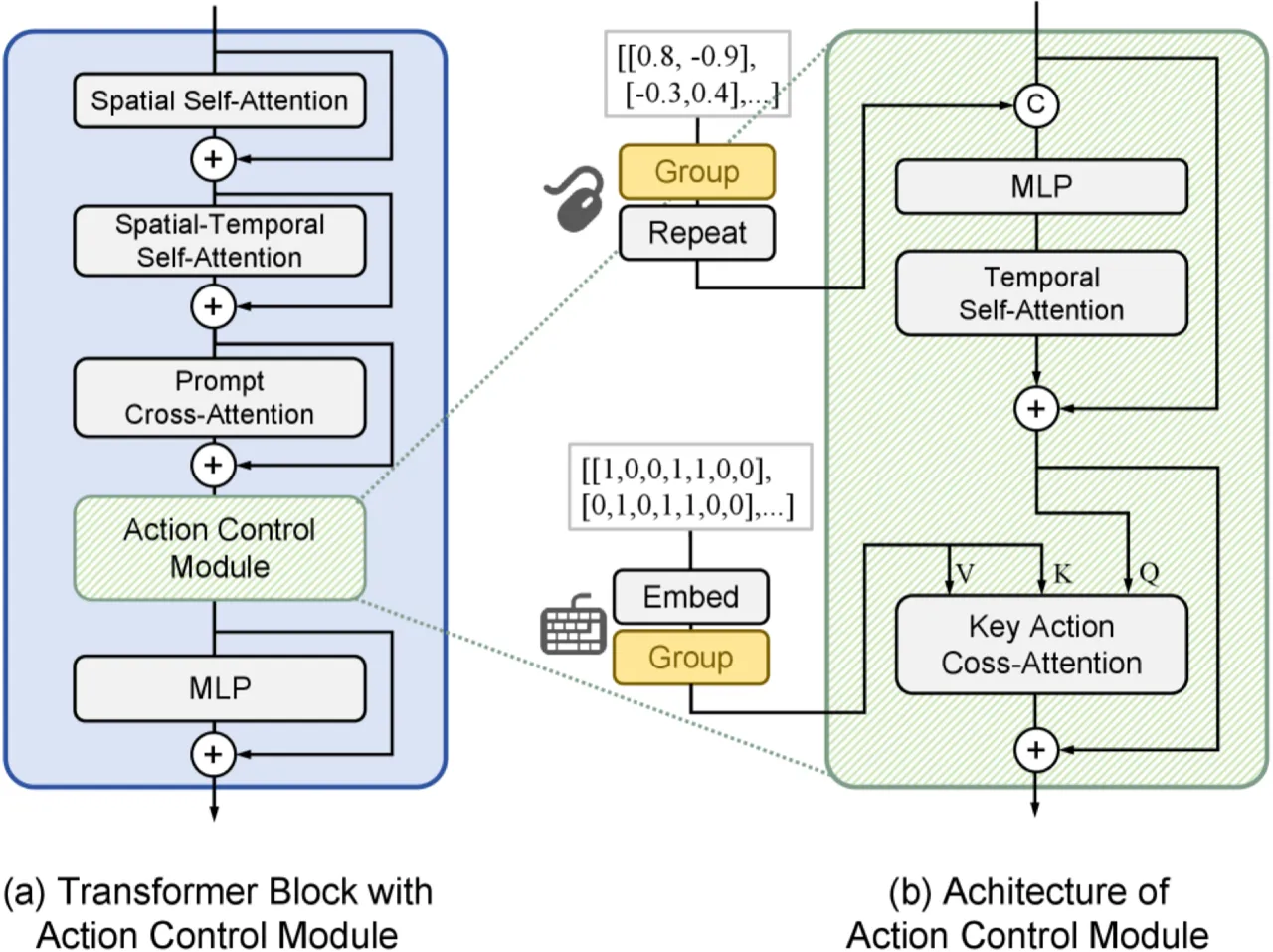
Figure 3(论文原图):动作控制模块的详细架构。键盘输入(离散信号)通过 cross-attention 与视频特征交互,类似文本条件化方式;鼠标输入(连续信号)经 MLP 和 temporal self-attention 处理后与特征拼接。分组操作(滑动窗口 w=3)解决了帧率与动作粒度不匹配的问题,并捕捉动作的延迟效果。Figure 3 (from the paper): Detailed architecture of the action control module. Keyboard input (a discrete signal) interacts with the video features through cross-attention, akin to text conditioning; mouse input (a continuous signal) is processed by an MLP and temporal self-attention and then concatenated with the features. The grouping operation (sliding window w=3) resolves the mismatch between frame rate and action granularity and captures the delayed effect of actions.
动作控制模块(Action Control Module)Action Control Module
将动作控制集成到基于 transformer 的 latent video diffusion 模型中:Action control is integrated into a transformer-based latent video diffusion model:
时序对齐(Temporal Alignment):采用滑动窗口(大小 w=3)对动作进行分组,处理视频帧与动作输入之间的粒度不匹配,同时捕捉动作效果的延迟性。Temporal Alignment: a sliding window (size w=3) groups the actions, handling the granularity mismatch between video frames and action inputs while capturing the delayed nature of action effects.
鼠标控制:连续运动信号经 MLP 处理后与特征拼接,再通过 temporal self-attention 建模时序依赖。消融实验显示 concatenation 优于 cross-attention(Cam: 0.0685 vs. 更高误差)。Mouse control: the continuous motion signal is processed by an MLP and concatenated with the features, after which temporal self-attention models the temporal dependency. Ablations show that concatenation outperforms cross-attention (Cam: 0.0685 vs. a higher error).
键盘控制:离散输入通过 cross-attention 与视频特征交互(类似文本条件化),消融实验显示 cross-attention 优于 concatenation(Cam: 0.0439 vs. 更高误差)。Keyboard control: the discrete input interacts with the video features through cross-attention (akin to text conditioning); ablations show that cross-attention outperforms concatenation (Cam: 0.0439 vs. a higher error).
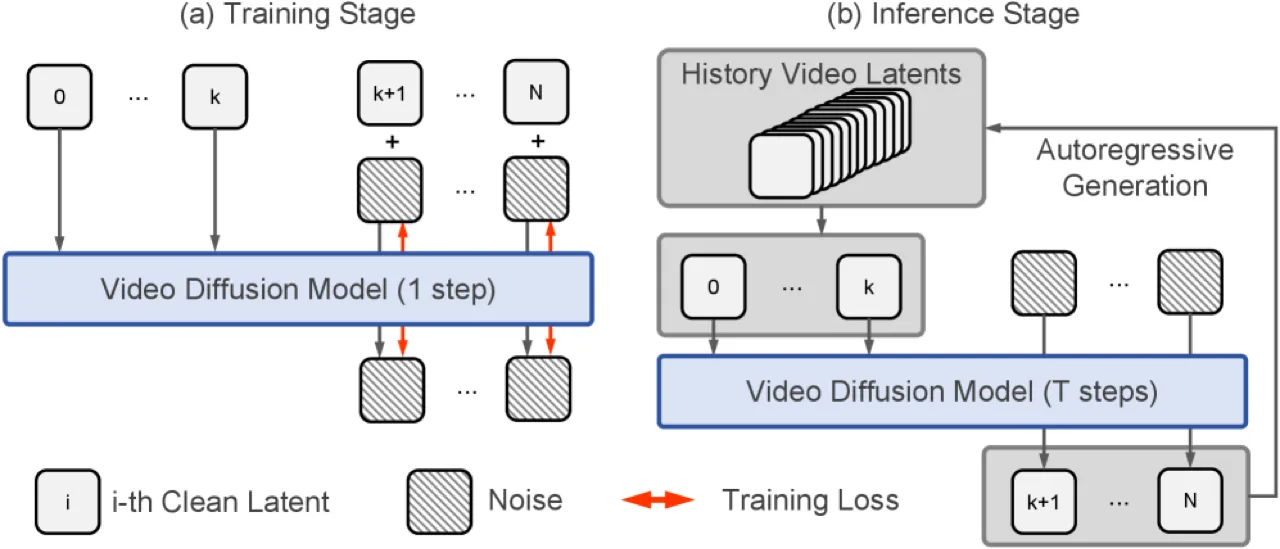
标准扩散模型在长序列生成上存在局限。GameFactory 采用变噪声水平策略:靠后帧携带更多噪声,靠前帧噪声较少作为条件帧。在训练时,仅对预测帧计算损失(不含条件帧),避免梯度泄漏。在推理时,系统迭代选取最近的 k+1 帧作为条件,生成 N−k 个新帧,从而支持无限长度的交互视频生成。Standard diffusion models are limited in long-sequence generation. GameFactory adopts a varying noise level strategy: later frames carry more noise, while earlier frames carry less noise and serve as condition frames. During training the loss is computed only on the predicted frames (excluding the condition frames), avoiding gradient leakage. At inference the system iteratively takes the most recent k+1 frames as conditions and generates N−k new frames, thereby supporting interactive video generation of unlimited length.
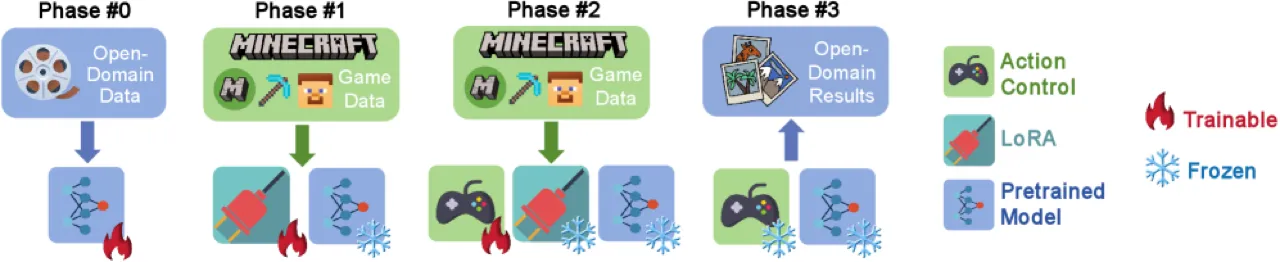
Figure 5(论文原图):四阶段训练流水线。Phase #0:在开放域数据上预训练视频扩散模型;Phase #1:在游戏视频上进行 LoRA fine-tuning,学习游戏风格;Phase #2:冻结预训练权重和 LoRA 参数,仅训练动作控制模块;Phase #3:推理时移除 LoRA 权重,保留动作控制同时消除游戏风格偏差,实现开放域场景泛化。Figure 5 (from the paper): The four-phase training pipeline. Phase #0: pre-train the video diffusion model on open-domain data; Phase #1: perform LoRA fine-tuning on game videos to learn the game style; Phase #2: freeze the pre-trained weights and the LoRA parameters and train the action control module only; Phase #3: remove the LoRA weights at inference, retaining action control while eliminating the game-style bias, which yields open-domain scene generalization.
关键洞察:若在 Phase #2 同时学习风格和动作控制,动作控制能力将与特定游戏风格深度绑定,无法泛化。通过先用 LoRA 隔离风格学习(Phase #1),再单独训练动作控制(Phase #2),最后推理时丢弃 LoRA(Phase #3),动作控制模块得以保留开放域生成先验,从而实现跨场景泛化。Key insight: learning style and action control together in Phase #2 would tie action control tightly to the specific game style and prevent generalization. By first isolating style learning with LoRA (Phase #1), then training action control on its own (Phase #2), and finally discarding LoRA at inference (Phase #3), the action control module retains the open-domain generative prior and thus generalizes across scenes.
GF-Minecraft 数据集The GF-Minecraft dataset
为解决人类行为偏差问题,作者构建了 GF-Minecraft 数据集:70 小时的 Minecraft 游戏录像,采用无偏采样策略收集动作(前进/后退/左/右/跳跃等各键出现频率均衡,约 13.56%),涵盖多样化环境(森林、沙漠、雪地等),并附有文本描述。To address human behavioral bias, the authors build the GF-Minecraft dataset: 70 hours of Minecraft gameplay recordings whose actions are collected under an unbiased sampling strategy (forward/backward/left/right/jump and the other keys occur at balanced frequencies, about 13.56%), covering diverse environments (forest, desert, snowfield, etc.) and accompanied by text descriptions.
03实验 ExperimentsExperiments
实验在 GF-Minecraft 测试集上评估动作可控性(Cam 相机姿态误差↓、Flow 光流误差↓)和生成质量(FID↓、FVD↓),并在开放域视频上评估场景泛化能力。Experiments evaluate action controllability (Cam, camera pose error↓; Flow, optical flow error↓) and generation quality (FID↓, FVD↓) on the GF-Minecraft test set, and assess scene generalization on open-domain videos.
动作控制机制消融(Table 2)Ablation on the action control mechanism (Table 2)
消融实验表明:离散键盘输入适合用 cross-attention 建模(类似文本条件化),而连续鼠标信号适合用 concatenation 方式注入特征。鼠标运动对视觉的影响强于键盘输入。The ablations show that discrete keyboard input is best modeled with cross-attention (akin to text conditioning), whereas the continuous mouse signal is best injected into the features by concatenation. Mouse motion affects the visuals more strongly than keyboard input does.
One-phase training(基线)One-phase training (baseline)
0.1134
76.02
167.79
1323.58
Multi-phase training(本文)Multi-phase training (ours)
0.0997
54.13
121.18
1256.94
多阶段训练在所有指标上均显著优于单阶段基线,验证了 style-action 解耦策略的有效性。Multi-phase training significantly outperforms the one-phase baseline on every metric, confirming the effectiveness of the style-action decoupling strategy.
数据集对比:GF-Minecraft vs. VPT(Table 4)Dataset comparison: GF-Minecraft vs. VPT (Table 4)
VPT 数据集中前进键(W)出现频率为 50.11%,后退键仅 0.32%;GF-Minecraft 中各键频率均衡(约 13.56%)。使用 VPT 训练的模型无法执行跳跃、后退等罕见动作,而 GF-Minecraft 训练的模型能成功完成这些动作。In the VPT dataset the forward key (W) occurs with a frequency of 50.11% and the backward key with only 0.32%; in GF-Minecraft the key frequencies are balanced (about 13.56%). A model trained on VPT cannot perform rare actions such as jumping or moving backward, whereas the model trained on GF-Minecraft completes them successfully.
长视频生成消融(Table 6)Ablation on long-video generation (Table 6)
训练策略Training strategy
Cam ↓
Flow ↓
FID ↓
全帧计算损失Loss computed on all frames
0.1547
—
—
仅预测帧计算损失(本文)Loss computed on predicted frames only (ours)
0.0924
85.45
136.95
Figure 6(论文原图):定性结果展示。黄色按钮指示当前按下的键盘键位,验证了模型对离散动作输入的精准跟踪能力。与基线方法相比,GameFactory 生成的视频能更准确地响应键盘操作并保持时序一致性。Figure 6 (from the paper): Qualitative results. Yellow buttons indicate the keyboard keys currently pressed, verifying that the model tracks discrete action inputs precisely. Compared with the baseline, the videos generated by GameFactory respond to keyboard operations more accurately and preserve temporal consistency.
拓展实验:跨游戏迁移Extended experiment: cross-game transfer
GameFactory 不仅限于 Minecraft 风格。实验展示了将学到的动作控制能力迁移至赛车游戏场景的能力,验证了该框架的跨游戏类型泛化潜力。此外,论文还展示了碰撞检测行为(在 Minecraft 中遇到墙壁时停止前进)的自动涌现,以及超过 100 帧的长序列生成效果。GameFactory is not restricted to the Minecraft style. Experiments demonstrate transferring the learned action control to a racing-game scene, verifying the framework's potential for generalization across game genres. The paper further shows the automatic emergence of collision-detection behavior (stopping when hitting a wall in Minecraft) as well as long-sequence generation of more than 100 frames.
04局限性 LimitationsLimitations
Note:以下局限性均为论文作者明确指出(stated),代表当前 GameFactory 框架尚未解决的开放性挑战。Every limitation below is explicitly stated by the authors and represents an open challenge that the current GameFactory framework has not yet solved.
GameFactory 目前缺乏生成多样化关卡结构与游戏玩法机制的能力。论文明确指出 "design of diverse levels and gameplay" 是重要的未来方向,现有框架更侧重于视觉连续性而非结构化游戏逻辑。GameFactory currently lacks the ability to generate diverse level structures and gameplay mechanics. The paper explicitly names "design of diverse levels and gameplay" as an important future direction; the present framework emphasizes visual continuity rather than structured game logic.
玩家反馈系统(Player Feedback Systems)Player Feedback Systems
当前框架不支持完整的玩家交互反馈循环,如血量、得分、碰撞奖励等游戏状态反馈机制。论文将 "player feedback systems" 列为未来工作。The current framework does not support a complete player interaction feedback loop, i.e. game-state feedback mechanisms such as health, score, or collision rewards. The paper lists "player feedback systems" as future work.
GameFactory 目前无法精细地操控游戏世界中的具体物体(如拾取道具、建造方块等),仅能控制摄像机视角和角色运动方向。GameFactory cannot yet finely manipulate specific objects in the game world (picking up items, placing blocks, and the like); it can only control the camera viewpoint and the direction of character motion.
自回归生成框架虽支持无限长度视频,但仍面临长上下文记忆衰减(超长序列中早期信息丢失)和实时生成速度两大挑战。论文将 "long-context memory" 和 "real-time game generation" 均列为尚待解决的问题。Although the autoregressive generation framework supports video of unlimited length, it still faces two major challenges: long-context memory decay (early information is lost in very long sequences) and real-time generation speed. The paper lists both "long-context memory" and "real-time game generation" as problems that remain to be solved.