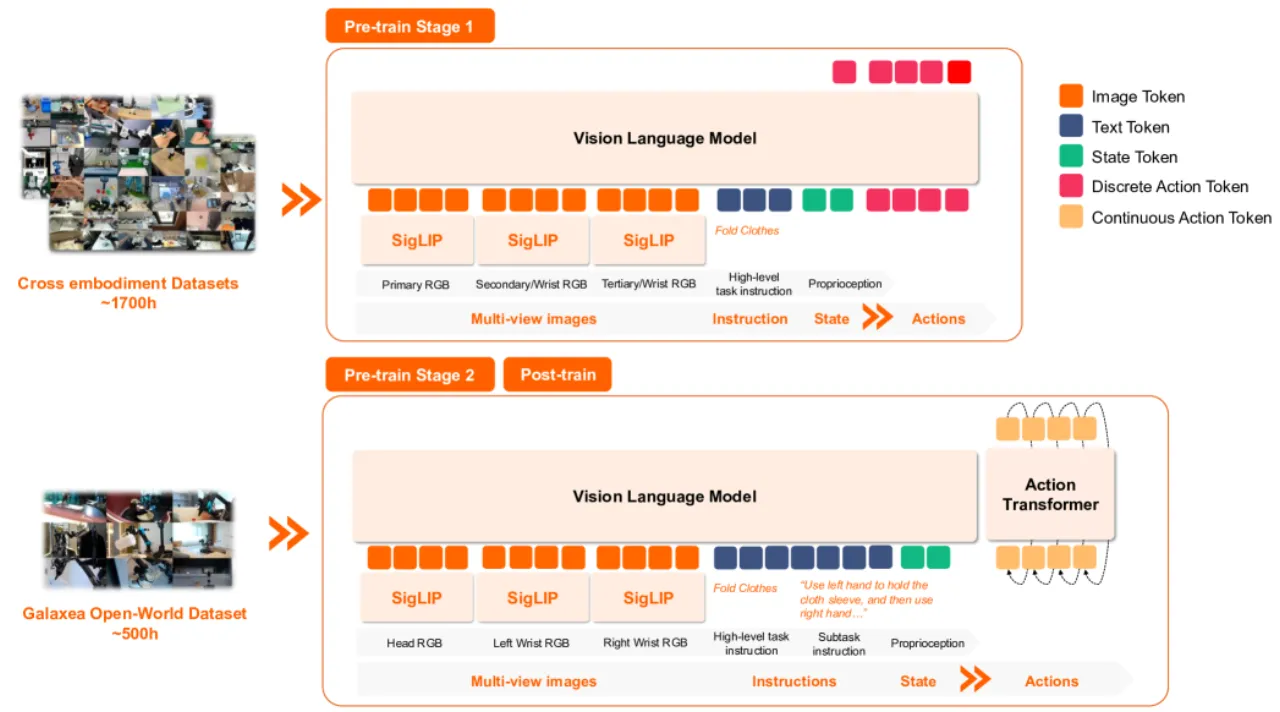
本文提出 Galaxea Open-World Dataset——一个在真实人居与工作环境中采集的大规模、高保真机器人行为数据集,并在此基础上设计了 G0 双系统框架:以 Vision-Language Model (VLM) 负责慢思考规划,以 Vision-Language-Action (VLA) 模型负责快速精细执行。三阶段训练流程(跨具身预训练 → 单体具身预训练 → 任务后训练)显著提升了模型在真实场景中的操作能力与迁移效率。This paper presents the Galaxea Open-World Dataset — a large-scale, high-fidelity dataset of robot behaviour collected in real human living and working environments — and, building on it, designs the G0 dual-system framework: a Vision-Language Model (VLM) is in charge of slow deliberative planning, while a Vision-Language-Action (VLA) model is in charge of fast, fine-grained execution. A three-stage training pipeline (cross-embodiment pre-training → single-embodiment pre-training → task post-training) markedly improves the model's manipulation ability and transfer efficiency in real-world settings.
VLA 模型的发展面临一个核心瓶颈:缺乏大规模、高质量的开放世界机器人数据。现有数据集(如 BridgeData V2、DROID、Open X-Embodiment)大多在受控或人工布置的实验室场景中采集,场景多样性有限、语言标注粗糙,难以支撑 VLA 向真实世界的泛化。The development of VLA models faces one core bottleneck: the scarcity of large-scale, high-quality open-world robot data. Existing datasets (such as BridgeData V2, DROID and Open X-Embodiment) are mostly collected in controlled or artificially arranged laboratory scenes, with limited scene diversity and coarse language annotation, which makes it hard to support the generalization of VLA to the real world.
"a substantial bottleneck persists due to the scarcity of large-scale, high-quality, open-world robot data."
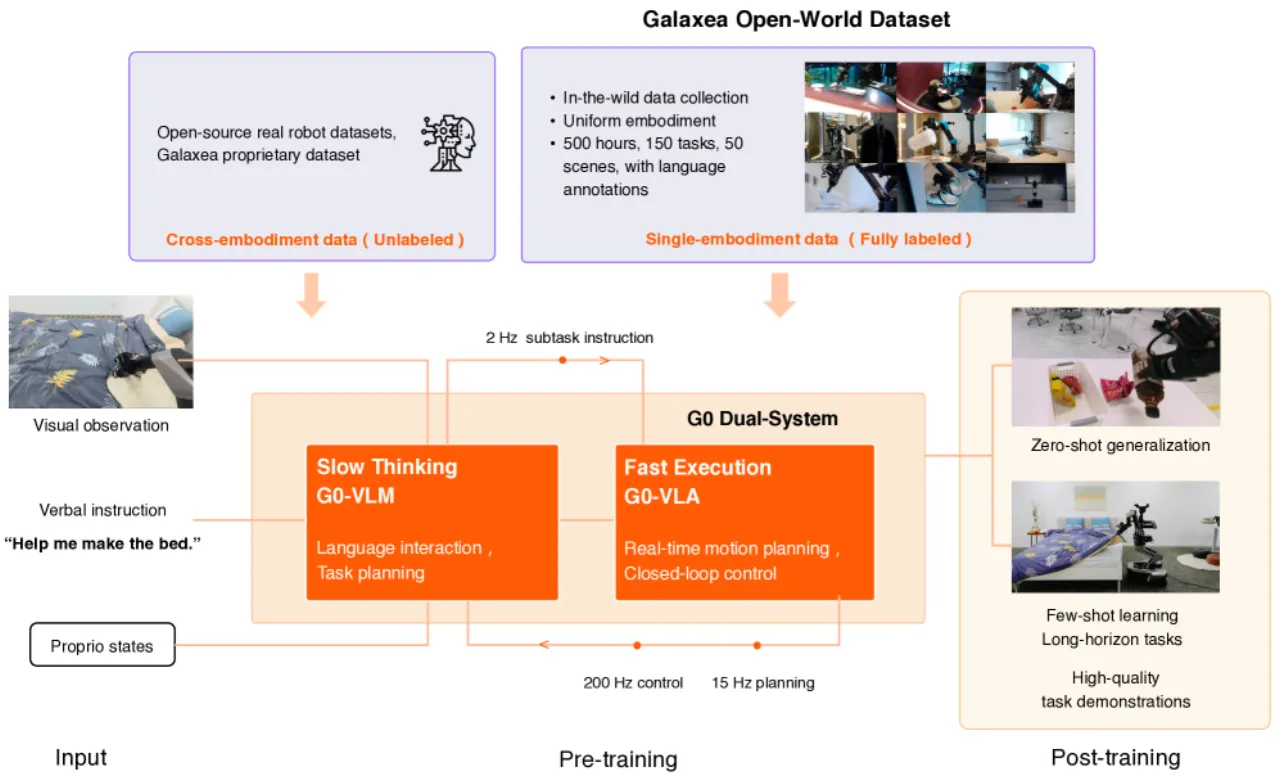
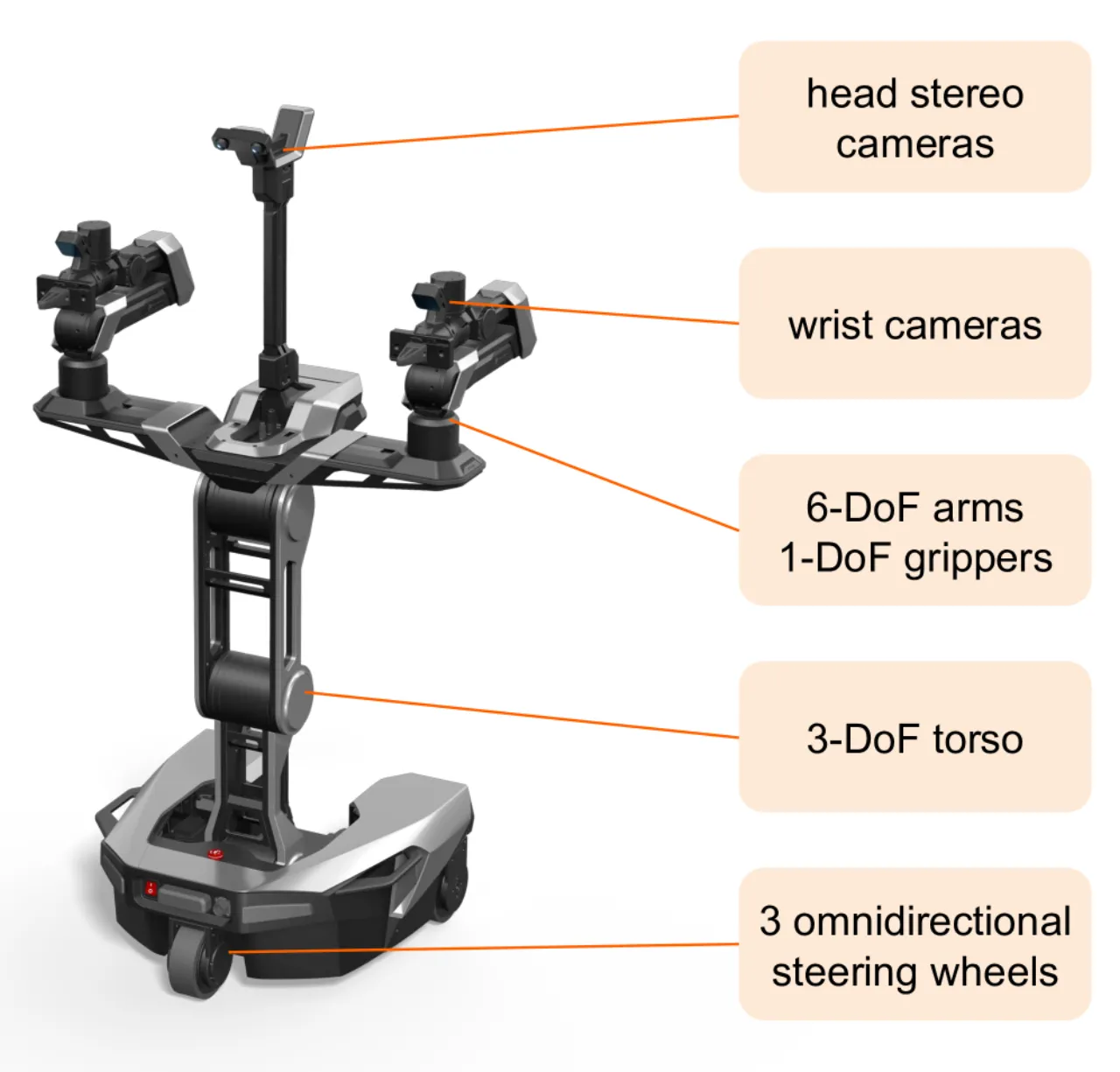
现有多具身数据集(如 OXE)虽然规模庞大,但来自不同机器人平台,动作空间不统一,反而可能因"具身鸿沟(embodiment gap)"损害特定机器人的学习效果。本文以单一机器人平台(Galaxea R1 Lite)在 11 个真实地点的 50 个场景采集数据,涵盖居民区、餐饮、零售和办公等多种环境,并提供细粒度子任务级别的语言标注,从根本上解决数据多样性与一致性的矛盾。Existing multi-embodiment datasets (such as OXE) are large in scale, but they come from different robot platforms with inconsistent action spaces, and may in fact hurt learning on a specific robot because of the "embodiment gap". This paper collects data with a single robot platform (Galaxea R1 Lite) across 50 scenes at 11 real-world locations, covering residential, dining, retail and office environments, and provides fine-grained subtask-level language annotation, which fundamentally resolves the tension between data diversity and consistency.
G0 由两个异步运行的系统组成:G0-VLM(System 2,慢系统)负责高层规划,将自然语言指令分解为子任务序列;G0-VLA(System 1,快系统)以 flow matching 方式生成 action chunk,实现精细执行。整个框架采用三阶段渐进式训练。G0 consists of two asynchronously running systems: G0-VLM (System 2, the slow system) handles high-level planning and decomposes a natural-language instruction into a subtask sequence; G0-VLA (System 1, the fast system) generates action chunks by flow matching for fine-grained execution. The whole framework adopts three-stage progressive training.
G0-VLA 以预训练 VLM(基于 PaLiGemma,含 SigLIP 视觉编码器 + 单层 MLP 投影 + Transformer)为骨干,新增 Action Transformer(flow matching action expert)作为动作生成头。给定语言指令、视觉观测与本体感知状态,生成 action chunk At = at:t+k(水平为 k)。G0-VLA takes a pre-trained VLM (based on PaLiGemma, with a SigLIP vision encoder + a single-layer MLP projection + a Transformer) as its backbone and adds an Action Transformer (flow matching action expert) as the action generation head. Given the language instruction, visual observations and proprioceptive state, it generates an action chunk At = at:t+k (horizon k).
G0-VLM 基于开源 Qwen2.5-VL 进行指令微调,融合 Galaxea 数据中的人工标注子任务与合成高层指令。训练时对关键帧(子任务终止或夹爪状态变化)赋予更高采样权重,并引入 1 秒间隔的 k 帧历史图像与机器人动作作为上下文。使用 DeepSeek-R1 reasoning LLM 生成自然语言指令(任务名称、历史/当前/下一子任务),大幅提升指令多样性与语义覆盖。G0-VLM is instruction-tuned from the open-source Qwen2.5-VL, combining the human-annotated subtasks in the Galaxea data with synthesized high-level instructions. During training, key frames (subtask termination or gripper state change) are given a higher sampling weight, and k history frames at one-second intervals together with the robot actions are introduced as context. The DeepSeek-R1 reasoning LLM is used to generate natural-language instructions (task name, previous/current/next subtask), greatly increasing instruction diversity and semantic coverage.
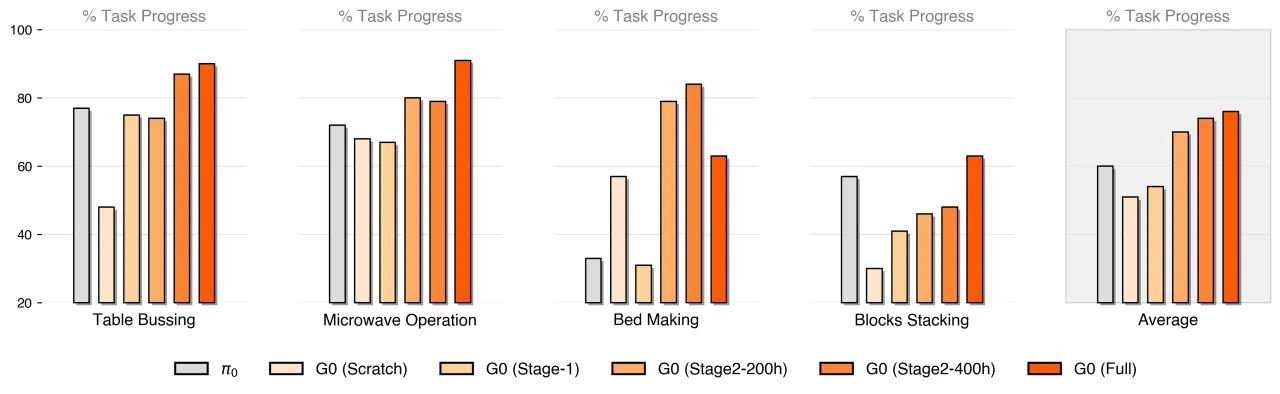
实验设计围绕核心问题:预训练数据如何影响 VLA? 评测指标为 "progress score"(每任务 10 次测试运行的平均分),基准任务涵盖桌面操作、少样本迁移与移动操作。The experiments are organized around a core question: how does pre-training data affect a VLA? The evaluation metric is the "progress score" (the average over 10 test runs per task), and the benchmark tasks cover tabletop manipulation, few-shot transfer and mobile manipulation.
在每任务 100 条训练轨迹的微调设置下,对比以下配置:Under a fine-tuning setting with 100 training trajectories per task, the following configurations are compared:
少样本迁移实验(每任务仅 20 条轨迹,10 个 epoch)表明:含 Stage-2 的模型显著优于无 Stage-2 的模型,动作更流畅稳定;而"Stage-1 alone do not show a clear advantage over models trained from scratch",说明跨具身动作预训练单独使用可能不足。Bed Making(全身协调任务)的 per-skill progress 分析进一步印证:Stage-2 单体预训练大幅改善底盘与躯干控制,而跨具身预训练(Stage-1、π₀)"yields weaker performance, in some cases worse than training from scratch",说明具身鸿沟在全身动作控制上尤为突出。Few-shot transfer experiments (only 20 trajectories per task, 10 epochs) show that models including Stage-2 clearly outperform those without it, with smoother and more stable actions; whereas "Stage-1 alone do not show a clear advantage over models trained from scratch", suggesting that cross-embodiment action pre-training on its own may be insufficient. The per-skill progress analysis on Bed Making (a whole-body coordination task) corroborates this: Stage-2 single-embodiment pre-training greatly improves base and torso control, while cross-embodiment pre-training (Stage-1, π₀) "yields weaker performance, in some cases worse than training from scratch", showing that the embodiment gap is especially pronounced for whole-body motion control.
| 模型Model | Table Bussing | Microwave Operation | Make the Bed | Build Blocks |
|---|---|---|---|---|
| Gemini-2.5-pro | 32.0 | 15.8 | 54.2 | 55.0 |
| Qwen2.5-VL-72B | 26.3 | 16.8 | 48.1 | 21.7 |
| Qwen2.5-VL-32B | 21.3 | 14.8 | 54.2 | 21.0 |
| Qwen2.5-VL-7B | 26.3 | 17.2 | 46.9 | 24.7 |
| G0-VLM(本文)G0-VLM (ours) | 83.3 | 74.2 | 78.2 | 75.6 |
G0-VLM "surpasses baseline accuracy by over 50%",验证了机器人应用需要精确对齐的动作原语,而非仅仅通用视觉-语言理解能力。G0-VLM "surpasses baseline accuracy by over 50%", confirming that robotic applications need precisely aligned action primitives rather than merely general vision-language understanding.
整个数据集以 Galaxea R1 Lite 单一机器人平台采集,以确保动作空间一致性。这是 Stage-2 单体预训练有效的关键前提,但也意味着模型在其他具身形态(不同 DoF、不同传感器配置)上的直接泛化受限——新平台需重新采集数据并经历相应的训练阶段。(inferred)The whole dataset is collected on the single Galaxea R1 Lite robot platform in order to guarantee action-space consistency. This is the key precondition for Stage-2 single-embodiment pre-training to be effective, but it also means that direct generalization to other embodiments (different DoF, different sensor configurations) is limited — a new platform would require re-collecting data and going through the corresponding training stages. (inferred)
实验显示,对于具身鸿沟较大的任务(如全身协调的 Bed Making),Stage-1 的跨具身预训练"in some cases worse than training from scratch",说明动作空间不对齐时,大规模跨具身数据可能带来负迁移。如何在跨具身广度与单体一致性之间取得平衡,仍是开放问题。(inferred)Experiments show that for tasks with a large embodiment gap (such as the whole-body coordination task Bed Making), the cross-embodiment pre-training of Stage-1 is "in some cases worse than training from scratch", indicating that when action spaces are misaligned, large-scale cross-embodiment data may bring negative transfer. How to balance cross-embodiment breadth against single-embodiment consistency remains an open question. (inferred)
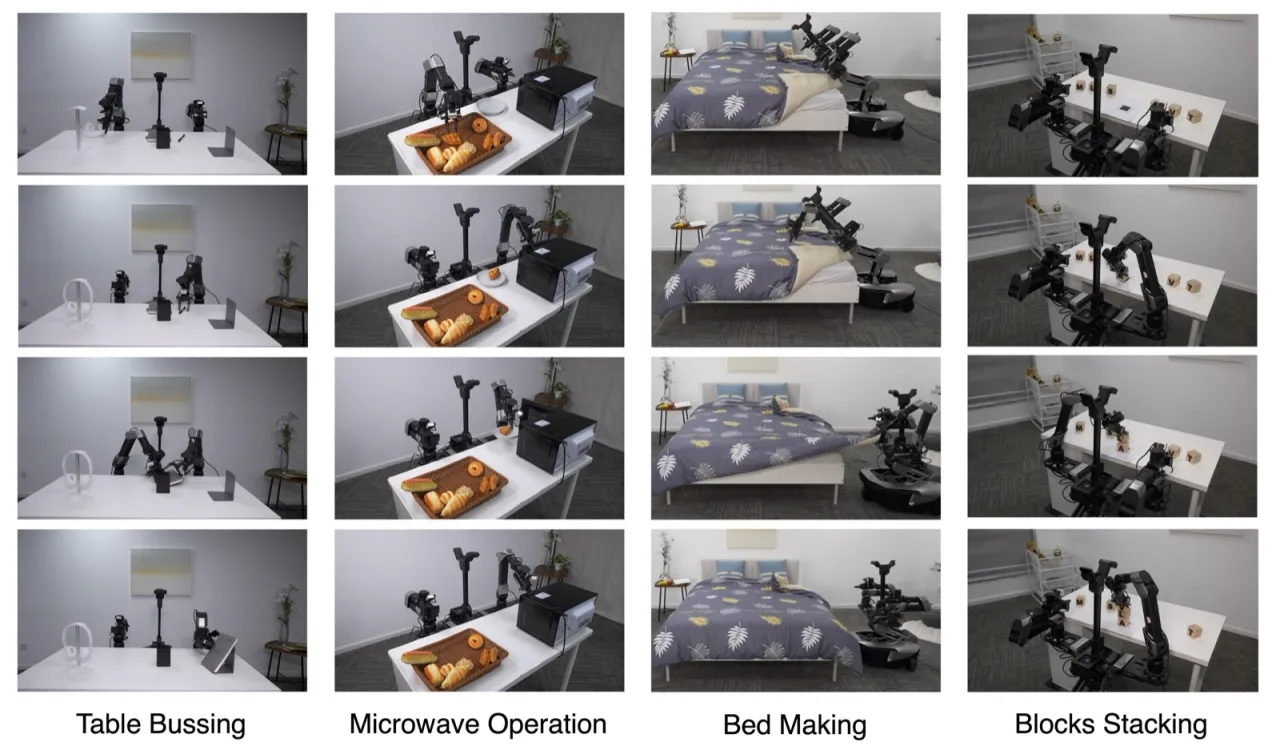
当前基准任务(Table Bussing、Microwave Operation、Bed Making、Blocks Stacking)设计合理但数量有限,每任务最多 100 条训练轨迹。论文中对移动操作(mobile manipulation)等更复杂场景的定量评测较少,泛化能力在更广泛的长尾任务上尚待验证。(inferred)The current benchmark tasks (Table Bussing, Microwave Operation, Bed Making, Blocks Stacking) are sensibly designed but limited in number, with at most 100 training trajectories per task. The paper reports relatively little quantitative evaluation of more complex settings such as mobile manipulation, so generalization over a broader long tail of tasks remains to be verified. (inferred)
G0-VLM(慢系统)与 G0-VLA(快系统)异步运行;慢系统的规划延迟可能在高动态任务中影响实时性。论文未详细报告两系统间通信延迟对任务成功率的影响。(inferred)G0-VLM (the slow system) and G0-VLA (the fast system) run asynchronously; the planning latency of the slow system may affect real-time behaviour in highly dynamic tasks. The paper does not report in detail how the communication latency between the two systems affects task success rate. (inferred)