← 论文海报合集← Paper Notes|
机器人操作 · Robotics · arXiv 2025Robotics · arXiv 2025

ForceVLA

Enhancing VLA Models with a Force-aware MoE for Contact-rich Manipulation
Jiawen Yu, Hairuo Liu, Qiaojun Yu, Jieji Ren, Ce Hao, Haitong Ding, Guangyu Huang, Guofan Huang, Yan Song, Panpan Cai, Cewu Lu, Wenqiang Zhang

ForceVLA 将 6 轴力-扭矩(force-torque)反馈提升为 VLA 框架中的一等模态,通过新颖的 FVLMoE(Force-aware Mixture-of-Experts)融合模块,在接触密集型操作任务中实现动态、自适应的力-视觉-语言联合决策,平均成功率较基线提升 23.2 个百分点ForceVLA elevates 6-axis force-torque feedback to a first-class modality inside the VLA framework. Through a novel FVLMoE (Force-aware Mixture-of-Experts) fusion module, it enables dynamic, adaptive joint force-vision-language decision making on contact-rich manipulation tasks, raising the average success rate over the baseline by 23.2 percentage points.

arXiv 2025-05-28 Flexiv Rizon 7-DOF · 双 RGB-D 相机Flexiv Rizon 7-DOF · dual RGB-D cameras π₀ 框架 · PaliGemma SigLIP · Flow Matchingπ₀ framework · PaliGemma SigLIP · Flow Matching 📄 arXiv:2505.22159
VLA force sensing Mixture-of-Experts contact-rich manipulation 机器人操作robot manipulation flow matching force-torque 触觉反馈tactile feedback FVLMoE π₀

01 动机Motivation

现有 VLA 模型在语义理解方面表现出色,却难以应对接触密集型操作(contact-rich manipulation)——如插拔、工具使用、装配——这类任务要求精细的力控制,尤其在视觉遮挡或动态不确定性场景下。 机器人系统普遍忽视了力感知这一关键模态,而人类却自然地整合触觉与本体感知来适应操作策略。Existing VLA models excel at semantic understanding, yet struggle with contact-rich manipulation (such as insertion and unplugging, tool use, assembly) — tasks that demand fine-grained force control, especially under visual occlusion or dynamic uncertainty. Robotic systems have largely neglected force sensing as a key modality, whereas humans naturally integrate tactile and proprioceptive cues to adapt their manipulation strategies.

"6D external force sensed at the robot's end-effector should be treated as a first-class modality",而非事后追加,这与人类操作中触觉与本体感知的协同机制一致。"6D external force sensed at the robot's end-effector should be treated as a first-class modality", rather than an afterthought bolted on later; this mirrors the interplay of touch and proprioception in human manipulation.
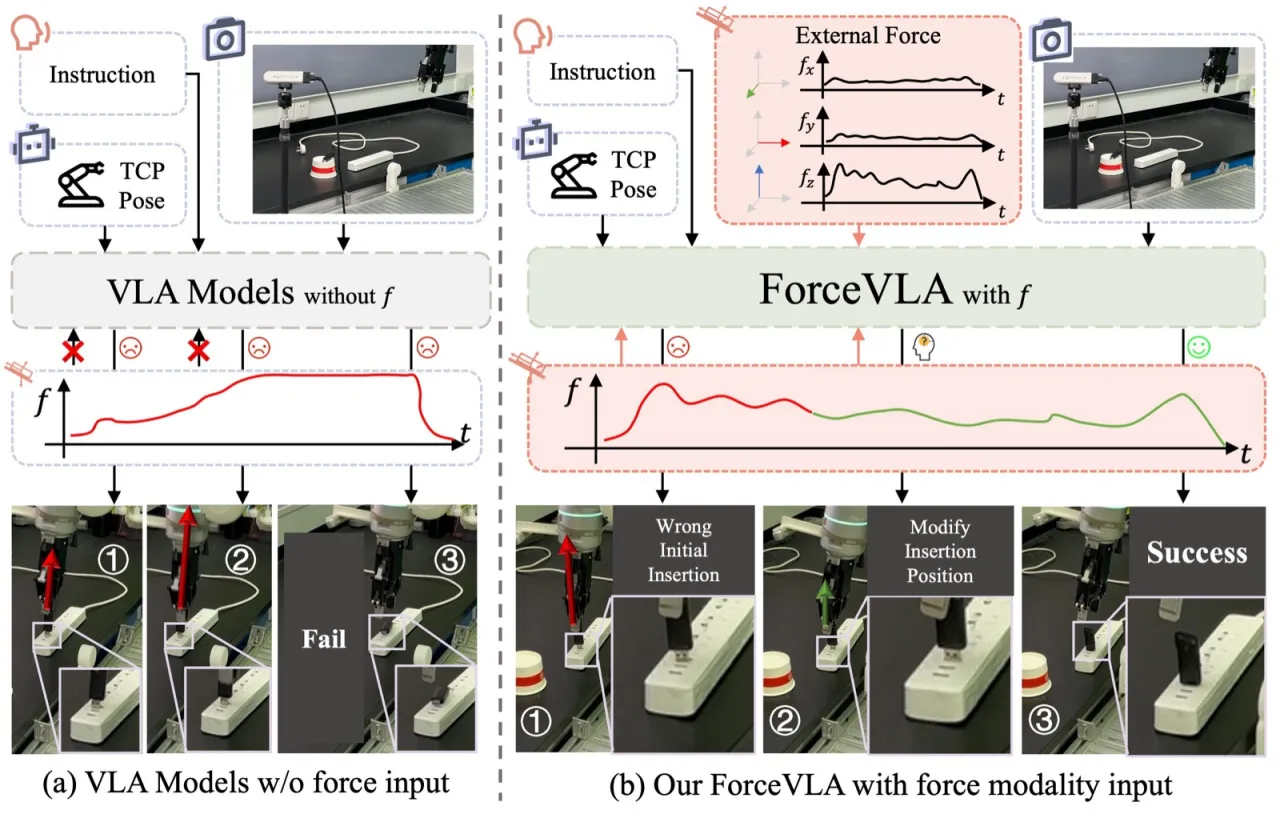
ForceVLA Teaser
图 1:动机示意。以 USB 插入任务为例:纯视觉 VLA(左)因接触遮挡导致插入失败;ForceVLA(右)借助实时 6D 力反馈持续调整末端姿态,最终成功完成插入。力信号在视觉信息缺失时充当关键的感知替代通道。Figure 1: Motivation. Take USB insertion as an example: the vision-only VLA (left) fails because contact occludes the view; ForceVLA (right) uses real-time 6D force feedback to keep adjusting the end-effector pose and finally completes the insertion. The force signal acts as a critical perceptual substitute when visual information is missing.
23.2%平均成功率提升(vs. π₀-base w/o Force)Average success-rate gain (vs. π₀-base w/o Force)
80%单任务最高成功率(对象泛化测试)Best single-task success rate (object generalization test)
90%视觉遮挡条件下成功率Success rate under visual occlusion
5接触密集型任务 · 244 条轨迹 · 140K 同步帧contact-rich tasks · 244 trajectories · 140K synchronized frames
02 方法Method

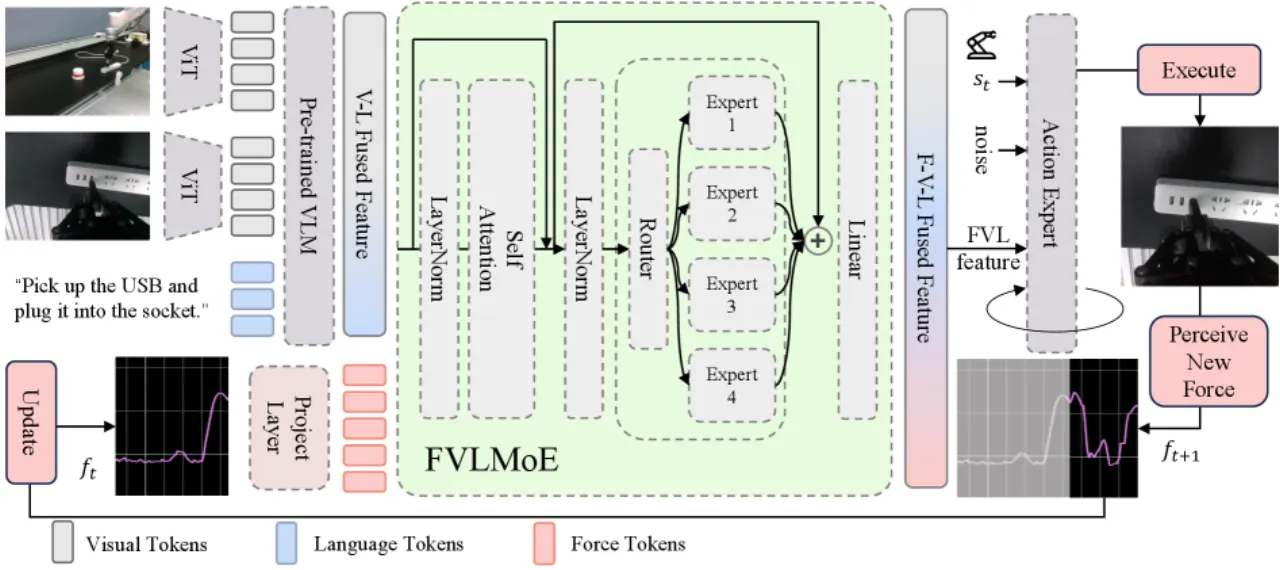
ForceVLA 以 π₀ 为骨干,融合 RGB 视觉、自然语言指令、本体感知状态与 6 轴力-扭矩数据,通过 FVLMoE 模块在 VLM 编码之后动态整合力特征,最终由基于 conditional flow matching 的动作头输出连续轨迹。ForceVLA takes π₀ as its backbone and fuses RGB vision, natural-language instructions, proprioceptive state and 6-axis force-torque data. The FVLMoE module dynamically integrates force features after VLM encoding, and an action head based on conditional flow matching outputs continuous trajectories.

FVLMoE Architecture
图 2:整体架构。系统管线分三个阶段:① 预训练 PaliGemma SigLIP 对 RGB 图像与语言指令编码,输出视觉-语言嵌入 E_VL;② FVLMoE 模块将 6D 原始力数据线性投影为力 token E_F,与 E_VL 拼接后经 Transformer 编码器(multi-head self-attention)和稀疏 MoE 层融合,得到 G_FVLMoE;③ 融合特征以 element-wise addition 注入状态与动作投影层,再经 flow matching 去噪生成动作轨迹。Figure 2: Overall architecture. The pipeline has three stages: ① a pretrained PaliGemma SigLIP encodes the RGB images and the language instruction into vision-language embeddings E_VL; ② the FVLMoE module linearly projects the raw 6D force data into force tokens E_F, concatenates them with E_VL, and fuses them through a Transformer encoder (multi-head self-attention) and a sparse MoE layer, yielding G_FVLMoE; ③ the fused feature is injected into the state and action projection layers by element-wise addition, and flow matching then denoises it into an action trajectory.

FVLMoE:力感知混合专家融合模块FVLMoE: A Force-aware Mixture-of-Experts Fusion Module

FVLMoE 的核心设计分三步:The core design of FVLMoE comprises three steps:

关键设计选择:Late-stage Force FusionA Key Design Choice: Late-stage Force Fusion

力信息在 VLM 编码之后引入,而非之前。消融实验表明,若在 VLM 之前融合力特征(MoE-before-VLM 变体),预训练视觉-语言表征会被破坏,导致成功率降至 0%。"晚融合"策略在保留 VLM 语义能力的同时,赋予模型实时力自适应能力。Force information enters after VLM encoding rather than before it. Ablations show that fusing force features ahead of the VLM (the MoE-before-VLM variant) destroys the pretrained vision-language representation and drives the success rate down to 0%. The "late fusion" strategy preserves the semantic capability of the VLM while granting the model real-time force adaptivity.

ForceVLA-Data:同步多模态数据集ForceVLA-Data: A Synchronized Multimodal Dataset

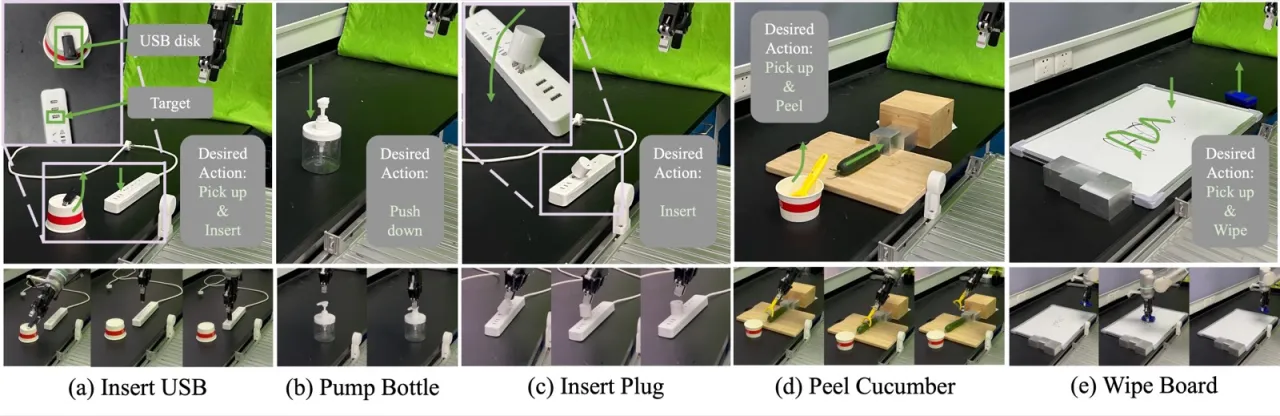
为支撑训练,团队采集了专用数据集:244 条轨迹,140K 个同步时间步,覆盖 5 种接触密集型任务(Bottle Pumping、Plug Insertion、USB Drive Insertion、Whiteboard Wiping、Cucumber Peeling),由 5 名专家操作员在 Flexiv Rizon 7-DOF 机械臂上完成,配备双 RGB-D 相机与 6 轴力-扭矩传感器。To support training, the team collected a dedicated dataset: 244 trajectories and 140K synchronized time steps, covering 5 contact-rich tasks (Bottle Pumping, Plug Insertion, USB Drive Insertion, Whiteboard Wiping, Cucumber Peeling), recorded by 5 expert operators on a Flexiv Rizon 7-DOF arm fitted with dual RGB-D cameras and a 6-axis force-torque sensor.

Task Setup
图 3:五种接触密集型任务场景。从左至右:Bottle Pumping(瓶泵按压)、Plug Insertion(插头插入)、USB Drive Insertion(USB 插入)、Whiteboard Wiping(白板擦拭)、Cucumber Peeling(黄瓜削皮)。每类任务均需精细力控制,且部分任务存在视觉遮挡。Figure 3: The five contact-rich task scenarios. From left to right: Bottle Pumping, Plug Insertion, USB Drive Insertion, Whiteboard Wiping, Cucumber Peeling. Every task calls for fine-grained force control, and some of them involve visual occlusion.

03 实验Experiments

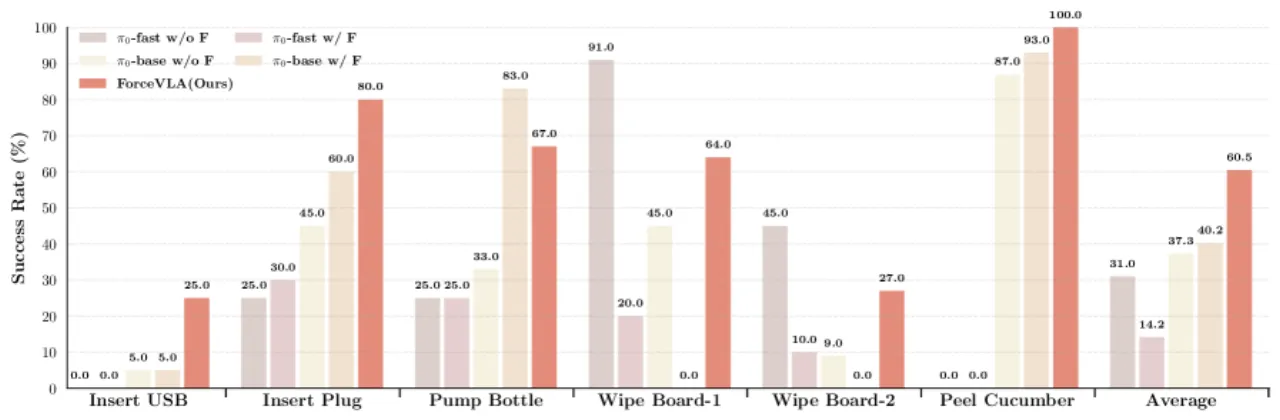
在 Flexiv Rizon 机械臂上评估三种方法:π₀-base w/o Force(纯视觉基线)、π₀-base w/ Force(朴素力融合)、ForceVLA(FVLMoE 完整方法)。评估维度包括 5 任务成功率、泛化鲁棒性与多任务联合训练。Three methods are evaluated on the Flexiv Rizon arm: π₀-base w/o Force (vision-only baseline), π₀-base w/ Force (naive force fusion) and ForceVLA (the complete FVLMoE method). The evaluation covers success rates on the 5 tasks, generalization robustness and multi-task joint training.

主要结果:五任务成功率Main Results: Success Rate on the Five Tasks

方法Method平均成功率Avg. success ratevs. w/o Force
π₀-base w/o Force37.3%
π₀-base w/ Force40.2%+2.9 pp
ForceVLA(ours)ForceVLA (ours)60.5%+23.2 pp
Success Rate Comparison
图 4:各任务成功率对比。ForceVLA 在所有五个接触密集型任务上均优于两条基线,在 Plug Insertion 等任务上个别条件可达约 80% 成功率。Figure 4: Per-task success rate comparison. ForceVLA outperforms both baselines on all five contact-rich tasks, and on tasks such as Plug Insertion it reaches roughly 80% success under individual conditions.

泛化测试(Plug Insertion,Table 2)Generalization Tests (Plug Insertion, Table 2)

测试条件Test conditionπ₀-base w/o ForceForceVLA
Object generalization(换插座)Object generalization (different socket)80.00%
Height variation(高度变化)Height variation88.89%
Visual occlusion(视觉遮挡)Visual occlusion90.00%
Unstable socket(插座不稳定)Unstable socket20.00%
平均Average38.93%63.78%

特别地,视觉遮挡条件下 ForceVLA 仍达 90.00%,充分证明力信号在视觉失效时的补偿作用。Notably, ForceVLA still reaches 90.00% under visual occlusion, ample evidence that force signals compensate when vision fails.

多任务联合训练(Table 5,4 任务)Multi-task Joint Training (Table 5, 4 tasks)

方法Method平均成功率(4 任务)Avg. success rate (4 tasks)
π₀-base w/o Force5%
π₀-base w/ Force42.5%
ForceVLA(ours)ForceVLA (ours)67.5%

消融实验(Table 3,Plug Insertion 单任务)Ablation Study (Table 3, Plug Insertion single task)

变体Variant成功率Success rate
Linear projection before VLM55%
MoE before VLM0%
Concatenate after VLM60%
ForceVLA(FVLMoE, ours)ForceVLA (FVLMoE, ours)80%

结果验证:① 力的融合位置至关重要,VLM 之后融合是最优策略;② 朴素拼接(Concatenate after VLM)虽优于早融合,但相比 FVLMoE 还差 20 个百分点;③ MoE 的动态路由带来显著收益。The results confirm that ① where force is fused matters greatly, and fusing after the VLM is the optimal strategy; ② naive concatenation (Concatenate after VLM) beats early fusion but still trails FVLMoE by 20 percentage points; ③ the dynamic routing of the MoE yields a substantial gain.

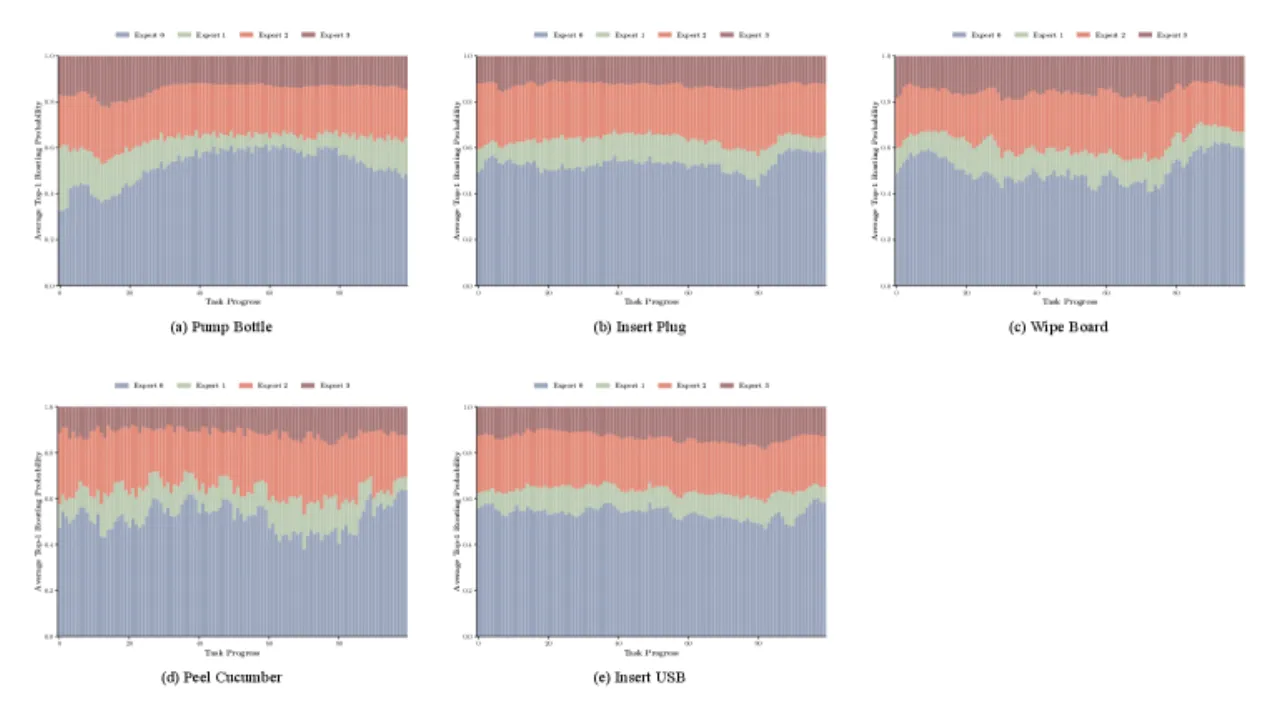
Router 分析:专家负载与任务专化Router Analysis: Expert Load and Task Specialization

Expert Router Analysis
图 5:MoE Router 分析。Expert 0 作为"通用专家"主导约 50% 的 token 分配;Plug Insertion 与 Cucumber Peeling 等任务在不同操作阶段呈现出不同专家的时序激活模式(phase-specific expert activation);Whiteboard Wiping 则始终由单一专家主导,反映该任务的相对均匀性。Figure 5: MoE router analysis. Expert 0 acts as a "generalist expert" and dominates about 50% of the token assignments; tasks such as Plug Insertion and Cucumber Peeling exhibit phase-specific expert activation across manipulation stages; Whiteboard Wiping is consistently dominated by a single expert, reflecting the relative uniformity of that task.

轨迹可视化Trajectory Visualization

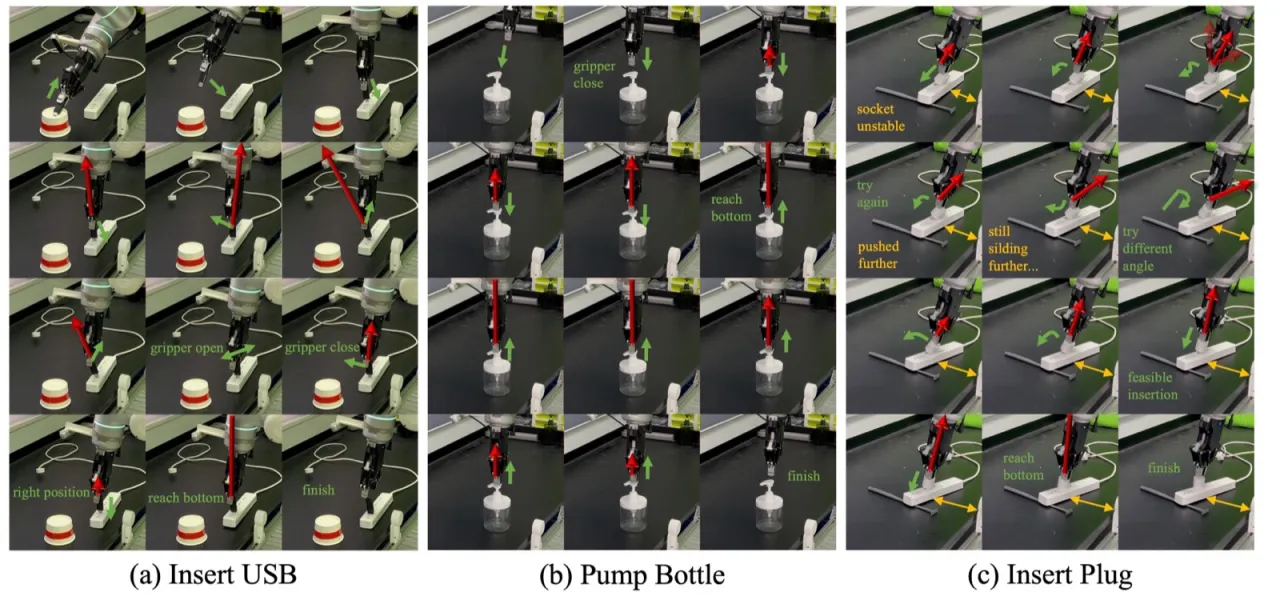
Trajectory Visualization
图 6:典型任务的操作轨迹序列。展示 USB 插入、瓶泵按压和插头插入三类任务的关键帧序列,可观察到 ForceVLA 在接触阶段的自适应调整行为——当力反馈指示对准偏差时,机器人会实时微调末端位姿直至成功接触。Figure 6: Manipulation trajectory sequences of representative tasks. Keyframe sequences for USB insertion, bottle pumping and plug insertion. ForceVLA visibly adapts during the contact phase: when force feedback signals a misalignment, the robot fine-tunes the end-effector pose in real time until contact succeeds.

04 局限性Limitations

Note:以下局限性均为论文作者明确陈述(stated by the authors)。Note:All limitations below are explicitly stated by the authors of the paper.
力估计精度的局限(Force Estimation Accuracy)Force Estimation Accuracy

系统使用的是估计的外力旋量(estimated external wrench),而非高保真传感器的直接测量值。对于需要极高触觉灵敏度的任务,这可能带来感知误差,影响精细力控的可靠性。The system relies on an estimated external wrench rather than a direct measurement from a high-fidelity sensor. For tasks that demand extremely high tactile sensitivity this may introduce perception error and undermine the reliability of fine force control.

硬件可及性的制约(Hardware Accessibility)Hardware Accessibility

当前评估局限于配备集成 6 轴力-扭矩传感器的高端平台(Flexiv Rizon)。作者承认,能否迁移至"lower-cost platforms equipped with external or retrofitted force sensors"尚不确定,这可能限制该方法的"broader accessibility"。The current evaluation is confined to a high-end platform with an integrated 6-axis force-torque sensor (Flexiv Rizon). The authors admit it is unclear whether the approach transfers to "lower-cost platforms equipped with external or retrofitted force sensors", which may limit its "broader accessibility".

不稳定场景的鲁棒性不足(Unstable Socket Condition)Insufficient Robustness in Unstable Scenarios (Unstable Socket Condition)

泛化测试中,在"Unstable socket"(插座不稳定)条件下 ForceVLA 成功率仅 20.00%,明显低于其他泛化条件(80%–90%)。这表明对于动态基座或随机扰动场景,当前方法仍存在明显短板。In the generalization tests, ForceVLA reaches only 20.00% under the "Unstable socket" condition, clearly below the other generalization conditions (80%–90%). This shows the method still falls short on dynamic bases or randomly perturbed scenes.