Democratizing Generalist Robot Policies with Efficient Vision-Language-Action Flow Policies
Moritz Reuss, Hongyi Zhou, Marcel Rühle, Ömer Erdinç Yağmurlu, Fabian Otto, Rudolf Lioutikov · Karlsruhe Institute of Technology & Microsoft Research
FLOWER 通过两项核心创新——中间模态融合(Intermediate-Modality Fusion)和Global-AdaLN 条件化——构建了一个仅需 200 H100 GPU 小时即可预训练的 950M 参数 VLA 模型,在 190 项仿真与真实世界任务中达到最新最优性能,同时大幅降低显存占用与推理延迟。Through two core innovations—Intermediate-Modality Fusion and Global-AdaLN conditioning—FLOWER builds a 950M-parameter VLA model that can be pretrained in only 200 H100 GPU hours, reaching state-of-the-art performance on 190 simulation and real-world tasks while substantially cutting GPU memory usage and inference latency.
大型视觉-语言-动作(VLA)模型在通用机器人策略学习中潜力巨大,但现有方法面临两大核心瓶颈:训练成本极高(往往需要数千 GPU 小时)以及推理效率低下(高显存占用、低频率输出),严重限制了其在真实场景与低资源环境中的落地。Large Vision-Language-Action (VLA) models hold great promise for generalist robot policy learning, but existing approaches face two core bottlenecks: extremely high training cost (often thousands of GPU hours) and poor inference efficiency (high GPU memory usage, low output frequency), which severely limits their deployment in real-world scenarios and low-resource environments.
"We present FLOWER, an efficient VLA flow policy capable of pretraining a 950M parameter model in only 200 H100 GPU hours, while achieving competitive performance across 190 tasks spanning simulation and real-world benchmarks."
FLOWER 的三大优势:相比现有 VLA 基线,显著降低 GPU 显存占用、减少计算量,同时在多基准任务上保持更强性能。图中纵轴越低越好(资源消耗),右侧柱状图越高越好(任务成功率)。FLOWER's three advantages: compared with existing VLA baselines, it markedly reduces GPU memory usage and computation while maintaining stronger performance across multiple benchmarks. In the figure, lower is better on the vertical axis (resource consumption), and higher is better in the bar chart on the right (task success rate).
4.53CALVIN ABC→D 平均序列长度(最优)CALVIN ABC→D average sequence length (best)
200 hH100 GPU 预训练时长H100 GPU pretraining time
311 HzRTX 4090 推理吞吐量RTX 4090 inference throughput
1848 MB推理所需显存GPU memory required for inference
现有方法的痛点主要体现在两个层面:The pain points of existing methods show up at two levels:
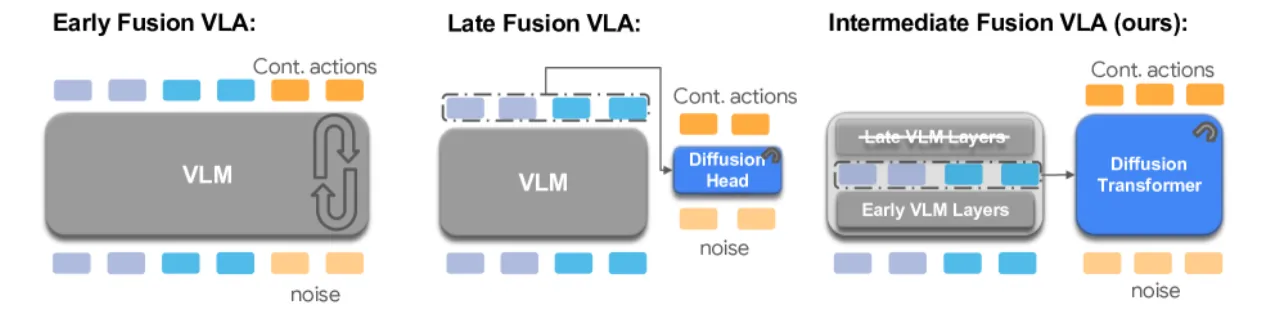
早期融合(Early Fusion):将视觉 token 直接拼接进 LLM,导致序列长度激增,计算开销随之大幅上升。Early Fusion: visual tokens are concatenated directly into the LLM, causing sequence length to grow sharply and computational cost to rise with it.
晚期融合(Late Fusion):虽然计算高效,但跨模态的语义对齐较弱,任务成功率受限。Late Fusion: computationally efficient, but cross-modal semantic alignment is weak, which limits task success rate.
FLOWER 通过截断预训练 VLM 的中间层特征(而非使用完整输出),在减少 20–35% 参数量的同时保留关键的跨模态语义信息,从而实现了训练效率与策略性能的双赢。By truncating the pretrained VLM and using its intermediate-layer features (rather than the full output), FLOWER preserves the key cross-modal semantic information while reducing parameters by 20–35%, achieving a win-win between training efficiency and policy performance.
02方法Method
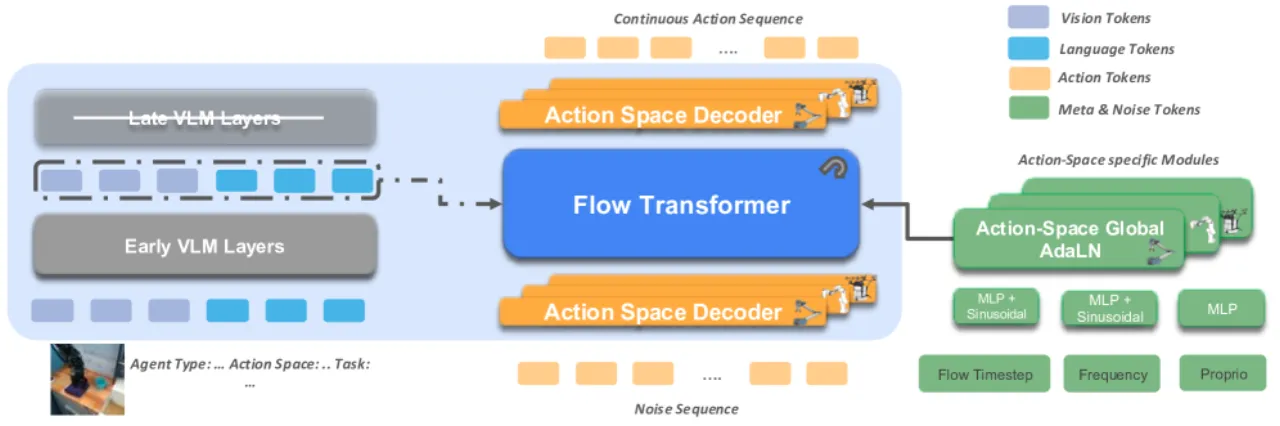
FLOWER 的整体框架由三个模块组成:视觉-语言编码器(VLM)提供多模态上下文表示;Flow Transformer 通过 cross-attention 接收 VLM 的中间层特征并执行 flow matching 动作解码;Global-AdaLN 以高效的参数共享方式为每层提供动作空间特定的调制信号。FLOWER's overall framework consists of three modules: the vision-language encoder (VLM) provides multimodal contextual representations; the Flow Transformer receives the VLM's intermediate-layer features through cross-attention and performs flow matching action decoding; Global-AdaLN supplies action-space-specific modulation signals to every layer via efficient parameter sharing.
FLOWER 整体架构:VLM(以 Florence-2 为例)处理图像与语言输入,其中间层嵌入通过 cross-attention 注入 Flow Transformer。Flow Transformer 接收噪声动作序列,经过去噪后输出目标动作。关键在于 VLM 仅使用前 50–70% 的层,大幅削减参数量与计算量。FLOWER overall architecture: the VLM (Florence-2 here) processes image and language inputs, and its intermediate-layer embeddings are injected into the Flow Transformer through cross-attention. The Flow Transformer takes a noisy action sequence and outputs the target actions after denoising. The key point is that only the first 50–70% of the VLM's layers are used, sharply cutting parameters and computation.
传统 VLA 模型通常使用 VLM 的最终层输出(晚期融合)或将图像 token 直接插入 LLM 输入(早期融合)。FLOWER 则采用"中间截断"策略:对于编码器-解码器结构(如 Florence-2),移除整个解码器(减少 50% 参数);对于仅解码器结构(如 LLaMA),丢弃最后 30% 的层(减少 20–35% 参数)。截断后的中间层特征通过 cross-attention 传入 Flow Transformer。Conventional VLA models typically use the VLM's final-layer output (late fusion) or insert image tokens directly into the LLM input (early fusion). FLOWER instead adopts an "intermediate truncation" strategy: for encoder-decoder architectures (such as Florence-2), it removes the entire decoder (a 50% parameter reduction); for decoder-only architectures (such as LLaMA), it drops the last 30% of the layers (a 20–35% parameter reduction). The truncated intermediate-layer features are passed into the Flow Transformer through cross-attention.
"The intermediate representation prunes between 30% and 50% of pretrained VLM layers, yielding a 20–35% parameter reduction while preserving rich cross-modal semantics."
消融实验证明,中间融合相比早期融合提升 61 个百分点(LIBERO-Long:93.4% vs 33.4%),相比晚期融合提升 21 个百分点,优势显著。Ablations show that intermediate fusion outperforms early fusion by 61 percentage points (LIBERO-Long: 93.4% vs 33.4%) and late fusion by 21 percentage points, a substantial margin.
Global-AdaLN 条件化Global-AdaLN Conditioning
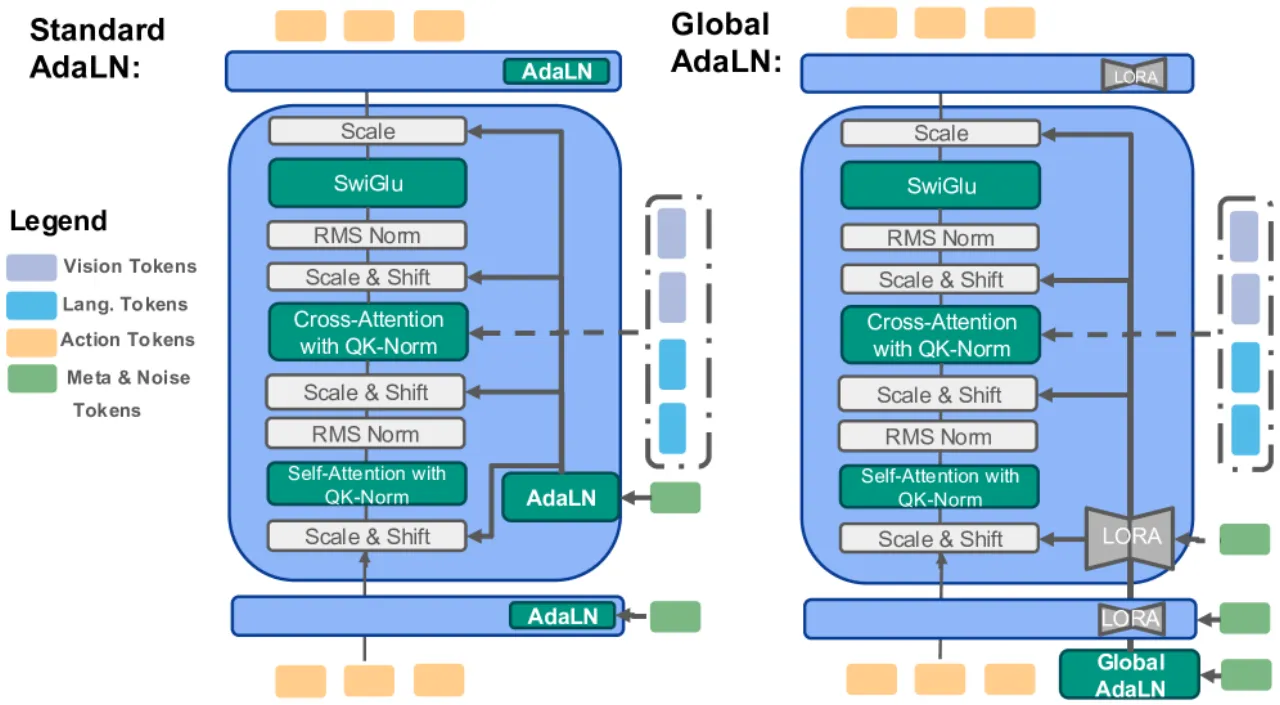
左:标准 DiT block 的 AdaLN-Zero 为每层独立分配调制权重,参数冗余。右:FLOWER 的 Global-AdaLN 在所有层间共享一组调制权重,再通过轻量级 LoRA 适配器为每层生成独特调制信号,兼顾效率与层级特异性。Left: AdaLN-Zero in a standard DiT block assigns independent modulation weights to each layer, which is parameter-redundant. Right: FLOWER's Global-AdaLN shares one set of modulation weights across all layers, then uses a lightweight LoRA adapter to generate a distinct modulation signal for each layer, balancing efficiency and layer-wise specificity.
标准的 AdaLN-Zero 为 Diffusion Transformer 的每一层分配独立的调制参数,随层数增多参数量线性增长。Global-AdaLN 则将调制权重全局共享:Standard AdaLN-Zero assigns independent modulation parameters to every layer of the Diffusion Transformer, so the parameter count grows linearly with depth. Global-AdaLN instead shares the modulation weights globally:
一个共享的调制网络生成全局调制向量;a shared modulation network generates a global modulation vector;
每层附加一个轻量级 LoRA 适配器,在全局信号基础上引入层特异性偏移;each layer adds a lightweight LoRA adapter that introduces layer-specific offsets on top of the global signal;
相比 naive AdaLN-Zero,参数量减少 20% 以上,同时保留对不同动作空间统计特性的适应能力。compared with naive AdaLN-Zero, this reduces parameters by more than 20% while retaining the ability to adapt to the statistics of different action spaces.
Flow Matching 动作解码Flow Matching Action Decoding
FLOWER 的动作解码头基于 flow matching 框架(而非 DDPM 扩散过程),通过学习从噪声分布到动作分布的连续 ODE 流实现动作生成。Flow Transformer 接收带噪声的动作序列作为输入,以 VLM 中间层嵌入为条件,经去噪后输出机器人动作序列。该框架支持灵活的采样步数,在推理时可以更少步数获得高质量动作,从而实现 311.04 Hz 的高频推理(RTX 4090)。FLOWER's action decoding head is based on the flow matching framework (rather than a DDPM diffusion process), generating actions by learning a continuous ODE flow from the noise distribution to the action distribution. The Flow Transformer takes a noisy action sequence as input, conditions on the VLM's intermediate-layer embeddings, and outputs the robot action sequence after denoising. The framework supports a flexible number of sampling steps, so high-quality actions can be obtained with fewer steps at inference, enabling high-frequency inference at 311.04 Hz (RTX 4090).
03实验Experiments
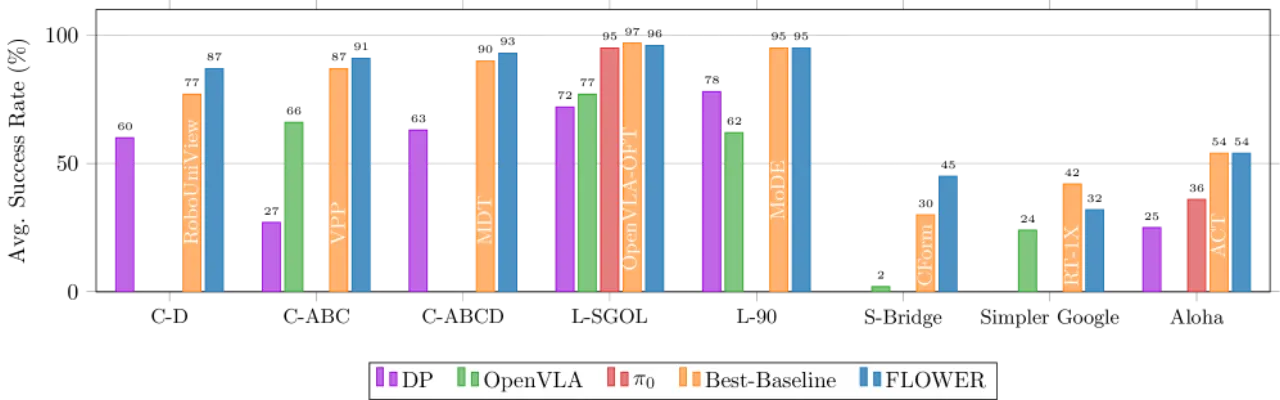
FLOWER 在 10 个基准上进行了系统评测,涵盖仿真(CALVIN、LIBERO、SIMPLER、Aloha)和真实世界(厨房操作)任务,共 190 项任务。对比基线包括 OpenVLA、π0、Octo、Seer、VPP 等代表性 VLA 模型。FLOWER is systematically evaluated on 10 benchmarks covering simulation (CALVIN, LIBERO, SIMPLER, Aloha) and the real world (kitchen manipulation), for a total of 190 tasks. Baselines include representative VLA models such as OpenVLA, π0, Octo, Seer, and VPP.
CALVIN ABC→D 基准CALVIN ABC→D Benchmark
方法Method
平均序列长度(满分5.0)Average sequence length (out of 5.0)
OpenVLA
3.27
Seer
4.28
VPP
4.29
π0
4.01±0.04
FLOWER(本文)FLOWER (ours)
4.53±0.04
LIBERO 多任务基准LIBERO Multi-Task Benchmark
任务Task
Octo
OpenVLA
π0
FLOWER
Spatial
78.9±1.0%
84.7±0.9%
96.8%
97.5±0.8%
Object
85.7±0.9%
88.4±0.8%
98.8%
99.1±0.4%
Goal
84.6±0.9%
79.2±1.0%
95.8%
96.1±0.6%
Long
51.1±1.3%
53.7±1.3%
85.2%
94.9±1.2%
真实世界厨房实验Real-World Kitchen Experiments
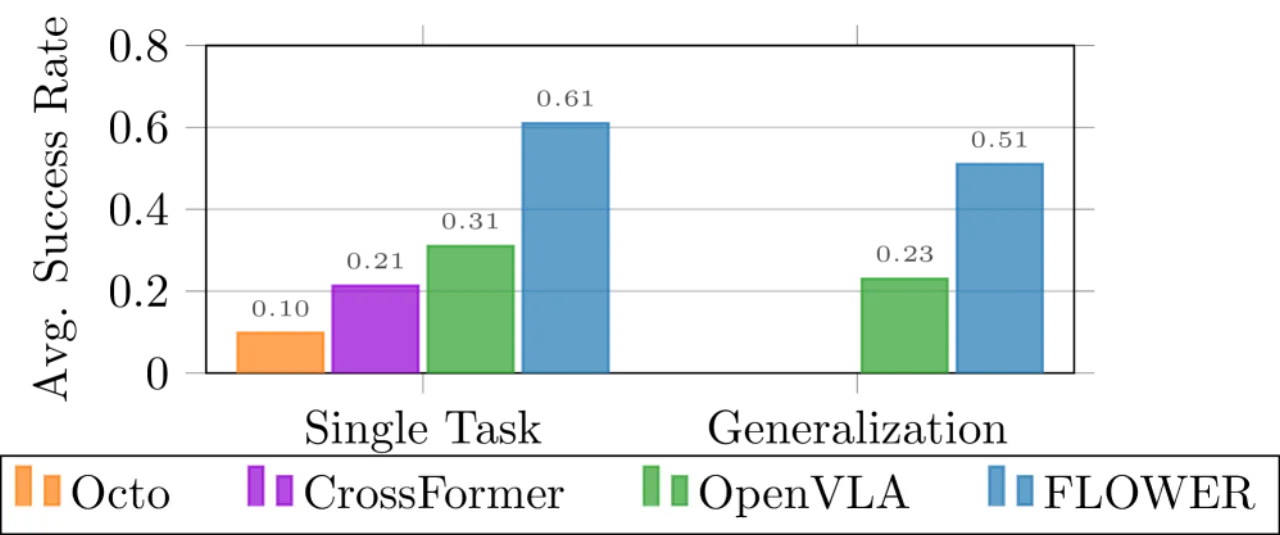
真实厨房操作任务(共 5 项)成功率对比,以及四种泛化场景(新物体、闪光灯光照、背景干扰物、新任务组合)下的性能。FLOWER 在所有条件下均显著优于 OpenVLA 基线。Success rates on real kitchen manipulation tasks (5 in total), together with performance under four generalization settings (novel objects, flashlight lighting, background distractors, novel task combinations). FLOWER significantly outperforms the OpenVLA baseline under all conditions.
多仿真基准上 FLOWER 与主流 VLA 基线的成功率对比,涵盖 CALVIN、LIBERO、SIMPLER 及 Aloha 任务集。Success-rate comparison between FLOWER and mainstream VLA baselines across simulation benchmarks, covering CALVIN, LIBERO, SIMPLER and the Aloha task suites.
模型Model
吞吐量 (Hz)Throughput (Hz)
延迟 (s)Latency (s)
显存 (MB)GPU memory (MB)
OpenVLA
6.09
0.164
14,574
Diffusion Policy
130.67
0.341
517
π0
288.11
0.104
6,692
FLOWER
311.04
0.052
1,848
FLOWER 推理速度比 π0 快 8%,比 OpenVLA 快 5,007%;显存仅为 π0 的 27.6%,OpenVLA 的 12.7%。FLOWER's inference is 8% faster than π0 and 5,007% faster than OpenVLA; its GPU memory is only 27.6% of π0's and 12.7% of OpenVLA's.
消融实验Ablation Studies
关键消融结果(CALVIN ABC 与 LIBERO-Long 双任务):Key ablation results (on both CALVIN ABC and LIBERO-Long):
融合策略:早期融合 57.1% / 33.4%;晚期融合 71.2% / 61.8%;中间融合(本文)89.5% / 93.4%——中间融合比早期融合高出 61 百分点。Fusion strategy: early fusion 57.1% / 33.4%; late fusion 71.2% / 61.8%; intermediate fusion (ours) 89.5% / 93.4%—intermediate fusion exceeds early fusion by 61 percentage points.
层剪枝比例:保留完整 VLM(不剪枝)66.3%;剪枝 30%(最优)72.1%;剪枝 50% 66.4%。Layer-pruning ratio: full VLM (no pruning) 66.3%; pruning 30% (best) 72.1%; pruning 50% 66.4%.
Global-AdaLN:相比 naive AdaLN-Zero 参数量减少 20% 以上,同时保持任务成功率不下降。Global-AdaLN: more than 20% fewer parameters than naive AdaLN-Zero, with no drop in task success rate.
04局限性Limitations
Note: 以下局限性均由作者在论文中明确陈述(stated)。Note: All limitations below are explicitly stated by the authors in the paper.
迭代采样速度慢于确定性策略Iterative sampling is slower than deterministic policies
"It relies on an iterative sampling procedure, which is inherently slower than a single forward pass from deterministic policies."——基于 flow matching 的多步去噪推理,在步数较多时仍慢于单步确定性策略(如 ACT)。"It relies on an iterative sampling procedure, which is inherently slower than a single forward pass from deterministic policies."—multi-step denoising inference based on flow matching is still slower than single-step deterministic policies (such as ACT) when many steps are used.
仅验证了三种操作动作空间Validated on only three manipulation action spaces
"We have validated FLOWER primarily on three manipulation action spaces; its ability to generalize to other embodiments, such as mobile navigation or humanoid locomotion, remains unexplored and is an important direction for future work."——尚未在移动导航或人形机器人场景下验证。"We have validated FLOWER primarily on three manipulation action spaces; its ability to generalize to other embodiments, such as mobile navigation or humanoid locomotion, remains unexplored and is an important direction for future work."—it has not yet been validated on mobile navigation or humanoid robot settings.
在 SIMPLER Google Robot 基准上有待提升Room for improvement on the SIMPLER Google Robot benchmark
"Pretraining performance for zero-shot deployment on the SIMPLER Google Robot benchmark indicates that further improvements are needed. We hypothesize that the generalization tested in SIMPLER benefits from larger models."——在 Google Robot 设置下(31.9%)低于 RT-1-X(42.4%),作者推测更大模型有助于改善。"Pretraining performance for zero-shot deployment on the SIMPLER Google Robot benchmark indicates that further improvements are needed. We hypothesize that the generalization tested in SIMPLER benefits from larger models."—under the Google Robot setting (31.9%) it falls below RT-1-X (42.4%), and the authors hypothesize that larger models would help.
约 1B 参数对低资源场景仍有挑战About 1B parameters remains challenging for low-resource settings
"Although FLOWER is considerably smaller than most state-of-the-art VLA models, its ≈1 B-parameter size may still present deployment challenges in low-resource or real-time settings."
8/10 基准在仿真环境中进行8 of the 10 benchmarks are conducted in simulation
"Eight out of our ten used benchmarks are conducted in simulation, limiting the extent to which our results can be taken as evidence of real-world generalization."——真实世界结果相对有限,泛化结论需谨慎外推。"Eight out of our ten used benchmarks are conducted in simulation, limiting the extent to which our results can be taken as evidence of real-world generalization."—real-world results are relatively limited, so generalization conclusions should be extrapolated with caution.