FLARE: Robot Learning with Implicit World Modeling
隐式世界模型赋能机器人策略学习Implicit World Modeling for Robot Policy Learning
Ruijie Zheng, Jing Wang, Scott Reed, Johan Bjorck, Yu Fang, Fengyuan Hu, Joel Jang 等 · NVIDIA / University of MarylandRuijie Zheng, Jing Wang, Scott Reed, Johan Bjorck, Yu Fang, Fengyuan Hu, Joel Jang et al. · NVIDIA / University of Maryland
FLARE 在扩散变换器策略内嵌入隐式潜在世界模型,通过余弦对齐损失将中间层特征与未来观测嵌入对齐,让机器人在生成动作时同步"预见"未来状态。无需像素级视觉生成,以极小的架构改动在多任务操作基准上最高超越现有方法 26%,并可利用无动作标注的人类示范视频提升泛化能力。FLARE embeds an implicit latent world model inside a diffusion transformer policy, aligning intermediate-layer features with future observation embeddings through a cosine alignment loss, so that the robot "foresees" future states while generating actions. Without pixel-level visual generation, and with minimal architectural change, it surpasses prior methods by up to 26% on multi-task manipulation benchmarks, and it can exploit action-free human demonstration videos to improve generalization.
隐式世界模型implicit world model机器人操作robot manipulationdiffusion transformerVLAimitation learning人形机器人humanoid robot潜空间对齐latent space alignmentcross-embodiment
01动机Motivation
机器人操作需要对长程因果关系的推理能力——预见当前动作对未来状态的影响。现有显式世界模型方法为此生成高保真像素级视觉预测,却带来巨大的计算开销,且面临内在矛盾:视觉生成强调空间细节与纹理合成,而动作建模更需紧凑、抽象、任务相关的表示。Robot manipulation demands reasoning about long-horizon causality — foreseeing how the current action affects future states. Existing explicit world-model methods generate high-fidelity pixel-level visual predictions for this purpose, but incur a huge computational cost and face an intrinsic tension: visual generation emphasizes spatial detail and texture synthesis, whereas action modeling calls for compact, abstract, task-relevant representations.
"We show that a surprisingly simple and flexible recipe, fully compatible with existing VLA architectures, can surpass prior VLA policy learning methods by a substantial margin."
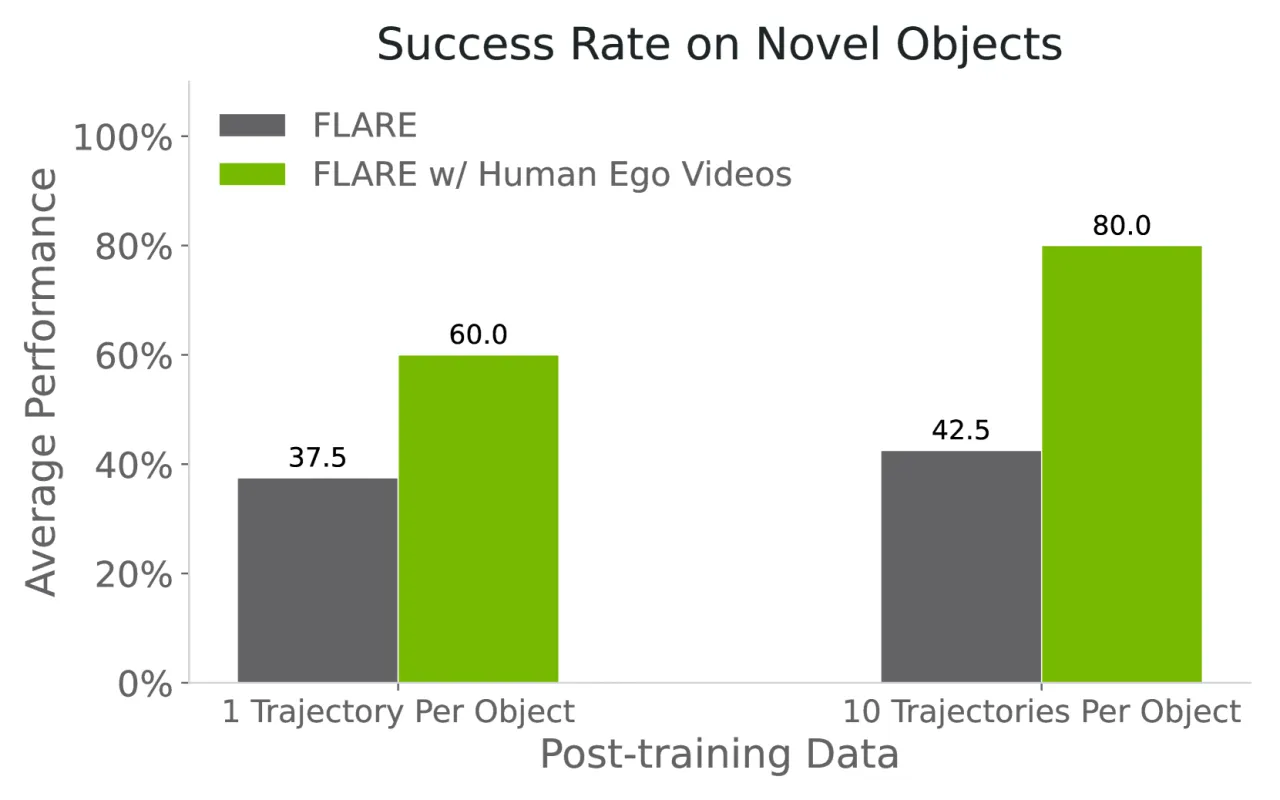
FLARE 的核心洞察:不必生成像素,只需在策略网络内部预测未来观测的隐式嵌入,便可赋予策略世界模型的感知能力,同时保持架构精简。这也解锁了对无动作标注人类视频的联合训练,大幅提升对新物体的泛化能力。FLARE's core insight: rather than generating pixels, it suffices to predict the implicit embedding of future observations inside the policy network, which endows the policy with the perceptual power of a world model while keeping the architecture lean. This also unlocks joint training on action-free human videos, greatly improving generalization to novel objects.
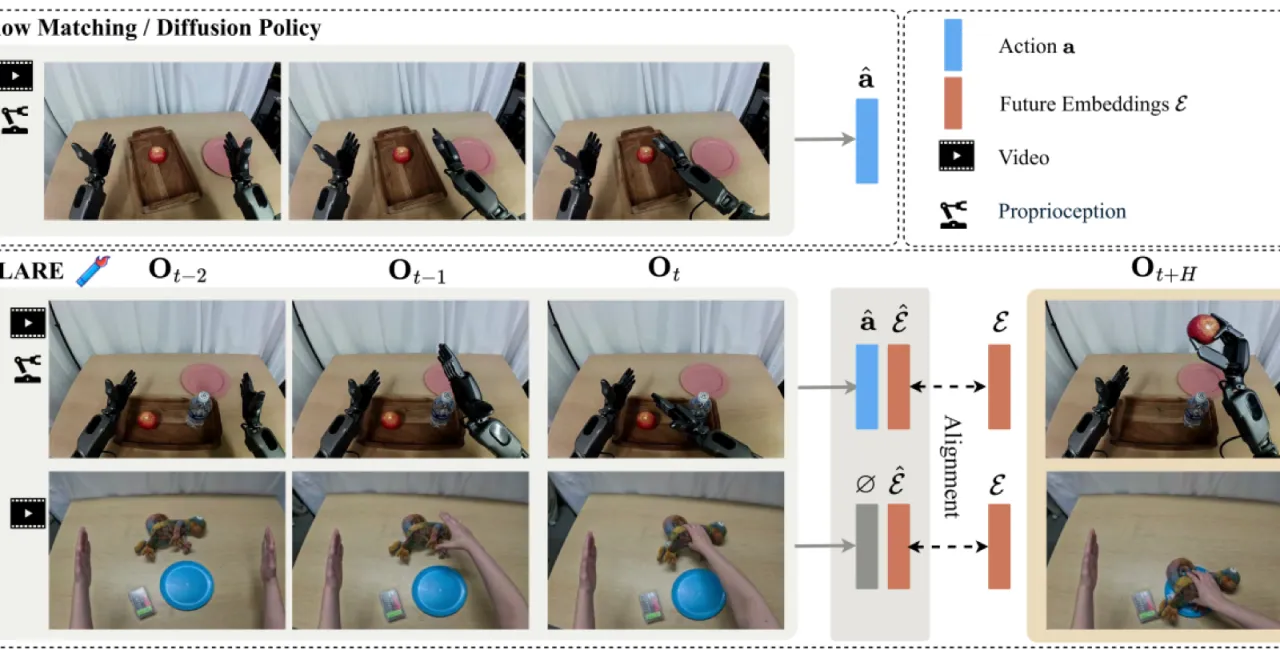
图 1:FLARE(右)与传统扩散策略(左)的对比。传统方法仅以当前观测预测动作;FLARE 在 diffusion transformer 中额外引入 future tokens,并通过潜在对齐损失将其与未来帧嵌入对齐,从而使策略在推断动作时隐式地"预见"未来。这一设计还支持从仅有视频(无动作标注)的人类示范数据中学习。Figure 1: FLARE (right) compared with a conventional diffusion policy (left). The conventional approach predicts actions from the current observation alone; FLARE additionally introduces future tokens into the diffusion transformer and aligns them with future-frame embeddings through a latent alignment loss, so that the policy implicitly "foresees" the future while inferring actions. This design also supports learning from human demonstration data that contains only video (no action labels).
80%仅 10 个机器人示范 + 人类视频后的新物体成功率Novel-object success rate with only 10 robot demonstrations plus human video
02方法Method
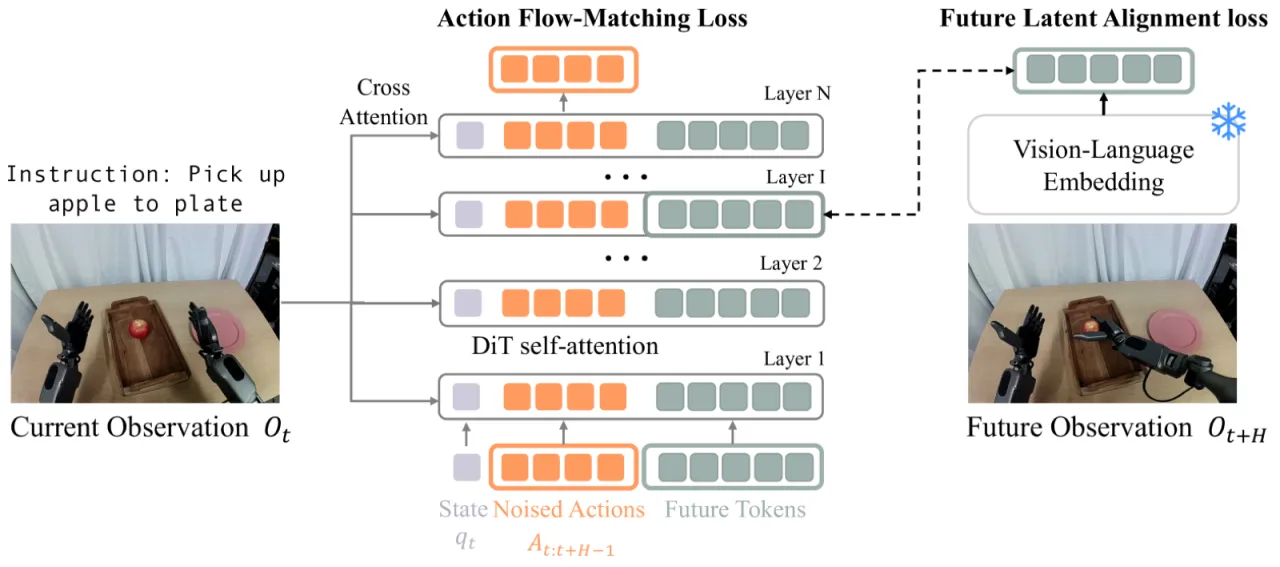
FLARE 在标准 diffusion transformer(DiT)策略之上增加两个组件:① 附加于序列末尾的可学习 future tokens;② 将 DiT 中间层特征对齐至冻结的未来观测嵌入的 alignment loss。推理时 future tokens 被直接丢弃,无任何额外开销。FLARE adds two components on top of a standard diffusion transformer (DiT) policy: ① learnable future tokens appended to the end of the sequence; ② an alignment loss that aligns DiT intermediate-layer features to frozen future observation embeddings. At inference the future tokens are simply discarded, so there is no extra cost.
图 2:FLARE 架构。输入序列由当前观测嵌入 ϕ_t(通过 Action-Aware Embedding Model 压缩为 32 个 query token)、扩散噪声动作 A_t^τ 以及 M 个可学习 future tokens q_t 组成。序列经过 self-attention 层后,future tokens 的中间层激活被 MLP 投影,通过余弦相似度损失与未来帧 t+H 的冻结嵌入 ϕ_{t+H} 对齐。action head 输出 flow-matching 损失所需的去噪预测。训练时同时优化 ℒ_flow 与 ℒ_align;推理时 future tokens 丢弃。Figure 2: the FLARE architecture. The input sequence consists of the current observation embedding ϕ_t (compressed into 32 query tokens by the Action-Aware Embedding Model), the diffusion-noised action A_t^τ, and M learnable future tokens q_t. After the self-attention layers, the intermediate-layer activations of the future tokens are projected by an MLP and aligned, through a cosine similarity loss, with the frozen embedding ϕ_{t+H} of the future frame t+H. The action head outputs the denoising prediction required by the flow-matching loss. Training optimizes ℒ_flow and ℒ_align jointly; at inference the future tokens are discarded.
潜在世界建模(Latent World Modeling)Latent World Modeling
在 DiT 的第 L 层,抽取与 future tokens 对应的中间激活,经 MLP 投影后与未来观测 ϕ_{t+H} 的冻结嵌入做余弦对齐:At layer L of the DiT, the intermediate activations corresponding to the future tokens are extracted and, after an MLP projection, cosine-aligned with the frozen embedding of the future observation ϕ_{t+H}:
其中 g(·) 为冻结的 Action-Aware Embedding Model,f_θ(·) 为可训练 MLP。预测紧凑的语义嵌入而非像素,既降低了计算量,又捕获了任务相关的高阶信息。超参数 λ 控制 ℒ_align 与标准 flow-matching 损失 ℒ_flow 的权重,实验中 λ = 0.2 最优。Here g(·) is the frozen Action-Aware Embedding Model and f_θ(·) is a trainable MLP. Predicting a compact semantic embedding instead of pixels both lowers the computational cost and captures task-relevant high-level information. The hyperparameter λ balances ℒ_align against the standard flow-matching loss ℒ_flow; λ = 0.2 is optimal in the experiments.
Action-Aware Embedding Model
通用视觉语言编码器(如 SigLIP2)缺乏对操作任务的敏感性,直接用于对齐效果不佳。FLARE 专门预训练了一个 Q-former 式编码器:General-purpose vision-language encoders (such as SigLIP2) are insensitive to manipulation tasks and align poorly when used directly. FLARE therefore pre-trains a dedicated Q-former-style encoder:
输入:多相机图像 + 语言指令的融合序列;Input: a fused sequence of multi-camera images and the language instruction;
输出:M = 32 个可学习 query token,压缩为固定长度表示,自然支持多相机输入;Output: M = 32 learnable query tokens, compressed into a fixed-length representation that naturally supports multi-camera input;
训练数据:来自多种机器人本体约 2,000 小时的跨具身数据集,以动作预测目标端到端训练,确保嵌入对动作信息高度敏感。Training data: a cross-embodiment dataset of roughly 2,000 hours collected from a variety of robot embodiments, trained end-to-end with an action-prediction objective so that the embedding is highly sensitive to action information.
消融实验表明,将通用 SigLIP2 替换为 Action-Aware Embedding 使 GR-1 基准成功率从 49.6–50.9% 提升至 55.0%。Ablations show that replacing the generic SigLIP2 with the Action-Aware Embedding raises the success rate on the GR-1 benchmark from 49.6–50.9% to 55.0%.
无动作标注视频的联合训练Joint Training with Action-Free Video
由于 ℒ_align 仅依赖当前与未来帧的嵌入对,不需要动作标注,FLARE 可以直接在人类示范视频(egocentric video)上计算世界模型损失,同时在机器人演示上计算完整的 flow-matching 损失。这为使用大规模无标注人类视频提供了天然途径。Because ℒ_align depends only on embedding pairs of the current and future frames and requires no action labels, FLARE can compute the world-model loss directly on human demonstration videos (egocentric video) while computing the full flow-matching loss on robot demonstrations. This offers a natural route to exploiting large-scale unlabeled human video.
03实验Experiments
实验分四部分:① 多任务基准对比;② 数据高效的 post-training;③ 人类视频辅助的新物体泛化;④ 消融研究。基准平台为 RoboCasa(仿真,24 任务,Franka 机械臂)与 GR-1 Tabletop(仿真,24 任务,人形机器人)以及真实 GR-1 机器人。The evaluation has four parts: ① comparison on multi-task benchmarks; ② data-efficient post-training; ③ novel-object generalization aided by human video; ④ ablation studies. The platforms are RoboCasa (simulation, 24 tasks, Franka arm), GR-1 Tabletop (simulation, 24 tasks, humanoid robot), and the real GR-1 robot.
多任务基准(Table 1)Multi-task Benchmarks (Table 1)
方法Method
RoboCasa 24 任务RoboCasa 24 tasks
GR-1 Tabletop 24 任务GR-1 Tabletop 24 tasks
Diffusion Policy
51.7%
40.9%
UWM
60.8%
29.5%
GR00T N1 (Scratch)
60.6%
45.1%
Policy Only(本文 baseline)Policy Only (baseline of this paper)
61.9%
44.0%
FLARE(本文)FLARE (ours)
70.1%
55.0%
FLARE 在两个基准上均大幅超越所有对比方法:RoboCasa 较 Policy Only 提升 +8.2%,较 UWM 提升 +9.3%;GR-1 Tabletop 较 Policy Only 提升 +11.0%,较 UWM 提升 +25.5%。FLARE substantially outperforms every competing method on both benchmarks: on RoboCasa it gains +8.2% over Policy Only and +9.3% over UWM; on GR-1 Tabletop it gains +11.0% over Policy Only and +25.5% over UWM.
数据高效 Post-training 与真实机器人Data-Efficient Post-training and the Real Robot
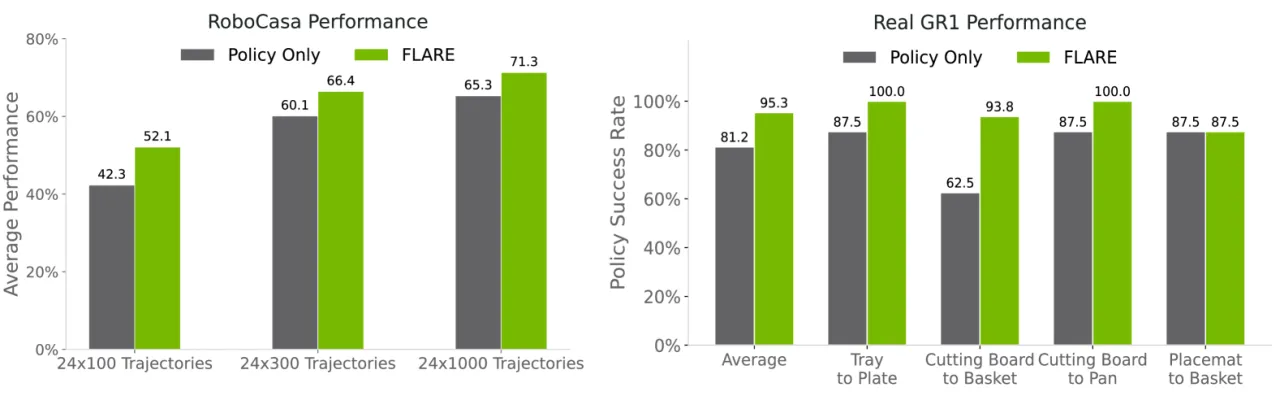
图 5–6:在 RoboCasa 仅 100 条轨迹的数据高效场景下,FLARE 较 Policy Only 提升约 10%。在真实 GR-1 机器人(每任务 100 次遥操作示范)上,FLARE 达到 95.1% 成功率,较 baseline 高约 14%。Figures 5–6: In the data-efficient RoboCasa setting with only 100 trajectories, FLARE improves over Policy Only by about 10%. On the real GR-1 robot (100 teleoperated demonstrations per task), FLARE reaches 95.1% success, roughly 14% above the baseline.
人类视频辅助的新物体泛化Novel-Object Generalization Aided by Human Video
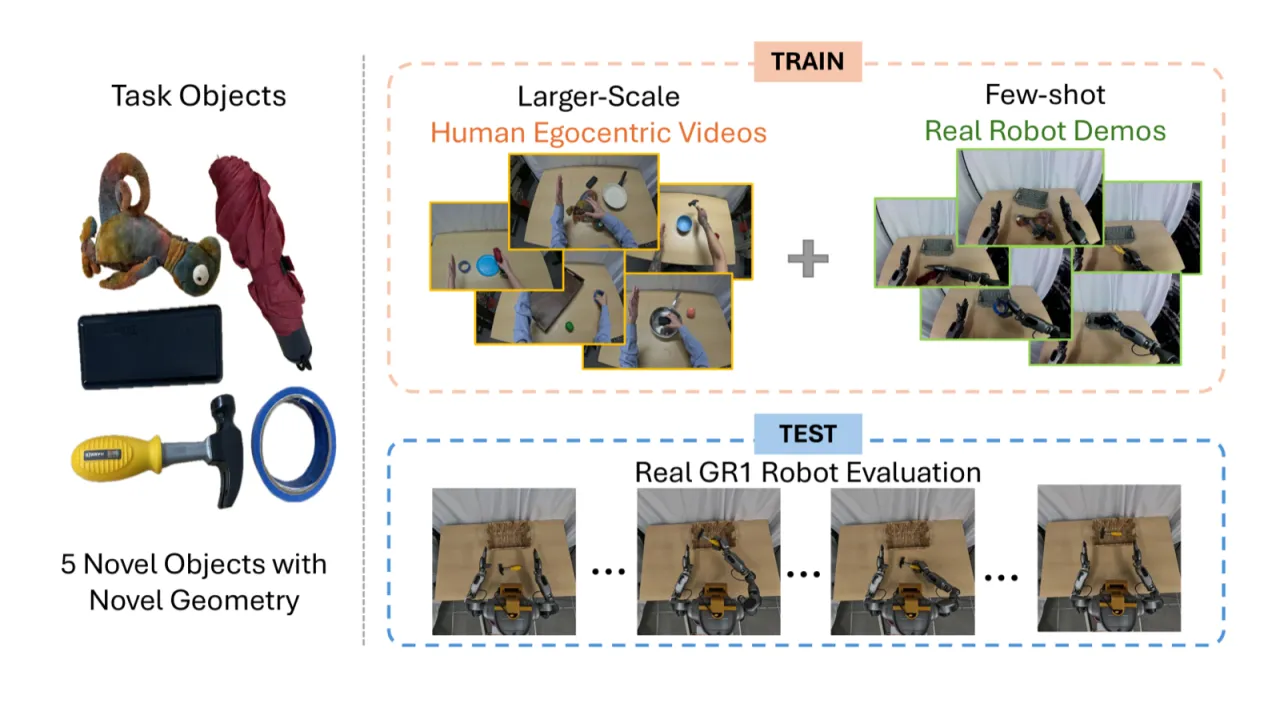
图 7:在新物体泛化实验中,以 10 个真实机器人示范 + 150 段人类第一视角视频联合训练后,FLARE 在从未见过的物体上达到 80% 成功率;当机器人示范降至仅 1 个时,成功率仍有 60%。纯策略方法在相同设定下表现大幅落后,验证了世界模型损失对人类视频信号的有效利用。Figure 7: In the novel-object generalization experiment, after joint training on 10 real robot demonstrations plus 150 egocentric human videos, FLARE reaches 80% success on objects it has never seen; when the robot demonstrations are cut to just 1, success is still 60%. Policy-only methods lag far behind under the same setting, confirming that the world-model loss makes effective use of the human-video signal.
消融研究Ablation Studies
图 8–9:左图展示不同 DiT 层 L 对性能的影响——中间层效果最佳,过浅或过深均会下降;右图展示 EMA 系数 ρ = 0.995 时性能最优。损失权重 λ = 0.2 为最佳,Action-Aware Embedding 对比通用 SigLIP2(49.6–50.9%)提升明显(55.0%)。Figures 8–9: Left, the effect of the DiT layer L on performance — intermediate layers work best, while too shallow or too deep degrades results; right, performance peaks at an EMA coefficient ρ = 0.995. A loss weight of λ = 0.2 is best, and the Action-Aware Embedding clearly improves on the generic SigLIP2 (49.6–50.9%), reaching 55.0%.
04局限性Limitations
Note:以下局限性均来自论文原文的 Limitations 部分(stated by the authors);附带标注 inferred 的为设计层面合理推断。All limitations below are taken from the Limitations section of the paper itself (stated by the authors); those marked inferred are reasonable design-level inferences.
任务范围局限于拾放操作Task scope limited to pick-and-place
论文明确指出:"we focus mainly on imitation learning with pick-and-place tasks on a real humanoid robot. Extending to more complex humanoid tasks that require more fine-grained dexterous manipulation … remains an important direction."细粒度灵巧操作(如工具使用、精密装配)尚未验证。The paper states explicitly: "we focus mainly on imitation learning with pick-and-place tasks on a real humanoid robot. Extending to more complex humanoid tasks that require more fine-grained dexterous manipulation … remains an important direction." Fine-grained dexterous manipulation (tool use, precision assembly and the like) has not been validated.
未集成强化学习Reinforcement learning not integrated
论文将"incorporating reinforcement learning into the training paradigm"列为重要未来方向。目前 FLARE 仅在模仿学习框架下验证,RL 是否能进一步放大世界模型带来的收益尚不清楚。The paper lists "incorporating reinforcement learning into the training paradigm" as an important future direction. So far FLARE has been validated only within an imitation-learning framework, and whether RL can further amplify the gains brought by the world model remains unclear.
人类视频数据采集受限(inferred)Constrained collection of human video data (inferred)
人类视频泛化实验依赖头戴式 GoPro 相机在受控环境中录制,视角与光照条件相对固定。论文提及"controlled settings using head-mounted GoPro cameras"。对真实野外场景的泛化能力尚未评估。The human-video generalization experiment relies on recordings made with head-mounted GoPro cameras in controlled environments, with relatively fixed viewpoints and lighting. The paper mentions "controlled settings using head-mounted GoPro cameras". Generalization to real in-the-wild scenes has not been evaluated.
对少量专家示范的依赖(inferred)Dependence on a modest set of expert demonstrations (inferred)
实验中真实机器人每任务使用 100 次遥操作示范;即便是"data-efficient"设定也需要 100 条轨迹。在极少示范(1–5 次)场景下,性能会显著下降,系统对示范质量较为敏感。In the experiments the real robot uses 100 teleoperated demonstrations per task; even the "data-efficient" setting requires 100 trajectories. With very few demonstrations (1–5), performance degrades markedly, and the system is fairly sensitive to demonstration quality.