FIPER: Failure Prediction at Runtime for Generative Robot Policies
无需失效数据的生成式机器人策略运行时失效预测框架A runtime failure prediction framework for generative robot policies that needs no failure data
Ralf Römer*, Adrian Kobras*, Luca Worbis, Angela P. Schoellig · Technical University of Munich · NeurIPS 2025
生成式模仿学习策略(扩散模型、flow matching)已能让机器人执行复杂的长时域任务,但分布偏移与动作误差累积仍会导致不可预期的失效行为。FIPER 提出一套轻量级运行时失效预测框架,无需任何失效样本,通过同时检测连续 out-of-distribution (OOD) 观测与高度不确定的动作分布来提前预警,在五个仿真和真实世界任务上达到最高的预测精度与最早的预警时机。Generative imitation learning policies (diffusion models, flow matching) already let robots carry out complex, long-horizon tasks, yet distribution shift and compounding action errors can still cause unpredictable failure behavior. FIPER proposes a lightweight runtime failure prediction framework that requires no failure samples: it warns early by simultaneously detecting persistent out-of-distribution (OOD) observations and highly uncertain action distributions, reaching the highest prediction accuracy and the earliest warning time across five simulated and real-world tasks.
基于生成模型的模仿学习策略(Imitation Learning, IL)在复杂机器人操作任务中取得了显著进展,但它们在现实部署中仍面临严峻的安全挑战:未见过的视觉或状态分布偏移(distribution shift)以及动作预测的误差累积,都可能导致策略产生危险行为甚至任务失败。在面向人类的安全关键环境中,尽早预测此类失效至关重要,以便及时干预或触发安全回退机制。Imitation Learning (IL) policies built on generative models have made remarkable progress on complex robot manipulation tasks, yet they still face severe safety challenges in real deployment: unseen visual or state distribution shift, together with compounding errors in action prediction, can drive the policy into dangerous behavior or even outright task failure. In human-centered, safety-critical environments, predicting such failures as early as possible is essential so that intervention or a safe fallback mechanism can be triggered in time.
"Distribution shifts from unseen environments or compounding action errors can still cause unpredictable and unsafe behavior, leading to task failure. Early failure prediction during runtime is therefore essential for deploying robots in human-centered and safety-critical environments."
现有方法存在两类主要缺陷:Existing methods suffer from two main shortcomings:
纯 OOD 检测方法(如 PCA-kmeans、logpZO):对任何新颖情景都会触发警报,即使策略能够泛化处理该情况,导致大量误报(false alarms)。Pure OOD detection methods (e.g. PCA-kmeans, logpZO): they raise an alarm for any novel situation, even one the policy generalizes to and handles fine, which produces a flood of false alarms.
基于视觉语言模型(VLM)的监控方法:只能在错误已经发生后才发出警报,无法提前预测失效,失去干预时机。Monitoring methods based on vision-language models (VLM): they can only raise an alarm after the error has already happened, cannot predict the failure in advance, and thus miss the window for intervention.
关键洞察:真正的任务失效同时伴随着两个信号——连续的 OOD 观测以及动作分布的持续高不确定性。仅关注其中之一会导致误报过多或检测过晚。Key insight: a genuine task failure is accompanied by two signals at once — persistent OOD observations and sustained high uncertainty in the action distribution. Watching only one of them leads either to too many false alarms or to detection that comes too late.
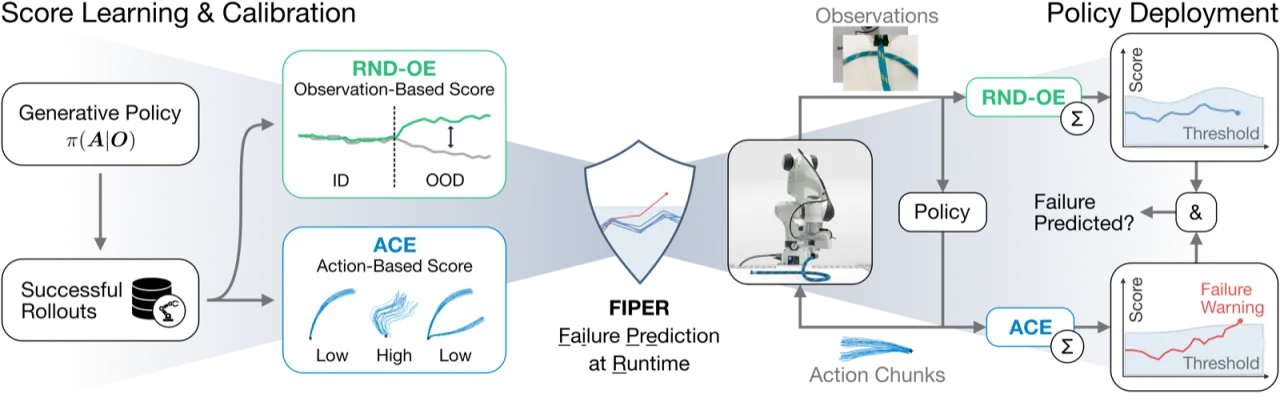
图 1:FIPER 框架总览。左侧为 Score Learning & Calibration 阶段(使用成功 rollout 训练 RND-OE 和 ACE 评分并通过 conformal prediction 标定阈值),右侧为运行时(Policy Deployment)推断阶段——两个子模块的评分在滑动窗口上聚合,当两者同时超过阈值时触发失效警告(Failure Warning)。Figure 1: Overview of the FIPER framework. Left is the Score Learning & Calibration stage, where successful rollouts train the RND-OE and ACE scores and conformal prediction calibrates the thresholds. Right is the runtime (Policy Deployment) inference stage — the scores of the two submodules are aggregated over sliding windows, and a Failure Warning fires when both exceed their thresholds at the same time.
FIPER(Failure Prediction at Runtime for generative IL policies)由两个互补子模块组成,分别从观测侧和动作侧检测失效前兆,通过逻辑"与"(AND)组合两者的警告信号,并用 conformal prediction 在少量成功 rollout 上标定各自阈值,实现对误报概率的统计保证。FIPER (Failure Prediction at Runtime for generative IL policies) consists of two complementary submodules that detect failure precursors on the observation side and on the action side respectively. Their warning signals are combined by a logical AND, and conformal prediction calibrates each threshold on a small number of successful rollouts, giving a statistical guarantee on the false-alarm probability.
RND-OE:基于随机网络蒸馏的 OOD 观测检测RND-OE: OOD observation detection via Random Network Distillation
Random Network Distillation (RND) 最初用于强化学习中的探索激励。FIPER 将其应用于策略的观测嵌入空间(observation embedding space),利用预训练好的策略编码器 h(·)(如 ResNet-18)提取嵌入,再训练一个预测网络 fθ(·) 去拟合随机目标网络 g(·) 在 ID 成功数据上的输出。OOD 样本会使两个网络的输出产生较大偏差,RND-OE 评分 sRND(Ot) = ‖fθ(Ot) − g(Ot)‖² 即量化这一差异。将该评分在大小为 wO 的滑动窗口上聚合,得到观测侧失效预测分 ηO。Random Network Distillation (RND) was originally used as an exploration bonus in reinforcement learning. FIPER applies it to the policy's observation embedding space: embeddings are extracted with the pretrained policy encoder h(·) (e.g. ResNet-18), and a predictor network fθ(·) is trained to fit the output of a random target network g(·) on in-distribution successful data. OOD samples make the outputs of the two networks diverge markedly, and the RND-OE score sRND(Ot) = ‖fθ(Ot) − g(Ot)‖² quantifies exactly this difference. Aggregating the score over a sliding window of size wO yields the observation-side failure prediction score ηO.
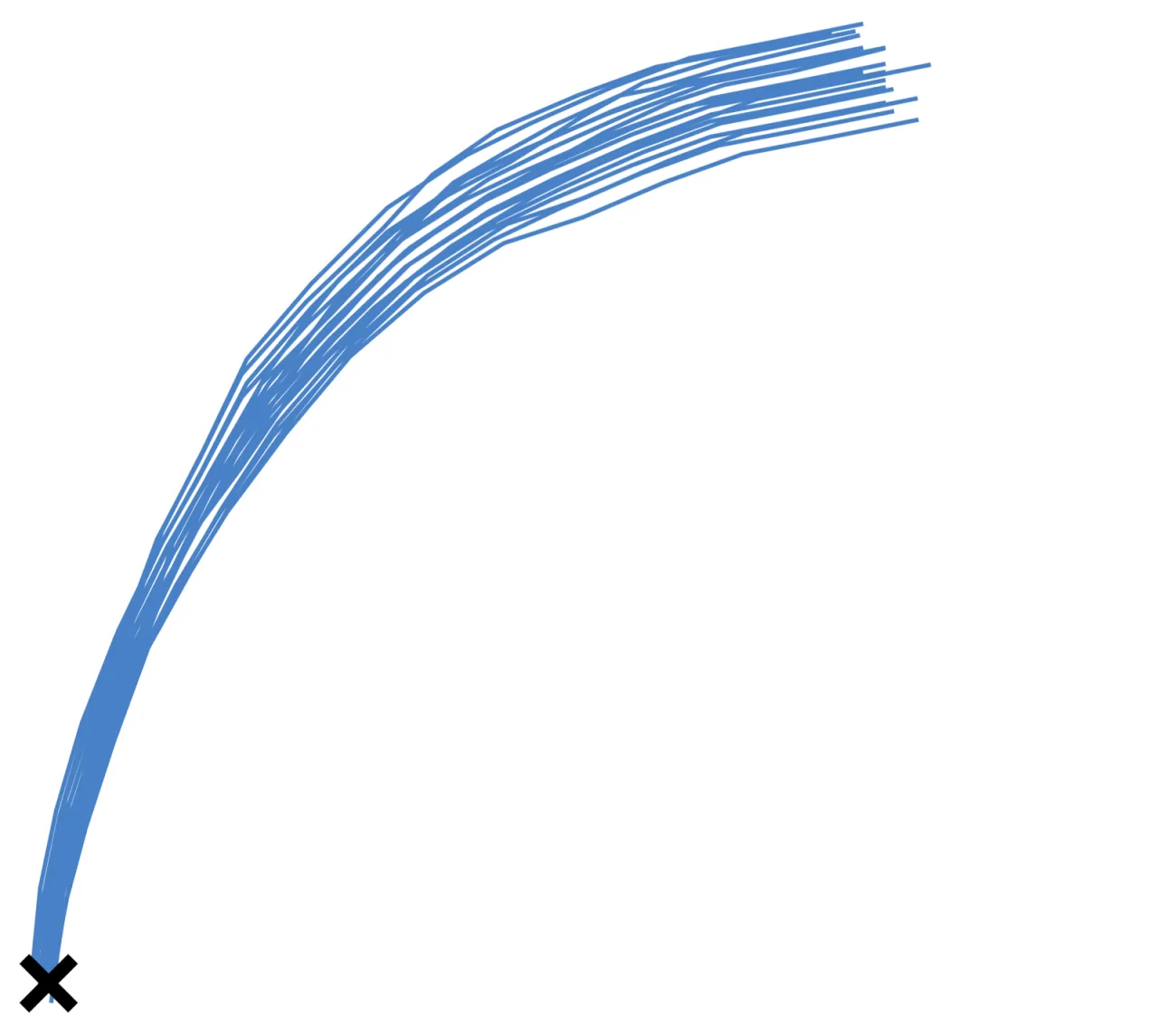
生成式策略在成功 rollout 中也可能产生高方差动作(多模态演示),因此方差并不是不确定性的可靠指标。FIPER 通过采样一批动作 At(1..B) ∼ π(·|Ot),对每个预测步骤计算动作维度上的分箱熵(dimension-wise binning entropy),再对整个 action chunk 求和得到 ACE 评分 sACE(At)。高熵意味着策略"拿不定主意"——无法确定当前应归属哪种行为模式,是潜在失效的前兆。同样在大小为 wA 的滑动窗口上聚合,得到动作侧失效预测分 ηA。A generative policy can produce high-variance actions even in successful rollouts (multimodal demonstrations), so variance is not a reliable indicator of uncertainty. FIPER instead samples a batch of actions At(1..B) ∼ π(·|Ot), computes a dimension-wise binning entropy at every prediction step, and sums it over the whole action chunk to obtain the ACE score sACE(At). High entropy means the policy cannot make up its mind — it cannot tell which behavior mode the current situation belongs to, a precursor of potential failure. Again aggregated over a sliding window of size wA, it yields the action-side failure prediction score ηA.
利用 M 条成功 rollout(仿真环境 M = 50,真实世界 M = 10)作为标定数据集 Dc,通过 functional conformal prediction 计算时变阈值 γO,t 和 γA,t。此设计提供统计保证:对于新的成功 rollout τ,FIPER 误报的概率上界为 δ(可调设计参数):Using M successful rollouts (M = 50 in simulation, M = 10 in the real world) as the calibration set Dc, functional conformal prediction computes the time-varying thresholds γO,t and γA,t. This design provides a statistical guarantee: for a new successful rollout τ, the probability that FIPER raises a false alarm is upper-bounded by δ (a tunable design parameter):
P(∃t: F(τ:t) = 1) ≤ δ
仅当两个子模块的聚合评分同时超过各自阈值时,FIPER 才触发失效警告:F(τ:t) = FO(τ:t) ∧ FA(τ:t)。逻辑 AND 设计有效抑制误报,同时论文实验表明仍能检出 91% 的真实失效。FIPER raises a failure warning only when the aggregated scores of both submodules exceed their respective thresholds at the same time: F(τ:t) = FO(τ:t) ∧ FA(τ:t). The logical AND design effectively suppresses false alarms, while the paper's experiments show it still detects 91% of the true failures.
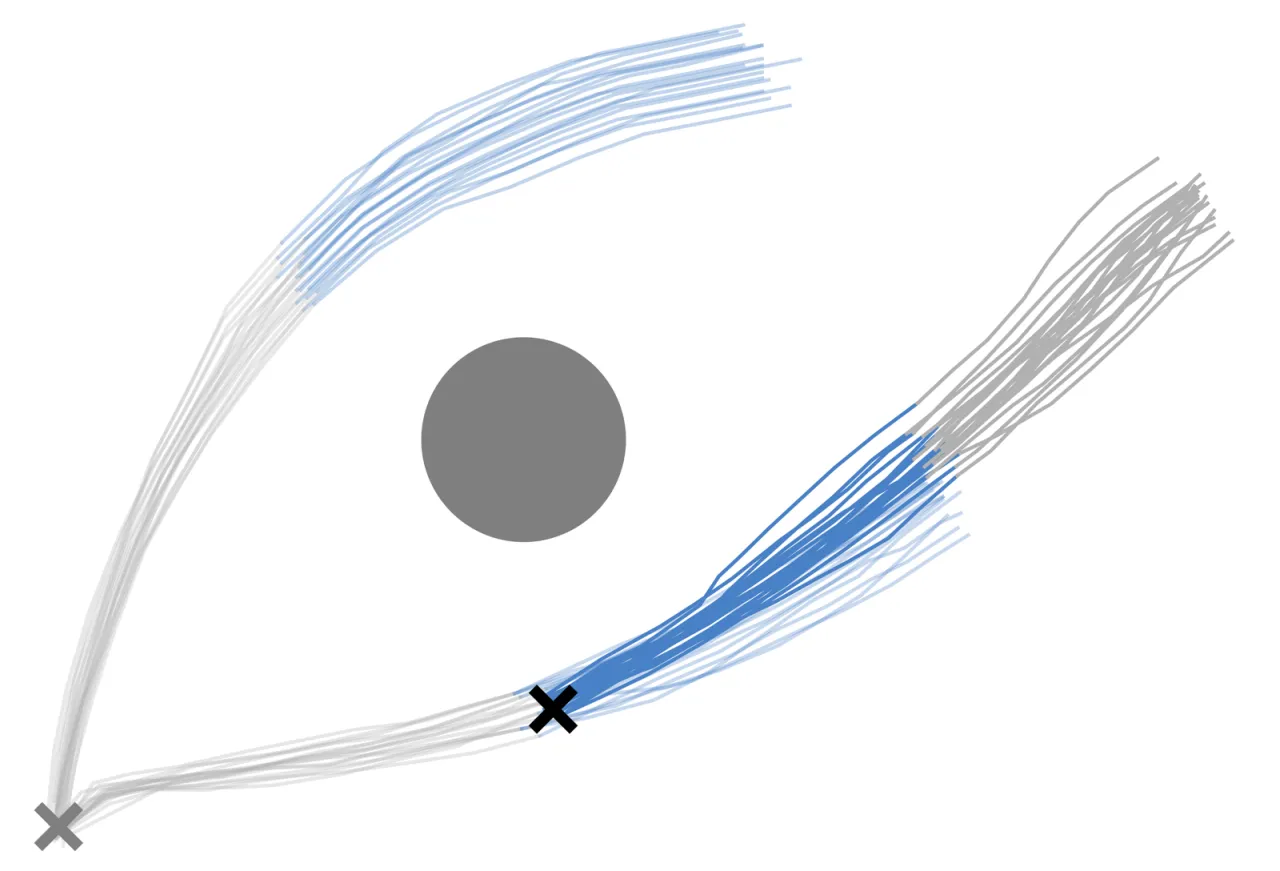
图 2:生成式策略中的动作不确定性示意。低熵(left):策略在多模态演示中坚定地选择某一行为模式;高熵(right):策略在模式之间摇摆不定,熵值升高,预示潜在失效。ACE 评分设计可正确区分"正常的多模态选择"与"病态的模糊不确定"。Figure 2: Illustration of action uncertainty in generative policies. Low entropy (left): among multimodal demonstrations the policy firmly commits to one behavior mode. High entropy (right): the policy oscillates between modes, entropy rises, and a potential failure is foreshadowed. The ACE score is designed to tell normal multimodal choice apart from pathological ambiguity.图 3:时序动作块中的熵评分(ACE)与 STAC 方法对比。ACE 能检测出策略在连续多个时间步上的持续高不确定性,而 STAC 在多模态任务(如 SORTING、STACKING)中容易因模式切换而误判。Figure 3: Entropy scoring over temporal action chunks (ACE) compared with the STAC method. ACE detects sustained high uncertainty of the policy across consecutive timesteps, whereas STAC is prone to misjudgment on multimodal tasks (such as SORTING and STACKING) because of mode switching.
03实验Experiments
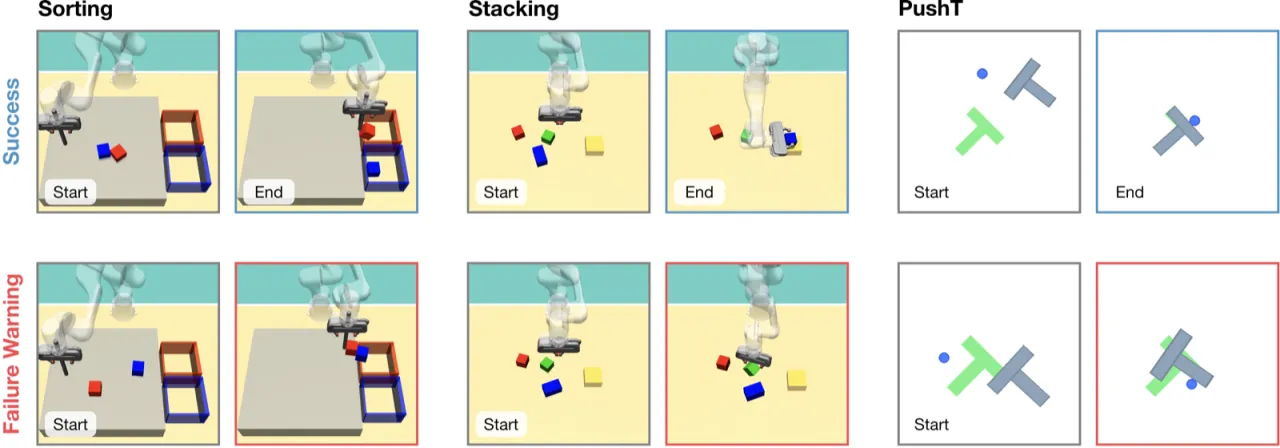
在 5 个多样化环境中(3 个仿真:SORTING、STACKING、PUSH-T;2 个真实:PRETZEL、PUSH CHAIR)评测 FIPER,覆盖不同机器人形态、观测/动作空间和 OOD 失效模式。基线包括 PCA-kmeans、logpZO(FAIL-Detect)、STAC(Sentinel)和 RND-A(ReDiffuser)。评测指标:Timestep-wise Accuracy (TWA)、Accuracy、Detection Time (DT)、TPR、TNR。FIPER is evaluated in 5 diverse environments (3 simulated: SORTING, STACKING, PUSH-T; 2 real: PRETZEL, PUSH CHAIR), covering different robot embodiments, observation/action spaces and OOD failure modes. Baselines include PCA-kmeans, logpZO (FAIL-Detect), STAC (Sentinel) and RND-A (ReDiffuser). Evaluation metrics: Timestep-wise Accuracy (TWA), Accuracy, Detection Time (DT), TPR, TNR.
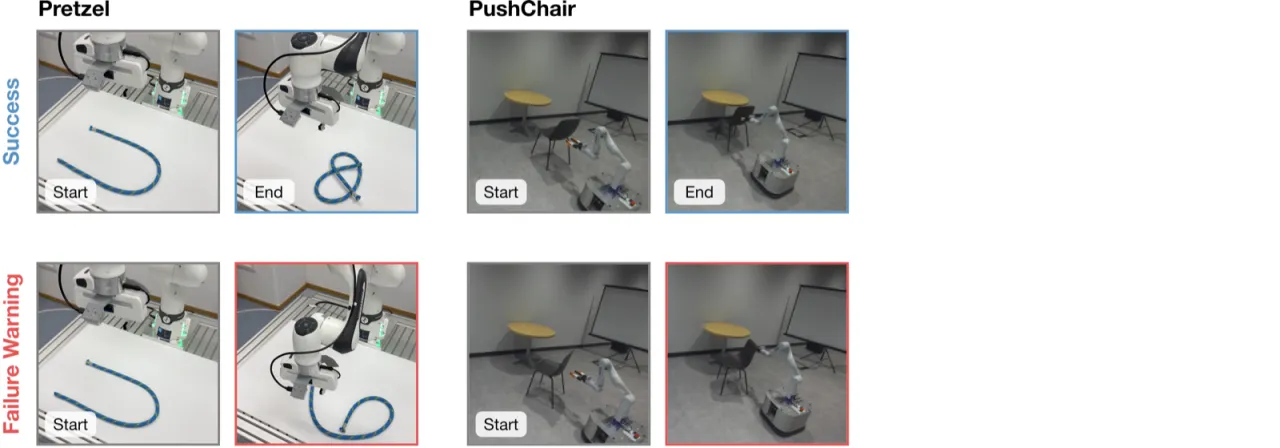
图 4:三个仿真评测任务。左:SORTING(将积木推入颜色匹配的盒子);中:STACKING(将三个积木堆叠到目标区域,有六种可能排列);右:PUSH-T(将 T 形物体推入目标构型)。OOD 场景通过改变积木/T 形物尺寸和目标位置引入。Figure 4: The three simulated evaluation tasks. Left: SORTING (push blocks into color-matched boxes). Middle: STACKING (stack three blocks in a target area, with six possible arrangements). Right: PUSH-T (push a T-shaped object into a target configuration). OOD scenarios are introduced by changing the size of the blocks / T-object and the target positions.图 5:两个真实机器人评测任务。左:PRETZEL(Franka 机器人将绳子折叠成蝴蝶结形状,OOD 为变化绳子初始位姿);右:PUSH CHAIR(移动操作臂将椅子推到目标位置,OOD 为变化椅子初始位姿)。Figure 5: The two real-robot evaluation tasks. Left: PRETZEL (a Franka robot folds a rope into a bow shape; OOD comes from varying the rope's initial pose). Right: PUSH CHAIR (a mobile manipulator pushes a chair to a target position; OOD comes from varying the chair's initial pose).
主要结果Main results
下表展示 FIPER 与各基线方法的核心指标对比(均值 ± 标准差,五个随机种子)。加粗为最优,下划线为次优。The table below compares FIPER with the baselines on the core metrics (mean ± standard deviation over five random seeds). Bold marks the best, underline the runner-up.
任务Task
指标Metric
PCA-kmeans
logpZO
RND-A
STAC
FIPER(ours)FIPER (ours)
SORTING
TWA ↑
0.49
0.54
0.55
0.46
0.54±0.00
Acc. ↑
0.56
0.67
0.62±0.01
0.48
0.66±0.00
DT ↓
(0.15)
0.48±0.01
0.34±0.03
(0.46)
0.32±0.00
STACKING
TWA ↑
0.66±0.00
0.58±0.00
0.50±0.00
0.56±0.01
0.62±0.00
Acc. ↑
0.75±0.00
0.69±0.01
0.59±0.00
0.66±0.00
0.73±0.00
DT ↓
0.19±0.00
0.49±0.00
(0.44±0.01)
(0.38±0.00)
0.28±0.00
PUSH-T
TWA ↑
0.53±0.00
0.52±0.00
0.52±0.00
0.58±0.00
0.55±0.00
Acc. ↑
0.58±0.00
0.55±0.01
0.55±0.01
0.71±0.00
0.71±0.00
DT ↓
(0.11)
(0.26)
(0.20±0.02)
0.52±0.00
0.32±0.00
PRETZEL
TWA ↑
0.64±0.00
0.58±0.03
0.51±0.05
0.51±0.00
0.68±0.03
Acc. ↑
0.65±0.00
0.65±0.04
0.53±0.05
0.67±0.00
0.85±0.00
DT ↓
(0.01)
0.24±0.04
(0.52±0.36)
0.44±0.00
0.33±0.07
PUSH CHAIR
TWA ↑
0.50±0.00
0.78±0.02
0.71±0.05
0.73±0.00
0.83±0.02
Acc. ↑
0.50±0.00
0.92±0.02
0.82±0.05
0.88±0.00
0.96±0.02
DT ↓
(0.00)
0.26±0.01
0.21±0.02
0.30±0.00
0.27±0.00
Average
TWA ↑
0.57±0.00
0.60±0.01
0.56±0.02
0.57±0.00
0.65±0.01
Acc. ↑
0.61±0.00
0.69±0.01
0.62±0.03
0.68±0.00
0.78±0.00
DT ↓
(0.09)
0.35±0.01
0.34±0.09
0.42±0.00
0.30±0.02
括号中的 DT 值(如 (0.15))表示对应方法的 TPR 或 TNR 低于 0.4,即无法有效区分成功与失败,该检测时间数值无实际参考意义。整体 TPR 达 0.92,说明 FIPER 在多样化环境中可高可靠地预测各类失效。A DT value in parentheses, e.g. (0.15), means that the TPR or TNR of that method is below 0.4, i.e. it cannot effectively separate success from failure, so its detection time carries no practical meaning. The overall TPR reaches 0.92, showing that FIPER can predict all kinds of failures with high reliability across diverse environments.
消融研究Ablation studies
Table 2 对逻辑组合方式与阈值类型进行消融。AND(逻辑与)组合在所有阈值类型下均优于 OR(逻辑或)组合,在 time-varying 阈值下达到最高 TWA(0.65)、Accuracy(0.78)和 TPR(0.91)。关键结论:Table 2 ablates the logical combination rule and the threshold type. The AND combination outperforms OR under every threshold type, and with time-varying thresholds it attains the highest TWA (0.65), Accuracy (0.78) and TPR (0.91). Key conclusions:
逻辑 AND 通过要求两个信号同时超阈来过滤 OOD 成功场景,TNR 高达 0.65,有效抑制误报。By requiring both signals to cross their thresholds at once, the logical AND filters out OOD-but-successful situations, pushing TNR as high as 0.65 and effectively suppressing false alarms.
Time-varying 阈值(FIPER 默认)比 CP constant 阈值更早发出警告(DT = 0.30 vs. 0.45),TWA 也更高。Time-varying thresholds (the FIPER default) warn earlier than CP constant thresholds (DT = 0.30 vs. 0.45) and also give a higher TWA.
将不确定性评分在滑动窗口上聚合,比逐时刻判断(w=1)和累积全历史两种方案都更稳健,在早发现和低误报之间取得最佳平衡。Aggregating the uncertainty scores over a sliding window is more robust than either judging each timestep on its own (w=1) or accumulating the entire history, striking the best balance between early detection and few false alarms.
04局限性Limitations
Note:以下局限性均由作者在论文 Conclusions and Limitations 一节中明确指出。All limitations below are explicitly stated by the authors in the Conclusions and Limitations section of the paper.
需要收集成功 rollout 数据并单独训练 RND-OE 模型Requires collecting successful rollout data and training a separate RND-OE model
尽管 FIPER 仅使用少量成功 rollout(仿真 50 条,真实世界 10 条)进行标定,但仍然需要额外收集这些数据并训练一个与策略独立的 RND-OE 网络,增加了部署前的准备工作量。作者将此列为方法的主要局限之一。Although FIPER uses only a small number of successful rollouts for calibration (50 in simulation, 10 in the real world), these data still have to be collected in addition, and an RND-OE network independent of the policy still has to be trained, which increases the preparation effort before deployment. The authors list this as one of the main limitations of the method.
高维动作空间下的运行时计算开销Runtime computational overhead in high-dimensional action spaces
在本文所考虑的环境中,FIPER 的运行时计算量较小。但对于动作空间维度极高的场景(例如人形机器人),ACE 评分所需的批量采样和熵计算可能带来显著的计算延迟,影响实时性。In the environments considered in this paper, the runtime computation of FIPER is small. But for settings whose action space is extremely high-dimensional (humanoid robots, for example), the batched sampling and entropy computation required by the ACE score may introduce noticeable computational latency and hurt real-time performance.
仅针对单任务视觉模仿学习策略验证Validated only on single-task visual imitation learning policies
本文评测均基于单任务、视觉输入的 IL 策略(Diffusion Policy 和 flow matching)。将 FIPER 扩展至大规模视觉语言动作模型(VLA,如 π0、OpenVLA)、多模态输入(触觉、语言)以及强化学习生成式策略,仍是未来工作方向,尚未在本文中验证。All evaluations in this paper are based on single-task, vision-based IL policies (Diffusion Policy and flow matching). Extending FIPER to large vision-language-action models (VLA, such as π0 and OpenVLA), to multimodal inputs (touch, language) and to generative reinforcement learning policies remains future work and is not validated in this paper.
需要访问策略内部嵌入空间Requires access to the internal embedding space of the policy
RND-OE 复用策略的预训练观测编码器 h(·),因此 FIPER 不适用于以黑盒 API 形式部署的策略。不过,由于 FIPER 不需要访问训练数据本身,作者预期其对未来 VLA 扩展也能较好适用。RND-OE reuses the pretrained observation encoder h(·) of the policy, so FIPER does not apply to policies deployed as black-box APIs. However, since FIPER does not need access to the training data itself, the authors expect it to carry over well to future VLA extensions.