Test-Time Training from Environment Feedback for Vision-Language-Action Models
Zechen Bai · Chen Gao · Mike Zheng Shou · Show Lab, National University of Singapore
EVOLVE-VLA 提出了一种基于环境反馈的 test-time training 框架,使 VLA 模型能够通过与环境的在线交互持续改进,而无需额外的人工示范。该框架结合学习式进度估计器(VLAC)、Accumulative Progress Estimation 和 Progressive Horizon Extension,在 LIBERO 基准上实现了显著的性能提升,并首次展示了无任务演示情况下的跨任务泛化能力。EVOLVE-VLA proposes a test-time training framework driven by environment feedback, allowing VLA models to keep improving through online interaction with the environment without any additional human demonstrations. Combining a learned progress estimator (VLAC), Accumulative Progress Estimation and Progressive Horizon Extension, the framework achieves substantial gains on the LIBERO benchmark and, for the first time, demonstrates cross-task generalization without task demonstrations.
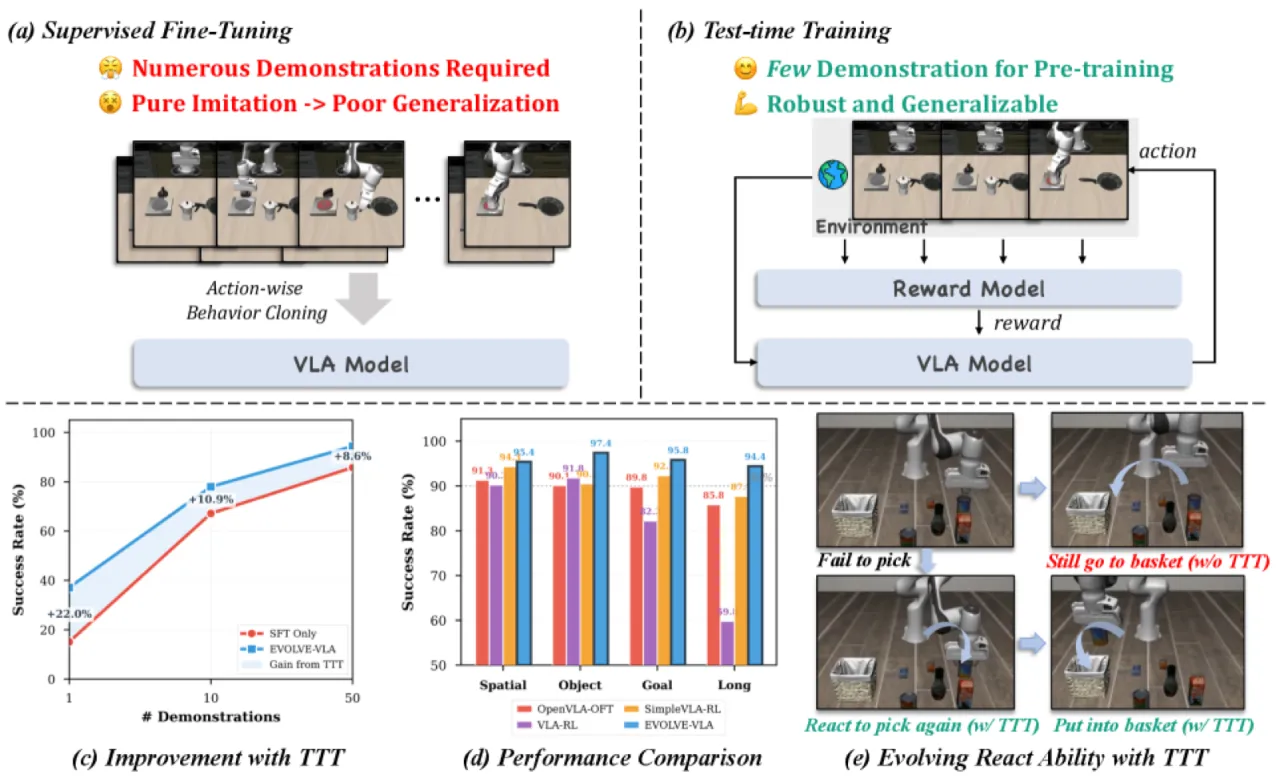
当前的 VLA 模型依赖大规模的监督微调(SFT),这在实际部署中存在两大根本缺陷:高昂的数据采集成本以及脆弱的分布内记忆。模型在面对部署环境与训练分布的差异时几乎无法自适应恢复。Current VLA models rely on large-scale supervised fine-tuning (SFT), which suffers from two fundamental drawbacks in real deployment: the high cost of data collection and brittle in-distribution memorization. When the deployment environment differs from the training distribution, such models can hardly adapt or recover.
"How do humans develop manipulation skills? We do not simply watch an expert perform a task once and then flawlessly replicate it. Instead, we learn through practice: attempting the task repeatedly, making mistakes, receiving feedback from the environment, and gradually refining our movements through continued experience."
作者指出,现有 VLA 的两大核心瓶颈为:The authors identify two core bottlenecks of existing VLAs:
高昂的数据成本:适应一个新任务往往需要收集数百条人工示范;High data cost: adapting to a new task usually requires collecting hundreds of human demonstrations;
脆弱的记忆化泛化(brittle memorization):通过行为克隆训练的 VLA 仅能模仿示范,一旦执行偏差发生,便缺乏恢复能力,更无法泛化到训练分布之外。Brittle memorized generalization (brittle memorization): a VLA trained by behavior cloning can only imitate demonstrations; once execution deviates, it lacks the ability to recover, let alone generalize beyond the training distribution.
Figure 1:传统 SFT 范式(左)与 EVOLVE-VLA 的 test-time training 框架(右)对比。随着交互次数增加,EVOLVE-VLA 在 LIBERO-Long 和 1-shot 场景下均大幅超越 SFT 基线。Figure 1: Comparison between the conventional SFT paradigm (left) and the test-time training framework of EVOLVE-VLA (right). As the number of interactions grows, EVOLVE-VLA substantially surpasses the SFT baseline in both the LIBERO-Long and the 1-shot settings.
+8.6%LIBERO-Long 成功率提升LIBERO-Long success rate gain
+17.7%1-shot 学习平均提升average gain in 1-shot learning
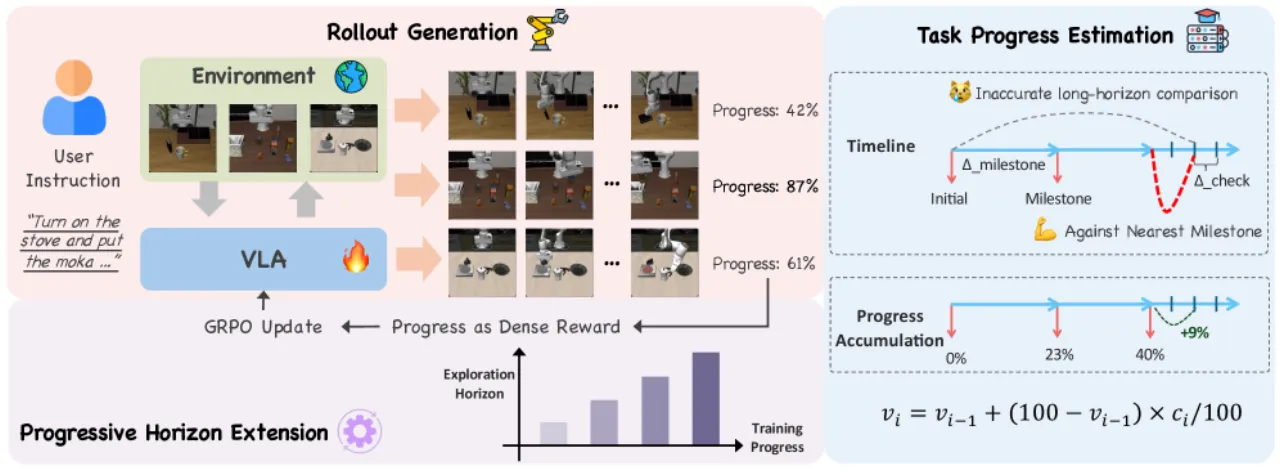
EVOLVE-VLA 的核心思路是:在测试时让 VLA 与真实或模拟环境交互,用环境反馈信号(而非人工标注)驱动在线强化学习,从而在无需额外示范的情况下持续提升策略。框架由三个相互协作的组件构成。The core idea of EVOLVE-VLA is to let the VLA interact with a real or simulated environment at test time and to drive online reinforcement learning with environment feedback signals rather than human annotations, so that the policy keeps improving without additional demonstrations. The framework consists of three cooperating components.
Figure 2:EVOLVE-VLA 框架总览。VLA 策略(左)与环境交互生成轨迹,进度估计器 VLAC(中)输出稠密 reward,GRPO(右)利用组内相对优势更新策略,无需单独 value network。Figure 2: Overview of the EVOLVE-VLA framework. The VLA policy (left) interacts with the environment to generate trajectories, the progress estimator VLAC (middle) outputs dense reward, and GRPO (right) updates the policy using group-relative advantages, requiring no separate value network.
由于现实环境中难以获取稀疏成功信号,EVOLVE-VLA 引入了基础模型级别的 critic 模型 VLAC。它接收两张图像和任务指令作为输入,输出一个连续的 critic 值——正值表示第二张图相对于第一张在任务完成上有所进展。这一设计将稀疏的结果信号转化为稠密的逐步反馈,有效解决了 sparse reward 的学习困难问题。Because sparse success signals are hard to obtain in real environments, EVOLVE-VLA introduces VLAC, a critic model at the foundation-model level. It takes two images and the task instruction as input and outputs a continuous critic value — a positive value indicates that the second image has made progress toward task completion relative to the first. This design turns sparse outcome signals into dense step-wise feedback and effectively addresses the learning difficulty of sparse reward.
直接使用 VLAC 比较相邻帧会引入大量噪声。论文提出了基于"区间里程碑采样"(interval-based milestone sampling)的累积进度估计策略:将当前状态与最近的里程碑状态对比,而非初始状态,并通过比例调整(proportional adjustments)平滑噪声。消融实验表明,在相同的 reward call 数量(32 次)下,该方法的 F-Score 从 0.04 提升至 0.20,成功率从 88.3% 提升至 91.3%。Directly using VLAC to compare adjacent frames introduces considerable noise. The paper proposes an accumulative progress estimation strategy based on "interval-based milestone sampling": the current state is compared with the most recent milestone state rather than with the initial state, and the noise is smoothed by proportional adjustments. Ablations show that under the same number of reward calls (32), this method raises the F-Score from 0.04 to 0.20 and the success rate from 88.3% to 91.3%.
长时域任务探索困难,策略难以直接从完整轨迹中学习。EVOLVE-VLA 采用渐进式扩展探索视野的训练策略:先让策略掌握较短子目标,再逐步延长任务长度直至完整任务。这一机制带来了额外的 +3.1% 成功率提升(91.3% → 94.4%),如 Table 4 所示。Long-horizon tasks are hard to explore, and a policy can hardly learn directly from complete trajectories. EVOLVE-VLA adopts a training strategy that progressively extends the exploration horizon: the policy first masters shorter sub-goals, and the task length is then gradually extended up to the full task. This mechanism brings an additional +3.1% success rate gain (91.3% → 94.4%), as shown in Table 4.
GRPO 在线优化Online Optimization with GRPO
策略更新采用 Group Relative Policy Optimization(GRPO)。GRPO 在每批轨迹内归一化奖励计算优势,应用 PPO 风格的 clipping 保证稳定更新,且无需独立的 value network,显著降低了计算开销。采样时以 temperature T > 1 采样以增强轨迹多样性。Policy updates use Group Relative Policy Optimization (GRPO). GRPO normalizes rewards within each batch of trajectories to compute advantages, applies PPO-style clipping to guarantee stable updates, and requires no separate value network, which markedly reduces computational overhead. Sampling is performed with temperature T > 1 to enrich trajectory diversity.
03实验Experiments
实验在 LIBERO 基准上进行,该基准包含 4 个任务套件(Spatial / Object / Goal / Long),每套 10 个任务,共 4 种测试场景。基础模型为 OpenVLA-OFT(autoregressive VLA)。Experiments are conducted on the LIBERO benchmark, which contains 4 task suites (Spatial / Object / Goal / Long) with 10 tasks each, i.e. 4 test settings. The base model is OpenVLA-OFT (autoregressive VLA).
主实验:LIBERO 全套件成功率(Table 1)Main Results: Success Rate on All LIBERO Suites (Table 1)
将在 LIBERO-Long 上训练的策略直接部署到 LIBERO-Object:SFT 基线成功率为 0%,而 EVOLVE-VLA 通过纯自主探索,无任务示范地达到 20.8% 成功率——证明了 test-time training 赋予 VLA 超出训练分布的泛化能力。Deploying the policy trained on LIBERO-Long directly to LIBERO-Object: the SFT baseline reaches 0% success, whereas EVOLVE-VLA attains 20.8% success through purely autonomous exploration without any task demonstration — showing that test-time training endows the VLA with generalization beyond the training distribution.
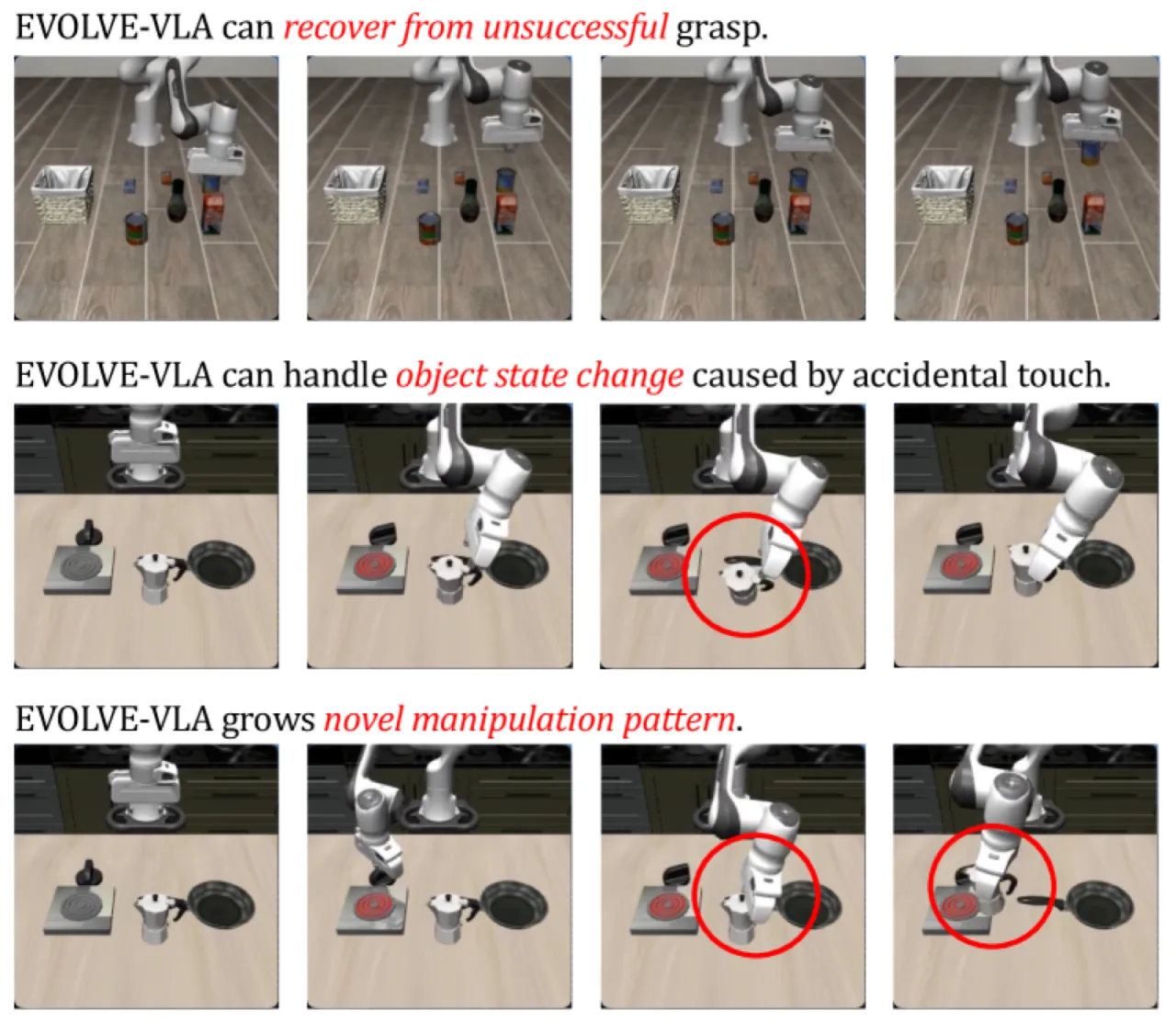
Figure 3:定性对比。EVOLVE-VLA(右列)展示了错误恢复和替代策略选择等 SFT 基线(左列)无法实现的行为,如在抓取失败后重新规划路径。Figure 3: Qualitative comparison. EVOLVE-VLA (right column) exhibits behaviors that the SFT baseline (left column) cannot achieve, such as error recovery and alternative strategy selection, e.g. replanning the path after a failed grasp.
消融实验(Ablations)Ablations
Table 3 验证了 Accumulative Progress Estimation 的有效性:在相同 reward call 数(32 次)下,相比直接比较相邻两帧的基线(F-Score 0.04,SR 88.3%),区间采样策略将 F-Score 提升至 0.20,成功率提升至 91.3%,同时避免了均匀采样(Uniform)随 call 数增加导致 SR 下降的问题。Table 3 validates the effectiveness of Accumulative Progress Estimation: under the same number of reward calls (32), compared with the baseline that directly compares two adjacent frames (F-Score 0.04, SR 88.3%), the interval sampling strategy raises the F-Score to 0.20 and the success rate to 91.3%, while avoiding the SR degradation that Uniform sampling suffers as the number of calls grows.
Table 4 展示了逐步叠加各模块的效果:SFT 85.8% → + Binary Outcome Rewards 87.7% → + Dense Reward (Vanilla Critic) 91.3% → + Progressive Horizon Extension 94.4%,每个模块均贡献了显著提升。Table 4 shows the effect of stacking the modules one by one: SFT 85.8% → + Binary Outcome Rewards 87.7% → + Dense Reward (Vanilla Critic) 91.3% → + Progressive Horizon Extension 94.4%, with every module contributing a clear gain.
04局限性Limitations
Note:以下局限性均为作者在论文中明确陈述(stated)。Note: All limitations below are explicitly stated by the authors in the paper.
Reward Hacking(奖励欺骗)Reward Hacking
进度估计器 VLAC 可能将语义上看似接近完成的状态评分为高分,但环境的规则化成功判据(coordinate rules)仍将其标记为失败。策略因此学会"欺骗"进度估计器而非真正完成任务,导致环境成功率虚低而 critic 评分虚高。The progress estimator VLAC may give a high score to a state that semantically looks close to completion, while the rule-based success criterion of the environment (coordinate rules) still marks it as a failure. The policy therefore learns to "cheat" the progress estimator instead of genuinely completing the task, so the environment success rate is deflated while the critic score is inflated.
环境成功判据与语义完成的不对齐Misalignment between Environment Success Criteria and Semantic Completion
与上述问题对立的一面:部分情况下环境根据坐标规则判定任务成功,但语义上任务并未完整完成(如物体位置满足坐标阈值但方向错误)。这一"inherent difficulty in aligning rule-based simulation criteria with semantic task understanding"是当前框架的固有缺陷,需要更精细的 reward 设计来解决。The flip side of the above problem: in some cases the environment judges the task successful according to coordinate rules, while semantically the task is not fully completed (e.g. the object position satisfies the coordinate threshold but its orientation is wrong). This "inherent difficulty in aligning rule-based simulation criteria with semantic task understanding" is an inherent defect of the current framework and calls for a finer-grained reward design.
仅在模拟环境验证(推断自设计)Validated only in simulation (inferred from design)
所有实验均在 LIBERO 仿真环境中进行。真实机器人部署面临额外挑战:视觉域差距、物理接触噪声、更稀疏且难以自动获取的成功信号。论文未报告真实世界实验,现实可行性有待验证(inferred from design)。All experiments are run in the LIBERO simulator. Real-robot deployment faces additional challenges: the visual domain gap, physical contact noise, and success signals that are sparser and harder to obtain automatically. The paper reports no real-world experiment, so practical feasibility remains to be verified (inferred from design).
依赖 VLAC 进度估计器的质量(推断自设计)Dependence on the quality of the VLAC progress estimator (inferred from design)
整个框架的 reward 质量高度依赖 VLAC 基础模型对操作进度的理解能力。若 VLAC 对特定任务类型(如精细抓取、工具使用)的理解存在偏差,上游 reward 噪声将放大策略训练的误差(inferred from design)。The reward quality of the whole framework depends heavily on how well the VLAC foundation model understands manipulation progress. If VLAC is biased on particular task types (e.g. fine-grained grasping or tool use), upstream reward noise will amplify the errors of policy training (inferred from design).