Agentic Robot Policy Self-Improvement in the Real World
Wenli Xiao†, Jia Xie†, Tonghe Zhang†, Haotian Lin†, Letian "Max" Fu, Haoru Xue, Jalen Lu, Yi Yang, Cunxi Dai, Zi Wang, Jimmy Wu, Guanzhi Wang, S. Shankar Sastry, Ken Goldberg, Linxi "Jim" Fan‡, Yuke Zhu‡, Guanya Shi‡ · NVIDIA · CMU · UC Berkeley
ENPIRE 是一个面向编程智能体(coding agent)的框架,通过"物理反馈闭环"让前沿代码智能体自主迭代机器人策略——无需人工监督,在真实世界灵巧操作任务(Push-T、插针、GPU 插拔、切扎带)上达到 99% pass@8 成功率。ENPIRE is a framework for coding agents: through a "physical feedback loop" it lets frontier code agents autonomously iterate robot policies — without human supervision — reaching a 99% pass@8 success rate on real-world dexterous manipulation tasks (Push-T, pin insertion, GPU insertion and removal, zip-tie cutting).
实现真实世界的灵巧机器人操作,长期依赖大量人工监督与算法工程投入,这是通向"通用物理智能"(general physical intelligence)的核心瓶颈。如果前沿编程智能体能够在机器人上自主运行实验、分析失败、改进策略,这一循环即可在无人介入的情况下持续推进。Achieving dexterous robotic manipulation in the real world has long relied on extensive human supervision and algorithmic engineering, a central bottleneck on the path to "general physical intelligence". If frontier coding agents could autonomously run experiments on robots, analyze failures, and improve policies, this loop could keep advancing without human intervention.
"Achieving dexterous robotic manipulation in the real world relies heavily on human supervision and algorithmic engineering, which is a central bottleneck in the pursuit of general physical intelligence."
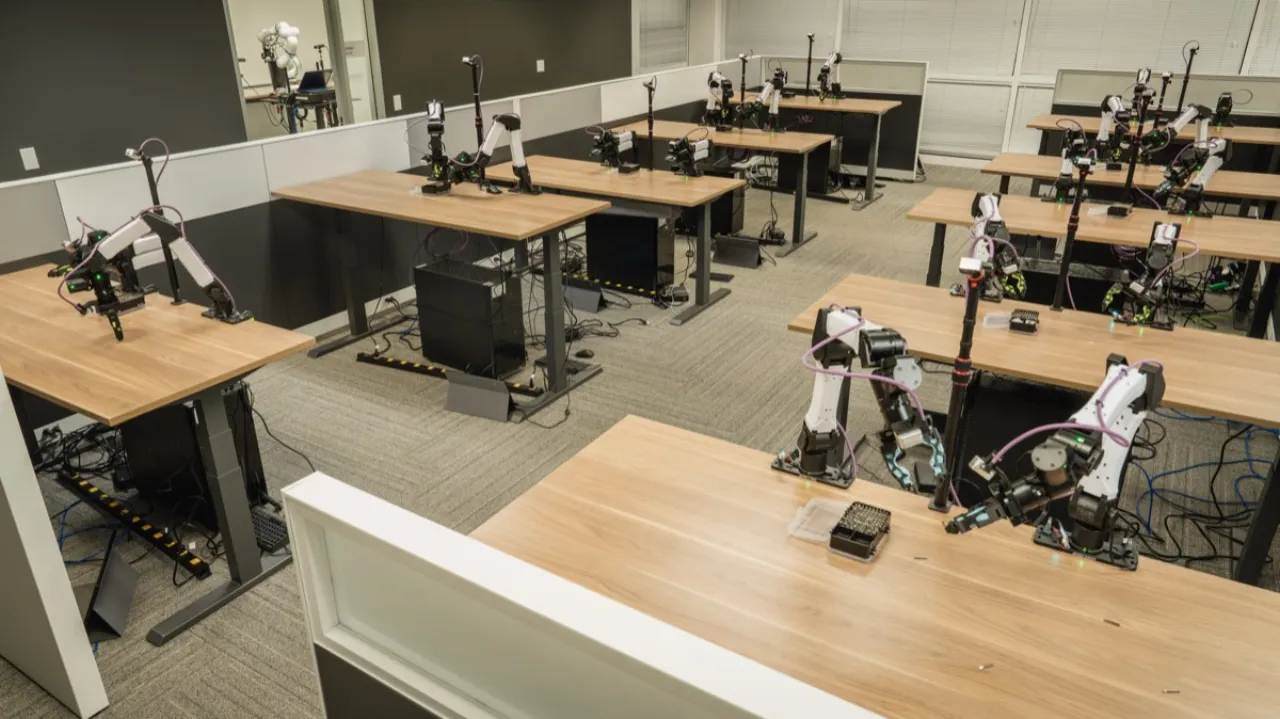
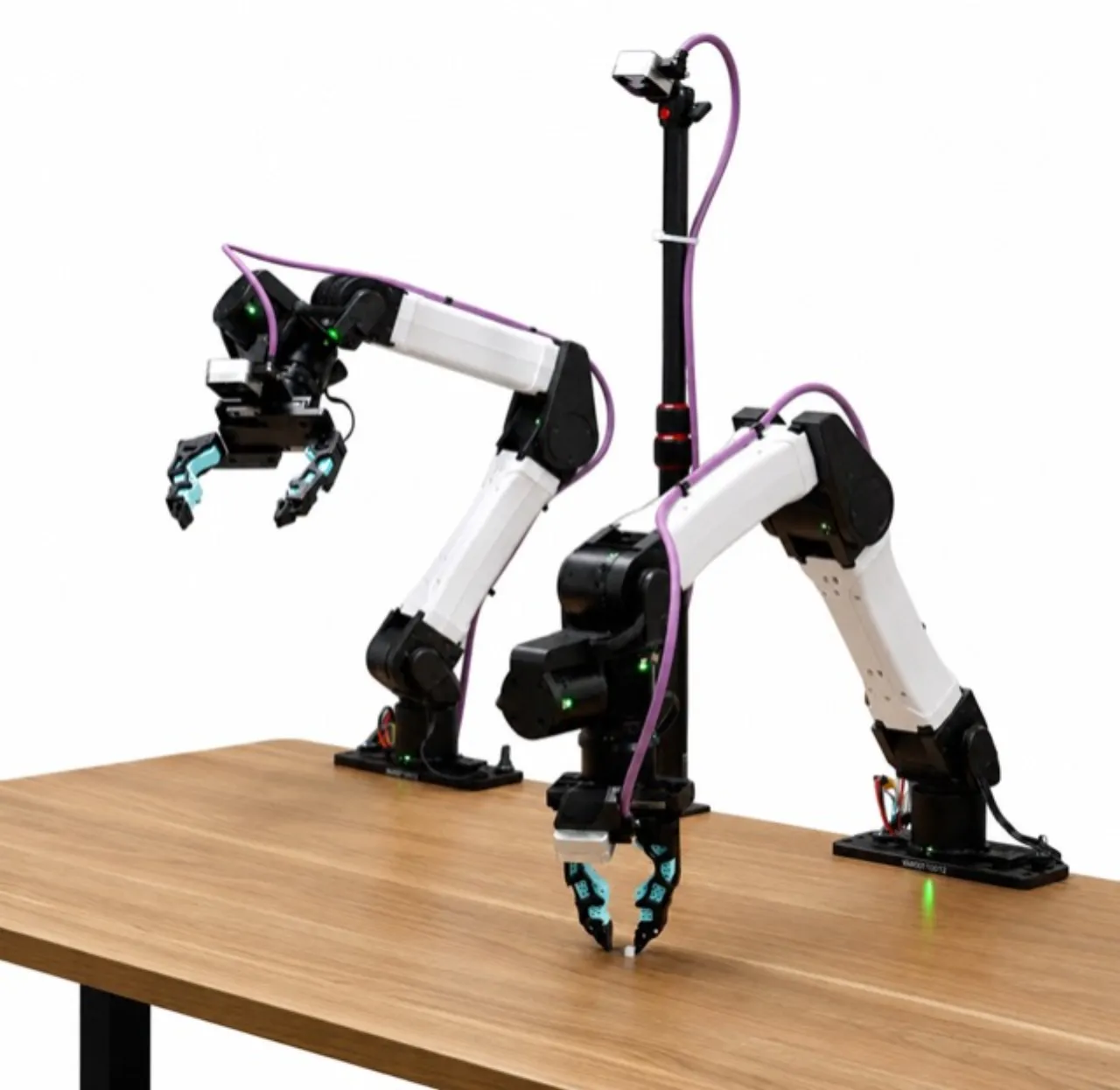
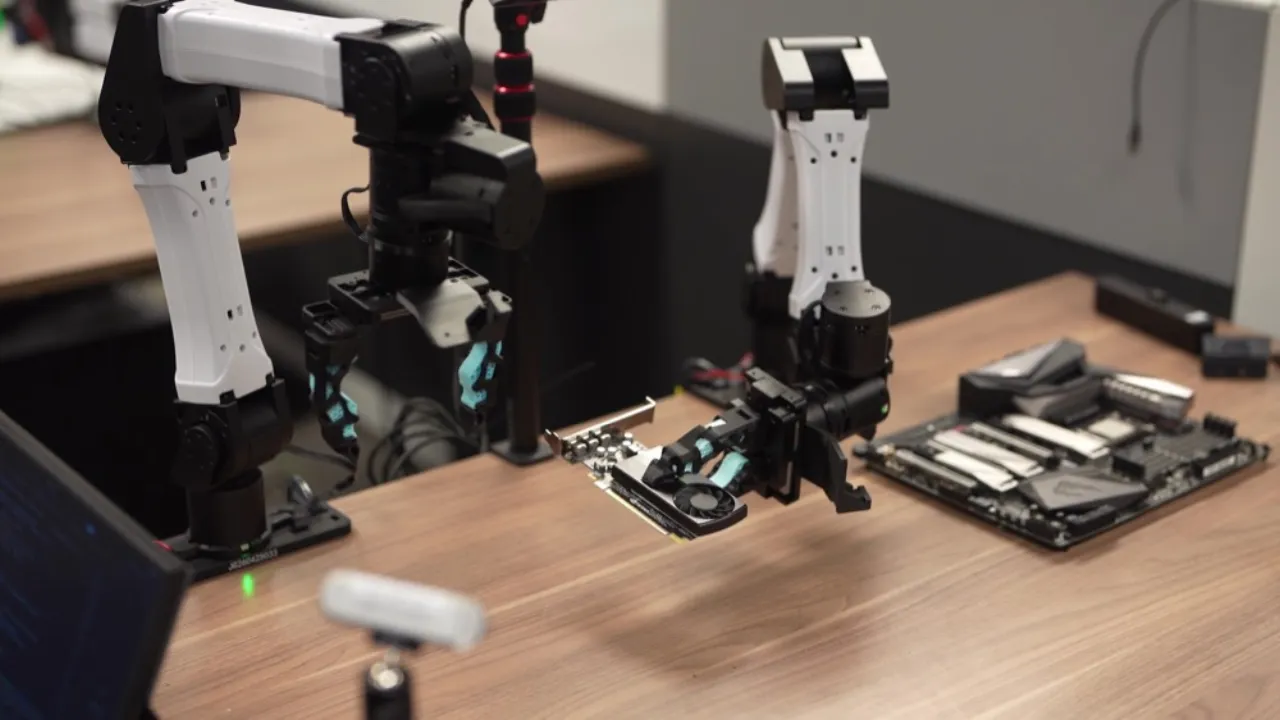
机器人实验室全景(robot farm):ENPIRE 支持单机器人到多机器人机队(fleet)并行运行,代码智能体在机队上自动采集轨迹、评估成功率、修订策略代码,形成闭环自研究(autoresearch)循环。Panorama of the robot farm: ENPIRE supports parallel operation from a single robot up to a multi-robot fleet, where code agents automatically collect trajectories, evaluate success rates, and revise policy code, forming a closed-loop autoresearch cycle.
99%pass@8 成功率 (多任务平均)pass@8 success rate (average over tasks)
ENPIRE 将"物理反馈"结构化为四个可调用模块,让编程智能体把机器人硬件当作实验基础设施来使用:生成策略代码、在真实机器人上执行 rollout、读取失败日志、查阅文献、修订代码——循环直到任务成功。ENPIRE structures "physical feedback" into four callable modules, letting coding agents use robot hardware as experimental infrastructure: generate policy code, run rollouts on real robots, read failure logs, consult the literature, revise code — looping until the task succeeds.
系统控制架构:展示四个核心模块(EN / PI / R / E)的交互关系——环境接口(EN)向智能体暴露复位、安全、验证和日志调用接口;策略改进模块(PI)从奖励信号、视频和失败案例生成并修订代码;Rollout 模块(R)在机器人上执行预算内的 trials;进化模块(E)对比分支、复用成功配方、剪枝失败假设。System control architecture: the interaction among the four core modules (EN / PI / R / E) — the environment interface (EN) exposes reset, safety, verification, and logging calls to the agent; the policy improvement module (PI) generates and revises code from reward signals, videos, and failure cases; the Rollout module (R) executes budgeted trials on the robot; the evolution module (E) compares branches, reuses successful recipes, and prunes failed hypotheses.
ENEnvironment — 环境模块Environment
"Construct reset, safety, verification, and logging interfaces the agent can call." 实现自动复位(auto reset)与自动评估(auto evaluation),保证每次 trial 从已知的随机初始状态出发,且结果可量化记录。"Construct reset, safety, verification, and logging interfaces the agent can call." It implements auto reset and auto evaluation, guaranteeing that every trial starts from a known random initial state and that the outcome is recorded quantitatively.
PIPolicy Improvement — 策略改进模块Policy Improvement
"Generate and revise policy code from rewards, videos, traces, and failure cases." 支持多种 PI 范式:启发式学习(heuristic learning)、工具调用(tool calling)、行为克隆(BC)、离线 RL、在线 RL。"Generate and revise policy code from rewards, videos, traces, and failure cases." It supports several PI paradigms: heuristic learning, tool calling, behavior cloning (BC), offline RL, and online RL.
RRollout — 轨迹执行模块Rollout
"Run budgeted robot trials and preserve the state, action, video, and result for audit." 支持单机器人或多机器人并行执行,保存状态、动作、视频和结果供后续分析。"Run budgeted robot trials and preserve the state, action, video, and result for audit." It supports single-robot or multi-robot parallel execution, saving states, actions, videos, and results for later analysis.
EEvolution — 进化模块Evolution
"Compare branches, reuse successful recipes, and prune hypotheses that fail on hardware." 代码智能体读取日志、查阅文献,改进训练基础设施和算法代码以应对失败模式。"Compare branches, reuse successful recipes, and prune hypotheses that fail on hardware." The code agent reads logs and consults the literature, improving the training infrastructure and algorithm code to cope with failure modes.
自动评估(Auto Evaluation)Auto Evaluation
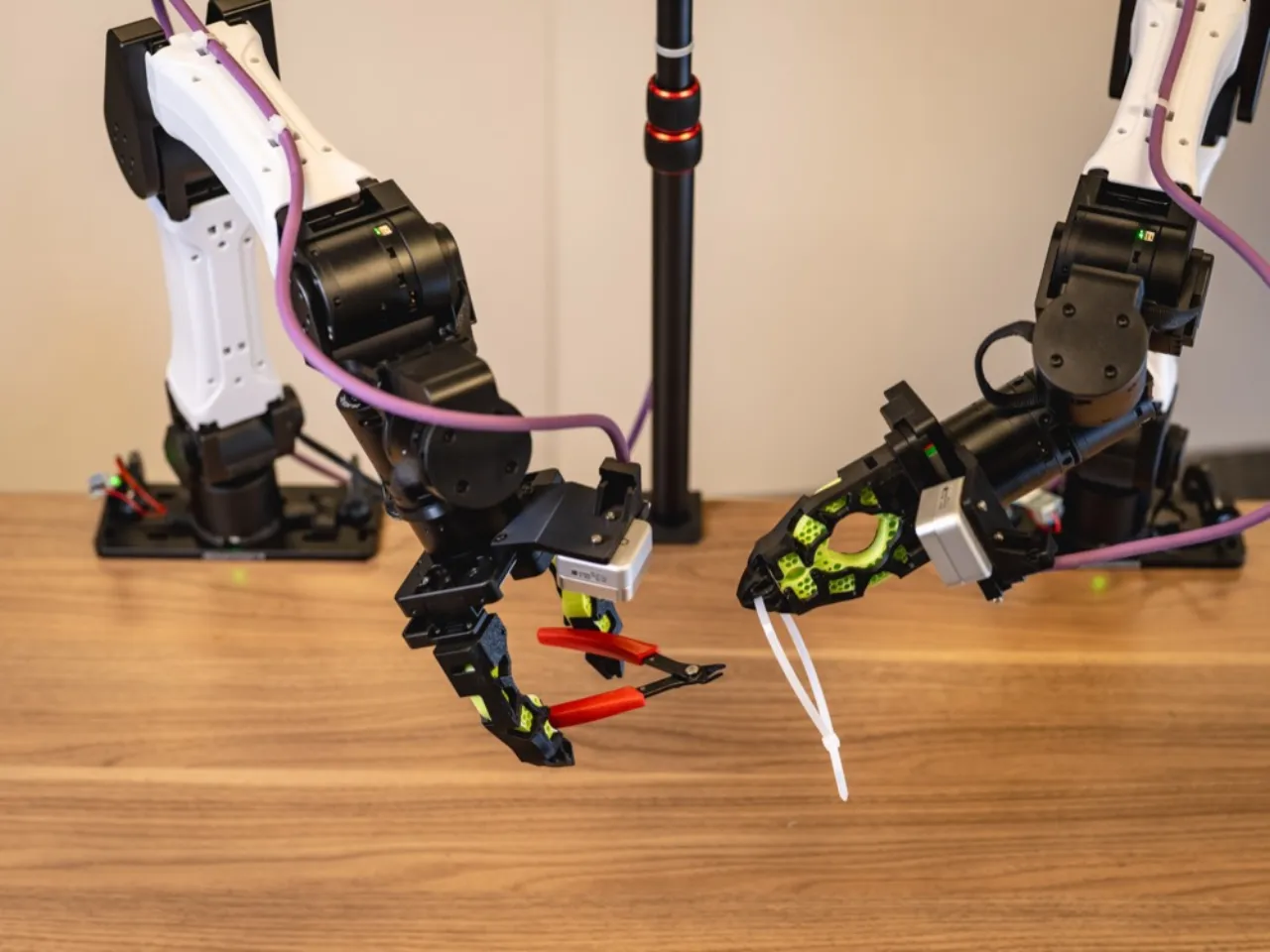
以"切扎带"任务为例,系统使用自动研究推导出的奖励函数对结果打分:检测器在扎带头和扎带条上画出 bounding box,分割模型(SAM 3)对原始视图进行像素级分割,每个摄像头视角独立判断扎带条是否通过扎带头(超过固定长度阈值)。全程无需人工判断。Take the "cut zip-tie" task as an example: the system scores outcomes with a reward function derived by autoresearch. A detector draws bounding boxes on the zip-tie head and strap, a segmentation model (SAM 3) performs pixel-level segmentation of the raw view, and each camera view independently judges whether the strap has passed through the head (beyond a fixed length threshold). No human judgment is needed anywhere in the process.
自动复位(Auto Reset)Auto Reset
每项任务设计了专用的自动复位流程,使机器人在无人干预的情况下将场景恢复到随机初始状态:Each task is given a dedicated auto-reset procedure so that the robot restores the scene to a random initial state without human intervention:
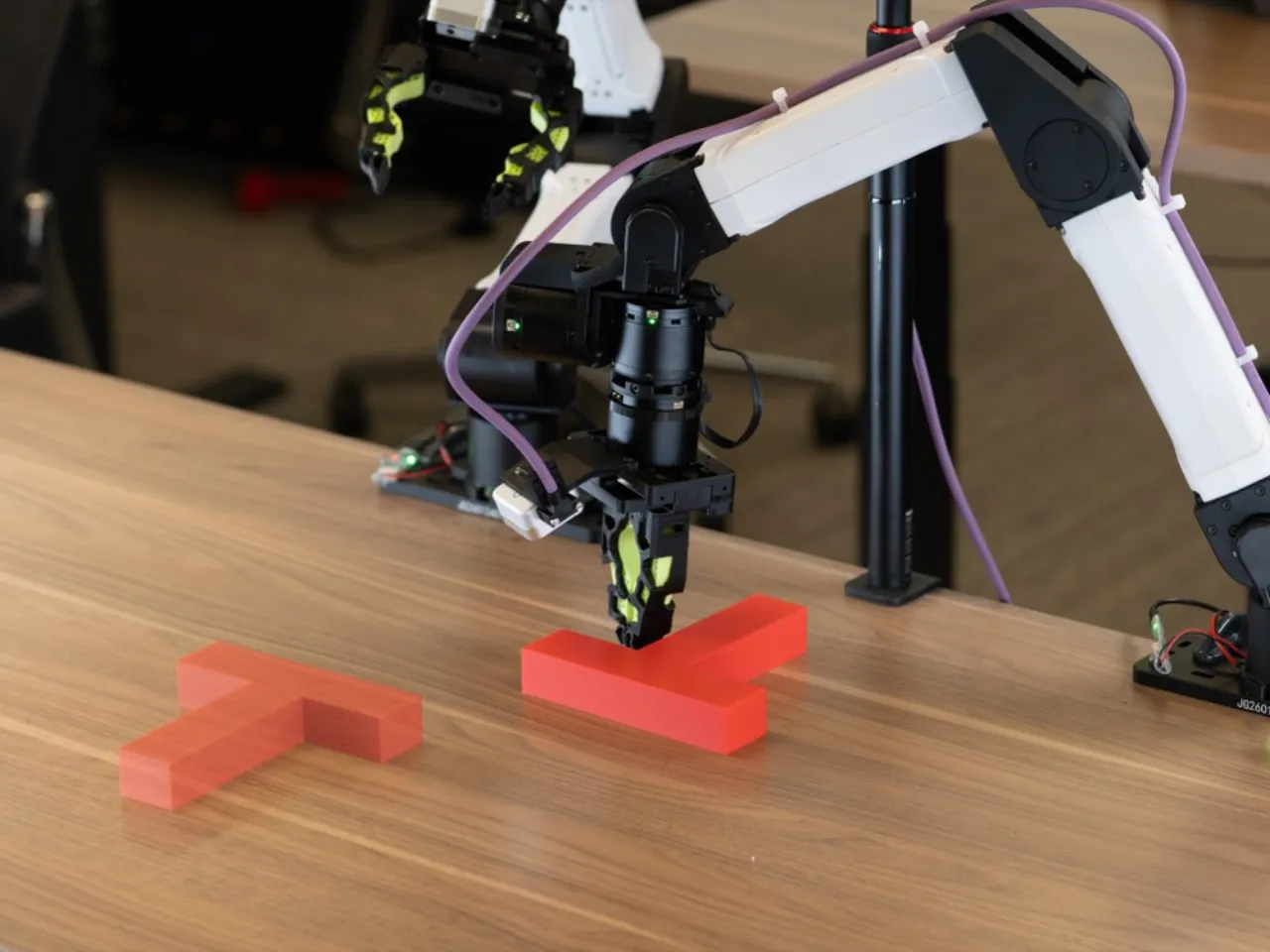
Push-T:将 T 形块复位到四种随机初始位形之一。Push-T: reset the T-shaped block to one of four random initial configurations.
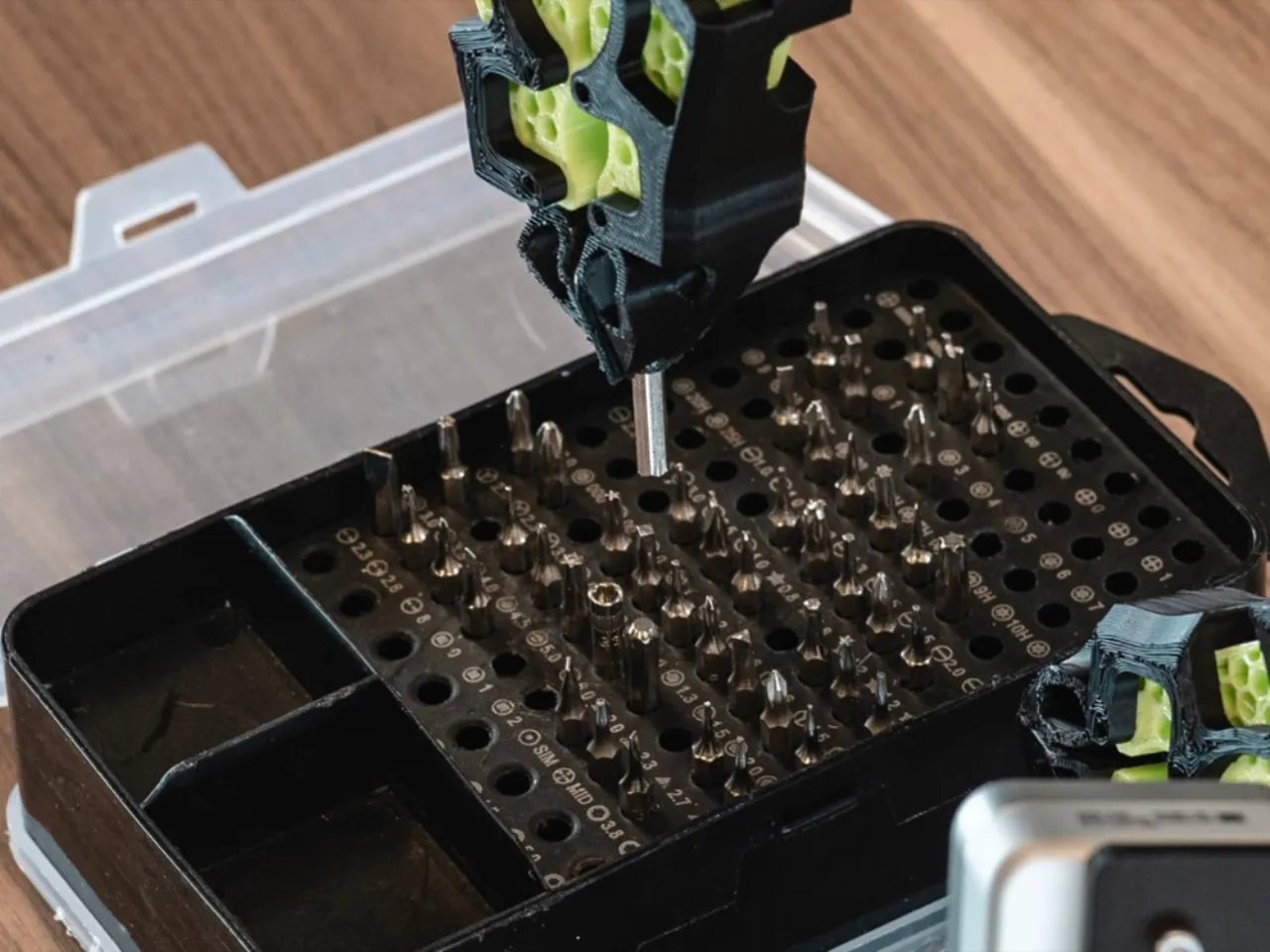
Pin Insertion:将散落的插针恢复到插针盒就绪状态。Pin Insertion: return scattered pins to the ready state in the pin box.
Tie Zip-tie:"Grasp the zip-tie's head from anywhere on the table with one hand. Use the other hand to grab and curl its tail, aligning the strap with the head."Tie Zip-tie: "Grasp the zip-tie's head from anywhere on the table with one hand. Use the other hand to grab and curl its tail, aligning the strap with the head."
GPU Insertion:"Pick up the GPU from anywhere on the table and move it to a pre-insertion pose. Unplug the GPU from the board to return the scene for the next trial."GPU Insertion: "Pick up the GPU from anywhere on the table and move it to a pre-insertion pose. Unplug the GPU from the board to return the scene for the next trial."
机队扩展(Fleet Scaling)Fleet Scaling
ENPIRE 支持 1、4、8 个智能体团队并行操控多台机器人,论文引入两个新指标量化资源效率:ENPIRE supports agent teams of 1, 4, and 8 operating multiple robots in parallel, and the paper introduces two new metrics to quantify resource efficiency:
MRU(Mean Robot Utilization):衡量机器人的平均有效利用率。MRU (Mean Robot Utilization): measures the average effective utilization of the robots.
MTU(Mean Token Utilization):衡量语言模型 token 的平均消耗效率。MTU (Mean Token Utilization): measures the average consumption efficiency of language-model tokens.
03 Experiments
实验分为三部分:(1)真实世界灵巧操作任务的端到端成功率;(2)AutoEnvBench 对三个主流编程智能体的横向对比;(3)机队规模扩展实验与仿真环境评测(RoboCasa)。The experiments have three parts: (1) end-to-end success rates on real-world dexterous manipulation tasks; (2) AutoEnvBench, a side-by-side comparison of three mainstream coding agents; (3) fleet-scaling experiments and evaluation in simulation (RoboCasa).
论文定义:"pass@8 is not best-of-8 i.i.d. samples on the task. Within a single long-horizon rollout, the agentic loop gets up to 8 in-context retries per subtask, each conditioned on the previous failures — so it measures emergent retry and recovery, not sampling luck."The paper defines: "pass@8 is not best-of-8 i.i.d. samples on the task. Within a single long-horizon rollout, the agentic loop gets up to 8 in-context retries per subtask, each conditioned on the previous failures — so it measures emergent retry and recovery, not sampling luck."
"Policies trained with ENPIRE reach a 99% pass@8 success rate across the showcased manipulation tasks."
Push-T:将 T 形木块推至目标位置,需精确接触控制。Push-T: push the T-shaped block to a target pose, requiring precise contact control.Pin Insertion:将多根插针逐一插入针盒,需亚毫米级精度。Pin Insertion: insert multiple pins one by one into the pin box, requiring sub-millimeter precision.GPU Insertion:将 GPU 插入 PCIe 插槽,真实工业级精密装配。GPU Insertion: insert a GPU into a PCIe slot, real industrial-grade precision assembly.Cut Zip-tie / Tie Zip-tie:使用切割工具切断或穿系扎带,高度灵巧双手协作任务。Cut Zip-tie / Tie Zip-tie: use a cutting tool to cut or thread a zip-tie, a highly dexterous bimanual task.
论文评测了三个前沿编程智能体在 Push-T 和 Pin Insertion 两项任务上的自主研究进展(随 wall-clock 时间跟踪成功率):The paper evaluates three frontier coding agents on their autonomous research progress on the Push-T and Pin Insertion tasks, tracking success rate against wall-clock time:
Coding Agent
底层模型Backbone Model
评测任务Evaluated Tasks
Codex
GPT-5.5
Push-T, Pin Insertion
Claude Code
Opus 4.7
Push-T, Pin Insertion
Kimi Code
Kimi K2.6
Push-T, Pin Insertion
注:项目页面未公布各 agent 的具体数值比较表格;论文追踪的是随时间变化的成功率曲线而非单一汇总数字。如需精确数字,请参阅原始论文。Note: The project page does not publish a table of concrete numerical comparisons between the agents; the paper tracks success-rate curves over time rather than a single summary number. For exact numbers, please consult the original paper.
项目页面展示了"ideation timeline"——代码智能体在 Push-T 上自主探索的策略改进节点,例如:The project page shows an "ideation timeline" — the policy improvement milestones the code agent explored autonomously on Push-T, for example:
Online RL mix Demo:+3.8 pp 成功率提升Online RL mix Demo: +3.8 pp gain in success rate
BC regularization:+10.8 pp 成功率提升BC regularization: +10.8 pp gain in success rate
典型提示词(prompt)示例:"Write a heuristic policy, with no neural network training, to achieve a 100% success rate in the Push-T environment over at least 50 continuous episodes. You are not allowed to modify environment code; that is cheating. No cheating. Fan out a subagent team to try approaches."A representative prompt: "Write a heuristic policy, with no neural network training, to achieve a 100% success rate in the Push-T environment over at least 50 continuous episodes. You are not allowed to modify environment code; that is cheating. No cheating. Fan out a subagent team to try approaches."
仿真评测(RoboCasa)Simulation Evaluation (RoboCasa)
ENPIRE 同时在 RoboCasa 仿真环境中评测了以下任务的策略自动生成能力:Coffee Setup Mug、Open Cabinet、Open Drawer、Open Stand Mixer、Counter to Cabinet、Sink to Counter、Turn Off Stove、Turn On Sink。ENPIRE also evaluates automatic policy generation in the RoboCasa simulation environment on the following tasks: Coffee Setup Mug, Open Cabinet, Open Drawer, Open Stand Mixer, Counter to Cabinet, Sink to Counter, Turn Off Stove, Turn On Sink.
04 Limitations
Note:以下限制均为论文作者在项目页面"Limitations & Future Directions"中明确陈述(stated)。All the limitations below are explicitly stated by the authors on the project page under "Limitations & Future Directions".
机器人与计算资源利用率不足Robot and compute resources are underutilized
"Coding agents do not fully utilize robot resources when they are reading logs, writing code, debugging, or waiting for the language-model backbone. As the number of robots scales, MRU decreases while GPU active utilization increases. Compared to a single-robot setup, agent teams spend more time summarizing peer branches and less time operating the robot, and coding agents may fail to launch enough parallel training sessions to exhaust GPU resources."
"Scaling the robot fleet drives higher token consumption: as more agents read logs, summarize peer branches, and coordinate, the total token budget required to reach a successful policy grows with fleet size. Larger fleets can reach success sooner, but the additional speedup comes at the cost of higher token consumption."