ICML 2024 · 具身智能 · 世界模型ICML 2024 · Embodied AI · World Models
Learning to Model the World with Language
用语言预测未来:Dynalang 多模态世界模型Predicting the Future with Language: the Dynalang Multimodal World Model
Jessy Lin · Yuqing Du · Olivia Watkins · Danijar Hafner · Pieter Abbeel · Dan Klein · Anca Dragan | UC Berkeley & Google DeepMind
Dynalang 将语言(任务指令、状态描述、动态解释、纠错反馈)统一视为预测未来观测的信号,构建多模态世界模型,在该模型的想象空间中训练策略,无需设计专门的语言融合模块,在 HomeGrid、Messenger、VLN-CE 和 LangRoom 四类任务上全面超越 model-free 及 model-based 基线。Dynalang treats language of every kind (task instructions, state descriptions, dynamics explanations, corrective feedback) uniformly as a signal for predicting future observations, builds a multimodal world model, and trains the policy inside that model's imagination, with no specially designed language-fusion module; it outperforms both model-free and model-based baselines across the four task families HomeGrid, Messenger, VLN-CE and LangRoom.
world modellanguage grounding多模态世界模型multimodal world modelreinforcement learningembodied AIDynalangDreamerV3vision-language navigation
01动机Motivation
现有具身 AI 智能体在处理语言时存在严重局限——它们往往只能接受简单的任务指令(如"拿起苹果"),却无法利用更丰富的语言形式:状态描述("碗在厨房里")、动态解释("这个按钮会关掉电视")、以及纠错反馈。当这些多样化语言信号涌入时,model-free 的基线方法(如 R2D2)甚至会出现性能退化的现象。Existing embodied AI agents are severely limited in how they handle language — they can usually accept only simple task instructions (such as "pick up the apple"), and cannot exploit richer forms of language: state descriptions ("the bowl is in the kitchen"), dynamics explanations ("this button turns off the TV"), or corrective feedback. When such diverse language signals flood in, model-free baselines (such as R2D2) even show performance degradation.
"We argue that agents should interpret such diverse language as a signal that helps them predict the future — what they will observe and what reward they will receive — rather than as a direct command to execute."
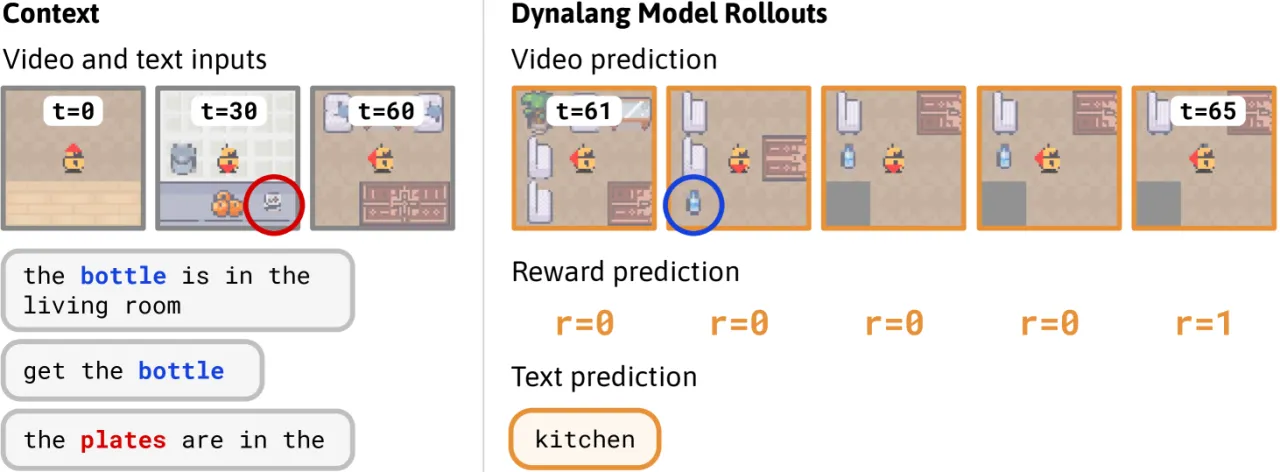
Figure 1:Dynalang 在 HomeGrid 环境中对真实世界模型预测的可视化。Agent 接收不同类型的语言提示(任务、状态描述、动态解释),并据此更新对未来帧的预测——这一自监督信号驱动语言与视觉的联合理解,无需额外标注。Figure 1: Visualization of the real world-model predictions of Dynalang in the HomeGrid environment. The agent receives different types of language hints (task, state description, dynamics explanation) and updates its predictions of future frames accordingly — this self-supervised signal drives joint understanding of language and vision without extra annotation.
4语言类型 (task / state / dynamics / corrections)language types (task / state / dynamics / corrections)
500MTinyStories tokens 用于文本预训练TinyStories tokens for text pretraining
S3唯一能在 Messenger Stage 3 取得非零成绩的方法the only method to score non-zero on Messenger Stage 3
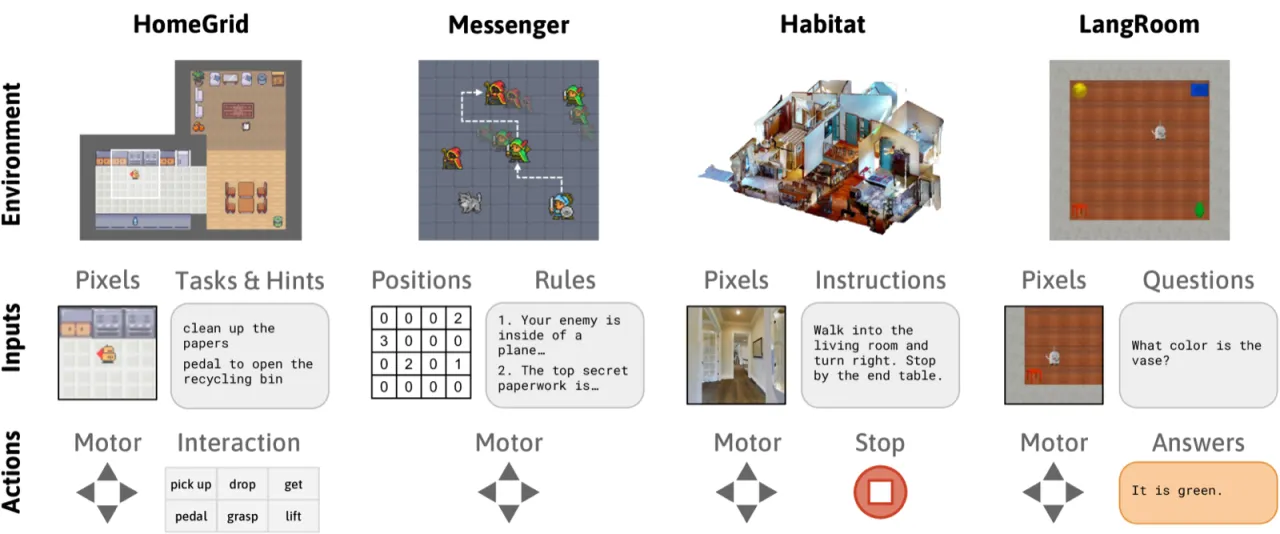
Figure 2:四个评测环境概览。HomeGrid:格子世界,含多类语言提示;Messenger:阅读随机化游戏手册完成消息传递;VLN-CE:在 Matterport3D 真实感房屋中执行自然语言导航指令;LangRoom:具身问答,Agent 需导航探索并生成文字回答。Figure 2: Overview of the four evaluation environments. HomeGrid: a grid world with several kinds of language hints; Messenger: read a randomized game manual to deliver messages; VLN-CE: follow natural-language navigation instructions in photorealistic Matterport3D houses; LangRoom: embodied question answering, where the agent must navigate, explore and generate a textual answer.
02方法Method
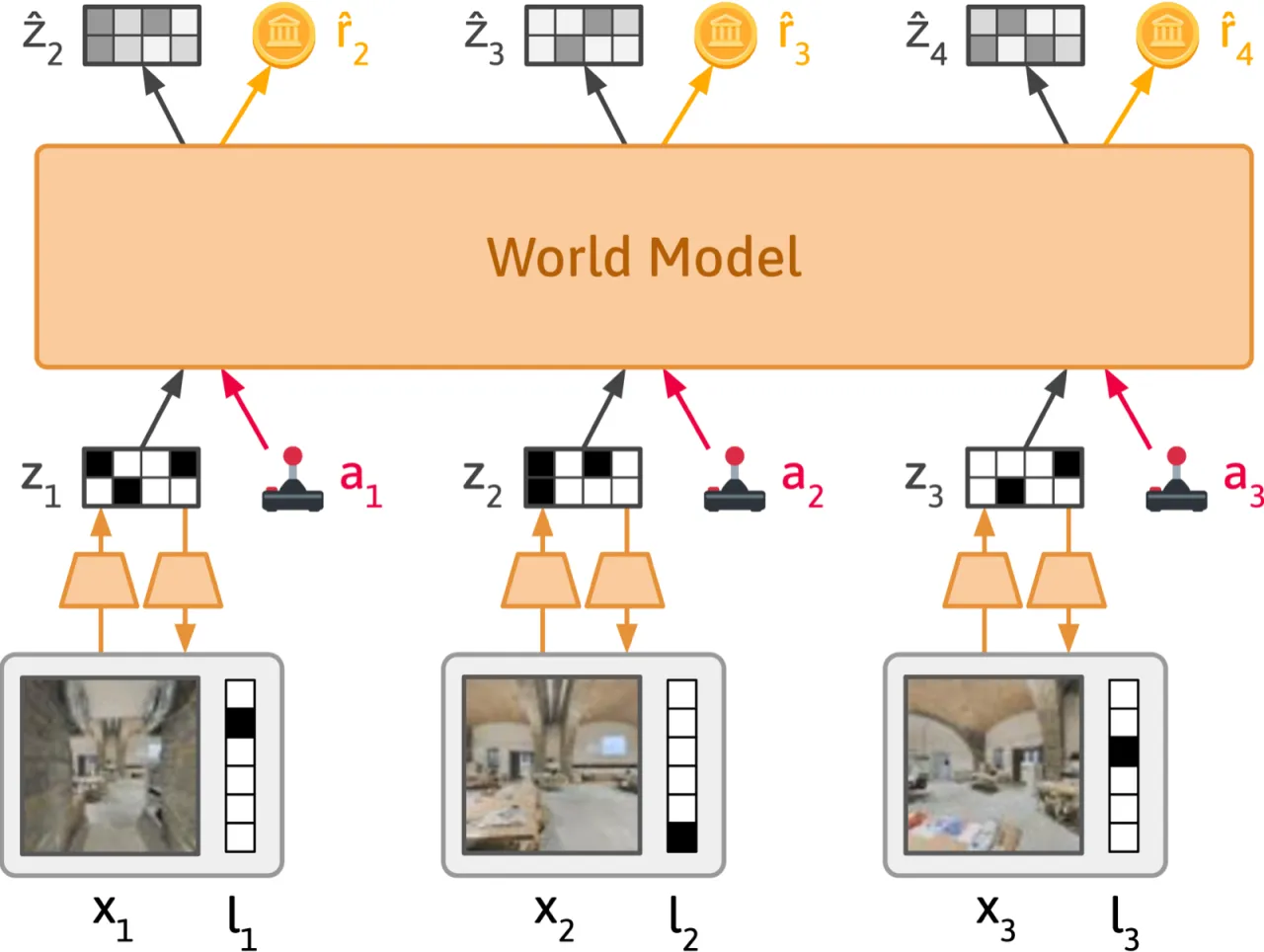
Dynalang 以 DreamerV3 为基础,将其扩展为多模态世界模型:每个时间步同时编码一帧图像和一个语言 token,通过 GRU 序列模型在潜空间中进行未来预测,再由 Actor-Critic 在世界模型的"想象"轨迹中学习策略——语言理解完全由未来预测的自监督信号驱动。Dynalang builds on DreamerV3 and extends it into a multimodal world model: at every time step it encodes one image frame and one language token together, predicts the future in latent space with a GRU sequence model, and then learns a policy with an Actor-Critic on "imagined" trajectories of the world model — language understanding is driven entirely by the self-supervised signal of future prediction.
Figure 3:(左)世界模型学习:每步输入一帧图像与一个文字 token,GRU 序列模型预测下一状态的离散 latent 表示,解码器重建图像、语言、奖励和 episode 终止信号,整体以变分自编码目标训练。(右)策略学习:Actor-Critic 完全在世界模型的想象 rollout 中训练,无需与真实环境额外交互。Figure 3: (Left) World-model learning: each step takes one image frame and one text token as input, the GRU sequence model predicts the discrete latent representation of the next state, and the decoders reconstruct the image, the language, the reward and the episode termination signal, the whole trained with a variational autoencoding objective. (Right) Policy learning: the Actor-Critic is trained entirely on imagined rollouts of the world model, with no extra interaction with the real environment.
多模态序列建模Multimodal Sequence Modeling
图像帧与文字 token 被编码为离散 latent 表示,投影到同一潜空间,无需显式的时序对齐。序列模型(GRU)在此空间上联合预测下一时刻的视觉与语言表示,解码器分别重建:Image frames and text tokens are encoded into discrete latent representations and projected into the same latent space, with no need for explicit temporal alignment. The sequence model (GRU) jointly predicts the visual and language representations of the next step in this space, and the decoders reconstruct, respectively:
图像(视觉一致性)images (visual consistency)
文字 token(语言预测)text tokens (language prediction)
奖励信号reward signal
Episode 终止标志Episode termination flag
策略学习与文本预训练Policy Learning and Text Pretraining
Actor-Critic 仅在世界模型想象的 rollout 中训练,最大化预测的累计奖励。得益于多模态生成目标,模型可在无 action 、无 reward 的纯文本数据上预训练,再迁移到下游 RL 任务。在大词表(10,000 token)场景下,用语言 action 的世界模型预测做正则,有效防止策略坍塌到特定词汇。The Actor-Critic is trained only on rollouts imagined by the world model, maximizing the predicted cumulative reward. Thanks to the multimodal generative objective, the model can be pretrained on plain text data with no action and no reward, and then transferred to downstream RL tasks. With a large vocabulary (10,000 tokens), regularizing with the world model's prediction of the language action effectively prevents the policy from collapsing onto specific words.
设计亮点:语言作为预测信号Design Highlight: Language as a Prediction Signal
核心洞察在于将语言的监督角色与行动角色解耦:语言提示经由未来预测损失自监督地嵌入世界模型,无需人工标注语言含义。这使得动态解释("按下蓝色按钮会打开门")和纠错("你走错方向了")这类在传统 instruction-following 范式中难以处理的语言类型,自然地融入统一框架。The core insight is to decouple the supervisory role of language from its action role: language hints are embedded into the world model in a self-supervised way through the future-prediction loss, with no need to annotate their meaning by hand. This lets dynamics explanations ("pressing the blue button opens the door") and corrections ("you are going the wrong way") — language types that are hard to handle in the traditional instruction-following paradigm — fit naturally into one unified framework.
03实验Experiments
在四个具有代表性的语言-具身任务上评测 Dynalang,基线包括 model-free 方法(IMPALA、R2D2)与 model-based 方法(多种语言条件化 DreamerV3 变体),以及任务专用架构 EMMA。Dynalang is evaluated on four representative language-embodied tasks; the baselines include model-free methods (IMPALA, R2D2) and model-based methods (several language-conditioned DreamerV3 variants), as well as the task-specific architecture EMMA.
HomeGrid — 多样化语言提示HomeGrid — Diverse Language Hints
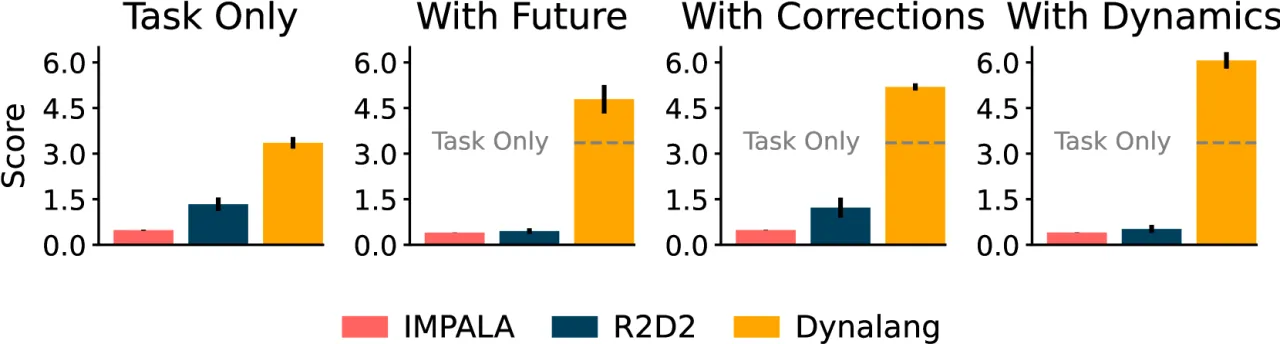
格子世界中,Agent 需完成物体操纵任务,并接收四类语言:仅任务(task only)、加状态描述(+ state)、加动态解释(+ dynamics)、加纠错(+ corrections)。关键发现:In a grid world the agent must complete object-manipulation tasks while receiving four kinds of language: task only, plus state descriptions (+ state), plus dynamics explanations (+ dynamics), and plus corrections (+ corrections). Key findings:
Dynalang 随语言类型增多单调提升;Dynalang improves monotonically as more language types are added;
R2D2 在语言变多时性能退化(无法利用多样化语言);R2D2 degrades as language becomes more varied (it cannot exploit diverse language);
IMPALA 无法完成任务。IMPALA fails to complete the tasks.
Figure 5:HomeGrid 各语言条件下任务完成率曲线。Dynalang(蓝线)在所有语言条件下均优于基线,且能随语言丰富程度持续提升;R2D2(橙线)在多类语言下性能下滑,佐证了传统 instruction-following 方案的局限。Figure 5: Task completion rate curves on HomeGrid under each language condition. Dynalang (blue) beats the baselines under every language condition and keeps improving as language grows richer; R2D2 (orange) declines under multiple language types, corroborating the limits of the traditional instruction-following approach.
Messenger — 游戏手册阅读Messenger — Reading the Game Manual
Agent 需阅读描述随机化实体角色与规则的游戏手册,完成消息传递并规避敌人。难度分三阶段(S1/S2/S3)。The agent must read a game manual describing randomized entity roles and rules, deliver the message and avoid enemies. Difficulty is split into three stages (S1/S2/S3).
S1:Dynalang 大幅领先所有 model-based 基线,尽管从零训练 token 嵌入;S1: Dynalang leads by a wide margin over all model-based baselines, even though token embeddings are trained from scratch;
S3:其他方法完全失败(零成绩),Dynalang 唯一取得非零性能;S3: all other methods fail completely (zero score), and Dynalang alone attains non-zero performance;
文本预训练(in-domain 手册 或 TinyStories ~500M tokens)进一步提升 S2 成绩,且 TinyStories 预训练超越 T5 嵌入基线的最终性能。text pretraining (in-domain manuals or TinyStories ~500M tokens) further improves S2 scores, and TinyStories pretraining surpasses the final performance of the T5 embedding baseline.
Figure 6:Messenger 三阶段训练曲线。S3 阶段(最难)仅 Dynalang 取得非零得分,验证了多模态世界模型在高复杂度语言推理任务上的优越性。Figure 6: Training curves for the three Messenger stages. In stage S3 (the hardest) only Dynalang attains a non-zero score, confirming the superiority of the multimodal world model on highly complex language-reasoning tasks.
在 Matterport3D 真实感房屋中,Agent 须跟随自然语言指令导航至目标位置(success rate 衡量)。Dynalang 在 success rate 上显著超越 R2D2 model-free 基线,但与使用演示数据或专用架构的 SOTA 方法仍有差距(paper 明确承认)。In photorealistic Matterport3D houses the agent must follow natural-language instructions to navigate to a target location (measured by success rate). Dynalang clearly surpasses the R2D2 model-free baseline in success rate, but still trails SOTA methods that use demonstration data or specialized architectures (as the paper explicitly acknowledges).
LangRoom — 具身问答与文本生成LangRoom — Embodied QA and Text Generation
Agent 需导航找到颜色目标,并通过生成语言 action 回答问题。在大词表(10,000 token)下:The agent must navigate to find a color target and answer the question by generating a language action. With a large vocabulary (10,000 tokens):
One-hot token 编码从零训练失败;training one-hot token encodings from scratch fails;
用世界模型预测正则化语言 action 后,性能恢复;after regularizing the language action with world-model prediction, performance recovers;
预训练(in-domain 或 TinyStories)进一步超越 T5 嵌入基线,体现多模态生成模型的迁移学习潜力。pretraining (in-domain or TinyStories) further surpasses the T5 embedding baseline, showing the transfer-learning potential of multimodal generative models.
消融分析Ablation Analysis
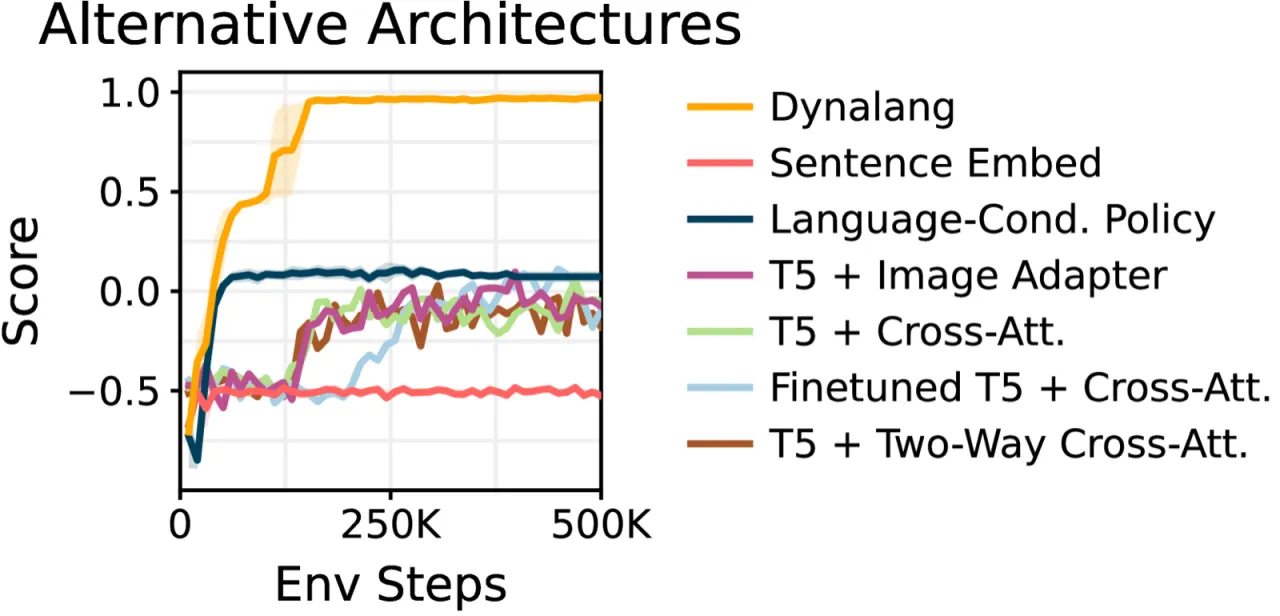
在 Messenger S1 上,作者系统对比了多种语言条件化策略(GRU 嵌入、SentenceBERT、T5 + image adapter、cross-attention、two-way cross-attention 等变体),Dynalang 在无需专用对齐模块的情况下全面超越所有变体,验证了"语言作为预测信号"这一核心设计的有效性。On Messenger S1 the authors systematically compare a range of language-conditioning strategies (GRU embeddings, SentenceBERT, T5 + image adapter, cross-attention, two-way cross-attention and other variants); without any dedicated alignment module Dynalang outperforms every variant across the board, confirming the effectiveness of the core design of "language as a prediction signal".
04局限性Limitations
注:本文没有独立的 Limitations 章节。以下条目中,标注"论文明确指出"者来自正文;其余为根据方法设计推断的潜在局限。Note: This paper has no standalone Limitations section. Among the items below, those marked "explicitly stated in the paper" come from the main text; the rest are potential limitations inferred from the method design.
VLN-CE 与 SOTA 仍有差距(论文明确指出)Still a gap to SOTA on VLN-CE (explicitly stated in the paper)
作者在 VLN-CE 实验中明确写道:"performance is not yet competitive with state-of-the-art VLN methods",这些 SOTA 方法往往使用人类演示、大型预训练视觉-语言编码器或专用导航架构,Dynalang 均未采用。In the VLN-CE experiments the authors write explicitly: "performance is not yet competitive with state-of-the-art VLN methods". Such SOTA methods typically use human demonstrations, large pretrained vision-language encoders or specialized navigation architectures, none of which Dynalang adopts.
大词表语言生成的不稳定性(推断自设计)Instability of language generation with a large vocabulary (inferred from the design)
LangRoom 实验显示,词表扩大至 10,000 时 one-hot 训练直接失败,需要额外的正则化(世界模型预测约束)或预训练才能恢复稳定性。这限制了 Dynalang 在开放域语言生成任务上的直接应用。The LangRoom experiments show that once the vocabulary grows to 10,000, one-hot training simply fails; extra regularization (the world-model prediction constraint) or pretraining is needed to restore stability. This limits the direct application of Dynalang to open-domain language generation tasks.
每步单 token 的语言处理假设(推断自设计)The one-token-per-step assumption for language processing (inferred from the design)
Dynalang 每个时间步仅处理一个视频帧和一个语言 token,不依赖时序对齐,但这也意味着长句描述被拆散到多步处理,可能丢失句子级别的语义连贯性,在需要理解长篇指令的任务中存在潜在风险。Dynalang processes only one video frame and one language token per time step and does not rely on temporal alignment, but this also means that long descriptions are split across many steps, which may lose sentence-level semantic coherence and poses a potential risk in tasks that require understanding lengthy instructions.
计算量与模型复杂度(推断自设计)Compute cost and model complexity (inferred from the design)
在世界模型想象空间中训练 Actor-Critic 需要维护和展开完整的 GRU 世界模型,计算成本高于 model-free 基线。论文未提供与基线方法的训练时间或 FLOPs 对比数据。Training the Actor-Critic in the imagination space of the world model requires maintaining and unrolling the full GRU world model, so the compute cost is higher than for model-free baselines. The paper gives no comparison of training time or FLOPs against the baselines.