Generalizable Visuomotor Policy Learning via Simple 3D Representations
Yanjie Ze · Gu Zhang · Kangning Zhang · Chenyuan Hu · Muhan Wang · Huazhe Xu | 上海 Qi Zhi Institute · 上海交通大学 · 清华大学 · Shanghai AI LabYanjie Ze · Gu Zhang · Kangning Zhang · Chenyuan Hu · Muhan Wang · Huazhe Xu | Shanghai Qi Zhi Institute · Shanghai Jiao Tong University · Tsinghua University · Shanghai AI Lab
DP3 将紧凑的 3D 点云视觉表征与 Diffusion Policy 相结合,提出一种高效的视觉运动策略学习框架。仅需 10 条演示数据,即可在 72 个仿真任务中大幅超越 2D 基线;在 4 个真实机器人灵巧操作任务上,以 40 条演示实现平均 85% 的成功率,并展现出跨空间、视角、外观与实例的强泛化能力。DP3 combines a compact 3D point-cloud visual representation with Diffusion Policy, yielding an efficient framework for visuomotor policy learning. With only 10 demonstrations it substantially outperforms 2D baselines across 72 simulated tasks; on 4 real-robot dexterous manipulation tasks it reaches an average success rate of 85% from 40 demonstrations, while showing strong generalization across space, viewpoint, appearance and instances.
3D Diffusion Policypoint cloudimitation learningvisuomotor policydiffusion model机器人操作robot manipulationdexterous manipulation泛化能力generalization3D representationDP3
01动机 MotivationMotivation
模仿学习为机器人提供了一条习得复杂技能的有效路径,但现有方法主要依赖 2D 图像或深度图作为视觉输入,在处理空间理解、视角变化与实例泛化等问题时存在明显局限。如何以最简单的方式引入 3D 信息,同时保持策略学习的高效性与泛化性,是本文要解决的核心问题。Imitation learning offers an effective route for robots to acquire complex skills, yet existing methods rely mainly on 2D images or depth maps as visual input and show clear limitations in spatial understanding, viewpoint change and instance-level generalization. How to introduce 3D information in the simplest possible way while preserving the efficiency and generalization of policy learning is the core problem this paper addresses.
"Enabling robots to dexterous manipulation of objects is a longstanding challenge for roboticists, primarily due to the necessity to manage a broader spectrum of motor skills… Visual imitation learning, which takes high-dimensional visual observations such as images or depth maps, eases the need for task-specific state estimation and thus gains its popularity."
现有方法(如 Diffusion Policy)以 2D RGB 图像为输入,面临两大核心挑战:Existing methods such as Diffusion Policy take 2D RGB images as input and face two core challenges:
空间感知不足:2D 图像缺乏深度信息,难以精确理解物体在三维空间中的位置与形状,对灵巧操作(如倒液、卷薄片)尤为不利。Insufficient spatial perception: 2D images lack depth information, making it hard to understand precisely where objects are and what shape they have in 3D space, which is especially harmful for dexterous manipulation (e.g. pouring liquid, rolling a thin sheet).
泛化能力有限:基于图像的策略对视角变化、光照变化和目标外观变化高度敏感,往往需要大量多样化的演示数据才能泛化。Limited generalization: image-based policies are highly sensitive to changes in viewpoint, lighting and target appearance, and usually need large amounts of diverse demonstration data to generalize.
本文核心假设:稀疏点云提供的紧凑 3D 表征天然具备几何一致性,无需颜色通道即可实现优越的泛化,且单视角点云(仅一台 RealSense L515 相机)已足够。The core hypothesis of this paper: the compact 3D representation provided by a sparse point cloud is inherently geometrically consistent and achieves superior generalization without any color channel, and a single-view point cloud (from just one RealSense L515 camera) already suffices.
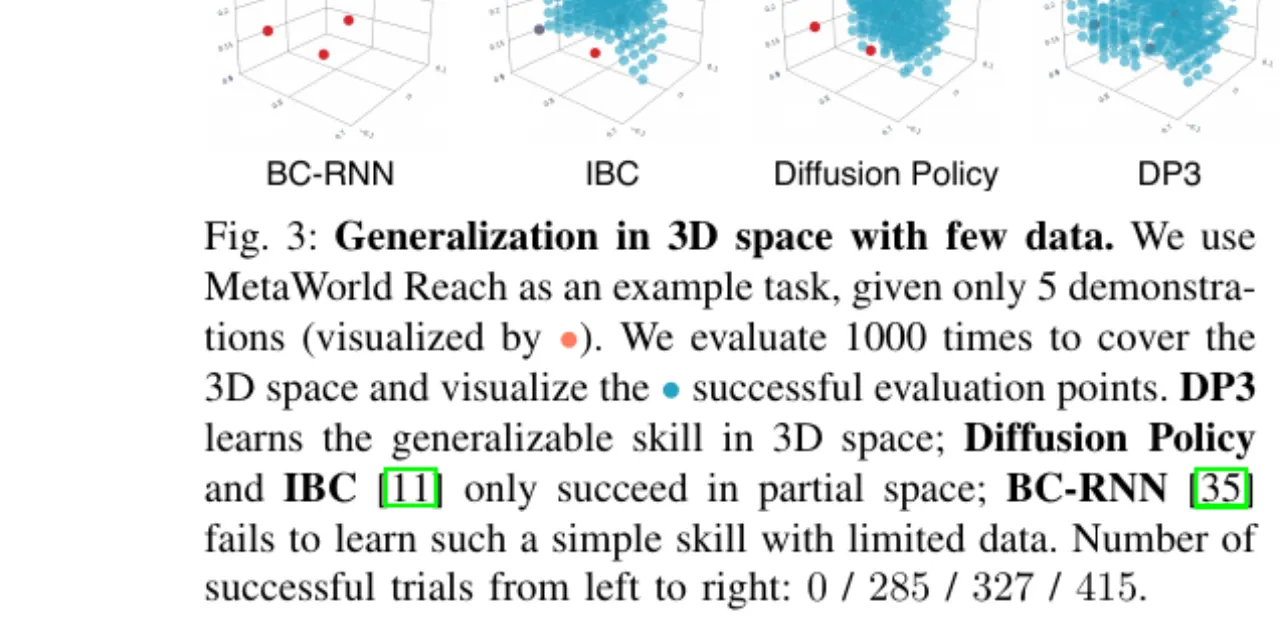
Fig. 3:在 3D 空间中以少量数据实现泛化。以 MetaWorld Reach 任务为例,仅给定 5 条演示(红色点),在 1000 次评估中可视化成功的评估点(蓝色)。DP3 在整个 3D 空间中均可成功;Diffusion Policy 和 IBC 仅在局部成功;BC-RNN 则几乎无法学习。从左到右成功次数:0 / 285 / 327 / 415。Fig. 3: Generalization in 3D space from little data. Taking the MetaWorld Reach task as an example, only 5 demonstrations (red points) are given, and the successful evaluation points among 1000 evaluations are visualized (blue). DP3 succeeds throughout the whole 3D space; Diffusion Policy and IBC succeed only locally; BC-RNN barely learns at all. Success counts from left to right: 0 / 285 / 327 / 415.
72仿真任务总数simulated tasks in total
85%真实机器人平均成功率average real-robot success rate
74.4仿真平均成功率(DP3)vs 59.8(Diffusion Policy)average success rate in simulation (DP3) vs 59.8 (Diffusion Policy)
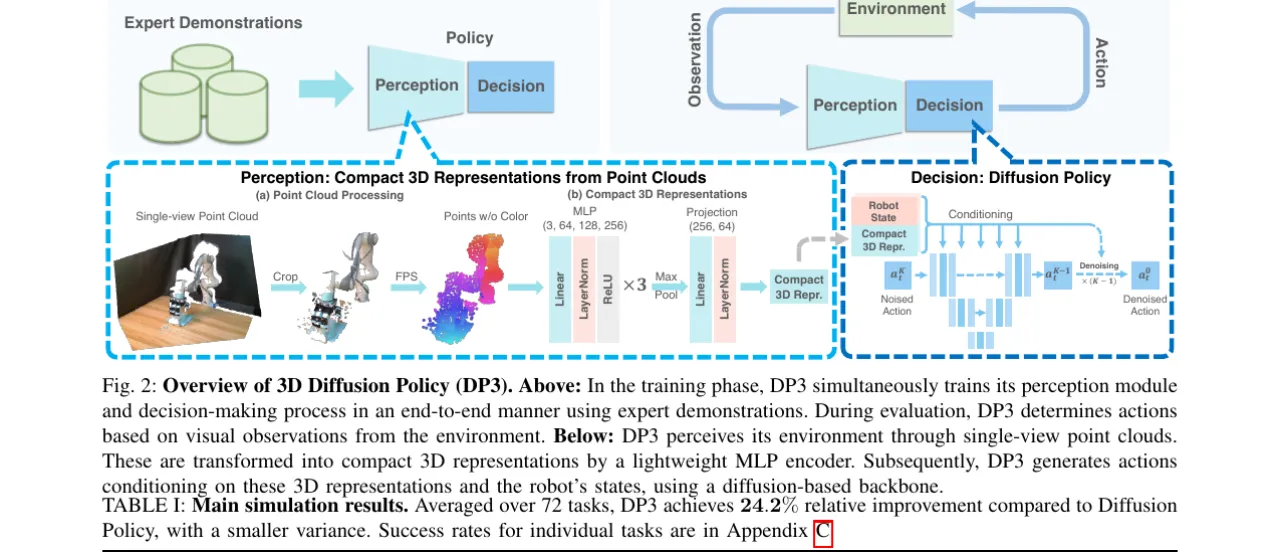
DP3 由两个模块构成:Perception(感知)模块将来自单视角深度相机的稀疏点云编码为紧凑的 3D 特征;Decision(决策)模块以 Diffusion Policy 为骨干,在机器人状态(关节角)条件下预测动作序列。两模块端到端联合训练。DP3 consists of two modules: the Perception module encodes the sparse point cloud from a single-view depth camera into a compact 3D feature; the Decision module takes Diffusion Policy as its backbone and predicts action sequences conditioned on the robot state (joint angles). The two modules are trained jointly end-to-end.
Fig. 2:DP3 端到端训练与评估流程。训练阶段:感知模块从点云中提取紧凑 3D 表征,决策模块(Diffusion Policy)基于该表征与机器人状态生成动作。评估阶段:机器人通过单目深度相机采集点云,实时执行推理得到动作序列。Fig. 2: End-to-end training and evaluation pipeline of DP3. Training: the perception module extracts a compact 3D representation from the point cloud, and the decision module (Diffusion Policy) generates actions from that representation together with the robot state. Evaluation: the robot captures point clouds with a monocular depth camera and runs inference in real time to obtain action sequences.
Perception:从点云到紧凑 3D 表征Perception: From Point Clouds to a Compact 3D Representation
深度图经相机内参投影为点云,随后经过以下处理:The depth map is projected into a point cloud with the camera intrinsics and then processed as follows:
裁剪(Cropping):保留以机器人为中心的边界框内的点,去除地面与背景噪声,减少冗余点。Cropping: keep only the points inside a robot-centered bounding box, removing ground and background noise and reducing redundant points.
下采样(Downsampling):使用最远点采样(FPS)将点云稀疏化至 512 或 1024 点,大幅降低计算量。Downsampling: farthest point sampling (FPS) sparsifies the point cloud to 512 or 1024 points, greatly reducing computation.
颜色通道去除:不使用 RGB 颜色,仅保留 XYZ 坐标,从而对外观变化天然鲁棒。Removing the color channel: no RGB color is used and only XYZ coordinates are kept, which makes the policy naturally robust to appearance changes.
DP3 Encoder:采用轻量 MLP 网络对点云编码,最终输出 64 维紧凑特征向量 v。该设计远比 PointNet++、Point Transformer 等复杂编码器计算高效,实验表明其精度也更优(见 Table V)。DP3 Encoder: a lightweight MLP network encodes the point cloud and finally outputs a 64-dimensional compact feature vector v. This design is far more compute-efficient than complex encoders such as PointNet++ or Point Transformer, and experiments show it is also more accurate (see Table V).
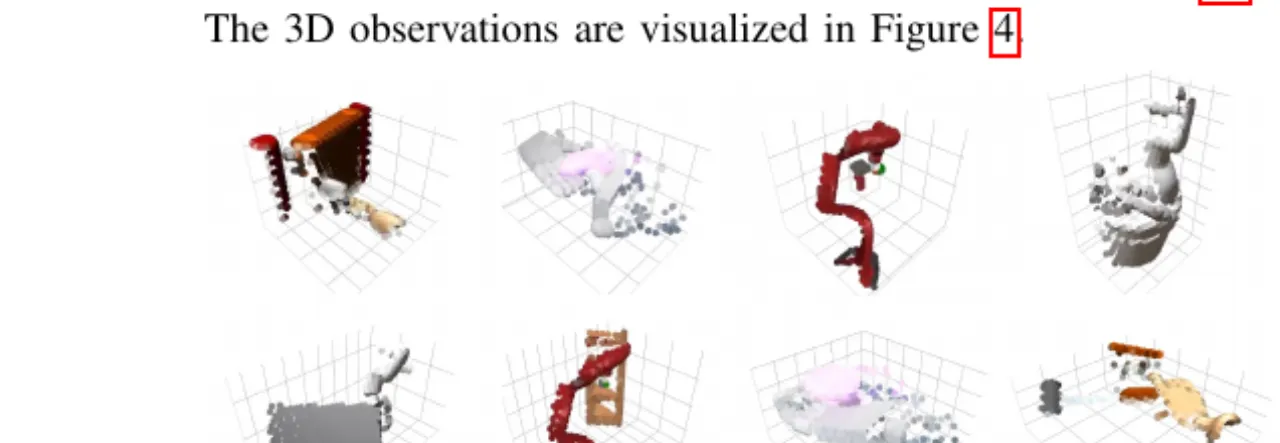
Fig. 4:仿真中的 3D 视觉观测。从多个不同仿真任务中采样,展示经过下采样处理后的点云。点云清晰呈现了机器人末端执行器与目标物体的空间结构,无需颜色信息即可区分关键部件。Fig. 4: 3D visual observations in simulation. Point clouds after downsampling, sampled from several different simulated tasks. The point clouds clearly render the spatial structure of the robot end-effector and the target object, so key parts can be distinguished without any color information.
Decision:Diffusion Policy 动作生成Decision: Action Generation with Diffusion Policy
决策模块采用基于卷积网络的 Diffusion Policy(DDIM 噪声调度器)。以机器人关节状态 s 与感知特征 v 为条件,通过去噪过程预测未来 T 步动作序列。训练目标为:The decision module adopts a convolutional Diffusion Policy (DDIM noise scheduler). Conditioned on the robot joint state s and the perception feature v, it predicts the action sequence for the next T steps through a denoising process. The training objective is:
L = MSE(εθ(αka0 + βkε, k, v, s), ε)
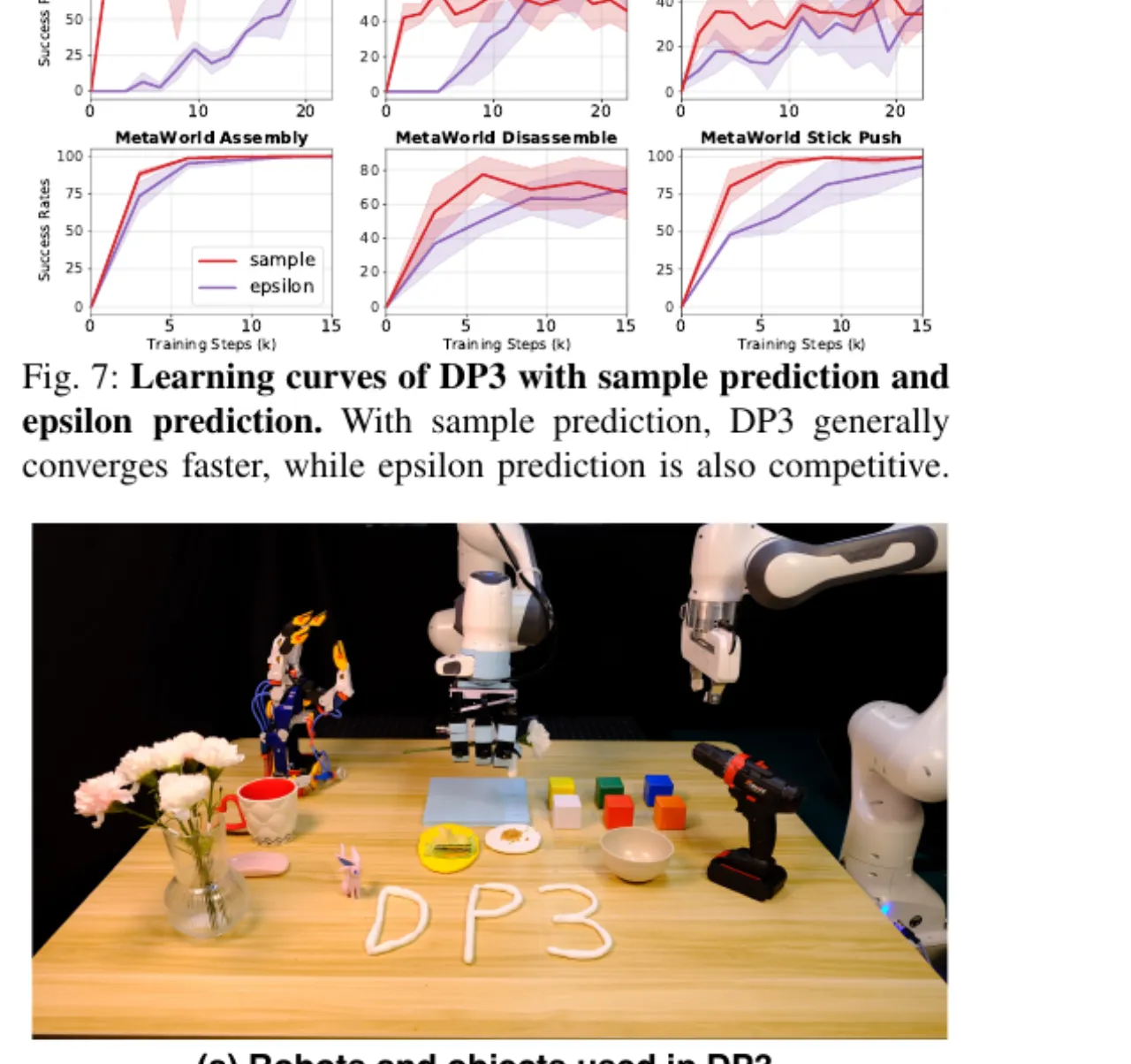
其中 αk、βk 为噪声调度参数,采用 one-step noise adding 策略。推理时使用 sample prediction(而非 epsilon prediction)以获得更快的收敛速度。实现细节:使用卷积网络 Diffusion Policy,DDIM 噪声调度;在 MetaWorld 任务上训练 1000 epochs,其他任务训练 8000 epochs;batch size 为 128;Projection head 输出维度为 1024 或 256。Here αk and βk are noise-schedule parameters, and a one-step noise adding strategy is used. At inference, sample prediction (rather than epsilon prediction) is used for faster convergence. Implementation details: a convolutional Diffusion Policy with DDIM noise scheduling; training for 1000 epochs on MetaWorld tasks and 8000 epochs on the others; batch size 128; projection head output dimension 1024 or 256.
03实验 ExperimentsExperiments
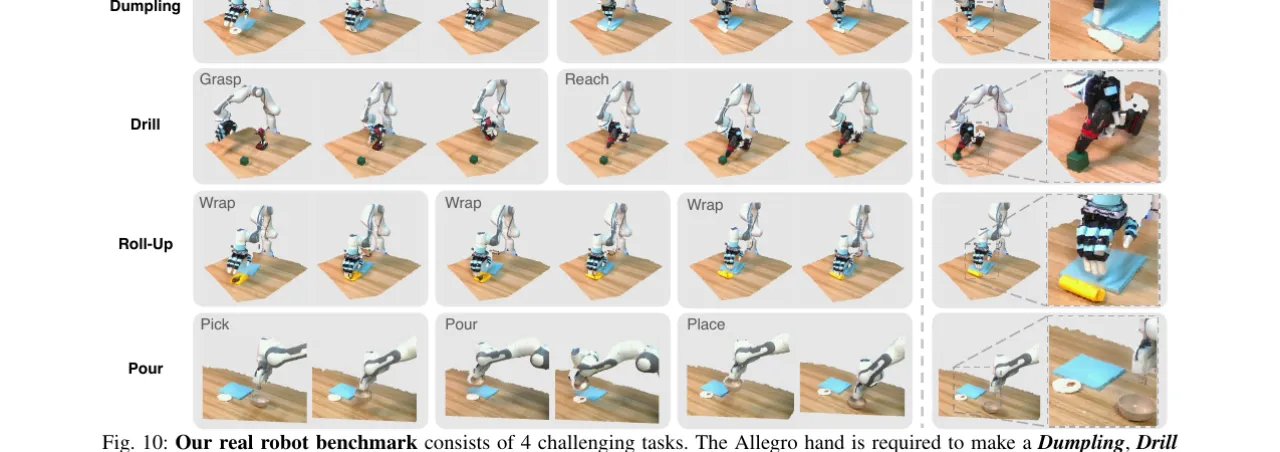
仿真基准:72 个任务,跨 7 个领域(Adroit、Bi-DexHands、DexArt、DexDeform、DexMV、HORA、MetaWorld),涵盖阴影手 / Allegro 手 / 平行夹爪等多种机器人形态,任务类型包含刚性/变形物体操作。每个任务仅使用 10 条演示(DexArt 和 HORA 除外)。真实机器人:4 个灵巧任务(Roll-Up、Dumpling、Drill、Pour),每任务 40 条演示,使用 Frankia 手臂 + Allegro 手 / 平行夹爪,RealSense L515 单目深度相机。Simulation benchmark: 72 tasks across 7 domains (Adroit, Bi-DexHands, DexArt, DexDeform, DexMV, HORA, MetaWorld), covering robot morphologies such as the Shadow Hand, the Allegro Hand and parallel grippers, with task types spanning rigid and deformable object manipulation. Each task uses only 10 demonstrations (except DexArt and HORA). Real robot: 4 dexterous tasks (Roll-Up, Dumpling, Drill, Pour) with 40 demonstrations each, using a Frankia arm plus an Allegro Hand or a parallel gripper and a RealSense L515 monocular depth camera.
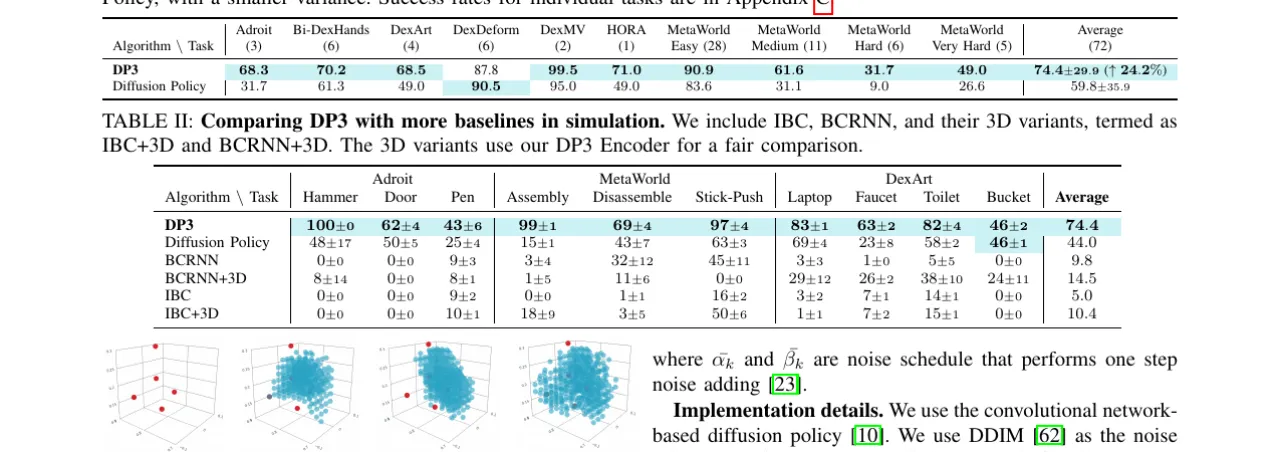
Table II:仿真基准对比(72 任务平均成功率)。DP3 在平均成功率上达到 74.4±29,显著优于 Diffusion Policy(59.8±9)、BCRNN(48±17)、IBC(0±0)及其 3D 变体。DP3 与所有基线相比均有明显提升,且在困难任务(如 Adroit Hammer 100±0、DexArt Assembly 99±1)上表现尤为突出。Table II: Simulation benchmark comparison (average success rate over 72 tasks). DP3 reaches an average success rate of 74.4±29, clearly ahead of Diffusion Policy (59.8±9), BCRNN (48±17), IBC (0±0) and their 3D variants. DP3 improves markedly over every baseline, and stands out especially on hard tasks such as Adroit Hammer (100±0) and DexArt Assembly (99±1).
算法Method
仿真平均(72任务)Sim. average (72 tasks)
Adroit Hammer
MetaWorld Easy
真实机器人平均Real-robot average
DP3
74.4 ± 29
100 ± 0
90.9
85%
Diffusion Policy
59.8 ± 9
48 ± 17
95.0
—
BCRNN
48 ± 17
0 ± 0
—
—
IBC
0 ± 0
0 ± 0
—
—
Fig. 10:真实机器人基准。4 个灵巧操作任务:(1) Roll-Up — Allegro 手将硅胶薄片卷成卷;(2) Dumpling — 捏合薄片边缘制成饺子形;(3) Drill — 抓住电钻并触碰目标绿色方块;(4) Pour — 抓取碗、倒入肉糜、放回桌面。图示展示了各任务的关键阶段点云轨迹。Fig. 10: Real-robot benchmark. 4 dexterous manipulation tasks: (1) Roll-Up — the Allegro Hand rolls a silicone sheet into a roll; (2) Dumpling — pinch the edges of the sheet into a dumpling shape; (3) Drill — grasp an electric drill and touch the target green cube; (4) Pour — grasp a bowl, pour in minced meat and put it back on the table. The figure shows the point-cloud trajectories at the key stages of each task.
关键发现Key Findings
效率优势:DP3 在 ~500 epochs 内收敛,而 Diffusion Policy 需要 3000 epochs 且常陷入次优。Efficiency: DP3 converges within ~500 epochs, whereas Diffusion Policy needs 3000 epochs and often ends up in a sub-optimal solution.
少演示扩展性:仿真中大多数任务仅用 10 条演示;真实任务用 40 条演示。DP3 在 Adroit 类任务中以更少演示达到可比精度。Scaling with few demonstrations: most simulated tasks use only 10 demonstrations, and the real tasks use 40. On Adroit-style tasks DP3 reaches comparable accuracy with fewer demonstrations.
安全性优势:DP3 安全违规率(Safety Violation Rate)远低于基于图像的基线,在 Roll-Up 任务上为 0,总平均为 0.0,而 Diffusion Policy (Depth) 平均为 21.0。Safety: the Safety Violation Rate of DP3 is far below that of image-based baselines — 0 on the Roll-Up task and 0.0 on overall average, versus 21.0 on average for Diffusion Policy (Depth).
推理速度:DP3 推理 58.1ms、预测 4 个动作步,而 PointNeXt 等复杂编码器推理更慢(60–120ms)。Inference speed: DP3 takes 58.1ms per inference and predicts 4 action steps, while complex encoders such as PointNeXt are slower (60–120ms).
消融实验 AblationsAblations
论文对 3D 表征选择、点云编码器设计和 DP3 设计细节进行了系统消融(Tables IV–VII):The paper systematically ablates the choice of 3D representation, the point-cloud encoder design and the design details of DP3 (Tables IV–VII):
3D 表征对比(Table IV):点云 > RGB-D 图像 > Depth 图像 > Voxel,使用点云的 DP3 在 6 个消融任务上平均成功率 100±0,而 RGB-D 为 62±c、Depth 为 80±c(各任务差异较大)。3D representation comparison (Table IV): point cloud > RGB-D image > depth image > voxel; with point clouds, DP3 attains an average success rate of 100±0 over 6 ablation tasks, while RGB-D reaches 62±c and depth 80±c (with large variance across tasks).
点云编码器对比(Table V):DP3 的轻量 MLP Encoder 平均 72.3,优于 PointNet(15.7)、PointNet++(16.0)、Point Transformer(26.0)等。作者将其归因于预训练编码器使用固定相机、需特征变换,与 DP3 的单视角设置不兼容。Point-cloud encoder comparison (Table V): the lightweight MLP encoder of DP3 averages 72.3, ahead of PointNet (15.7), PointNet++ (16.0) and Point Transformer (26.0). The authors attribute this to pre-trained encoders assuming a fixed camera and requiring feature transforms, which is incompatible with the single-view setting of DP3.
设计选项(Table VII):裁剪点云 (+)、使用 LayerNorm、Sample prediction、Projection head 尺寸 1024 等组合最终达到平均 72.3,消除任意一项均会导致性能下降。Design options (Table VII): combining cropped point clouds (+), LayerNorm, sample prediction and a projection head of size 1024 finally reaches an average of 72.3; removing any single item degrades performance.
左:DP3 真实机器人实验装置,包含 Allegro 手与 Franka 手臂,以及 RealSense L515 深度相机("DP3"字样由薄片摆放而成)。右:MetaWorld 任务学习曲线对比,DP3(蓝色)收敛速度明显快于 Diffusion Policy(红色),epsilon prediction(虚线)也具有竞争力。Left: the real-robot setup of DP3, with an Allegro Hand and a Franka arm plus a RealSense L515 depth camera (the letters “DP3” are laid out from silicone sheets). Right: learning-curve comparison on MetaWorld tasks — DP3 (blue) converges markedly faster than Diffusion Policy (red), and epsilon prediction (dashed) is also competitive.
04局限性 LimitationsLimitations
Note:论文 Conclusion 部分明确提出一条局限性(stated);其余由设计特点推断(inferred from the design)。The Conclusion of the paper states one limitation explicitly (stated); the rest are inferred from the design.
最优 3D 表征尚未确定(stated)The optimal 3D representation is still undetermined (stated)
论文明确指出:"Though we demonstrate the importance of 3D representations, the optimal 3D representation for control is still yet discovered." 当前 DP3 选择了稀疏点云 + 轻量 MLP,但其他 3D 表征(如隐式场、Gaussian splatting、dense voxel grid)是否更优仍是开放问题。The paper states explicitly: “Though we demonstrate the importance of 3D representations, the optimal 3D representation for control is still yet discovered.” DP3 currently opts for a sparse point cloud plus a lightweight MLP, but whether other 3D representations (implicit fields, Gaussian splatting, dense voxel grids) are better remains an open question.
视角变化的局限:依赖准确的相机-机器人变换(inferred)Limits under viewpoint change: reliance on an accurate camera-to-robot transform (inferred)
DP3 在视角泛化实验(Table IX)中,对轻微视角偏移通过点云变换保持一致性;但论文也指出"it is important to acknowledge that while the network can generalize across minor variations in camera views, significant changes might be hard to handle." 较大视角变化(如从顶视到侧视)仍具挑战。In the viewpoint-generalization experiments (Table IX), DP3 keeps consistency under slight viewpoint shifts by transforming the point cloud; but the paper also notes that “it is important to acknowledge that while the network can generalize across minor variations in camera views, significant changes might be hard to handle.” Large viewpoint changes (e.g. from top-down to side view) remain challenging.
复杂场景中的点云质量限制(inferred)Point-cloud quality limits in complex scenes (inferred)
DP3 使用单目深度相机,点云质量依赖深度图精度。在遮挡严重或反光材质(如金属、玻璃)场景下,点云噪声增大;同时论文也提及 "Cluttered Scenes" 需要 50 条演示(对比标准 40 条),说明场景复杂度对数据需求有影响。DP3 uses a monocular depth camera, so point-cloud quality depends on the accuracy of the depth map. Under heavy occlusion or with reflective materials (metal, glass) the point-cloud noise grows; the paper also mentions that “Cluttered Scenes” requires 50 demonstrations (versus the standard 40), showing that scene complexity affects the data requirement.
任务范围:目前限于单阶段操作(inferred)Task scope: currently limited to single-stage manipulation (inferred)
论文提及双手操作、可变形物体操作等复杂场景均在仿真中测试,真实机器人任务(4 个)均为单阶段。论文明确将"exploring tasks with long horizons"列为未来工作方向。The paper notes that complex settings such as bimanual manipulation and deformable-object manipulation are all tested in simulation, while the real-robot tasks (4 of them) are all single-stage. It explicitly lists “exploring tasks with long horizons” as a direction for future work.