现有 VLA 模型要么以固定从左到右的顺序自回归生成动作(性能差、速度慢),要么在主干之外附加独立的扩散头(割裂信息通路、损伤视觉语言能力)。本文提出 Discrete Diffusion VLA,在统一的 transformer 主干内对离散动作块进行掩码扩散建模,通过 Adaptive Decoding 和 Secondary Re-Masking 实现渐进式精炼,在保留视觉语言能力的同时达到 SOTA 性能。Existing VLA models either generate actions autoregressively in a fixed left-to-right order (poor performance, slow inference), or attach a separate diffusion head outside the backbone (severing the information pathway and damaging vision-language capabilities). This paper proposes Discrete Diffusion VLA, which performs masked diffusion modeling over discrete action chunks inside a unified transformer backbone and achieves progressive refinement through Adaptive Decoding and Secondary Re-Masking, reaching SOTA performance while preserving vision-language capabilities.
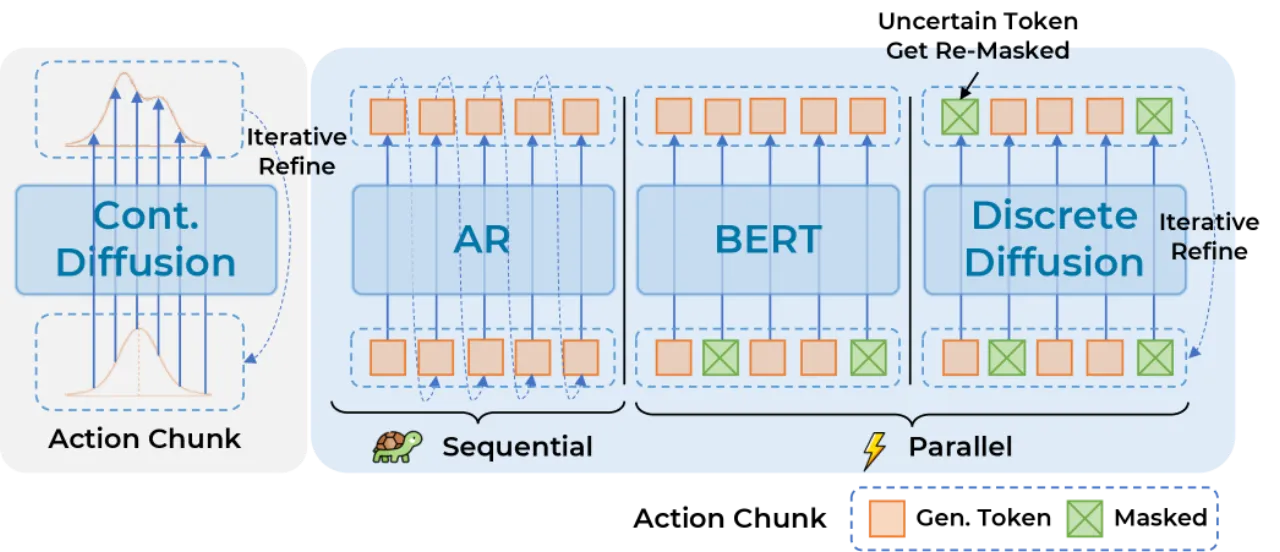
当前 VLA 动作解码范式面临两大根本性缺陷:自回归方法存在从左到右的累积误差与推理效率低下问题;而将独立扩散头附加于主干之外的方式,则割裂了信息通路,并损害了视觉语言预训练能力。Current VLA action-decoding paradigms suffer from two fundamental flaws: autoregressive methods incur left-to-right error accumulation and low inference efficiency; while attaching a separate diffusion head outside the backbone severs the information pathway and harms the pretrained vision-language capabilities.
"This design not only complicates policy training but also degrades the pretrained vision-language capabilities, which represents a critical issue we address in this work."
Figure 1:范式对比。 连续扩散(对动作块做扩散,附加在主干外)vs. 离散 token 解码器:AR(顺序生成)、BERT-style 并行解码,以及本文的 Discrete Diffusion(带 re-masking 的迭代精炼)。本文方法在统一主干内完成所有计算,避免信息割裂。Figure 1: Paradigm comparison. Continuous diffusion (diffusing over action chunks, attached outside the backbone) vs. discrete token decoders: AR (sequential generation), BERT-style parallel decoding, and the Discrete Diffusion of this paper (iterative refinement with re-masking). Our method performs all computation inside a unified backbone, avoiding information fragmentation.
96.4%LIBERO 平均成功率(离散方法最优)LIBERO average success rate (best among discrete methods)
14.53 Hz实时控制频率(12 步去噪)Real-time control frequency (12 denoising steps)
核心洞察在于:离散扩散与大语言模型的预训练目标(交叉熵)天然一致——训练时均以掩码 token 的预测为优化目标,因此不需要引入竞争性梯度信号,即可在同一主干内同时保留视觉语言推理能力和动作生成能力。The core insight is that discrete diffusion is naturally consistent with the pretraining objective of large language models (cross-entropy): both optimize for the prediction of masked tokens during training, so no competing gradient signal has to be introduced, and vision-language reasoning and action generation can be preserved simultaneously within the same backbone.
02方法Method
Discrete Diffusion VLA 以 Prismatic-7B(Llama 2 主干)为基础,将机器人动作离散化为 token 序列,在统一 transformer 内以掩码扩散方式迭代精炼,并通过 Adaptive Decoding 和 Secondary Re-Masking 在推理阶段实现自适应去噪顺序与错误纠正。Discrete Diffusion VLA builds on Prismatic-7B (Llama 2 backbone), discretizes robot actions into token sequences, refines them iteratively by masked diffusion inside a unified transformer, and realizes an adaptive denoising order together with error correction at inference time through Adaptive Decoding and Secondary Re-Masking.
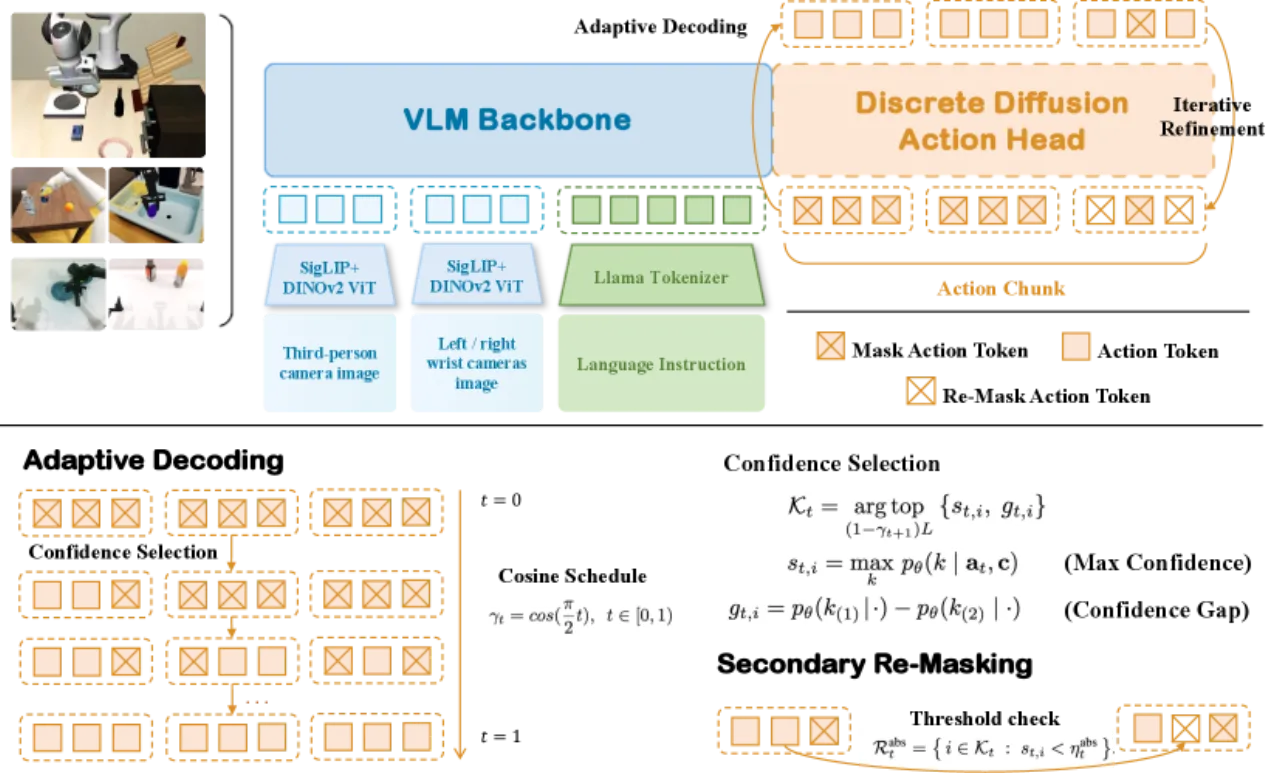
Figure 2:架构总览。 多视角 RGB 图像经 SigLIP+DINOv2 ViT 编码,与自然语言指令一同输入主干;动作 token 使用双向 attention 与视觉/语言 token 充分融合。底部左侧为 Adaptive Decoding(按 cosine 调度逐轮保留高置信度 token),底部右侧为 Secondary Re-Masking(阈值检测重置不确定 token)。Figure 2: Architecture overview. Multi-view RGB images are encoded by SigLIP+DINOv2 ViT and fed into the backbone together with the natural-language instruction; action tokens are fully fused with visual and language tokens through bidirectional attention. Bottom left: Adaptive Decoding (keeping high-confidence tokens round by round along a cosine schedule); bottom right: Secondary Re-Masking (threshold detection resets uncertain tokens).
动作离散化Action discretization
末端执行器动作(平移 3 维、旋转 3 维、夹爪 1 维)通过分位数分箱离散化:每个连续维度划分为 256 个 bin(采用第 1—99 百分位以剔除异常值),夹爪单独作二值处理。每个时间步产生 D_act = 7 个 token,动作块长度 H 个时间步则产生 L = H × D_act 个 token。End-effector actions (3 translation dimensions, 3 rotation dimensions, 1 gripper dimension) are discretized by quantile binning: every continuous dimension is divided into 256 bins (taking the 1st to 99th percentiles so as to discard outliers), while the gripper is treated separately as binary. Each timestep yields D_act = 7 tokens, so an action chunk of H timesteps yields L = H × D_act tokens.
训练目标Training objective
训练时随机采样掩码比例 γ_t,将 γL 个动作位置替换为 [MASK],以交叉熵损失预测原始 token:During training a mask ratio γ_t is sampled at random, γL action positions are replaced with [MASK], and the original tokens are predicted under a cross-entropy loss:
ℒ_CE(θ) = −∑i∈ℳ_γt log p_θ(a0,i | ã_t, c)
该目标与预训练 VLM 的优化目标完全一致,从而保留视觉语言能力,无需引入竞争性梯度信号。动作 token 的 attention 从因果改为双向,使每个动作位置均可 attend 到所有视觉、语言和动作 token。This objective is exactly consistent with the optimization objective of the pretrained VLM, thereby preserving vision-language capabilities without introducing a competing gradient signal. The attention of action tokens is changed from causal to bidirectional, so that every action position can attend to all visual, language and action tokens.
推理时,从全掩码(γ₁ = 1)出发,迭代 T 步:At inference, starting from the fully masked state (γ₁ = 1), iterate for T steps:
按最大置信度 s_{t,i} = max_k p_θ(k | ã_t, c) 对所有位置打分;score all positions by the maximum confidence s_{t,i} = max_k p_θ(k | ã_t, c);
保留置信度最高的 (1−γ_{t+1})L 个位置,按温度采样(Gumbel 采样),其余重置为 [MASK];keep the (1−γ_{t+1})L positions with the highest confidence and sample them with temperature (Gumbel sampling), resetting the remaining ones to [MASK];
掩码比例以 cosine 调度单调递减,直至 γ_T = 0。the mask ratio decreases monotonically along a cosine schedule until γ_T = 0.
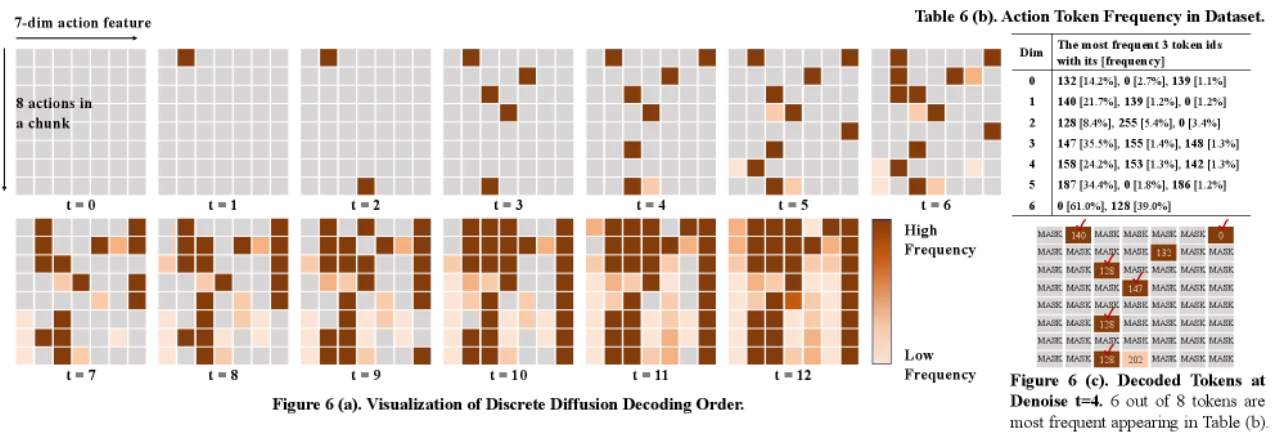
此策略实现"instance-wise ranking"——对当前情境更确定的动作维度(如夹爪开合)优先解码,不确定的维度保留到后续迭代。This strategy realizes "instance-wise ranking": action dimensions that are more certain in the current context (such as gripper opening and closing) are decoded first, while uncertain dimensions are deferred to later iterations.
Secondary Re-Masking(二次重掩码纠错)Secondary Re-Masking (re-masking for error correction)
为防止低置信度 token 被错误固化,引入绝对阈值检测:若已承诺位置的置信度 s_{t,i} < η_t^abs(单调递增阈值),则将该 token 重置为 [MASK] 重新预测,实现"多迭代一致性与鲁棒错误纠正"。To prevent low-confidence tokens from being wrongly committed, an absolute threshold check is introduced: if the confidence s_{t,i} of an already committed position falls below η_t^abs (a monotonically increasing threshold), that token is reset to [MASK] and re-predicted, achieving "multi-iteration consistency and robust error correction".
Figure 6:Adaptive Decoding 顺序可视化。 不同任务场景下,模型自动学习到不同的解码顺序——夹爪状态和高置信度动作维度优先解码,末端执行器精细轨迹维度在后续步骤中精炼。Figure 6: Visualization of the Adaptive Decoding order. Across different task scenarios the model automatically learns different decoding orders: gripper state and high-confidence action dimensions are decoded first, while the fine-grained end-effector trajectory dimensions are refined in later steps.
03实验Experiments
在 LIBERO、SimplerEnv-Fractal(Google Robot)、SimplerEnv-Bridge(WidowX)等模拟基准及 AgileX Cobot Magic 真实机器人上评估,与 OpenVLA、pi0、pi0-FAST、OpenVLA-OFT、GR00T-N1 等方法对比。Evaluated on simulation benchmarks such as LIBERO, SimplerEnv-Fractal (Google Robot) and SimplerEnv-Bridge (WidowX), as well as on the AgileX Cobot Magic real robot, and compared with methods such as OpenVLA, pi0, pi0-FAST, OpenVLA-OFT and GR00T-N1.
在所有离散方法中性能最优;与最强连续方法 OpenVLA-OFT L1 (97.1%) 相差仅 0.7%。Best among all discrete methods; only 0.7% behind the strongest continuous method, OpenVLA-OFT L1 (97.1%).
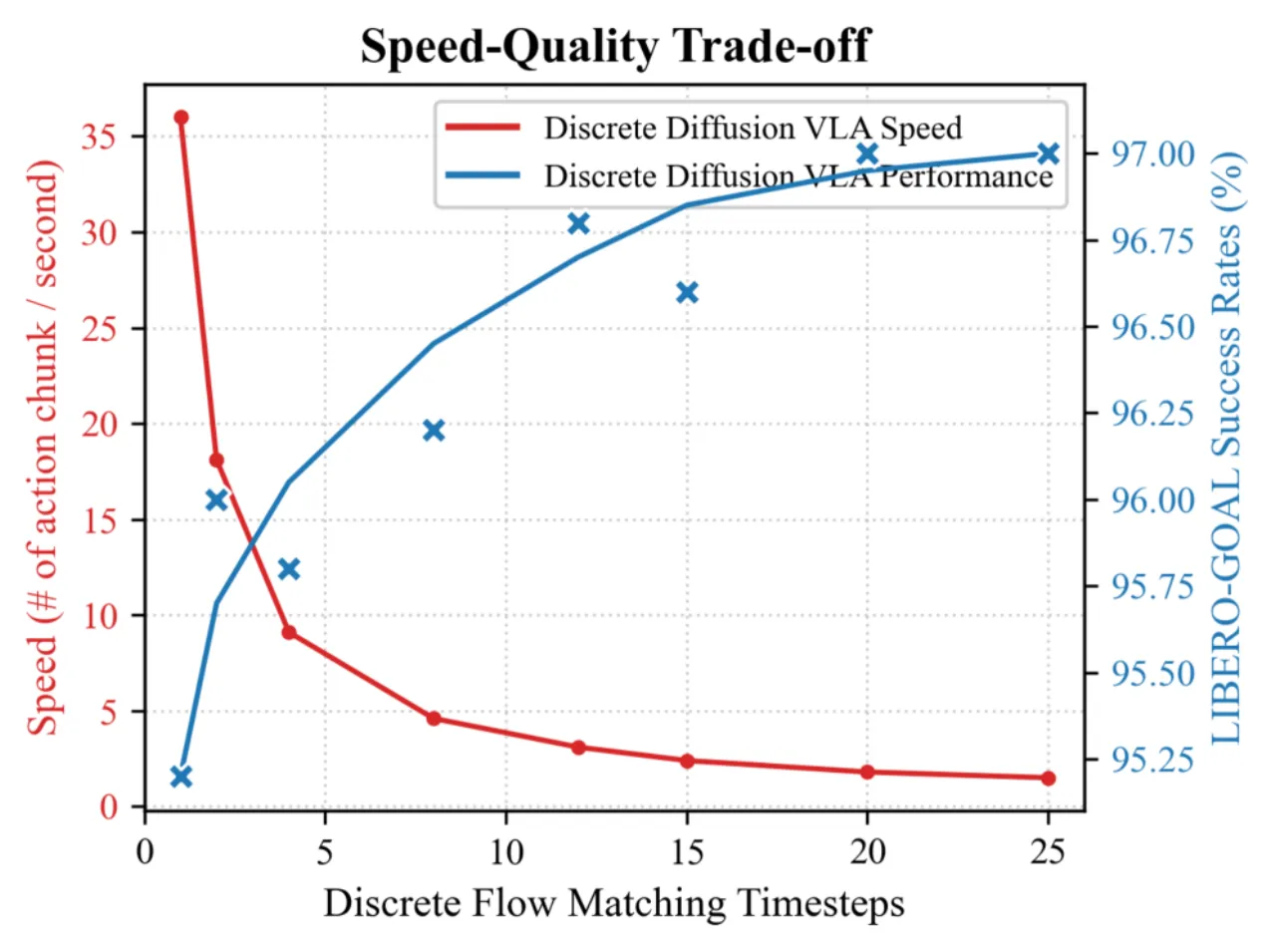
Figure 4:Speed–Quality trade-off。 左 y 轴:每秒生成动作块数(吞吐量);右 y 轴:去噪步数消融(性能 vs. 步数)。12 步时延迟 68.8 ms(14.53 Hz),比 AR(136.2 ms)快约 2×,NFE 从 56 减至 12(减少 4.7×)。Figure 4: Speed–Quality trade-off. Left y-axis: action chunks generated per second (throughput); right y-axis: ablation on the number of denoising steps (performance vs. steps). With 12 steps the latency is 68.8 ms (14.53 Hz), about 2× faster than AR (136.2 ms), and NFE drops from 56 to 12 (a 4.7× reduction).
解码顺序: 并行解码 95.6%,随机顺序 95.8%,confidence gap 96.6%,max confidence 96.8%(最优);Decoding order: parallel decoding 95.6%, random order 95.8%, confidence gap 96.6%, max confidence 96.8% (best);
采样温度: 硬采样 96.2%,固定温度 96.4%,线性衰减温度 96.8%(最优);Sampling temperature: hard sampling 96.2%, fixed temperature 96.4%, linearly decaying temperature 96.8% (best);
Adaptive Decoding + Secondary Re-Masking 均有正向贡献,组合使用效果最佳。Adaptive Decoding and Secondary Re-Masking both contribute positively, and combining them works best.
在 AgileX Cobot Magic 双臂机器人上,每项任务各测试 15 次(控制频率 9.69 Hz):On the AgileX Cobot Magic dual-arm robot, each task was tested 15 times (control frequency 9.69 Hz):
"Click the bell":66.7% 成功率;"Click the bell": 66.7% success rate;
"Place cup on coaster":40.0% 成功率。"Place cup on coaster": 40.0% success rate.
04局限性Limitations
Note:以下局限性由作者在论文结论部分明确陈述(stated);未注明者为基于设计推断(inferred)。The limitations below are explicitly stated by the authors in the conclusion of the paper; those not marked as such are inferred from the design.
多步迭代解码速度慢于单步解码Multi-step iterative decoding is slower than single-pass decoding
作者明确指出:"Our multi-step iterative decoding is slower than single-pass decoding by design。"12 步去噪虽比 AR 快 2×,但仍比单次前向传播(如并行 BERT-style 解码)开销更大,在对延迟极度敏感的应用场景中存在限制。The authors state explicitly: "Our multi-step iterative decoding is slower than single-pass decoding by design." Although 12-step denoising is 2× faster than AR, it is still more expensive than a single forward pass (such as parallel BERT-style decoding), which is a limitation in applications that are extremely sensitive to latency.
不兼容可变长度动作 tokenizationIncompatible with variable-length action tokenization
作者明确指出:"variable-length action tokenization schemes are incompatible with discrete diffusion。"当前方法仅支持固定长度动作块(fixed-length chunk),无法直接应用于需要动态时间对齐的任务或变长指令跟踪场景。The authors state explicitly: "variable-length action tokenization schemes are incompatible with discrete diffusion." The current method supports fixed-length action chunks only, and cannot be applied directly to tasks requiring dynamic temporal alignment or to variable-length instruction-following scenarios.
依赖预定义 bin 数量与量化方案(inferred)Dependence on a predefined number of bins and on the quantization scheme (inferred)
256-bin 分位数量化在有限数据下可能引入量化误差,且 bin 数量是超参数;对于精度要求极高的灵巧操作任务(如穿针引线),离散化精度是否足够尚未充分验证。256-bin quantile quantization may introduce quantization error under limited data, and the number of bins is a hyperparameter; for dexterous manipulation tasks with extremely high precision requirements (such as threading a needle), whether the discretization resolution is sufficient has not been adequately verified.
真实机器人评估规模有限(inferred)Limited scale of the real-robot evaluation (inferred)
真实机器人实验仅在 AgileX Cobot Magic 单一平台、2 项任务、各 15 次试验下进行,泛化到更多平台、更长任务链和非结构化环境的能力有待验证。The real-robot experiments were carried out on the single platform AgileX Cobot Magic, with 2 tasks and 15 trials each; the ability to generalize to more platforms, longer task chains and unstructured environments remains to be verified.