Diffusion Policy 将去噪扩散概率模型(DDPM)引入机器人策略学习:将机器人动作生成建模为条件去噪扩散过程, 通过学习动作分布的分数函数梯度,在推理时经多步去噪输出一段动作序列。在 4 个操作基准的共 15 个任务中, Diffusion Policy 平均超越现有最优方法 46.9%,并在多个真实机器人任务上达到接近人类示范的性能。Diffusion Policy introduces the denoising diffusion probabilistic model (DDPM) into robot policy learning: robot action generation is formulated as a conditional denoising diffusion process, and by learning the gradient of the score function of the action distribution the model outputs an action sequence through multi-step denoising at inference time. Across a total of 15 tasks from 4 manipulation benchmarks, Diffusion Policy outperforms the prior state of the art by 46.9% on average, and attains performance close to human demonstrations on several real-robot tasks.
机器人 visuomotor 策略学习面临三大核心挑战:多模态动作分布(同一状态存在多种合理行为)、 高维动作序列的时序相关性以及高精度控制要求。 现有方法(显式策略、IBC 隐式策略、BET 序列模型)各有缺陷,均难以同时满足这三点。Robot visuomotor policy learning faces three core challenges: multimodal action distributions (multiple reasonable behaviors exist for the same state), temporal correlation within high-dimensional action sequences, and high-precision control requirements. Existing approaches (explicit policies, IBC implicit policies, BET sequence models) each have shortcomings, and none satisfies all three simultaneously.
"This work presents Diffusion Policy, a new way of generating robot behavior by representing a robot's visuomotor policy as a conditional denoising diffusion process on robot action space."
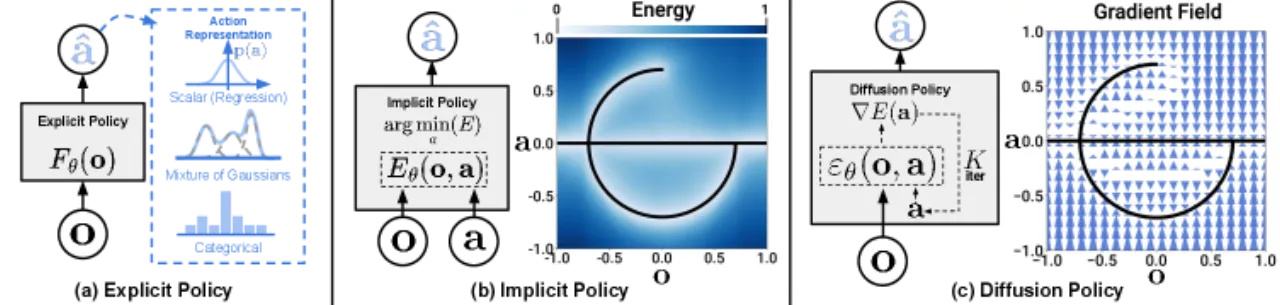
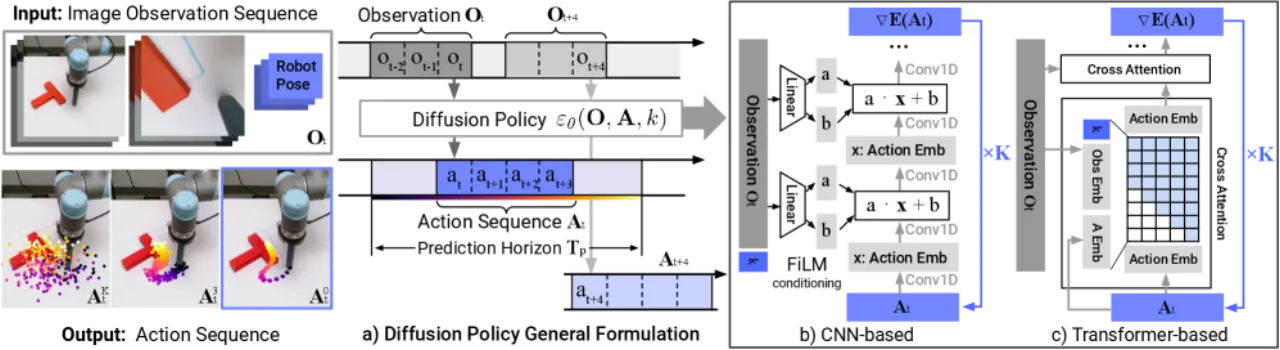
Diffusion Policy 将策略参数化为条件去噪扩散过程:给定最近 To 步观测 Ot, 从高斯噪声出发,经过 K 步去噪(学习动作分布的分数函数梯度),输出 Ta 步动作序列, 再通过 receding-horizon control 执行其中前 Ta 步并滑窗更新。 论文提供两种网络骨干:CNN-based(DP-C)与Transformer-based(DP-T)。Diffusion Policy parameterizes the policy as a conditional denoising diffusion process: given the most recent To steps of observation Ot, it starts from Gaussian noise and, after K denoising steps (learning the gradient of the score function of the action distribution), outputs an action sequence of Ta steps; the leading Ta steps are then executed under receding-horizon control and the window slides forward. The paper provides two network backbones: CNN-based (DP-C) and Transformer-based (DP-T).
训练时对动作加噪,学习预测噪声(或分数);推理时从 AK ∼ 𝒩(0, I) 出发, 迭代执行 K 步 DDPM 去噪(或 DDIM 加速推理)得到动作序列 A0。 关键优势:能量函数无需显式定义,分布覆盖度由扩散过程天然保证,可表达任意复杂的多模态分布。During training, noise is added to the actions and the network learns to predict the noise (or the score); at inference the process starts from AK ∼ 𝒩(0, I) and iteratively performs K DDPM denoising steps (or DDIM for accelerated inference) to obtain the action sequence A0. Key advantage: the energy function need not be defined explicitly, distribution coverage is guaranteed naturally by the diffusion process, and arbitrarily complex multimodal distributions can be expressed.
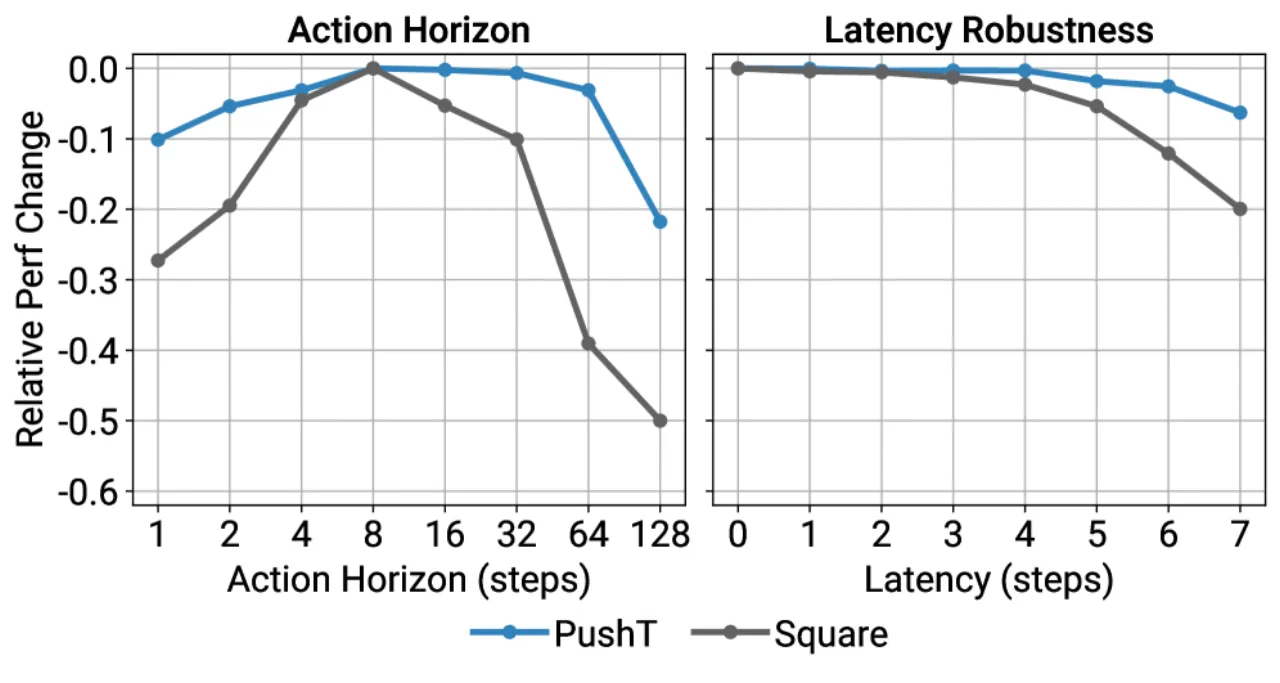
每次推理预测未来 Ta 步动作,实际执行前 Ta 步, 再以滑窗获取新观测、重新推理。这一机制在保持时序一致性(trajectory coherence)的同时 保留闭环响应能力。论文消融实验表明 action horizon 的选择对性能影响显著。Each inference predicts Ta future action steps, of which the leading Ta steps are actually executed; new observations are then obtained with a sliding window and inference is run again. This mechanism preserves closed-loop responsiveness while maintaining trajectory coherence. The ablation study in the paper shows that the choice of action horizon has a significant effect on performance.
观测 Ot(RGB 图像或状态向量)仅作为条件输入去噪网络, 而非被去噪的对象,从而保持动作空间扩散的简洁性。 CNN 变体用 FiLM conditioning;Transformer 变体用 cross-attention。The observation Ot (RGB image or state vector) is fed into the denoising network only as a condition, rather than being the object that is denoised, which keeps diffusion in the action space simple. The CNN variant uses FiLM conditioning; the Transformer variant uses cross-attention.
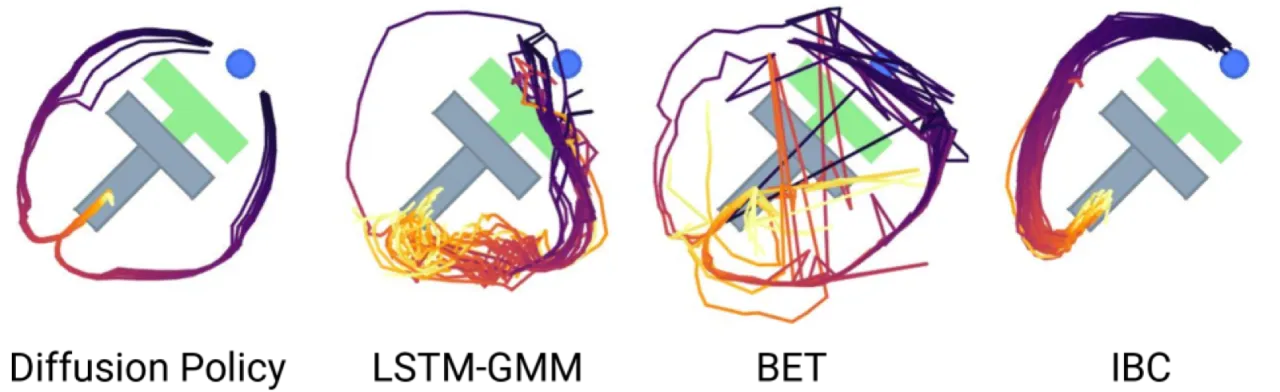
扩散模型天然支持多峰(multimodal)分布:同一观测下策略可采样出截然不同但各自合理的动作轨迹, 且每次 rollout 内部保持一致性,不会在执行中途切换模式。Diffusion models naturally support multimodal distributions: under the same observation the policy can sample markedly different yet individually reasonable action trajectories, and each rollout stays internally consistent, never switching mode midway through execution.
实验覆盖 4 个基准(Robomimic 仿真、Push-T 仿真、真实 Push-T、多个真实操作任务), 基线包括 BC、LSTM-GMM、IBC、BET。指标为任务成功率(sim)和 IoU / 成功率(real Push-T)。 DP-C = CNN-based Diffusion Policy,DP-T = Transformer-based Diffusion Policy。The experiments cover 4 benchmarks (Robomimic simulation, Push-T simulation, real-world Push-T, and several real-world manipulation tasks), with BC, LSTM-GMM, IBC and BET as baselines. The metrics are task success rate (sim) and IoU / success rate (real Push-T). DP-C = CNN-based Diffusion Policy, DP-T = Transformer-based Diffusion Policy.
| 方法Method | Lift | Can | Square | Transport | ToolHang | Push-T |
|---|---|---|---|---|---|---|
| LSTM-GMM | 1.00/0.96 | 1.00/0.93 | 1.00/0.91 | 1.00/0.81 | 0.95/0.73 | 0.86/0.59 |
| IBC | 0.79/0.41 | 0.15/0.02 | 0.00/0.00 | 0.01/0.01 | 0.00/0.00 | 0.00/0.00 |
| BET | 1.00/0.96 | 1.00/0.99 | 1.00/0.89 | 1.00/0.90 | 0.76/0.52 | 0.68/0.43 |
| DP-C(ours) | 1.00/0.98 | 1.00/0.97 | 1.00/0.96 | 1.00/0.96 | 1.00/0.93 | 0.97/0.82 |
| DP-T(ours) | 1.00/1.00 | 1.00/1.00 | 1.00/1.00 | 1.00/0.94 | 1.00/0.89 | 0.95/0.81 |
| 方法Method | Lift | Can | Square | Transport | ToolHang | Push-T |
|---|---|---|---|---|---|---|
| LSTM-GMM | 1.00/0.96 | 1.00/0.95 | 1.00/0.88 | 0.98/0.90 | 0.82/0.59 | 0.64/0.38 |
| IBC | 0.94/0.73 | 0.39/0.05 | 0.08/0.01 | 0.00/0.00 | 0.03/0.00 | 0.00/0.00 |
| DP-C(ours) | 1.00/1.00 | 1.00/1.00 | 1.00/0.97 | 1.00/0.96 | 0.98/0.92 | 0.98/0.84 |
| DP-T(ours) | 1.00/1.00 | 1.00/0.99 | 1.00/0.98 | 1.00/0.98 | 1.00/0.90 | 0.94/0.80 |
| 方法Method | IoU | 成功率Success rate | 时长(秒)Duration (s) |
|---|---|---|---|
| 人类示范Human demonstration | 0.84 | 1.00 | 20.3 |
| IBC (pos) | 0.14 | 0.00 | 56.3 |
| IBC (vel) | 0.19 | 0.00 | 41.6 |
| LSTM-GMM (pos) | 0.24 | 0.20 | 47.3 |
| LSTM-GMM (vel) | 0.25 | 0.10 | 51.7 |
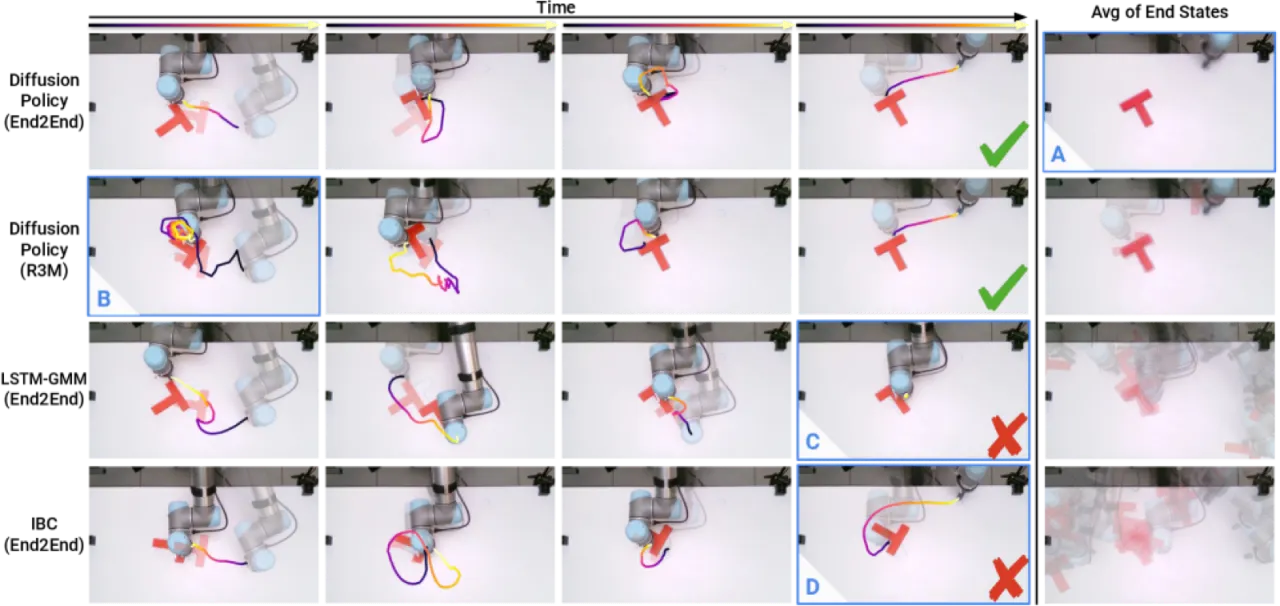
| DP (R3M) | 0.53 | 0.65 | 57.5 |
| DP (ImgNet) | 0.24 | 0.15 | 55.8 |
| DP E2E Trans(ours) | 0.80 | 0.95 | 22.9 |
| DP E2E CNN(ours) | 0.66 | 0.80 | 31.7 |
| 任务Task | 成功率Success rate | 试验次数Trials | 示范数Demos |
|---|---|---|---|
| Mug Flipping(6DoF 抓取+翻转杯子)Mug Flipping (6DoF grasping and flipping a mug) | 90% | 20 | — |
| Sauce Pouring(酱料倒浇披萨)Sauce Pouring (pouring sauce onto a pizza) | 79% | — | — |
| Sauce Spreading(酱料涂抹)Sauce Spreading (spreading the sauce) | 100% | — | — |
| 双臂 Egg Beater(打蛋器操作)Bimanual Egg Beater (operating an egg beater) | 55% | 20 | 210 |
| 双臂 Mat Unrolling(展开垫子)Bimanual Mat Unrolling (unrolling a mat) | 75% | 20 | 162 |
| 双臂 Shirt Folding(折叠衬衫)Bimanual Shirt Folding (folding a shirt) | 75% | 20 | 284 |
训练稳定性方面,论文专门与 IBC 对比(Figure 6):IBC 的 evaluation success rate 剧烈震荡, 即便训练 loss 单调下降也无法获得稳定收敛的策略;Diffusion Policy 则展现出平稳的训练曲线, checkpoint 选择不敏感。这一特性在实际应用中尤为重要。Regarding training stability, the paper makes a dedicated comparison with IBC (Figure 6): the evaluation success rate of IBC oscillates violently, and even when the training loss decreases monotonically no stably converged policy can be obtained; Diffusion Policy, by contrast, exhibits a smooth training curve and is insensitive to checkpoint selection. This property is particularly important in practice.
Diffusion Policy 本质是一种 behavior cloning 方法,当示范数据不足或质量较差时, 性能会显著下降。论文指出其改进并不能突破 BC 范式的根本限制—— 若示范覆盖的状态空间有限,策略在分布外状态的泛化性仍无法保证。Diffusion Policy is in essence a behavior cloning method, and its performance degrades markedly when demonstration data are insufficient or of low quality. The paper points out that its improvements do not break through the fundamental limitations of the BC paradigm — if the state space covered by the demonstrations is limited, generalization of the policy to out-of-distribution states still cannot be guaranteed.
每次动作推理需要运行 K 步去噪(DDPM K=100,DDIM K=10~16), 推理延迟明显高于直接回归策略。论文承认这使得 Diffusion Policy 在需要高频(如 > 10 Hz)控制的任务上可能遇到瓶颈。 虽然 DDIM 加速推理可缓解此问题,但代价是生成质量可能略有下降。Every action inference requires running K denoising steps (DDPM K=100, DDIM K=10~16), so the inference latency is clearly higher than that of a direct regression policy. The paper acknowledges that this may create a bottleneck on tasks that require high-frequency control (e.g. > 10 Hz). DDIM accelerated inference can alleviate the problem, at the cost of a possible slight drop in generation quality.
DP-T(Transformer-based)在多数任务上性能优异,但论文指出其对超参数(如 action horizon、 observation horizon)的选择较为敏感,需要细致调优。 此外,Transformer 变体的显存占用和训练时间也更高(inferred from architecture scale)。DP-T (Transformer-based) performs excellently on most tasks, but the paper points out that it is fairly sensitive to the choice of hyperparameters (such as action horizon and observation horizon) and requires careful tuning. In addition, the Transformer variant has a higher memory footprint and longer training time (inferred from architecture scale).
在双臂操作任务(Egg Beater 55%、Mat Unrolling 75%、Shirt Folding 75%)中, 成功率相比单臂任务明显偏低。这部分源于任务本身的复杂性(多步骤、双臂协调、 接触点丰富),也暗示当前方法在长时程、高接触任务中仍有较大提升空间(inferred)。On the bimanual manipulation tasks (Egg Beater 55%, Mat Unrolling 75%, Shirt Folding 75%), success rates are clearly lower than on single-arm tasks. This partly stems from the intrinsic complexity of the tasks (multiple stages, bimanual coordination, rich contact), and also suggests that current methods still have substantial room for improvement on long-horizon, high-contact tasks (inferred).