← 论文海报合集← Paper Notes|
机器人 · Robotics · VLA Post-Training · arXiv 2026Robotics · VLA Post-Training · arXiv 2026

Breaking Lock-In: Preserving Steerability under Low-Data VLA Post-Training

DeLock:解决低数据 VLA post-training 后的 "锁死" 失效问题DeLock: resolving the "lock-in" failure of low-data VLA post-training
Suning Huang, Jiaqi Shao, Ke Wang, Qianzhong Chen, Jiankai Sun, Yanjiang Guo, Mac Schwager, Jeannette Bohg  ·  2026-04-25

将通用 VLA 策略在少量演示数据上做 post-training 后,模型往往会丧失对新指令的响应能力——这种现象被称为 lock-in(锁死)。DeLock 通过两个轻量机制解决这一问题:在 fine-tuning 阶段用 L2 正则化保护视觉编码器的预训练 grounding 能力,在推理阶段用 contrastive prompt guidance(CPG)将 denoising 轨迹重定向到新指令。在 8 项仿真与真实世界评测中,DeLock 持续超越强基线,且在仅用 80–100 条演示的情况下媲美或超越用大量精标数据训练的 generalist policy。After post-training a generalist VLA policy on a small amount of demonstration data, the model often loses its ability to respond to novel instructions — a phenomenon known as lock-in. DeLock resolves this with two lightweight mechanisms: during fine-tuning, an L2 regularizer protects the pre-trained grounding ability of the visual encoder; at inference, contrastive prompt guidance (CPG) redirects the denoising trajectory toward the novel instruction. Across 8 simulated and real-world evaluations, DeLock consistently outperforms strong baselines, and with only 80–100 demonstrations it matches or surpasses generalist policies trained on large amounts of carefully annotated data.

cs.RO · cs.CV 8 tasks · simulation + real-world 80–100 demos (low-data regime) 📄 arXiv:2604.23121 PDF
VLA post-training lock-in failure visual grounding contrastive prompt guidance instruction following 机器人操作robot manipulation 低数据微调low-data fine-tuning diffusion policy 视觉语言动作模型vision-language-action model

01 动机(Motivation)Motivation

将一个预训练的通用 VLA 策略在少量演示上做 supervised fine-tuning(SFT),往往会使它 "过拟合" 到训练数据的行为分布,无法正确响应在 post-training 阶段未出现过的新指令。Supervised fine-tuning (SFT) of a pre-trained generalist VLA policy on a handful of demonstrations often makes it "overfit" to the behavior distribution of the training data, leaving it unable to respond correctly to novel instructions that did not appear during post-training.

"Have you ever post-trained a generalist vision-language-action (VLA) policy on a small demonstration dataset, only to find that it stops responding to new instructions and is limited to behaviors observed during post-training?"

作者把这一失效模式命名为 lock-in(锁死),并区分出两种表现形式:The authors name this failure mode lock-in, and distinguish two manifestations of it:

现有的补救手段通常需要额外的监督信号(如来自大型基础模型的奖励、辅助目标),或依赖扩增数据集。但作者指出,预训练 VLA 本身已具备足够的内部知识,无需额外数据即可克服 lock-in。Existing remedies usually require additional supervision signals (such as rewards from large foundation models, or auxiliary objectives), or rely on augmented datasets. The authors argue instead that the pre-trained VLA already possesses sufficient internal knowledge to overcome lock-in without any extra data.
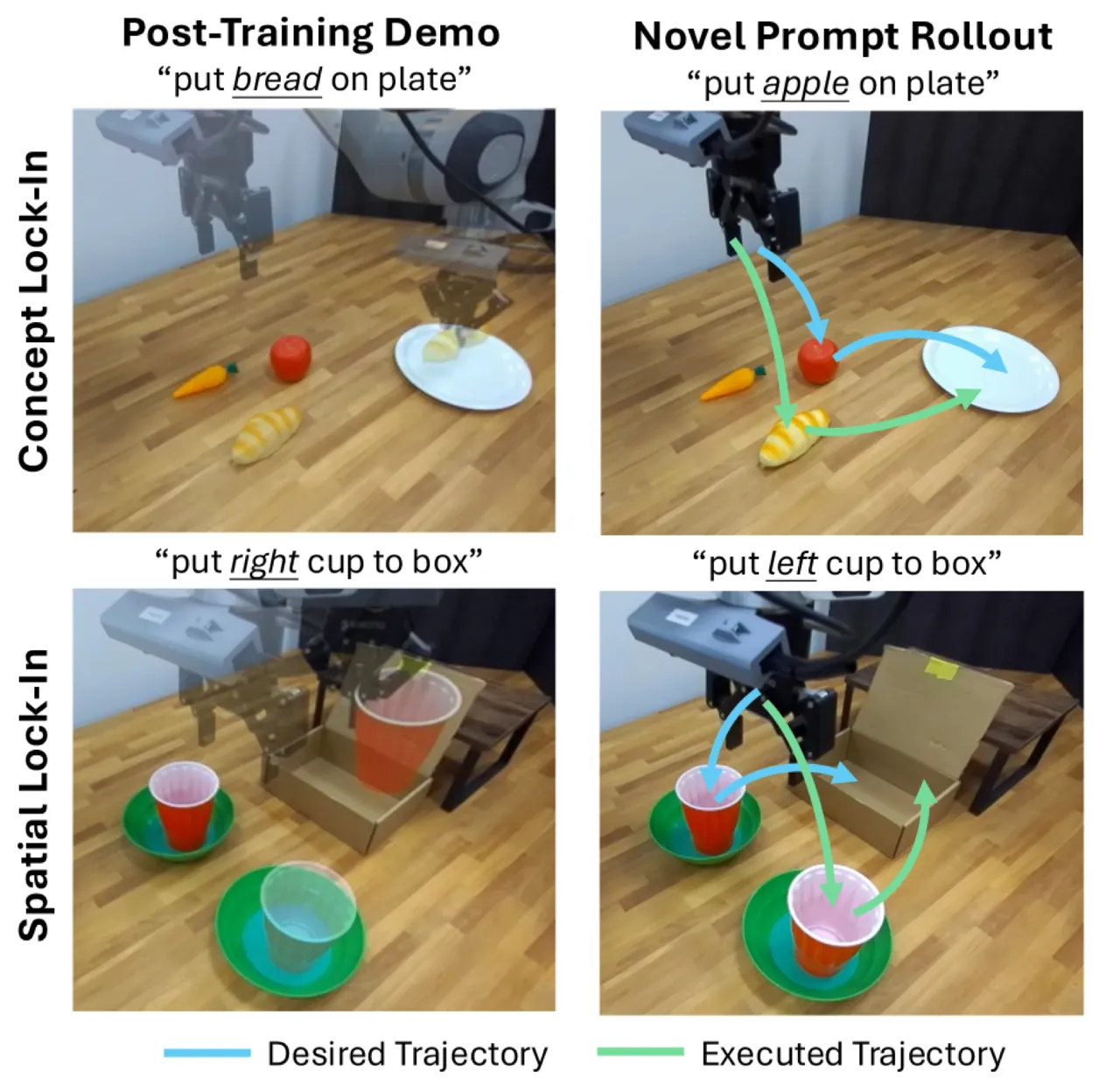
DeLock teaser — lock-in failure modes and DeLock solution overview
Figure 1. Lock-in 的两类失效(concept lock-in 与 spatial lock-in)示意,以及 DeLock 如何通过视觉编码器正则化与推理时 contrastive prompt guidance 加以克服。低数据 SFT 后策略丧失语言 grounding,DeLock 以无监督方式恢复其对新指令的响应能力。Figure 1. Illustration of the two lock-in failure types (concept lock-in and spatial lock-in), and of how DeLock overcomes them through visual encoder regularization and inference-time contrastive prompt guidance. After low-data SFT the policy loses its language grounding; DeLock restores its responsiveness to novel instructions in an unsupervised manner.
8仿真 + 真实世界评测任务数evaluation tasks in simulation + the real world
80–100每任务演示条数(低数据 regime)demonstrations per task (low-data regime)
2lock-in 类型:concept + spatiallock-in types: concept + spatial
0额外监督信号需求(仅用预训练知识)additional supervision signals required (pre-trained knowledge only)

02 方法(Method)Method

DeLock 由两个轻量组件构成:训练时的视觉编码器权重漂移正则化,以及推理时的Contrastive Prompt Guidance(CPG)。两者均无需额外标注或数据扩增,只利用预训练模型自身的内部知识。DeLock consists of two lightweight components: a training-time regularizer on visual encoder weight drift, and an inference-time Contrastive Prompt Guidance (CPG). Neither requires extra annotation or data augmentation; both exploit only the internal knowledge of the pre-trained model itself.

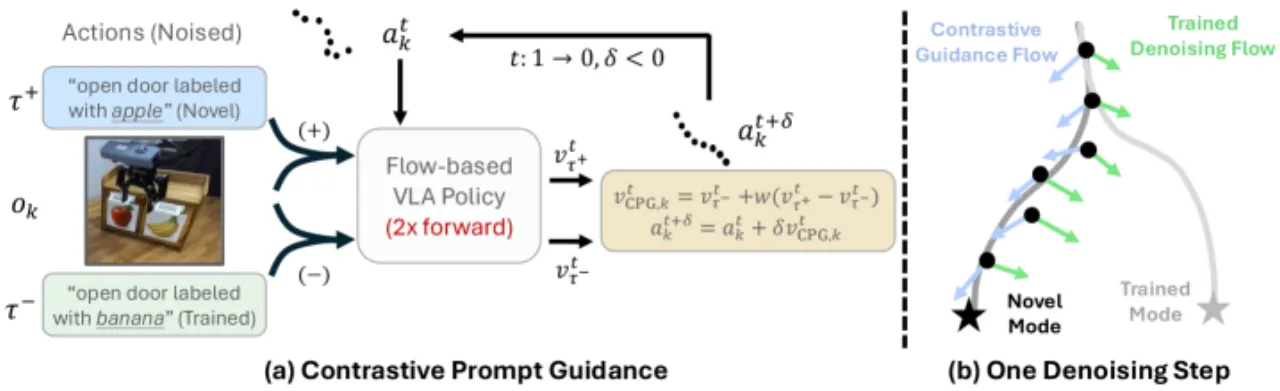
DeLock method — contrastive prompt guidance diagram
Figure 2. 推理时 CPG 机制示意:以 novel instruction τ⁺ 为正向提示、以 post-training instruction τ⁻ 为负向提示,对 denoising vector field 做加权线性组合,将动作生成向新指令方向引导,同时远离 post-training 的固化分布。Figure 2. The inference-time CPG mechanism: taking the novel instruction τ⁺ as the positive prompt and the post-training instruction τ⁻ as the negative prompt, a weighted linear combination of the denoising vector field steers action generation toward the novel instruction and away from the locked-in post-training distribution.

视觉编码器权重漂移正则化Regularizing visual encoder weight drift

在标准 SFT 目标 ℒBC 上增加 L2 正则项,约束视觉编码器参数 θv 不偏离预训练权重 θvpre 过远:An L2 regularization term is added to the standard SFT objective ℒBC, constraining the visual encoder parameters θv not to drift too far from the pre-trained weights θvpre:

DeLock(θ; D★) = ℒBC(θ; D★) + λ‖θv − θvpre‖²₂

语言 backbone 和 action expert 仍通过 LoRA 正常适配。视觉特征是指令 grounding 的核心媒介,编码器漂移是 lock-in 的关键诱因,因此仅对视觉编码器施加约束即可精准干预,同时保留对新任务的学习能力。The language backbone and the action expert are still adapted normally through LoRA. Visual features are the core medium of instruction grounding and encoder drift is the key trigger of lock-in, so constraining the visual encoder alone already gives a precise intervention while preserving the capacity to learn new tasks.

Contrastive Prompt Guidance(CPG)

推理阶段,CPG 利用 post-training 指令(τ⁻)作为负向提示,novel instruction(τ⁺)作为正向提示,对 denoising vector field 做线性插值引导:At inference, CPG takes the post-training instruction (τ⁻) as the negative prompt and the novel instruction (τ⁺) as the positive prompt, guiding the denoising vector field by linear interpolation:

vCPG,kt = vθ(ok, τ⁻, t) + w(vθ(ok, τ⁺, t) − vθ(ok, τ⁻, t))

其中 w ≥ 0 为 guidance scale。CPG 依赖视觉编码器正则化保留的 grounding 能力,在推理时将策略的 denoising 动态"steer"到新指令所指向的行为。Here w ≥ 0 is the guidance scale. CPG relies on the grounding ability preserved by visual encoder regularization to "steer", at inference time, the denoising dynamics of the policy toward the behavior indicated by the novel instruction.

设计直觉Design intuition

Lock-in 的根本原因在于低数据 SFT 破坏了预训练时建立的视觉-语言对应关系(visual grounding)。视觉编码器正则化在微调中保护这一能力,使模型保有识别新物体/新位置的潜力;CPG 则在推理时进一步利用这种潜力,通过与 post-training 分布的"对比"将动作生成重定向到新指令。两者互补:正则化解决 concept lock-in(concept 理解需要 grounding),CPG 解决 spatial lock-in(空间导航需要实时引导)。The root cause of lock-in is that low-data SFT destroys the visual–language correspondence (visual grounding) established during pre-training. Visual encoder regularization protects this ability during fine-tuning, so that the model retains the potential to recognize new objects and new locations; CPG then further exploits that potential at inference, redirecting action generation to the novel instruction by "contrasting" against the post-training distribution. The two are complementary: regularization addresses concept lock-in (concept understanding requires grounding), while CPG addresses spatial lock-in (spatial navigation requires real-time guidance).

03 实验(Experiments)Experiments

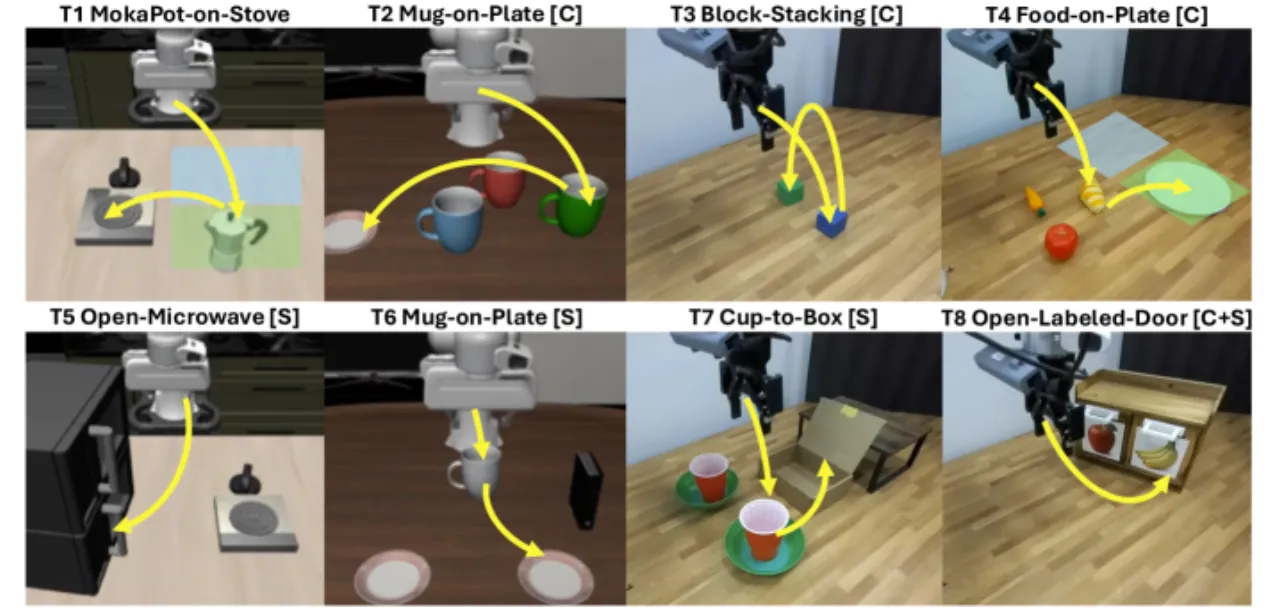
作者构建了一套专门探测 lock-in 失效的 8 任务评测套件,覆盖 LIBERO 仿真(4 任务,每任务 100 条演示)和 DROID 真实世界(4 任务,每任务 80 条演示),任务按失效类型标记为 [C](concept)、[S](spatial)或 [C+S](复合)。每项任务评测 20 次试验(20 trials)。The authors build an 8-task evaluation suite designed specifically to probe lock-in failures, covering LIBERO simulation (4 tasks, 100 demonstrations per task) and DROID real-world settings (4 tasks, 80 demonstrations per task); tasks are labeled by failure type as [C] (concept), [S] (spatial) or [C+S] (composite). Each task is evaluated over 20 trials.

DeLock evaluation benchmark tasks
Figure 3. 评测任务集概览(含 LIBERO 仿真与 DROID 真实世界任务)。每个任务设计了专门的 OOD 条件(新物体颜色、新空间位置等)以触发 concept 或 spatial lock-in 失效。Figure 3. Overview of the evaluation task set (including LIBERO simulation and DROID real-world tasks). Each task is designed with dedicated OOD conditions (new object color, new spatial location, etc.) so as to trigger concept or spatial lock-in failures.

定量结果(OOD 性能,Table 2,单位:成功次数 / 20 次试验)Quantitative results (OOD performance, Table 2; unit: successes / 20 trials)

下表展示各方法在 OOD(out-of-distribution)prompt 下的成功次数,共 8 个任务(T1–T8),其中 T1 为基础参照,T2–T4 为 concept lock-in 任务,T5–T7 为 spatial lock-in 任务,T8 为 concept+spatial 复合任务。The table below reports the number of successes of each method under OOD (out-of-distribution) prompts, over 8 tasks in total (T1–T8), where T1 serves as the base reference, T2–T4 are concept lock-in tasks, T5–T7 are spatial lock-in tasks, and T8 is a composite concept+spatial task.

MethodT1T2 [C]T3 [C]T4 [C]T5 [S]T6 [S]T7 [S]T8 [C+S]
RETAIN10/200/206/203/200/200/202/201/20
π₀.₅-DROID(大规模数据基线)π₀.₅-DROID (large-scale-data baseline)18/2018/2018/2011/200/20
DeLock w/o CPG16/2017/2018/2015/200/200/200/200/20
DeLock w/o Vis-Reg4/209/207/202/200/200/200/200/20
DeLock w/ Frozen-Vis7/2016/2014/2013/202/2011/208/204/20
DeLock(完整)DeLock (full)16/2019/2019/2017/2011/2013/2014/2013/20

DeLock 在全部 8 项 OOD 任务上均大幅领先 RETAIN,并在多项任务上媲美或超越大规模数据基线 π₀.₅-DROID——后者使用了远多于 80–100 条的精标演示。DeLock leads RETAIN by a wide margin on all 8 OOD tasks, and on several of them matches or surpasses the large-scale-data baseline π₀.₅-DROID — which used far more than 80–100 carefully annotated demonstrations.

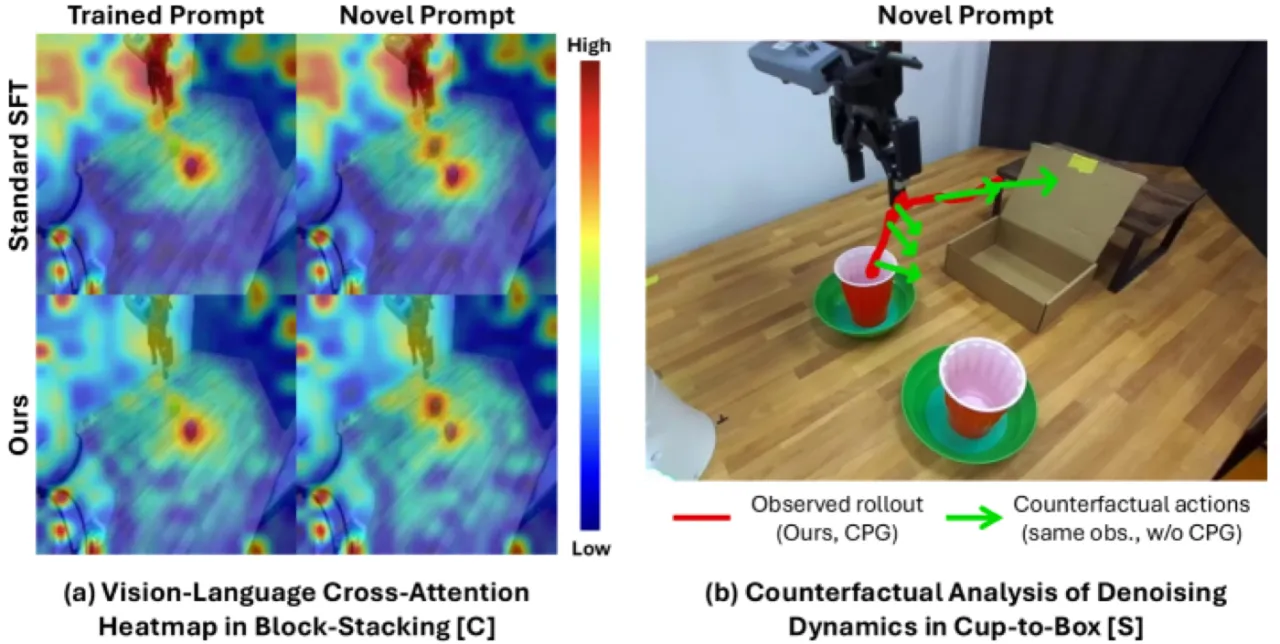
DeLock mechanistic analysis — attention maps and CPG denoising trajectories
Figure 4. 机制分析。左:cross-attention 可视化对比——标准 SFT 下注意力模式坍缩(collapsed),DeLock 下注意力随指令变化而迁移(prompt-conditioned shift),说明 visual grounding 得到保留。右:反事实 rollout 分析——CPG 将 denoising 轨迹从 post-training 的空间固化点引导至新指令所指的位置,直接验证 spatial lock-in 被克服。Figure 4. Mechanistic analysis. Left: comparison of cross-attention visualizations — under standard SFT the attention pattern is collapsed, whereas under DeLock attention shifts as the instruction changes (prompt-conditioned shift), showing that visual grounding is preserved. Right: counterfactual rollout analysis — CPG steers the denoising trajectory from the spatial point locked in during post-training to the location indicated by the novel instruction, directly verifying that spatial lock-in is overcome.

Ablations(消融分析)Ablations

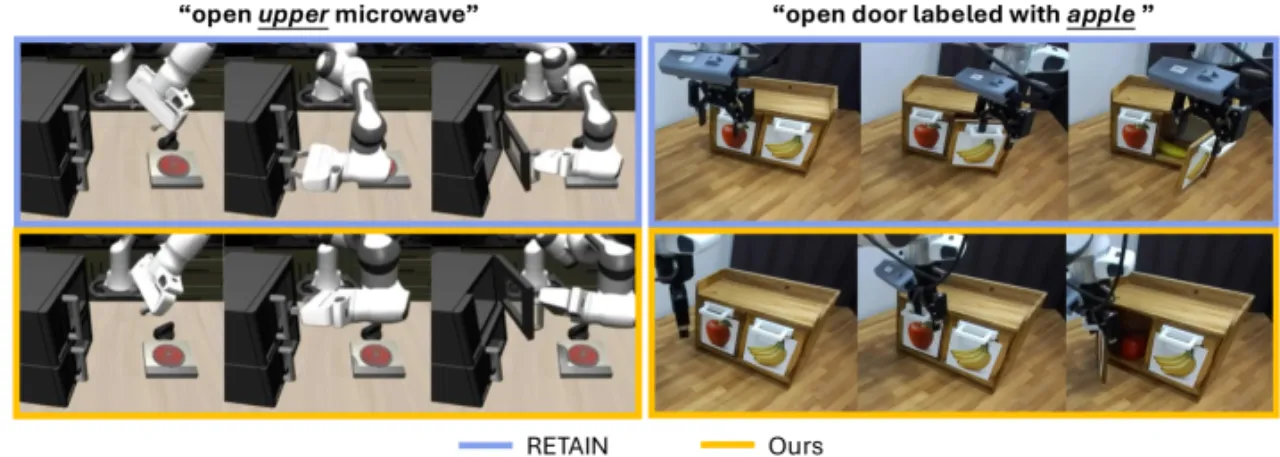
DeLock qualitative OOD rollout comparisons
Figure 5. OOD 任务的定性 rollout 对比。标准 SFT 策略执行固化行为,忽视新指令;DeLock 正确响应 novel prompt,执行新目标物体或新位置的操作。Figure 5. Qualitative rollout comparison on OOD tasks. The standard SFT policy executes its locked-in behavior and ignores the novel instruction; DeLock responds correctly to the novel prompt and manipulates the new target object or the new location.

04 局限性(Limitations)Limitations

Note:以下局限性部分为论文明确陈述,部分为根据方法设计推断(已标注)。Note: Some of the limitations below are stated explicitly in the paper, others are inferred from the method design (marked as such).
受控低数据设定:尚未验证更广泛指令分布的扩展性Controlled low-data setting: scalability to broader instruction distributions is not yet verified

当前评测聚焦于受控的低数据 setting,post-training 指令覆盖范围有限,且 CPG 依赖预先定义好的 contrastive prompt 对(τ⁺ / τ⁻)。对于开放域指令分布、长时域任务或大规模多样化数据的扩展性尚未验证。(论文明确陈述)The current evaluation focuses on a controlled low-data setting, the coverage of post-training instructions is limited, and CPG depends on pre-defined contrastive prompt pairs (τ⁺ / τ⁻). Scalability to open-domain instruction distributions, long-horizon tasks or large-scale diverse data is not yet verified. (Stated explicitly in the paper)

CPG 引导需要提供负向 prompt(τ⁻)CPG guidance requires supplying a negative prompt (τ⁻)

Contrastive Prompt Guidance 需要在推理时指定代表 "post-training 固化行为" 的负向提示 τ⁻。在实际部署中,如何自动化地确定合适的 τ⁻ 尚需进一步研究。(根据方法设计推断)Contrastive Prompt Guidance requires specifying at inference time a negative prompt τ⁻ representing the "locked-in post-training behavior". How to determine a suitable τ⁻ automatically in real deployment still requires further study. (Inferred from the method design)

正则化超参 λ 与引导尺度 w 的设计较简单The designs of the regularization hyperparameter λ and the guidance scale w are rather simple

L2 正则化系数 λ 和 guidance scale w 目前采用相对简单的固定设计。如何在不同 VLA 架构和任务上自适应调整这两个超参,尚待进一步研究。(论文明确陈述)The L2 regularization coefficient λ and the guidance scale w currently use a relatively simple fixed design. How to adapt these two hyperparameters across different VLA architectures and tasks remains to be studied further. (Stated explicitly in the paper)

尚未研究更长时域任务与开放环境中的表现Performance on longer-horizon tasks and in open environments has not been studied

所有评测任务均为单步或短时域操作。在需要多步规划和动态开放环境中,lock-in 的表现形式及 DeLock 的有效性仍有待探索。(论文明确陈述)All evaluation tasks are single-step or short-horizon manipulations. In settings requiring multi-step planning and in dynamic open environments, how lock-in manifests and how effective DeLock is remain to be explored. (Stated explicitly in the paper)