Towards Efficient and Robust Manipulation via Multi-Frame Vision-Language-Action Modeling
Hao Li, Shuai Yang, Yilun Chen, Xinyi Chen, Xiaoda Yang, Yang Tian, Hanqing Wang, Tai Wang, Dahua Lin, Feng Zhao, Jiangmiao Pang
CronusVLA 将单帧 VLA 模型扩展至多帧范式:先在大规模具身数据集上进行单帧预训练,再通过 feature chunking 与跨帧解码器(cross-frame decoder)汇聚历史帧信息进行后训练,同时大幅提升推理速度与观测鲁棒性。CronusVLA extends single-frame VLA models to a multi-frame paradigm: it first performs single-frame pretraining on large-scale embodied datasets, then post-trains with feature chunking and a cross-frame decoder that aggregates information from historical frames, substantially improving both inference speed and observational robustness.
VLA多帧建模multi-frame modeling机器人操作robot manipulationcross-frame decoderfeature chunkingobservational robustnessSimplerEnv-ORdiffusion transformer具身智能embodied AI
01动机Motivation
现有基于预训练视觉-语言模型(VLM)的 VLA 模型仍受限于单帧图像范式,无法充分利用多帧历史提供的时序信息。
直接将多帧图像输入 VLM backbone 会因 self-attention 的二次方计算复杂度带来巨大的计算开销和推理延迟。
低级策略(low-level policies)的研究已表明多帧历史观测可提升性能与鲁棒性,但如何将其高效地引入大型 VLA 模型仍是未解难题。Existing VLA models built on pretrained vision-language models (VLM) remain constrained by the single-frame image paradigm and cannot fully exploit the temporal information offered by multi-frame histories.
Feeding multiple frames directly into a VLM backbone incurs substantial computational overhead and inference latency because of the quadratic complexity of self-attention.
Work on low-level policies has shown that multi-frame historical observations improve performance and robustness, yet efficiently introducing them into large VLA models remains an open problem.
"these models remain constrained by the single-frame image paradigm and fail to fully leverage the temporal information offered by multi-frame histories, as directly feeding multiple frames into VLM backbones incurs substantial computational overhead and inference latency."
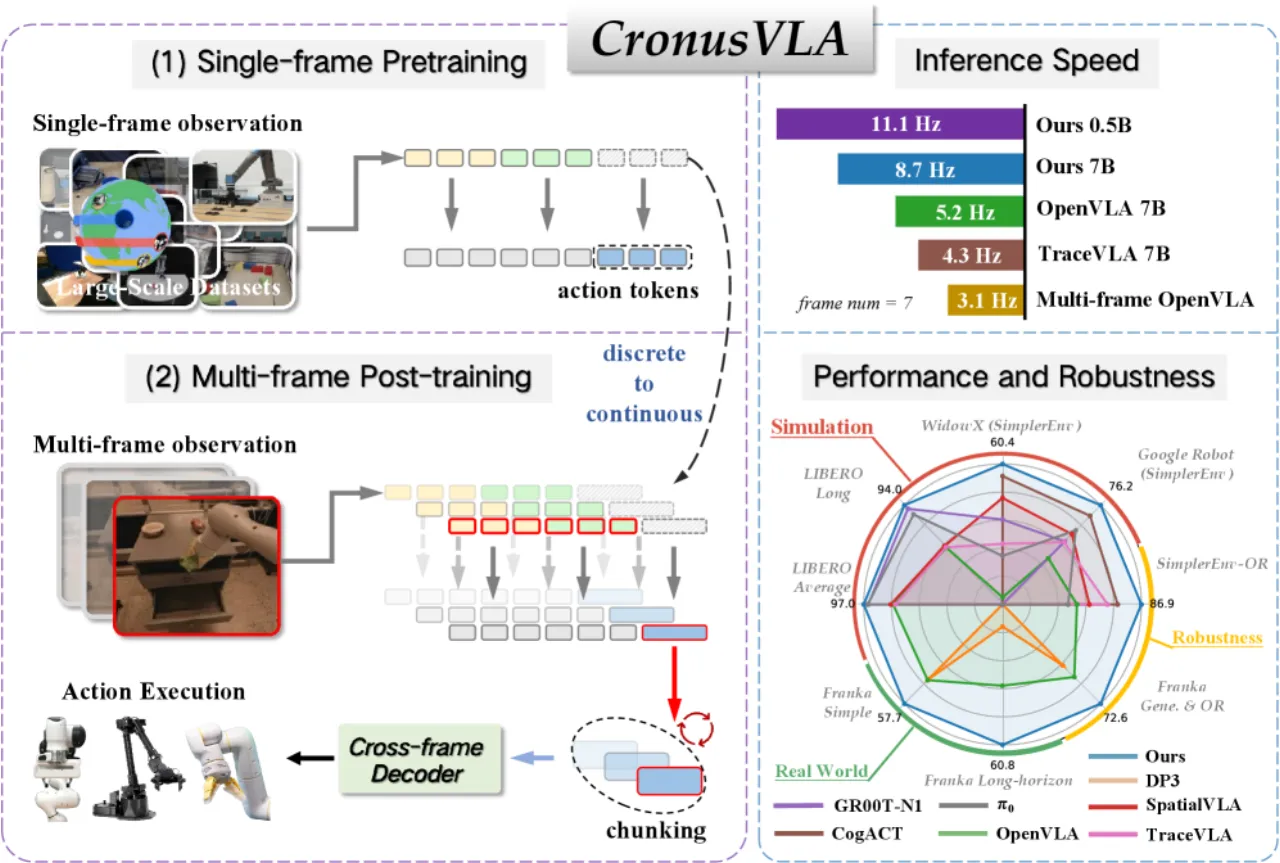
图1:CronusVLA 整体框架概览。系统包含在大规模操作数据集上的单帧预训练(single-frame pretraining)阶段,以及在跨体态数据集上的多帧后训练(multi-frame post-training)阶段。CronusVLA 在仿真 benchmark 与真实环境中均展现出快速推理、高成功率与优越观测鲁棒性。Figure 1: Overview of the CronusVLA framework. The system comprises a single-frame pretraining stage on large-scale manipulation datasets and a multi-frame post-training stage on cross-embodiment datasets. CronusVLA delivers fast inference, high success rates and superior observational robustness in both simulation benchmarks and real-world settings.
70.9%SimplerEnv 平均成功率SimplerEnv average success rate
+26.8%LIBERO 较 OpenVLA 的提升LIBERO gain over OpenVLA
CronusVLA 采用两阶段训练策略:第一阶段在大规模具身数据集上进行单帧 VLA 预训练,建立有效的具身视觉-语言基础;
第二阶段通过 feature chunking 将 VLM backbone 的输出从离散 token 替换为可学习特征(learnable features),
并经由跨帧解码器(cross-frame decoder)汇聚历史多帧信息,同时利用队列机制(queue mechanism)实现快速推理。CronusVLA adopts a two-stage training strategy: the first stage performs single-frame VLA pretraining on large-scale embodied datasets, establishing an effective embodied vision-language foundation;
the second stage uses feature chunking to replace the discrete-token output of the VLM backbone with learnable features,
aggregates multi-frame history through a cross-frame decoder, and exploits a queue mechanism for fast inference.
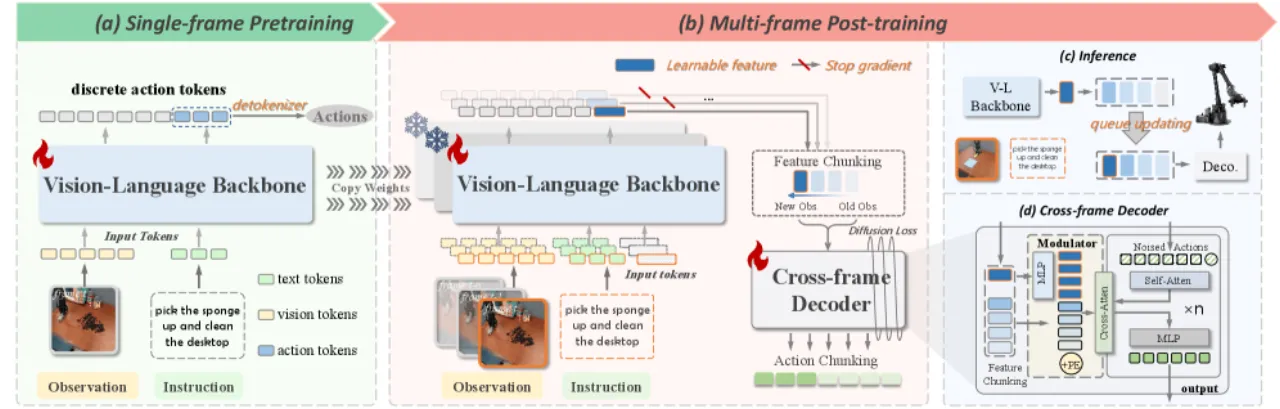
图2:CronusVLA 框架详解。(a) 单帧预训练:使用自回归方式预测离散动作 token(256 bins);(b) 多帧后训练:复制模型权重后,通过跨帧解码器汇聚历史帧的可学习特征;(c) 队列机制(queue mechanism)用于 feature chunking 以加速推理;(d) 跨帧解码器(cross-frame decoder)内部结构,包含 cross-attention 与 DiT-based 扩散预测。Figure 2: Details of the CronusVLA framework. (a) Single-frame pretraining: discrete action tokens (256 bins) are predicted autoregressively; (b) multi-frame post-training: after the model weights are copied, the cross-frame decoder aggregates learnable features from historical frames; (c) the queue mechanism used for feature chunking to accelerate inference; (d) internal structure of the cross-frame decoder, containing cross-attention and DiT-based diffusion prediction.
第一阶段在大规模异构具身数据集上训练基础单帧 VLA 模型,采用自回归方式预测离散动作 token(量化为 256 bins)。
该阶段保留了 VLM backbone 的视觉感知能力,为后续多帧扩展奠定强基础。
模型配置包括:CronusVLA-7B(Llama 2 7B backbone,DINOv2 + SigLIP 视觉编码器)
与 CronusVLA-0.5B(Qwen2.5 0.5B backbone)。The first stage trains a base single-frame VLA model on large-scale heterogeneous embodied datasets, predicting discrete action tokens (quantized into 256 bins) autoregressively.
This stage preserves the visual perception ability of the VLM backbone and lays a strong foundation for the subsequent multi-frame extension.
Model configurations include CronusVLA-7B (Llama 2 7B backbone, DINOv2 + SigLIP visual encoders)
and CronusVLA-0.5B (Qwen2.5 0.5B backbone).
后训练阶段将 VLM backbone 的预测目标从离散 token 切换为连续的可学习特征,并通过 feature chunking 将 M 步历史帧的特征组织为结构化序列送入跨帧解码器。
跨帧解码器基于 DiT(Diffusion Transformer)设计,包含:In post-training the prediction target of the VLM backbone switches from discrete tokens to continuous learnable features, and feature chunking organizes the features of M historical steps into a structured sequence fed to the cross-frame decoder.
The cross-frame decoder is built on DiT (Diffusion Transformer) and contains:
Cross-attention 机制:计算复杂度与帧数线性增长(区别于直接输入多帧图像的二次方复杂度)Cross-attention mechanism: computational cost grows linearly with the number of frames (in contrast to the quadratic complexity of feeding multiple frames directly)
Feature modulator:动态平衡当前帧与历史帧特征的贡献Feature modulator: dynamically balances the contributions of the current frame and the historical frames
扩散损失(Diffusion loss):用于动作序列预测Diffusion loss: used for action sequence prediction
历史帧特征采用 stop-gradient 操作,防止梯度更新 VLM backbone,从而在保留单帧感知能力的同时实现解码器层面的时序建模(multi-frame regularization)。
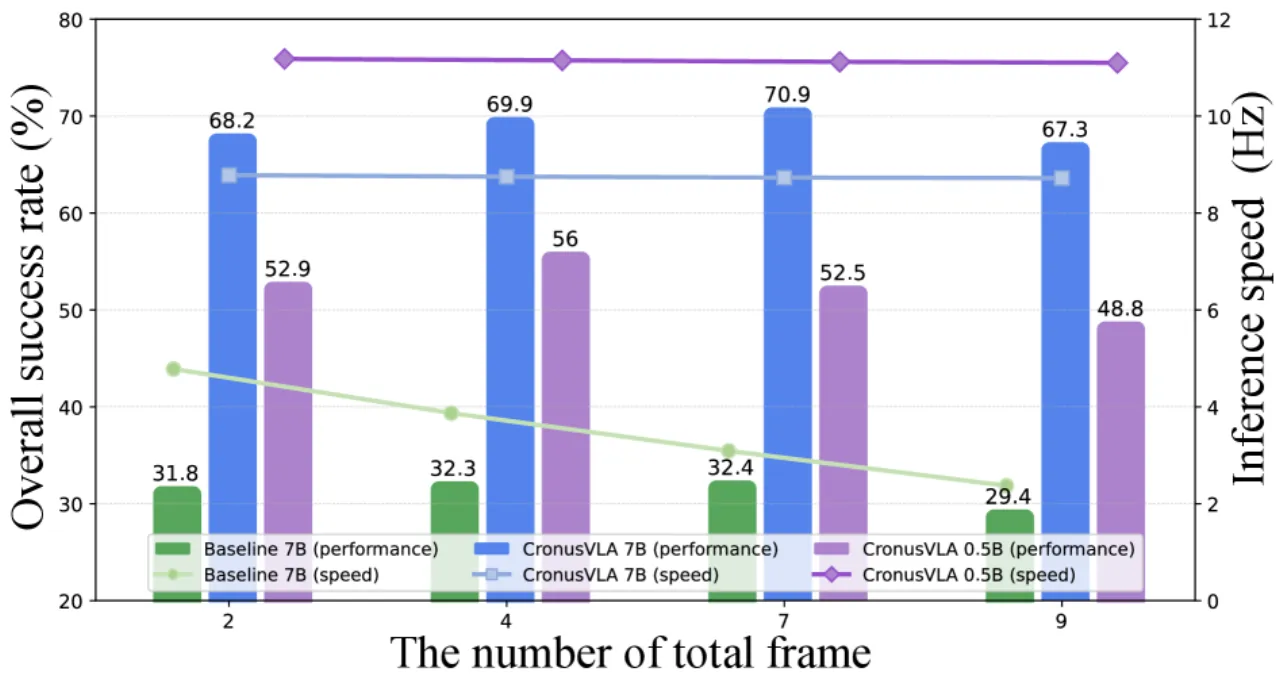
推理时利用 feature 缓存(feature caching)消除重复的视觉-语言计算,实现 8.73 Hz 的高速推理(基线仅 3.09 Hz,提升 184%)。
后训练数据集为 Bridge-v2 + Fractal(148k 轨迹,5M 多帧片段)。Historical-frame features use a stop-gradient operation that prevents gradients from updating the VLM backbone, so temporal modeling is realized at the decoder level while single-frame perception is preserved (multi-frame regularization).
At inference, feature caching eliminates redundant vision-language computation and reaches 8.73 Hz (the baseline reaches only 3.09 Hz, a 184% improvement).
The post-training dataset is Bridge-v2 + Fractal (148k trajectories, 5M multi-frame clips).
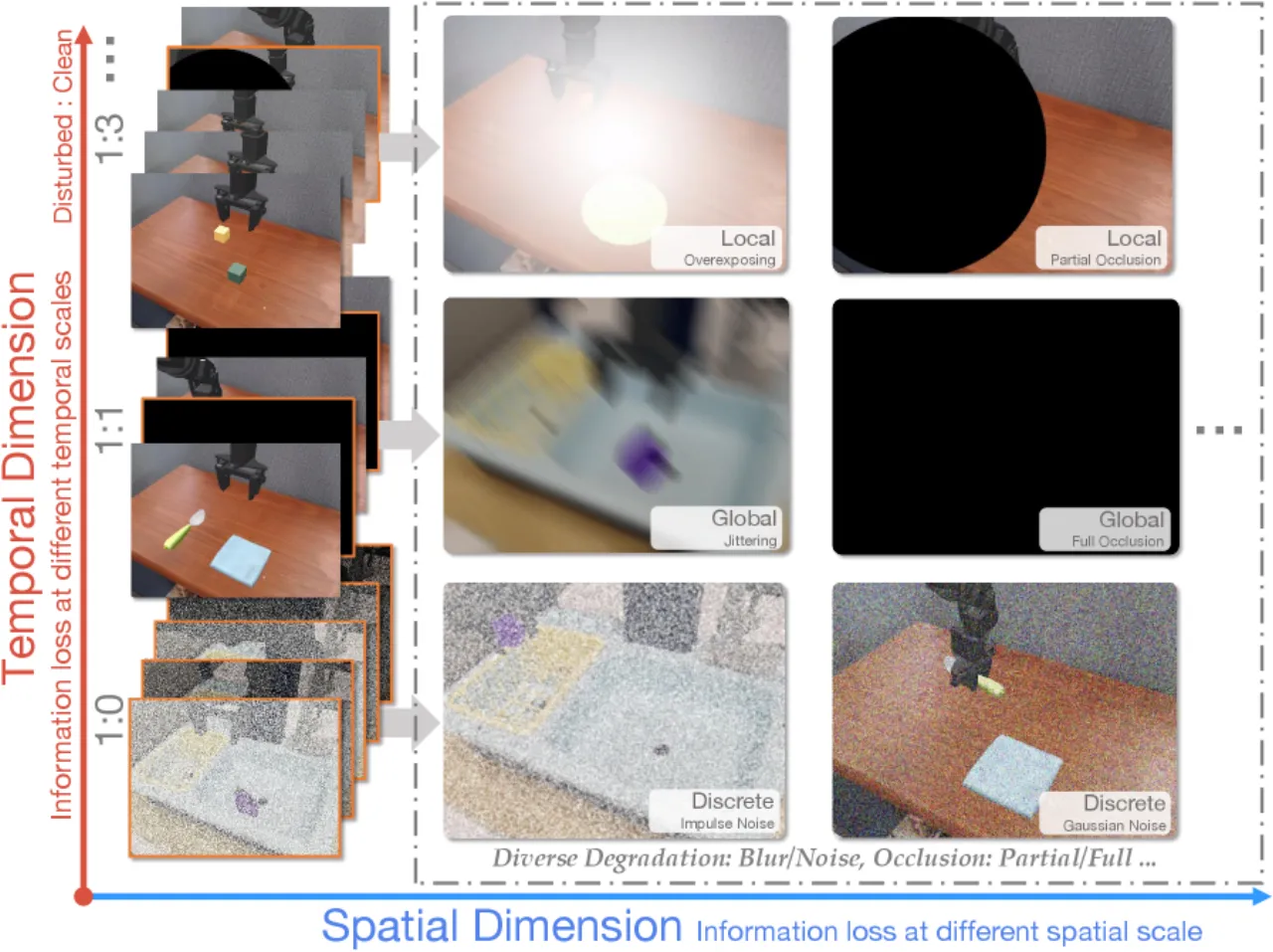
为评估时序与空间干扰下的鲁棒性,论文提出 SimplerEnv-OR benchmark,包含 24 种观测干扰类型(模糊、抖动、丢帧、遮挡、噪声等)与 120+ 严重程度等级,覆盖 Global、Local、Discrete 三大类别,支持空间维度与时序维度的独立评估。To evaluate robustness under temporal and spatial disturbances, the paper introduces the SimplerEnv-OR benchmark, which covers 24 types of observational disturbance (blur, jitter, frame drop, occlusion, noise, etc.) and more than 120 severity levels across the three categories Global, Local and Discrete, supporting independent evaluation along the spatial and the temporal dimension.
图3:SimplerEnv-OR benchmark 示例。包含 Global(全局)、Local(局部)、Discrete(离散)三大干扰类别,以及 Constant(1:0)、Cyclic(1:1)、Sparse(1:3 或 1:5)三种干扰-清洁帧比例,支持时序与空间双维度评估。Figure 3: Examples from the SimplerEnv-OR benchmark. It includes the three disturbance categories Global, Local and Discrete, together with three disturbance-to-clean frame ratios, Constant (1:0), Cyclic (1:1) and Sparse (1:3 or 1:5), supporting evaluation along both the temporal and the spatial dimension.
03实验Experiments
实验在三种具身平台(Google Robot VM/VA、WidowX、Franka)上进行,涵盖 SimplerEnv 仿真 benchmark、LIBERO benchmark、SimplerEnv-OR 鲁棒性评测及真实世界 Franka 机器人实验。
基线包括 OpenVLA、TraceVLA、RoboVLMs、SpatialVLA、DP3 等。Experiments are run on three embodiments (Google Robot VM/VA, WidowX, Franka) and cover the SimplerEnv simulation benchmark, the LIBERO benchmark, the SimplerEnv-OR robustness evaluation and real-world Franka robot experiments.
Baselines include OpenVLA, TraceVLA, RoboVLMs, SpatialVLA and DP3.
相较 TraceVLA,CronusVLA-7B 在 Google VM 上取得 +71.6% 的相对提升,Google VA 上提升 +48.2%。Compared with TraceVLA, CronusVLA-7B achieves a relative gain of +71.6% on Google VM and +48.2% on Google VA.
LIBERO 基准测试(Table 2)LIBERO Benchmark (Table 2)
方法Method
LIBERO-Spatial
LIBERO-Object
LIBERO-Goal
LIBERO-Long
平均Average
OpenVLA
84.7%
88.4%
79.2%
53.7%
76.5%
CronusVLA-7B
99.0%
99.3%
95.8%
94.0%
97.0%
长时序任务(LIBERO-Long)成功率从 OpenVLA 的 53.7% 提升至 94.0%(+40.3%);整体平均成功率较 OpenVLA 提升 +26.8%(论文摘要原文数据)。On long-horizon tasks (LIBERO-Long) the success rate rises from OpenVLA's 53.7% to 94.0% (+40.3%); the overall average success rate improves by +26.8% over OpenVLA (figure as stated in the paper's abstract).
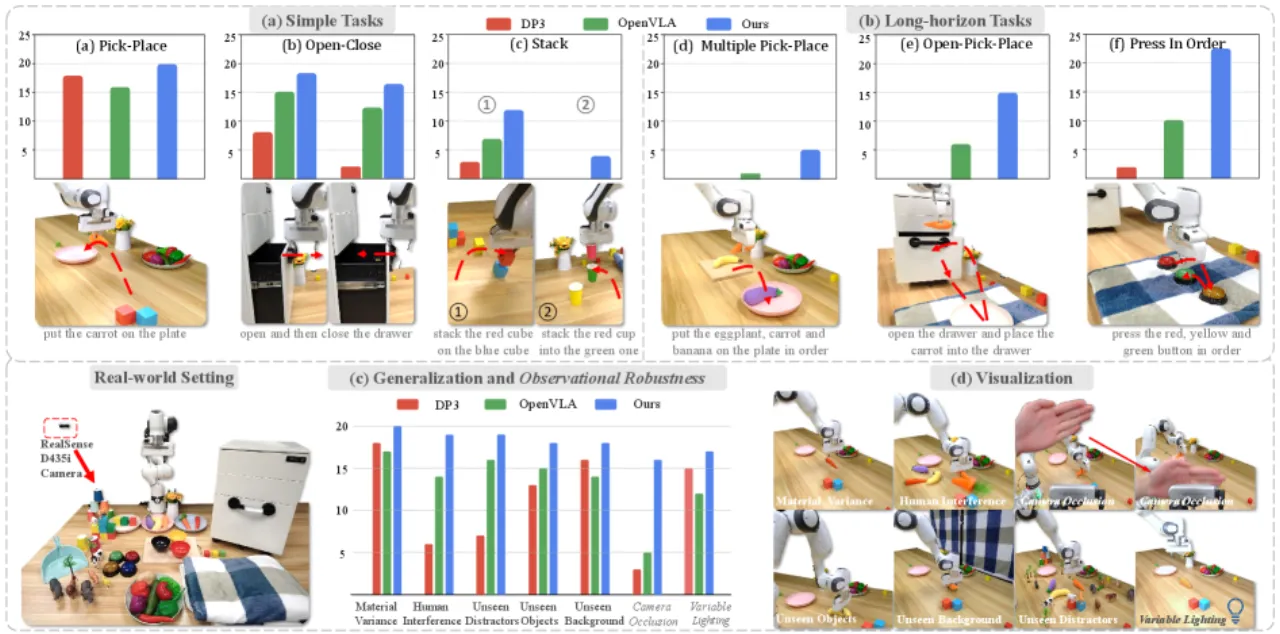
图4:真实世界实验。(a) 基础抓放能力(precise manipulation:block/cup stacking);(b) 长时序任务(long-horizon tasks),多帧建模在处理时序依赖操作中优势显著;(c) 泛化与鲁棒性测试,相机遮挡(camera occlusion)与各类干扰下成功率达 72.6%,持续优于 OpenVLA 与 DP3。Figure 4: Real-world experiments. (a) Basic pick-and-place ability (precise manipulation: block/cup stacking); (b) long-horizon tasks, where multi-frame modeling shows a clear advantage on temporally dependent operations; (c) generalization and robustness tests, where the success rate reaches 72.6% under camera occlusion and various disturbances, consistently outperforming OpenVLA and DP3.
消融实验(Ablations)Ablations
图5:帧数影响分析。随着输入帧数增加,成功率提升但推理速度下降;feature caching + cross-frame decoder 的组合方案在保持高成功率的同时恢复推理速度至 8.73 Hz。Figure 5: Effect of the number of input frames. The success rate improves as more frames are used, but inference speed drops; combining feature caching with the cross-frame decoder keeps the high success rate while restoring inference speed to 8.73 Hz.
加入 decoder 与连续特征(+M.F. +Dec.):成功率 +48.2%,速度提升 2.8×Adding the decoder and continuous features (+M.F. +Dec.): success rate +48.2%, speed improved 2.8×
多帧正则化(multi-frame regularization,stop-gradient):加速收敛并提升整体性能Multi-frame regularization (stop-gradient): faster convergence and better overall performance
04局限性Limitations
说明:以下局限性均来自论文 Appendix I 中作者明确陈述的内容(stated by the authors)。Note: All limitations below are stated explicitly by the authors in Appendix I of the paper.
SimplerEnv-OR 覆盖的干扰类型有限SimplerEnv-OR covers a limited range of disturbance types
SimplerEnv-OR 当前涵盖 24 种干扰类型,尚不包含针对关键帧(keyframe)的定向扰动,无法全面模拟真实部署场景中的所有干扰形式,需进一步扩充。SimplerEnv-OR currently covers 24 disturbance types and does not yet include targeted perturbations of keyframes, so it cannot fully simulate every form of disturbance in real deployment and needs further extension.
固定频率干扰未能捕获最坏情况Fixed-frequency disturbances fail to capture the worst case
现有评估使用固定频率的干扰模式(Constant / Cyclic / Sparse),可能无法覆盖最恶劣的连续干扰场景(worst-case scenarios)。The current evaluation uses fixed-frequency disturbance patterns (Constant / Cyclic / Sparse), which may not cover the most severe continuous-disturbance settings (worst-case scenarios).
基线对比与仿真环境支持有待扩充Baseline comparisons and simulator support remain to be broadened
论文指出未来工作需扩展基线方法的对比范围,并增加对更多仿真环境的支持,以更全面地评估方法的泛化能力。The paper notes that future work should broaden the range of baseline methods compared and add support for more simulation environments, so as to evaluate the generalization of the method more comprehensively.