Scaling Verification Can Be More Effective than Scaling Policy Learning for Vision-Language-Action Alignment
测试时验证扩展比扩大策略预训练更高效地提升 VLA 指令对齐Scaling test-time verification improves VLA instruction alignment more efficiently than scaling policy pre-training
Jacky Kwok†, Xilun Zhang†, Mengdi Xu, Yuejiang Liu§, Azalia Mirhoseini§, Chelsea Finn§, Marco Pavone§ · Stanford University & NVIDIA Research · arXiv 2602.12281
现有视觉语言动作模型(VLA)在执行机器人任务时存在严重的"intention-action gap"——
生成的动作与自然语言指令语义不一致,导致高昂的失败代价。
本文提出 CoVer(Contrastive Verifier),一种在测试时对动作候选进行分层验证的框架,
无需修改基础策略即可显著提升指令跟随能力,
并证明测试时验证的扩展效率远优于增大策略预训练规模。Existing vision-language-action models (VLA) exhibit a severe "intention-action gap" when executing robotic tasks: the generated actions are semantically inconsistent with the natural language instruction, which incurs a high cost of failure. This paper proposes CoVer (Contrastive Verifier), a framework that hierarchically verifies action candidates at test time, markedly improving instruction-following ability without modifying the base policy, and shows that scaling test-time verification is far more efficient than scaling policy pre-training.
VLA机器人操作robot manipulationtest-time scalingcontrastive verifier指令对齐instruction alignmentinstruction followingaction verificationCoVer视觉语言动作模型vision-language-action model
01动机Motivation
大规模预训练的 VLA(如 π0、π0.5)具备强大的操作能力,但在将自然语言指令转化为精确动作时仍频繁出现"intention-action gap"。
扩大策略预训练规模(更多数据、更大模型)虽然有效,但代价极高。
那么,能否在推理时利用额外算力来弥合这一鸿沟?Large-scale pre-trained VLAs (e.g. π0, π0.5) possess strong manipulation capabilities, yet they still frequently show an "intention-action gap" when turning natural language instructions into precise actions. Scaling policy pre-training (more data, larger models) is effective but extremely costly. Can we then exploit additional computation at inference time to bridge this gap?
"Can we enable VLAs to leverage additional computation at test time to improve alignment between generated actions and provided language instructions?"
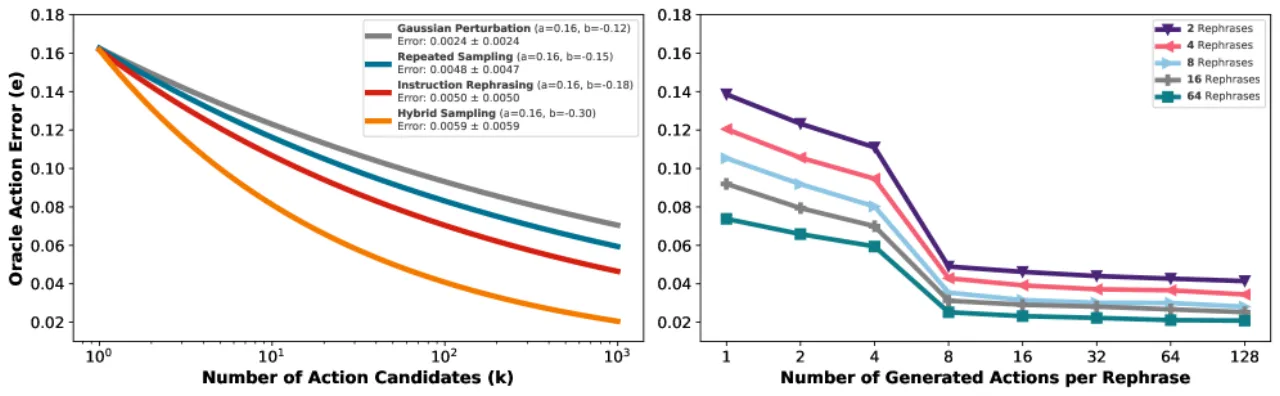
图1 · Test-Time Scaling Law for Embodied Instruction Following。
随着动作候选数 M 增大,CoVer 的 oracle 和实际 top-1 成功率均持续上升,
说明测试时验证存在明确的 scaling law,且验证器能有效从更多候选中识别最优动作。Figure 1 · Test-Time Scaling Law for Embodied Instruction Following. As the number of action candidates M grows, both the oracle and the actual top-1 success rates of CoVer keep rising, showing that test-time verification obeys a clear scaling law and that the verifier can effectively identify the best action among more candidates.
+45%真实机器人实验成功率提升Success rate gain in real-robot experiments
+13.9%PolaRiS 基准任务进度提升Task progress gain on the PolaRiS benchmark
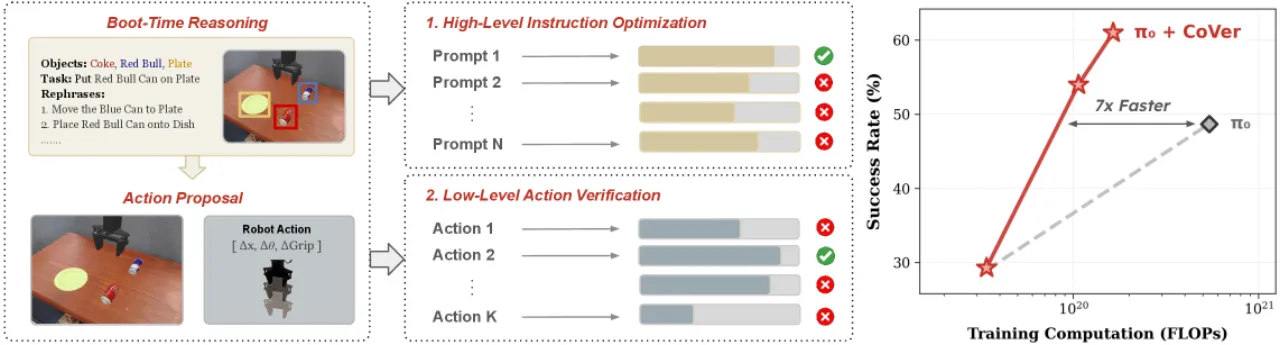
图2 · 分层测试时验证总览。
CoVer-VLA 在语言层面生成 K 个指令 rephrase,在动作层面对每个 rephrase 采样 M 个动作候选,
最终通过 contrastive verifier 分层选择最优动作块(action chunk)执行。Figure 2 · Overview of hierarchical test-time verification. CoVer-VLA generates K instruction rephrasings at the language level, samples M action candidates for each rephrasing at the action level, and finally selects the best action chunk hierarchically through the contrastive verifier for execution.
02方法Method
CoVer-VLA 将验证与策略生成解耦:基础策略(如 π0)负责生成动作,
CoVer 作为独立的 1B-param contrastive verifier 在测试时对候选动作打分。
整体流程分为语言层优化和动作层优化两个阶段,并通过 Boot-Time 预计算将 VLM 延迟移至离线。CoVer-VLA decouples verification from policy generation: the base policy (e.g. π0) generates actions, while CoVer, an independent 1B-param contrastive verifier, scores the candidate actions at test time. The overall pipeline is split into a language-level and an action-level optimization stage, and Boot-Time pre-computation moves the VLM latency offline.
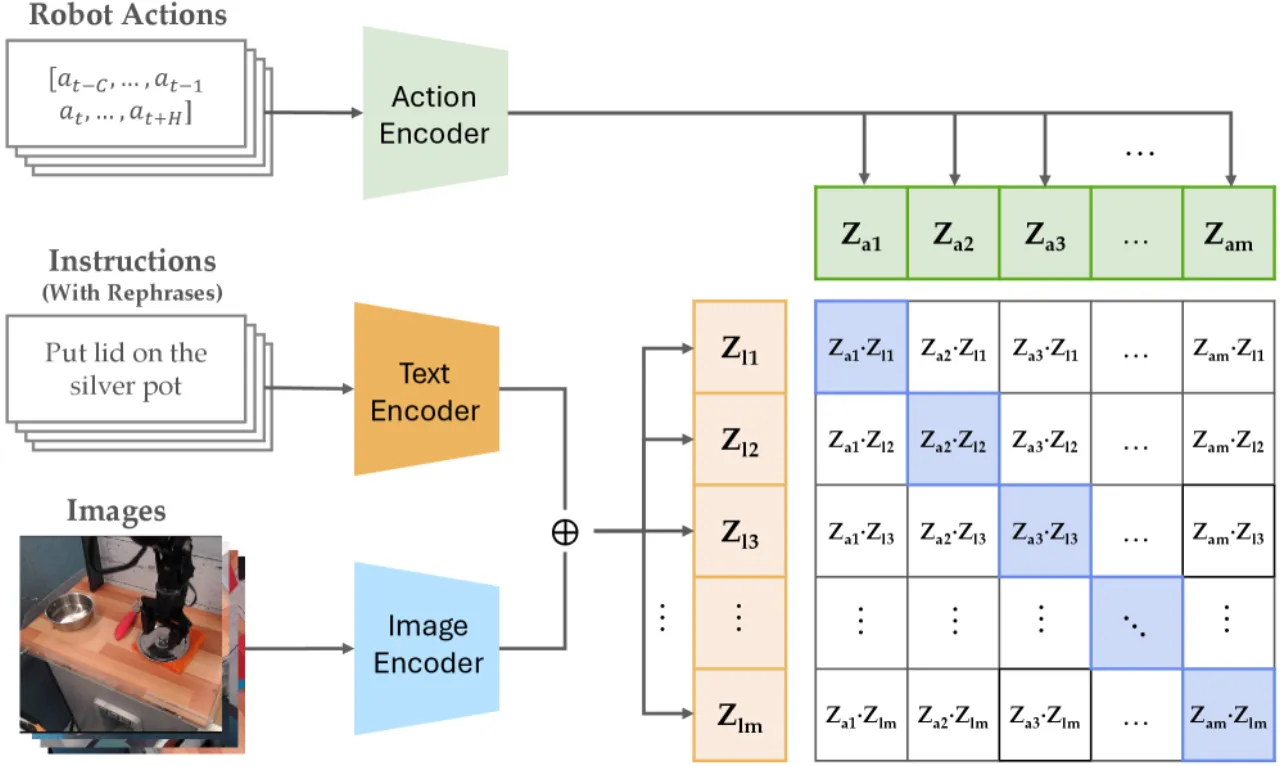
图3 · CoVer 训练策略。
CoVer 使用 SigLIP2 视觉编码器与语言编码器(均冻结),以及专门的 Transformer action encoder。
训练采用双向 InfoNCE 对比损失,以批内其他样本为负例,无需显式的失败标签。
在 Bridge V2 数据集的 2000 万条样本上训练(16× 指令增广),8 块 H200 GPU,2000 步。Figure 3 · CoVer training strategy. CoVer uses a SigLIP2 visual encoder and a language encoder (both frozen), plus a dedicated Transformer action encoder. Training adopts a bidirectional InfoNCE contrastive loss that takes the other in-batch samples as negatives, requiring no explicit failure labels. It is trained on 20000000 samples of the Bridge V2 dataset (16× instruction augmentation), on 8 H200 GPUs for 2000 steps.
在执行前(boot-time),使用 VLM 对原始指令生成 K 个语义等价但表达多样的 rephrase,
并预计算各 rephrase 诱导的动作分布嵌入。推理时,CoVer 选择与原始指令语义最对齐的 rephrase——
通过比较各候选 rephrase 诱导的动作分布与原始指令的余弦相似度实现。
Boot-time 预计算使 VLM 推理完全移至离线,不增加在线延迟。Before execution (boot-time), a VLM generates K semantically equivalent but lexically diverse rephrasings of the original instruction, and the action-distribution embeddings induced by each rephrasing are pre-computed. At inference time, CoVer selects the rephrasing that is semantically most aligned with the original instruction — realized by comparing the cosine similarity between the action distribution induced by each candidate rephrasing and that of the original instruction. Boot-time pre-computation moves VLM inference entirely offline and adds no online latency.
对选定的 rephrase,基础策略采样 M 个动作候选(action chunk)。
CoVer 对每个候选打出对齐分数,选分最高者执行。
验证器同时接收视觉观测、语言指令和动作序列,输出一个标量分数衡量三者语义一致性。
实际部署使用 3 个 verifier 集成 以提升鲁棒性。For the selected rephrasing, the base policy samples M action candidates (action chunks). CoVer assigns an alignment score to every candidate and executes the highest-scoring one. The verifier simultaneously receives the visual observation, the language instruction and the action sequence, and outputs a scalar score measuring the semantic consistency among the three. The actual deployment uses an ensemble of 3 verifiers to improve robustness.
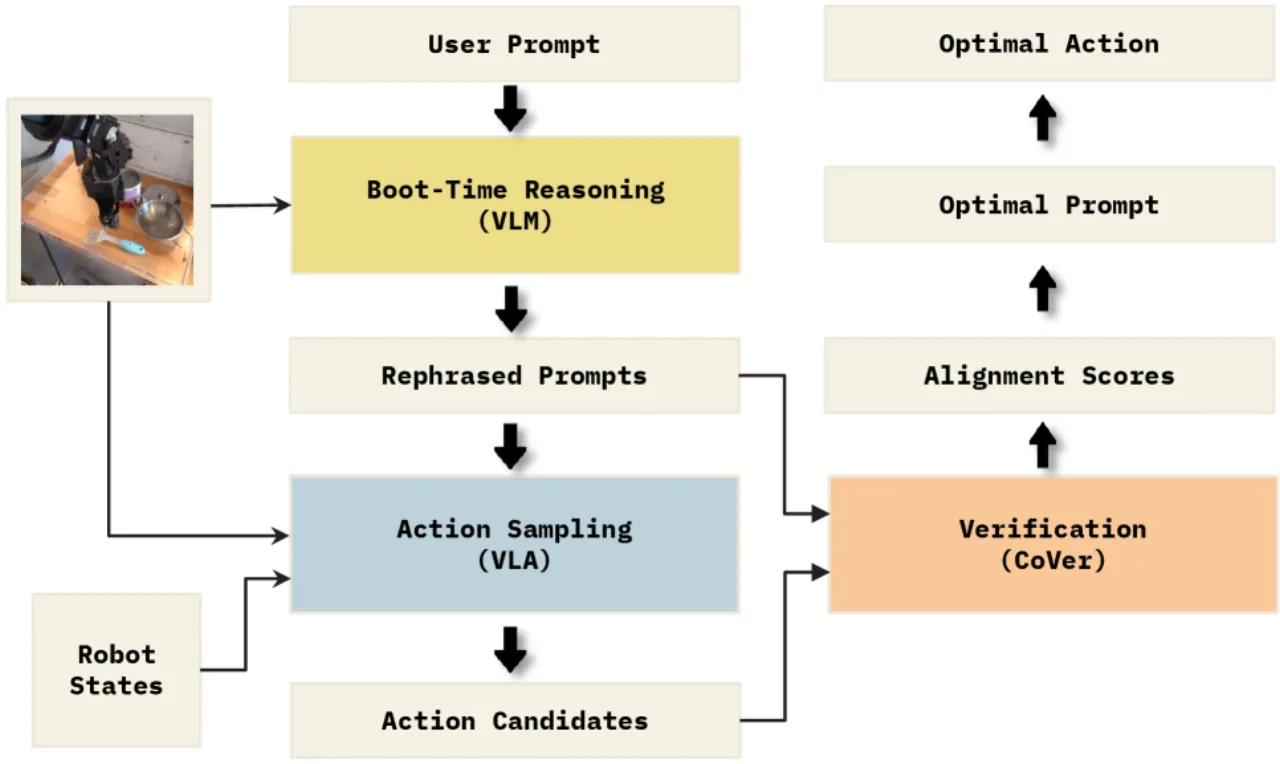
图4 · 测试时验证流水线细节。
K×M 个提案经过 CoVer 联合打分,再经过分层选择(先语言层,后动作层)确定最终执行动作。
action encoder 带来的延迟仅约 8ms;16 候选完整采样+验证端到端约 453ms(≈2.2Hz 控制频率)。Figure 4 · Details of the test-time verification pipeline. The K×M proposals are jointly scored by CoVer and then pass through hierarchical selection (language level first, action level second) to determine the final action to execute. The latency introduced by the action encoder is only about 8ms; full sampling plus verification of 16 candidates takes about 453ms end to end (≈2.2Hz control frequency).
对比训练与指令增广Contrastive training and instruction augmentation
CoVer 的训练基于双向 InfoNCE 对比损失,使用 16× 合成指令增广(由 VLM 对同一动作轨迹生成多种表述),
将同轨迹的不同指令表述视为正例,批内其他样本为负例,无需任何失败演示标签。
这一设计使 CoVer 能从纯成功轨迹数据中学习指令-动作的语义对齐。The training of CoVer is based on a bidirectional InfoNCE contrastive loss, with 16× synthetic instruction augmentation (a VLM produces multiple phrasings for the same action trajectory); different instruction phrasings of the same trajectory are treated as positives and the other in-batch samples as negatives, requiring no failure-demonstration labels whatsoever. This design lets CoVer learn the semantic alignment between instruction and action from purely successful trajectory data.
03实验Experiments
实验在三个平台进行:仿真 SIMPLER 基准(域内+域外)、PolaRiS 真实机器人基准,以及 WidowX 真实机器人任务。
基础策略为 π0 和 π0.5,对比方法包括扩大策略预训练数据量、RoboMonkey 等测试时扩展基线。Experiments are run on three platforms: the simulated SIMPLER benchmark (in-domain and out-of-domain), the PolaRiS real-robot benchmark, and WidowX real-robot tasks. The base policies are π0 and π0.5; the compared methods include scaling the policy pre-training data as well as test-time scaling baselines such as RoboMonkey.
SIMPLER 基准结果SIMPLER benchmark results
方法Method
ID Avg (%)
OOD Avg (%)
π0(基线)π0 (baseline)
41.5
29.7
π0 w/ Inst. Aug.(训练时增广)π0 w/ Inst. Aug. (train-time augmentation)
44.0
48.7
π0 + CoVer(本文,无 rephrase)π0 + CoVer (ours, without rephrasing)
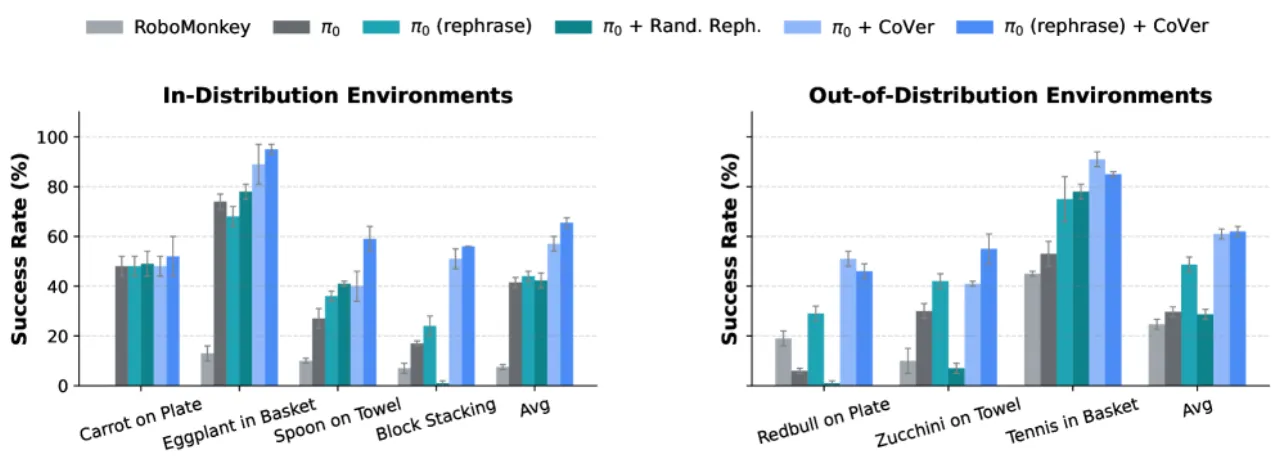
各任务细分(ID):Carrot on Plate 52±8%,Eggplant in Basket 95±2%,Spoon on Towel 59±5%,Block Stacking 56±0%。Per-task breakdown (ID): Carrot on Plate 52±8%, Eggplant in Basket 95±2%, Spoon on Towel 59±5%, Block Stacking 56±0%.
图5 · SIMPLER 各任务成功率对比。
CoVer 在域内(ID)和域外(OOD)任务上均大幅超越基线,尤其在 OOD 场景增益显著,
说明验证机制有效提升了模型对未见过指令变体的泛化能力。Figure 5 · Comparison of per-task success rates on SIMPLER. CoVer substantially surpasses the baseline on both in-domain (ID) and out-of-domain (OOD) tasks, with especially pronounced gains in the OOD setting, indicating that the verification mechanism effectively improves the model's generalization to unseen instruction variants.
PolaRiS 真实机器人基准PolaRiS real-robot benchmark
在 PolaRiS 基准的三项任务(PanClean、BlockStack、FoodBussing)上,
π0.5 + CoVer 相比 π0.5 基线实现 13.9% 任务进度提升 和 9.3% 成功率提升。On the three tasks of the PolaRiS benchmark (PanClean, BlockStack, FoodBussing), π0.5 + CoVer achieves a 13.9% gain in task progress and a 9.3% gain in success rate over the π0.5 baseline.
真实机器人实验(WidowX)Real-robot experiments (WidowX)
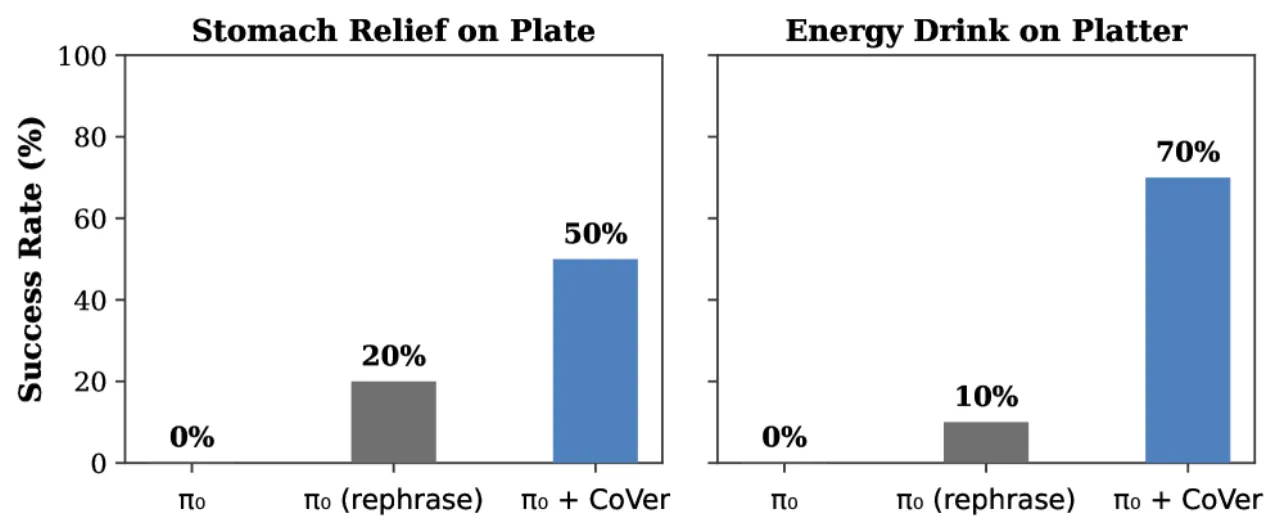
图6 · WidowX 真实机器人实验结果。
两项任务均包含域外对象和光照变化。π0 基线在挑战性场景下成功率为 0%,
CoVer-VLA 通过测试时验证实现 45% 总体成功率提升。Figure 6 · Results of the WidowX real-robot experiments. Both tasks involve out-of-domain objects and lighting changes. The π0 baseline reaches a success rate of 0% in the challenging setting, whereas CoVer-VLA attains a 45% overall gain in success rate through test-time verification.
Verifier 规模与集成实验Verifier scaling and ensembling experiments
图7 · Verifier Scaling 结果。
Top-1 检索精度随模型规模(250M→1B)单调提升,3 个 verifier 集成在鲁棒性与推理开销之间取得最佳平衡。Figure 7 · Verifier scaling results. Top-1 retrieval accuracy improves monotonically with model scale (250M→1B), and an ensemble of 3 verifiers strikes the best balance between robustness and inference overhead.
消融实验Ablation studies
关键消融结论:Key ablation findings:
单独训练时指令增广:ID 从 41.5% 提升至 44%,收益有限;Train-time instruction augmentation alone: ID rises from 41.5% to 44%, a limited gain;
随机选择 rephrase(无验证):ID 略升至 42.3%,但 OOD 下降(29.7→28.7%),任务间方差极大(1%–78%);Randomly choosing a rephrasing (no verification): ID rises slightly to 42.3%, but OOD drops (29.7→28.7%), with extremely large variance across tasks (1%–78%);
CoVer 与策略扩展互补:在更强基础策略(π0.5)上叠加 CoVer 仍有显著增益,说明两者不互斥。CoVer is complementary to policy scaling: stacking CoVer on a stronger base policy (π0.5) still yields significant gains, showing that the two are not mutually exclusive.
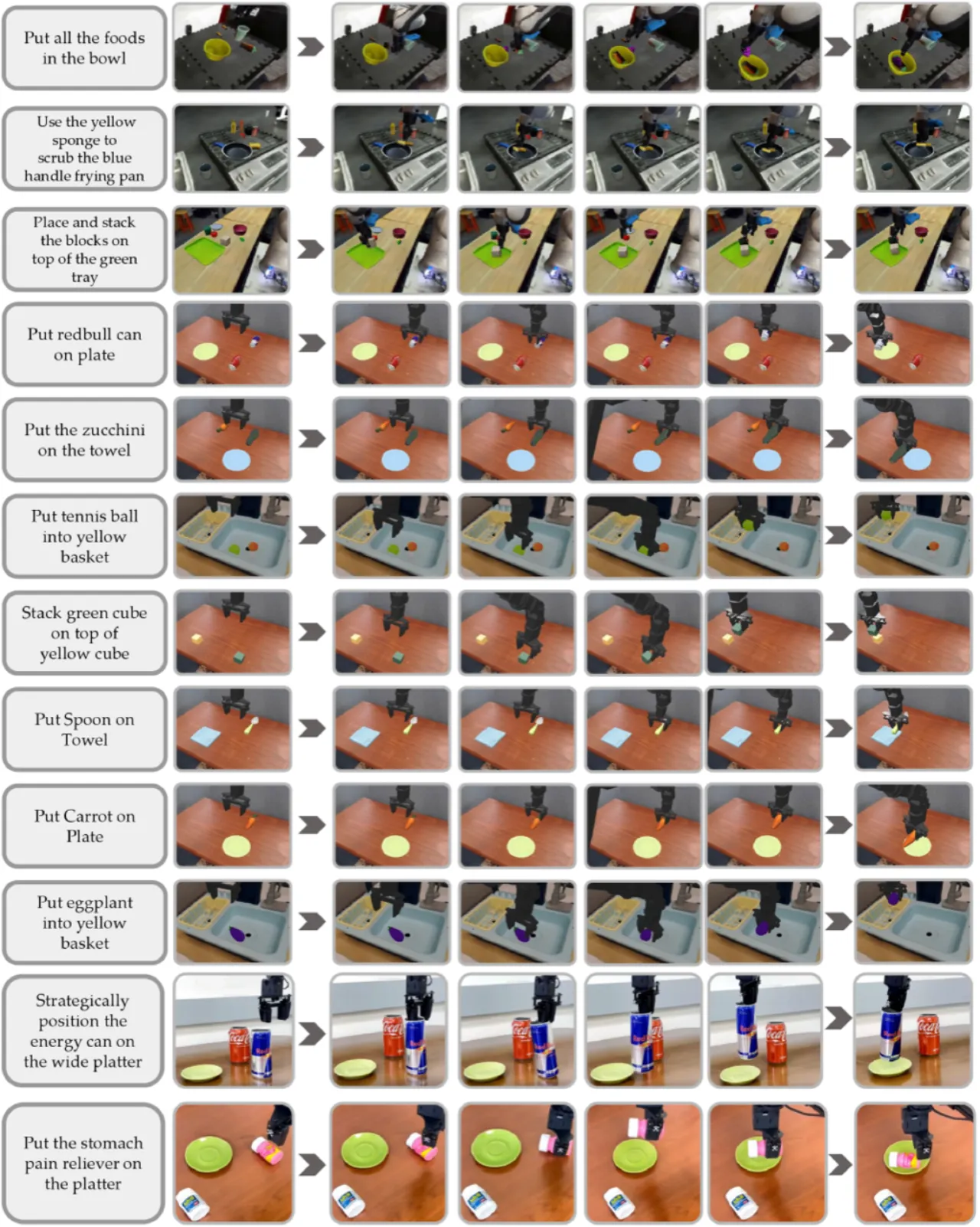
图8 · 任务执行示例。
展示 PolaRiS、SIMPLER 和 Bridge-V2 环境中 CoVer-VLA 与基线的执行对比,
可见 CoVer 显著减少了动作与指令语义不一致的错误。Figure 8 · Examples of task execution. Execution comparisons between CoVer-VLA and the baseline in the PolaRiS, SIMPLER and Bridge-V2 environments; CoVer clearly reduces errors in which the action is semantically inconsistent with the instruction.
04局限性Limitations
说明:本文无独立的 Limitations 章节。以下条目中,标注「stated」的来自论文正文的明确表述,标注「inferred」的由方法设计推断。Note: This paper has no standalone Limitations section. Among the items below, those marked "stated" come from explicit statements in the paper's text, while those marked "inferred" are deduced from the method design.
计算开销(stated)Computational overhead (stated)
CoVer 每时间步需采样 K×M 个动作候选并逐一打分,端到端延迟约 453ms(≈2.2Hz)。
尽管通过并行化和 boot-time 预计算缓解了部分开销,对实时高频控制场景仍构成限制。
论文指出未来工作将探索"more efficient architectures for both base policy and verifier to further reduce latency"。CoVer has to sample K×M action candidates at every time step and score them one by one, with an end-to-end latency of about 453ms (≈2.2Hz). Although parallelization and boot-time pre-computation alleviate part of the overhead, it still constrains real-time high-frequency control scenarios. The paper notes that future work will explore "more efficient architectures for both base policy and verifier to further reduce latency".
Boot-Time Rephrase 质量依赖(inferred)Dependence on Boot-Time rephrasing quality (inferred)
方法的语言层优化依赖 VLM 在初始化阶段生成高质量的指令 rephrase。
对于 VLM 未见过的场景或极端歧义指令,rephrase 质量可能不稳定,
论文对此未做充分消融分析。The language-level optimization of the method relies on the VLM producing high-quality instruction rephrasings during the initialization stage. For scenes unseen by the VLM or for extremely ambiguous instructions, the rephrasing quality may be unstable, and the paper provides no sufficient ablation analysis of this.
Action Chunk 级别验证(inferred)Verification at the action-chunk level (inferred)
CoVer 以动作块(action chunk)而非单步动作为粒度进行验证,
可能限制对需要精细步级别纠正的任务的适用性。CoVer verifies at the granularity of action chunks rather than single-step actions, which may limit its applicability to tasks requiring fine-grained step-level correction.
CoVer 在 Bridge V2 数据集上训练,跨数据集迁移能力(如 DROID 等其他分布)
尚未充分验证。论文在 PolaRiS 等外部基准上已有正面结果,但系统性跨域评估仍缺失。CoVer is trained on the Bridge V2 dataset, and its cross-dataset transfer ability (to other distributions such as DROID) has not yet been sufficiently verified. The paper already reports positive results on external benchmarks such as PolaRiS, but a systematic cross-domain evaluation is still missing.