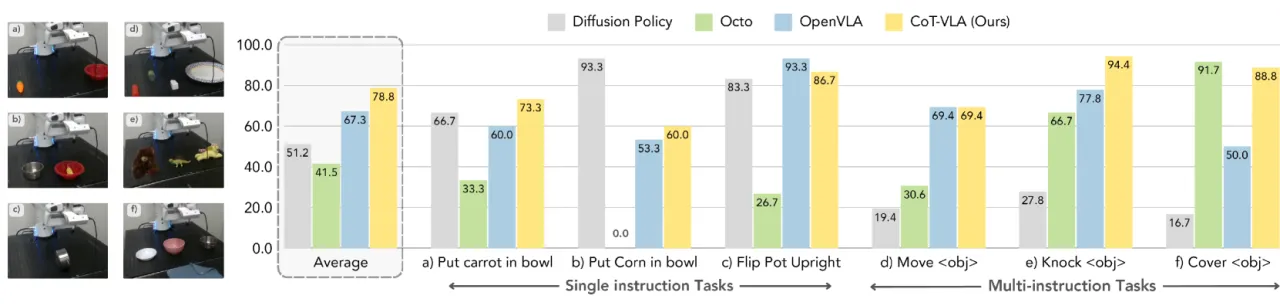
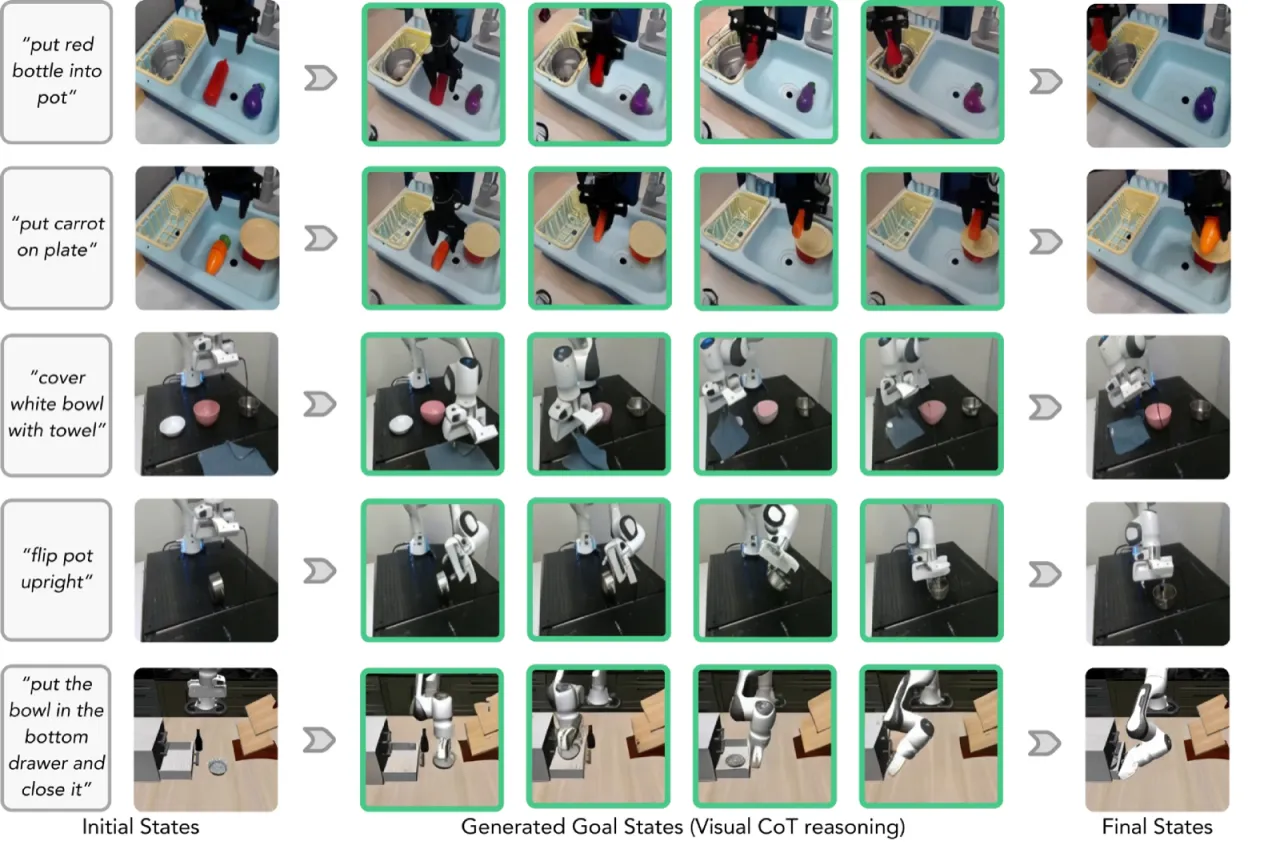
CoT-VLA 在视觉语言动作模型(VLA)中引入显式视觉思维链(visual chain-of-thought)推理:模型在生成动作序列之前,先自回归地预测若干步后的未来图像帧作为"子目标",以此为中间推理步骤指导动作生成。基于 7B 参数的 VILA-U 骨干网络,CoT-VLA 在真实机器人操作任务上超越当时最优 VLA 基线 17%,在仿真 benchmark 上超越 6%。CoT-VLA introduces explicit visual chain-of-thought reasoning into vision-language-action models (VLA): before generating an action sequence, the model autoregressively predicts future image frames several steps ahead as "sub-goals", and uses them as intermediate reasoning steps to guide action generation. Built on a 7B-parameter VILA-U backbone, CoT-VLA surpasses the then-best VLA baselines by 17% on real-robot manipulation tasks and by 6% on simulation benchmarks.
当前主流 VLA 模型直接将语言指令与视觉观测映射到机器人动作,缺乏中间推理过程。这与人类"先在脑海中规划目标状态,再执行"的认知方式相悖,也限制了模型在复杂长视野任务中的泛化能力。Mainstream VLA models map language instructions and visual observations directly to robot actions, with no intermediate reasoning process. This runs counter to the human cognitive pattern of "first planning the goal state in the mind, then executing", and it also limits generalization on complex, long-horizon tasks.
"We propose to incorporate explicit visual chain-of-thought (CoT) reasoning into VLAs by predicting future image frames autoregressively as visual goals before generating a short action sequence to achieve these goals."
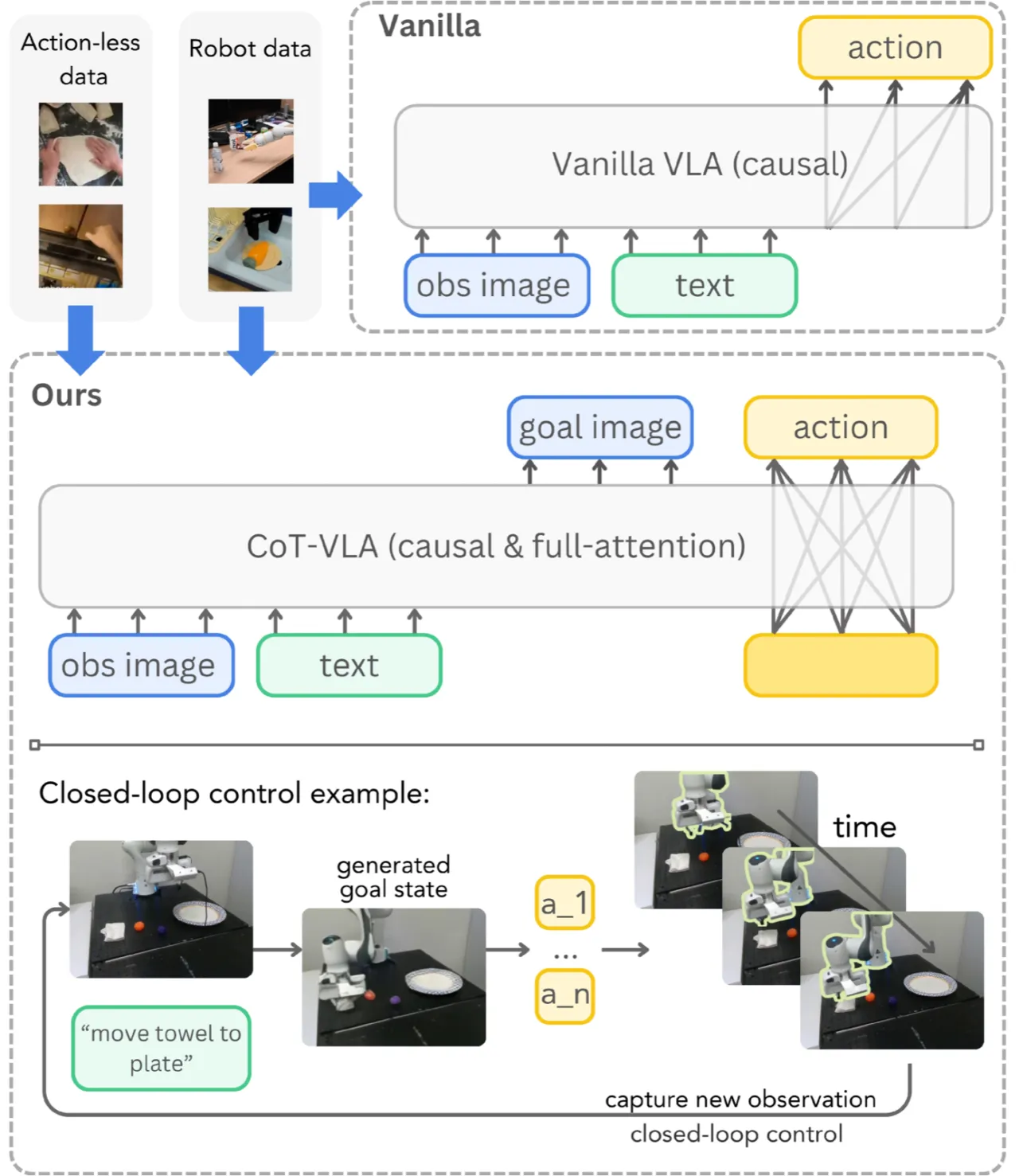
核心洞察在于:若模型能生成"接下来 n 步后的场景应该是什么样"的图像,则这一预测本身就构成了对任务进度的显式规划。无动作标注的视频数据(如 EPIC-KITCHEN、Something-Something V2)同样包含丰富的视觉动态先验,可用于训练子目标图像生成能力,从而扩大有效训练数据规模。The core insight: if a model can generate an image of "what the scene should look like n steps from now", that prediction itself constitutes explicit planning over task progress. Action-free video data (e.g. EPIC-KITCHEN, Something-Something V2) likewise carries rich visual dynamics priors and can be used to train sub-goal image generation, thereby enlarging the effective training corpus.
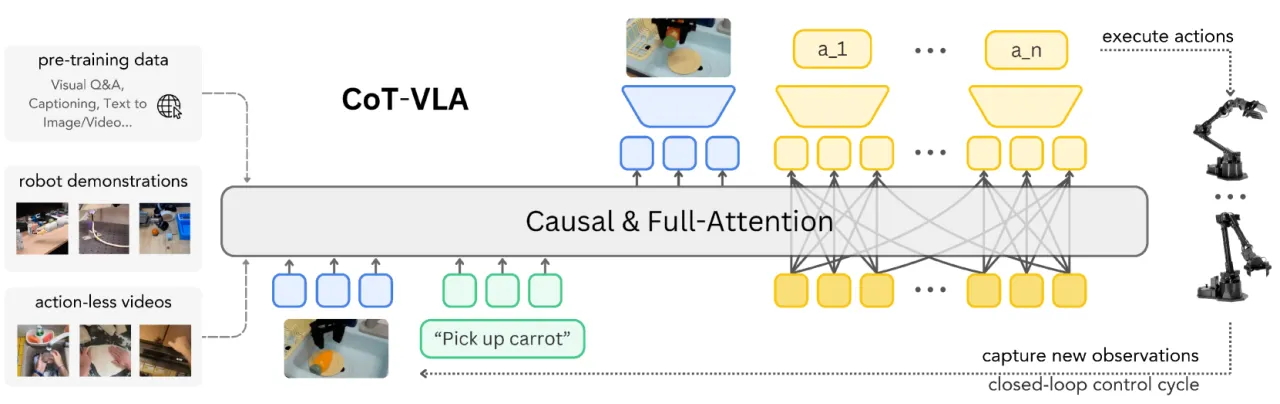
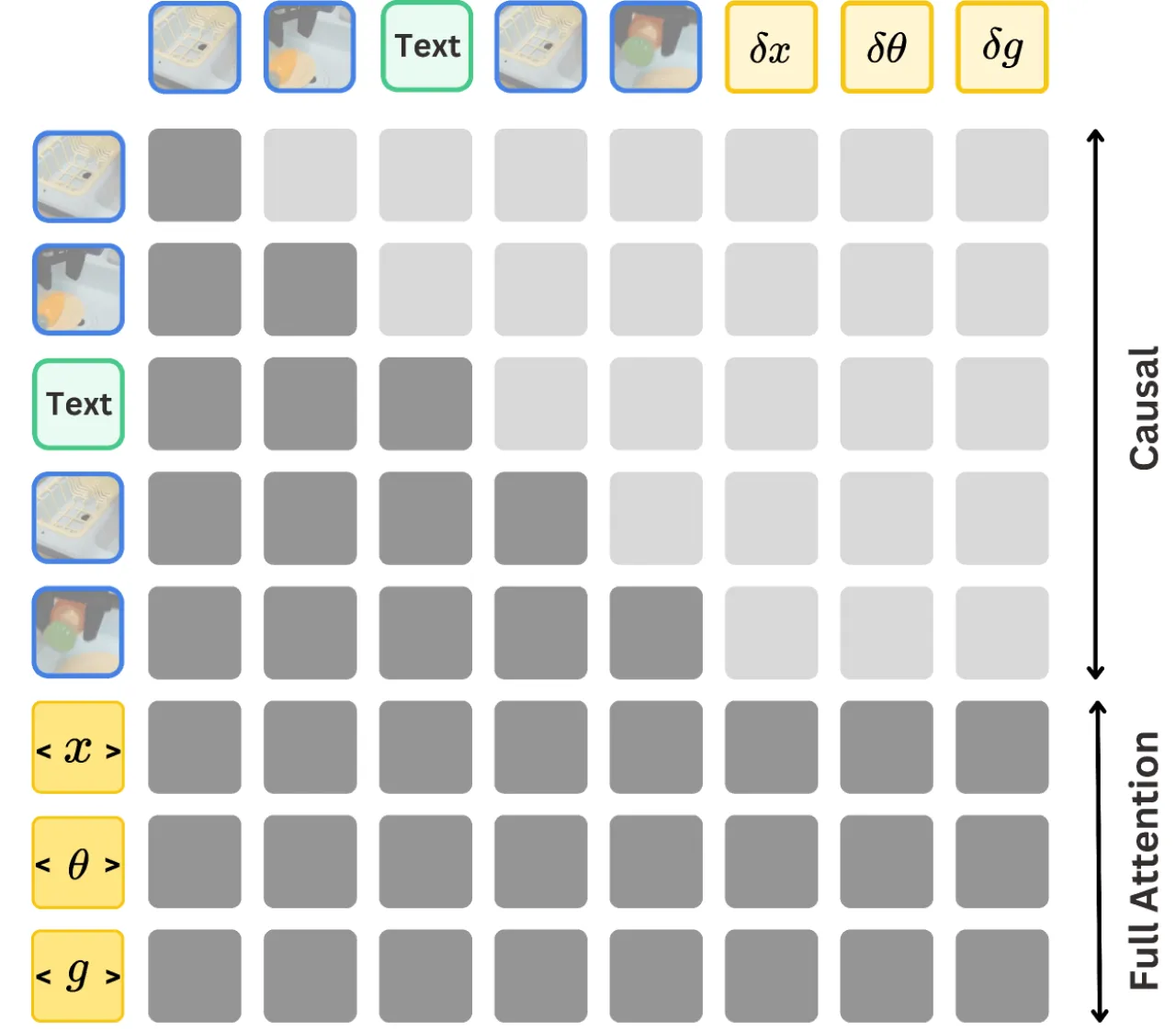
CoT-VLA 以 VILA-U 为基础模型,采用"两阶段条件生成":先以自回归 Transformer 生成子目标图像 token,再以 full-attention 并行解码 action chunk。训练分三阶段:通用预训练 → 机器人预训练(含无动作视频)→ 任务微调。CoT-VLA takes VILA-U as its base model and adopts a "two-stage conditional generation" scheme: an autoregressive Transformer first generates the sub-goal image tokens, then a full-attention pass decodes the action chunk in parallel. Training proceeds in three stages: general pre-training → robot pre-training (including action-free video) → task fine-tuning.
VILA-U 是一个统一的多模态基础模型,同时支持图像理解与生成。图像通过 RQ-VAE(Residual Quantization VAE)编码为 16×16×4 的 token 网格(残差深度为 4),在 256×256 分辨率下每帧共 256 个 token。深度 Transformer 逐层预测残差 token,从而在离散 token 空间内实现高质量图像生成。动作 token 则直接拼接在图像/文本序列之后,以统一的 Transformer 解码。VILA-U is a unified multimodal foundation model that supports both image understanding and image generation. Images are encoded by an RQ-VAE (Residual Quantization VAE) into a 16×16×4 token grid (residual depth 4), giving 256 tokens per frame at 256×256 resolution. A depth Transformer predicts the residual tokens level by level, achieving high-quality image generation within a discrete token space. Action tokens are appended directly after the image/text sequence and decoded by the same unified Transformer.
这一设计将自回归图像生成与并行动作解码统一在同一 Transformer 中,避免了双网络带来的额外复杂度。Action chunking(m=10)减少了闭环控制的决策频率,提升执行流畅度。This design unifies autoregressive image generation and parallel action decoding inside a single Transformer, avoiding the extra complexity of a two-network setup. Action chunking (m=10) lowers the decision frequency of closed-loop control and makes execution smoother.
实验在两个平台展开:LIBERO 仿真 benchmark(4 个任务分组)与真实 Franka-Tabletop 机器人平台(6 个操作任务,含 3 个单指令与 3 个多指令任务)。同时在 Bridge-V2 数据集上评估跨任务泛化。基线包括 Diffusion Policy、Octo 和 OpenVLA。Experiments span two platforms: the LIBERO simulation benchmark (4 task suites) and a real Franka-Tabletop robot platform (6 manipulation tasks, comprising 3 single-instruction and 3 multi-instruction tasks). Cross-task generalization is additionally evaluated on the Bridge-V2 dataset. Baselines include Diffusion Policy, Octo and OpenVLA.
| 模型Model | Spatial | Object | Goal | Long | 平均Average |
|---|---|---|---|---|---|
| Diffusion Policy | 78.3±1.1% | 92.5±0.7% | 68.3±1.2% | 50.5±1.3% | 72.4±0.7% |
| Octo (fine-tuned) | 78.9±1.0% | 85.7±0.9% | 84.6±0.9% | 51.1±1.3% | 75.1±0.6% |
| OpenVLA (fine-tuned) | 84.7±0.9% | 88.4±0.8% | 79.2±1.0% | 53.7±1.3% | 76.5±0.6% |
| CoT-VLA-7B(本文)CoT-VLA-7B (ours) | 87.5±1.4% | 91.6±0.5% | 87.6±0.6% | 69.0±0.8% | 81.13±0.6% |
CoT-VLA 在所有 4 个 LIBERO 子分组上均取得最优,尤其在长视野任务 LIBERO-Long 上提升显著(53.7% → 69.0%),体现了视觉子目标对长时序规划的帮助。CoT-VLA is best on all 4 LIBERO suites, with a particularly clear gain on the long-horizon LIBERO-Long suite (53.7% → 69.0%), showing how visual sub-goals help long-horizon planning.
| 模型Model | Visual | Motion | Semantic | Language |
|---|---|---|---|---|
| SUSIE | 30% | 10% | 20% | 40% |
| Octo | 35% | 10% | 0% | 40% |
| OpenVLA | 75% | 45% | 40% | 75% |
| CoT-VLA(本文)CoT-VLA (ours) | 65% | 60% | 50% | 70% |
在 Bridge-V2 上,CoT-VLA 在 Motion 泛化(60% vs 45%)与 Semantic 泛化(50% vs 40%)上超越 OpenVLA,但在 Visual 与 Language 分类上略低于 OpenVLA(65% vs 75%,70% vs 75%)。On Bridge-V2, CoT-VLA beats OpenVLA on Motion generalization (60% vs 45%) and Semantic generalization (50% vs 40%), but is slightly behind OpenVLA on the Visual and Language categories (65% vs 75%, 70% vs 75%).
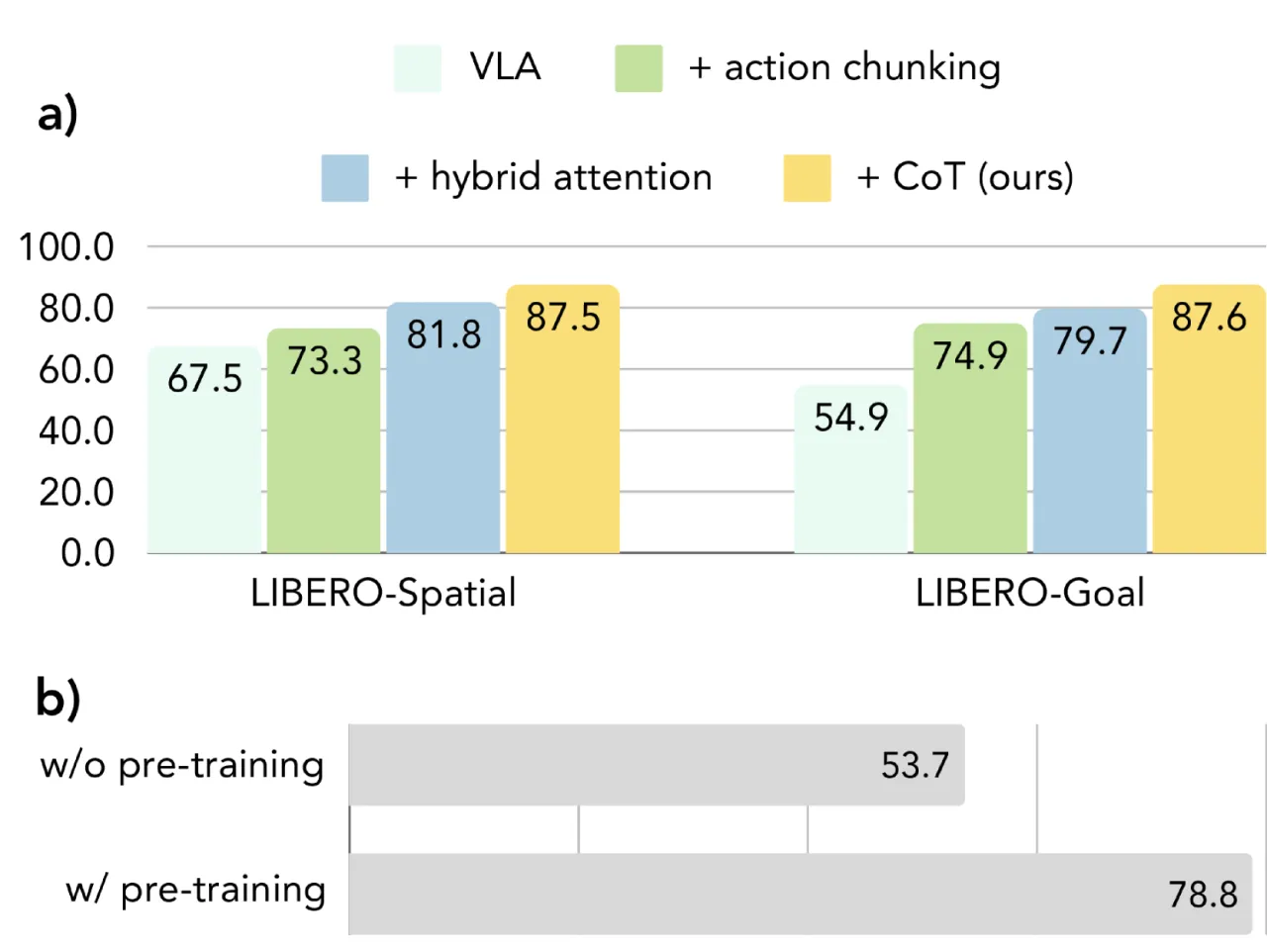
消融实验验证了每个组件的独立贡献:Action chunking 提供稳定基础;Hybrid attention 使动作预测更连贯;Visual CoT 带来最终的性能跃升,尤其在需要多步规划的任务中效果最为明显。The ablations verify the independent contribution of each component: action chunking provides a stable base; hybrid attention makes action prediction more coherent; visual CoT delivers the final performance jump, most clearly on tasks that require multi-step planning.
论文明确指出:"Our method requires generating 256 image tokens before action tokens, leading to a 7×slowdown on average with an action chunk size of 10."。在实时控制场景下,推理延迟是主要瓶颈,限制了对高频控制任务的适用性。The paper states plainly: "Our method requires generating 256 image tokens before action tokens, leading to a 7×slowdown on average with an action chunk size of 10." In real-time control settings, inference latency is the main bottleneck and limits applicability to high-frequency control tasks.
VILA-U 的自回归图像生成在视觉细节上弱于扩散模型(如 DALL-E、Stable Diffusion)。子目标图像存在模糊或细节丢失,可能在需要精密视觉对准的任务中降低动作质量。论文在 OOD 泛化实验中也发现,使用生成子目标(20%/0%)远低于使用真实子目标(60%/40%)的成功率,印证了图像质量的瓶颈。VILA-U's autoregressive image generation is weaker in visual detail than diffusion models (e.g. DALL-E, Stable Diffusion). Sub-goal images can be blurry or lose detail, which may degrade action quality on tasks that require precise visual alignment. In the OOD generalization experiments the paper also finds that success rates with generated sub-goals (20%/0%) are far below those with ground-truth sub-goals (60%/40%), confirming the image-quality bottleneck.
预测固定长度的动作序列(chunk)会在两个 chunk 交界处出现动作不连续,且缺乏逐步反馈调整能力。当任务需要精细的实时感知-动作闭环时,chunk 边界的抖动可能影响执行稳定性。Predicting a fixed-length action sequence (chunk) produces action discontinuities at the boundary between two chunks, and offers no step-by-step feedback correction. When a task requires a fine-grained real-time perception-action loop, jitter at chunk boundaries may affect execution stability.
论文指出,模型在面对训练分布之外的全新视觉推理任务时泛化能力有限,部分原因在于计算约束(模型规模、生成 token 数)限制了推理深度与多样性。The paper notes that the model generalizes only to a limited degree to entirely new visual reasoning tasks outside the training distribution, partly because compute constraints (model size, number of generated tokens) restrict the depth and diversity of reasoning.