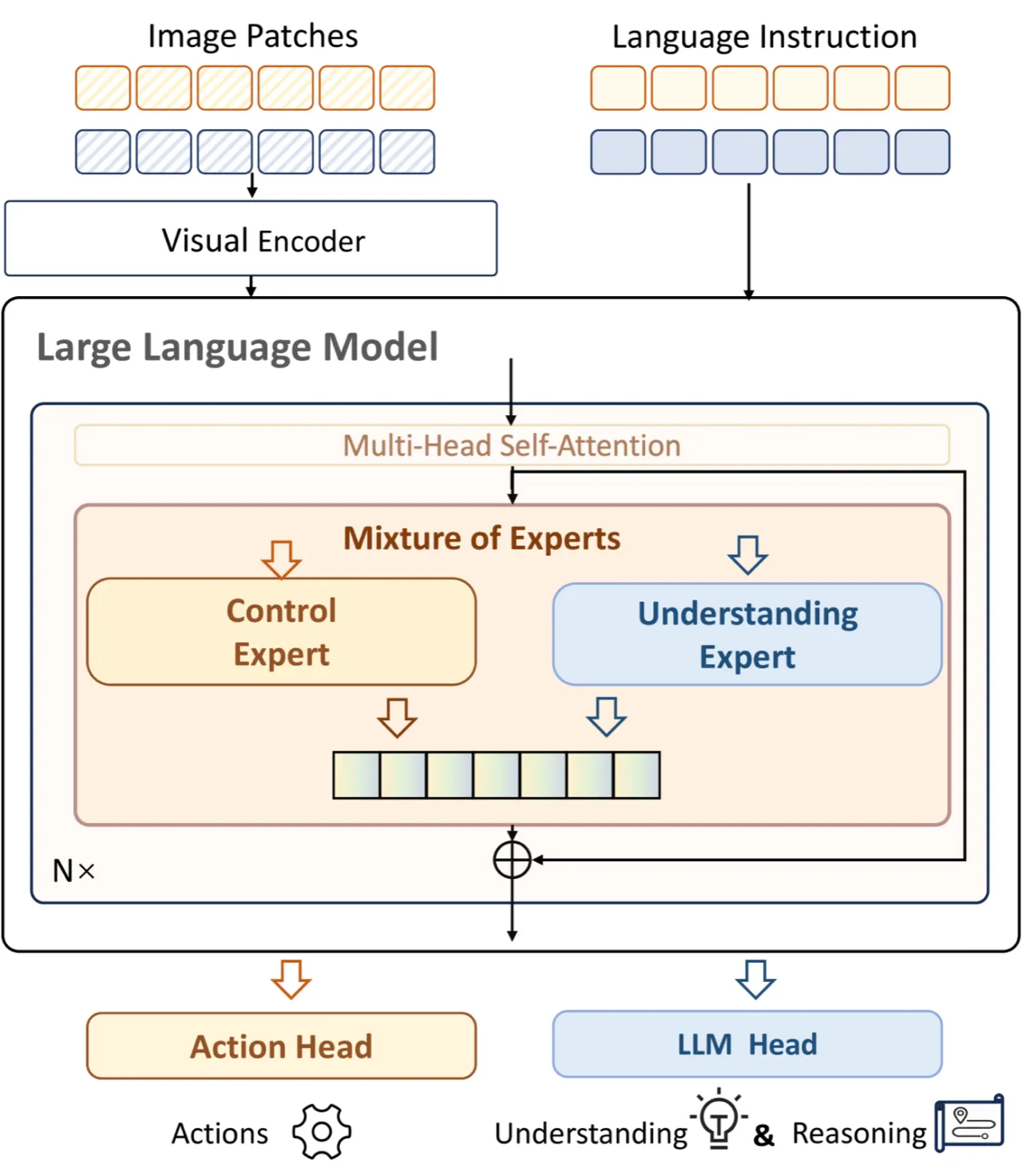
ChatVLA 提出统一的 Vision-Language-Action 框架,通过分阶段对齐训练(Phased Alignment Training)与混合专家架构(Mixture-of-Experts),同步解决 VLA 模型中的"伪遗忘"与"任务干扰"两大痛点,在多模态理解与真实机器人操作两个维度均达到 SOTA 水平。ChatVLA proposes a unified Vision-Language-Action framework that, through Phased Alignment Training and a Mixture-of-Experts architecture, simultaneously resolves the two pain points of "spurious forgetting" and "task interference" in VLA models, reaching SOTA on both multimodal understanding and real-robot manipulation.
现有 VLA 模型在机器人控制与多模态理解之间存在根本性矛盾:擅长底层操作的架构往往丧失视觉-语言对齐能力,而强大的 VLM 又缺乏物理交互能力。作者通过系统分析训练范式,识别出两大核心挑战。Existing VLA models face a fundamental tension between robot control and multimodal understanding: architectures that excel at low-level manipulation tend to lose their vision-language alignment, while powerful VLMs lack physical interaction ability. Through a systematic analysis of training paradigms, the authors identify two key challenges.
"Through a systematic analysis of existing training paradigms in vision-language-action models (VLA), we identify two key challenges: spurious forgetting, where robot training overwrites crucial visual-text alignments, and task interference, where competing control and understanding tasks degrade performance when trained jointly."
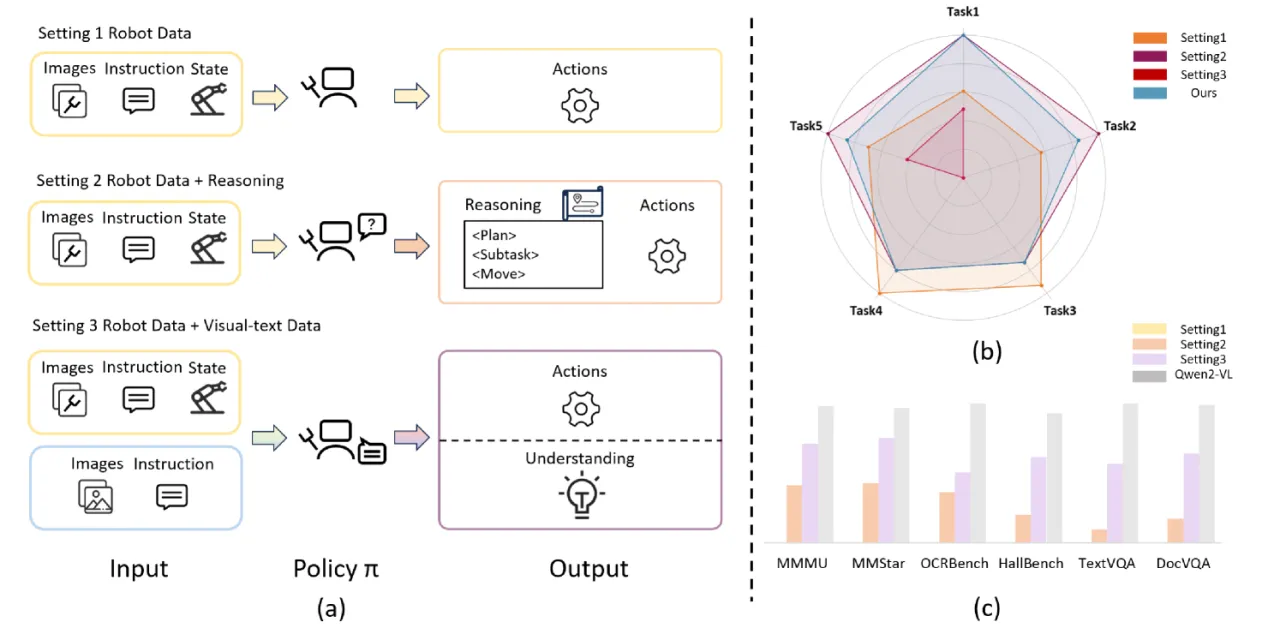
机器人数据微调过程中,模型会覆盖预训练阶段习得的视觉-文本对齐能力。即便使用 LoRA 等参数高效方法,这种遗忘现象依然存在,导致 VLA 在多模态理解基准(如 MMMU、TextVQA)上性能几乎归零。During fine-tuning on robot data, the model overwrites the vision-text alignment acquired in pre-training. Even with parameter-efficient methods such as LoRA, this forgetting persists, driving VLA performance on multimodal understanding benchmarks (e.g. MMMU, TextVQA) to nearly zero.
当控制任务与理解任务同时训练时,二者的梯度方向相互冲突,导致两端性能均出现退化。这与 Dual Coding Theory(双编码理论)的预测一致——不同模态的信息在大脑中由独立通道处理。When control and understanding tasks are trained jointly, their gradient directions conflict and performance degrades on both sides. This agrees with the prediction of Dual Coding Theory: information from different modalities is processed by separate channels in the brain.
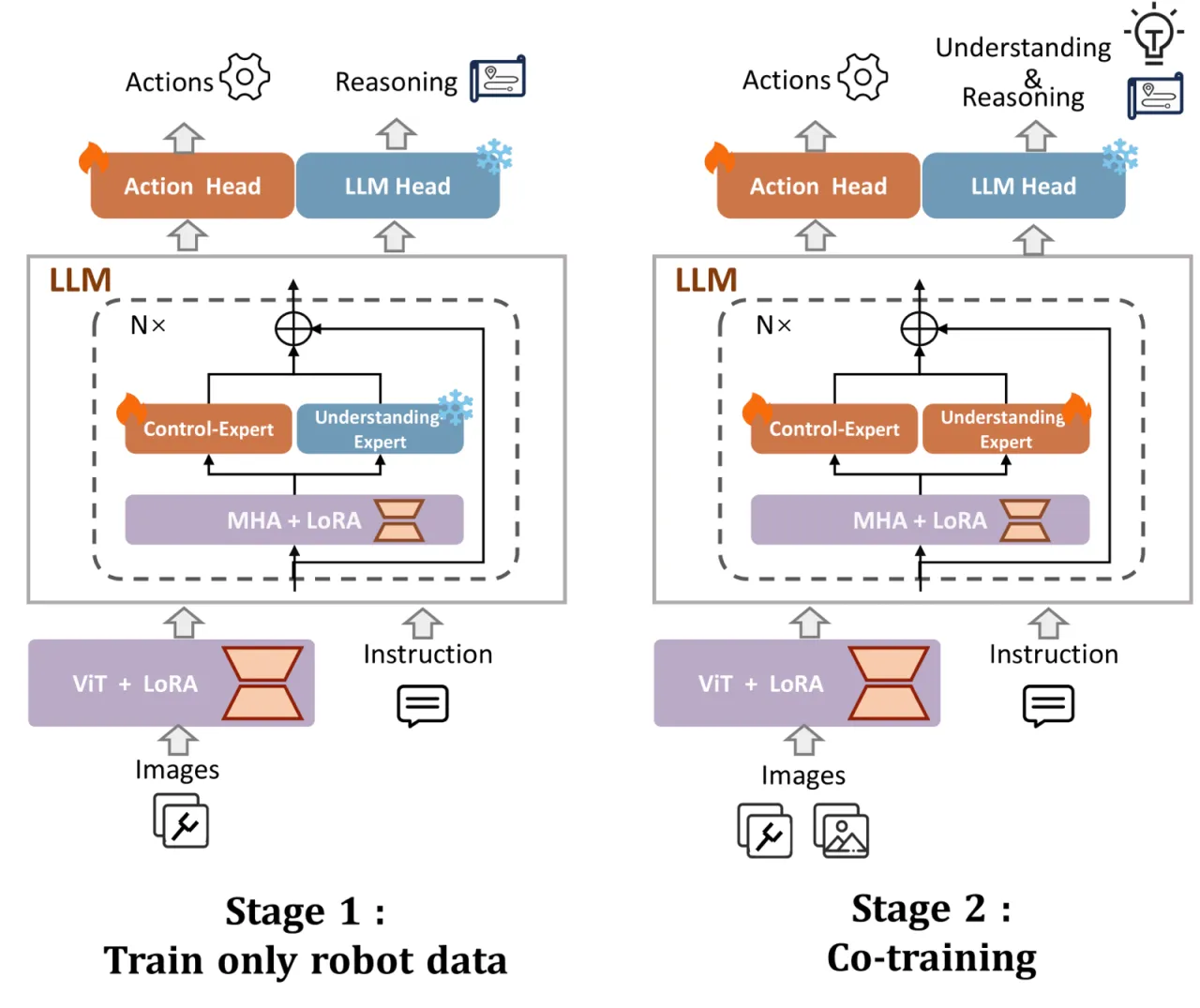
ChatVLA 提出两项互补的创新:Phased Alignment Training(分阶段对齐训练)解决伪遗忘问题,Mixture-of-Experts (MoE) 架构解决任务干扰问题。两者共同实现多模态理解与机器人控制的统一。ChatVLA introduces two complementary innovations: Phased Alignment Training resolves spurious forgetting, and a Mixture-of-Experts (MoE) architecture resolves task interference. Together they unify multimodal understanding and robot control.
直接将机器人数据与视觉-文本数据混合训练会导致两类任务相互拖累。ChatVLA 的解决思路是:先专注控制,再逐步引入理解。第一阶段让模型在机器人轨迹上充分优化,建立稳固的动作预测能力;第二阶段再以合理的数据比例混入视觉-文本数据(论文发现 1:3 的视觉-文本:机器人数据比例最优),"渐进式"地恢复多模态对齐能力,而不损害已学到的控制策略。Mixing robot data with vision-text data from the start makes the two task families drag each other down. ChatVLA's remedy is to focus on control first, then introduce understanding gradually. The first stage optimizes the model on robot trajectories until action prediction is solid; the second stage then mixes in vision-text data at a sensible ratio (the paper finds a 1:3 vision-text-to-robot data ratio optimal), progressively restoring multimodal alignment without damaging the control policy already learned.
受 Dual Coding Theory 启发,ChatVLA 在每个 Transformer 块中设置两类专家(Expert):Inspired by Dual Coding Theory, ChatVLA places two kinds of Expert in every Transformer block:
与 Dense MoE(所有 token 使用全部专家)不同,ChatVLA 的路由策略是确定性的——机器人 token 只走机器人专家,视觉-文本 token 只走理解专家,避免了 top-k sparse routing 带来的负载均衡问题。Unlike Dense MoE, where all tokens use all experts, ChatVLA's routing policy is deterministic: robot tokens go only to the robot expert and vision-text tokens only to the understanding expert, avoiding the load-balancing problems of top-k sparse routing.
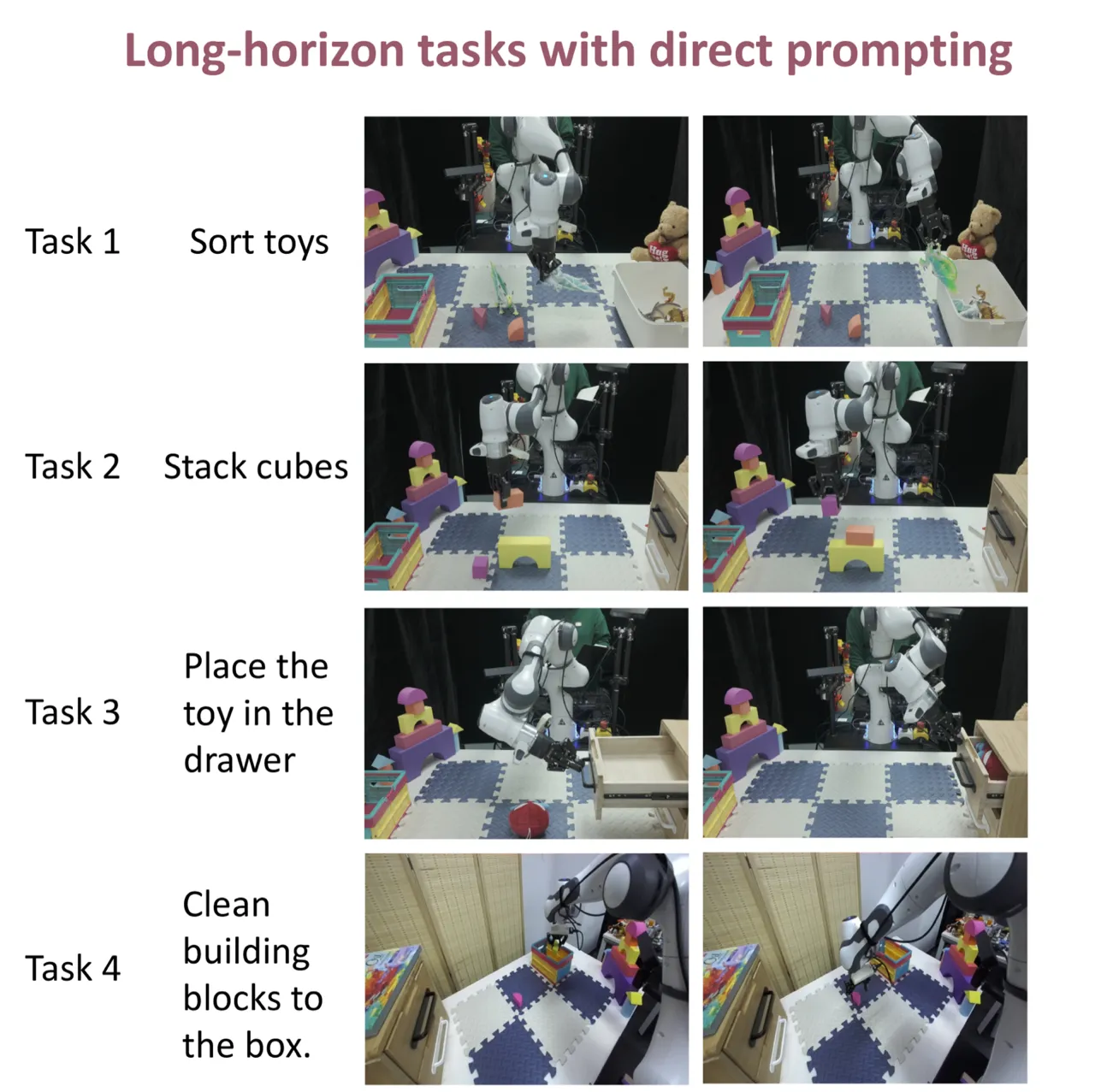
实验分两部分:(1)在13个多模态理解基准上与 Qwen2-VL、OpenVLA、ECoT、DiVLA 对比;(2)在25项真实机器人任务(长时序操作 + 跨技能多任务)上与 Octo、OpenVLA 对比。所有机器人实验均在真实物理环境中进行,无仿真。The evaluation has two parts: (1) comparison against Qwen2-VL, OpenVLA, ECoT and DiVLA on 13 multimodal understanding benchmarks; (2) comparison against Octo and OpenVLA on 25 real-robot tasks (long-horizon manipulation plus cross-skill multi-tasking). All robot experiments are run in the real physical world, without simulation.
| Method | #Params | MMMU | MMStar | TextVQA | DocVQA | MME | OCRBench | HallBench |
|---|---|---|---|---|---|---|---|---|
| Qwen2-VL | 2B | 41.1 | 48.0 | 79.7 | 88.57 | 1872.0 | 809 | 41.7 |
| OpenVLA | 7B | 0 | 0 | 0 | 0 | 0 | 0 | 0 |
| ECoT | 7B | 5.4 | 0 | 0 | 0 | 0 | 12 | 0.9 |
| DiVLA | 2B | 17.2 | 21.1 | 7.5 | 15.2 | 186.5 | 294 | 9.0 |
| ChatVLA (Ours) | 2B | 37.4 | 47.2 | 71.2 | 83.3 | 1435.2 | 729 | 39.9 |
ChatVLA 在大多数理解基准上远超同等参数的 VLA 竞品(OpenVLA、ECoT、DiVLA),并接近纯 VLM 基线 Qwen2-VL。在 MMMU 上实现 37.4 vs. ECoT 的 5.4(约 6 倍提升);在 TextVQA 上达到 71.2(OpenVLA 为 0)。ChatVLA far outperforms VLA competitors of comparable size (OpenVLA, ECoT, DiVLA) on most understanding benchmarks and comes close to the pure-VLM baseline Qwen2-VL. On MMMU it reaches 37.4 vs. 5.4 for ECoT (about six times higher); on TextVQA it reaches 71.2 (OpenVLA scores 0).
| Method | Task 1 平均成功长度Task 1 average success length | Task 2 | Task 3 | Task 4 |
|---|---|---|---|---|
| Octo | 0.08 | 0.21 | 0.11 | 0.33 |
| OpenVLA | 0.06 | 0.29 | 0.15 | 0.42 |
| ChatVLA (Ours) | 0.54 | 0.64 | 1.00 | 0.75 |
| Method | Bathroom (Tasks 14-17) | Kitchen (Tasks 18-19) | Tabletop (Tasks 20-25) | Total |
|---|---|---|---|---|
| Octo | 4/34 | 4/18 | 10/55 | 18/107 |
| OpenVLA | 3/34 | 5/18 | 12/55 | 20/107 |
| ChatVLA (Ours) | 16/34 | 12/18 | 27/55 | 55/107 |
论文对视觉-文本数据与机器人数据的比例进行系统消融(1:1 / 3:1 / 1:3):The paper systematically ablates the ratio of vision-text data to robot data (1:1 / 3:1 / 1:3):
| Ratio (VT:Robot) | MMMU | MMStar | TextVQA | DocVQA | MME |
|---|---|---|---|---|---|
| 1:1 | 36.1 | 44.7 | 72.6 | 82.9 | 1426.9 |
| 3:1 | 35.3 | 45.3 | 72.7 | 83.6 | 1399.5 |
| 1:3(最优)1:3 (optimal) | 37.4 | 47.2 | 71.2 | 83.3 | 1435.2 |
结果表明,1:3 的视觉-文本:机器人数据比例在多数理解基准上取得最优,同时维持机器人任务成功率。增大视觉-文本比例(3:1)不仅未能进一步提升理解性能,反而对 MMMU 等指标略有损害。The results show that a 1:3 vision-text-to-robot data ratio is best on most understanding benchmarks while maintaining robot task success rates. Raising the vision-text share (3:1) does not improve understanding further and even slightly hurts metrics such as MMMU.
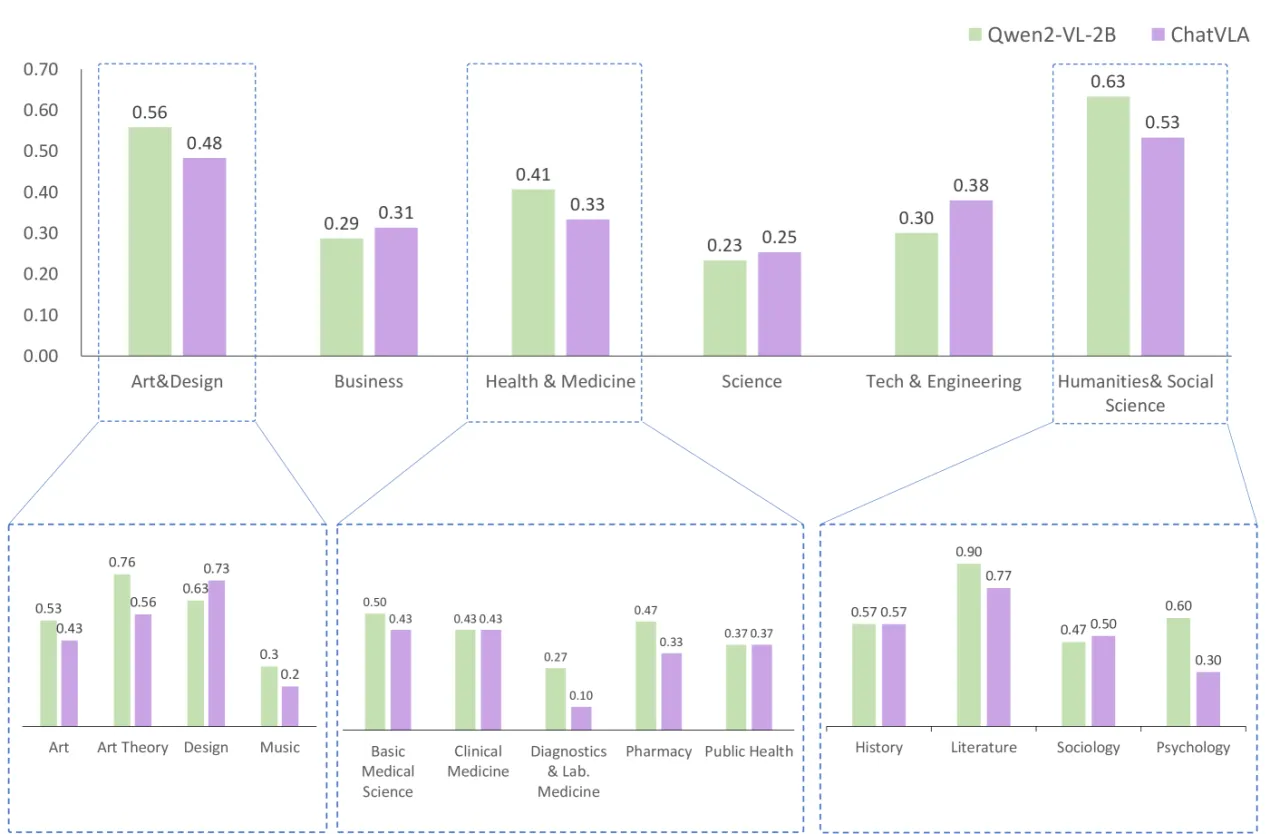
论文明确指出:ChatVLA 在 MMMU 的艺术理论(Art Theory)、实验室医学(Lab Medicine)、药学(Pharmacy)、文学(Literature)、心理学(Psychology)等专业类别上与 Qwen2-VL 仍有明显差距,原因是训练所用的 LLaVA 数据集对这些专业领域的覆盖有限。作者表示"carefully curated data is crucial for mitigating spurious forgetting, a topic we plan to explore in future work"。The paper states explicitly that ChatVLA still lags clearly behind Qwen2-VL on MMMU's specialized categories such as Art Theory, Lab Medicine, Pharmacy, Literature and Psychology, because the LLaVA dataset used for training covers these domains only to a limited extent. The authors note that "carefully curated data is crucial for mitigating spurious forgetting, a topic we plan to explore in future work".
尽管 ChatVLA(2B)在多数基准上远超同类 VLA,但与同等参数的纯视觉语言模型 Qwen2-VL-2B 相比仍有差距(例如 MMMU:37.4 vs. 41.1;TextVQA:71.2 vs. 79.7)。引入机器人控制能力本身仍会带来一定的理解能力损耗。Although ChatVLA (2B) far exceeds comparable VLAs on most benchmarks, a gap remains against the pure vision-language model Qwen2-VL-2B of the same size (e.g. MMMU: 37.4 vs. 41.1; TextVQA: 71.2 vs. 79.7). Adding robot control ability still costs some understanding performance.
ChatVLA 的 MoE 路由采用基于 token 类型的确定性分配(机器人 token → 机器人专家,视觉-文本 token → 理解专家),这简化了训练但也限制了模型在混合任务场景下的灵活性。对于需要同时融合动作预测与语言推理的复杂指令,固定路由可能不是最优方案(inferred)。ChatVLA's MoE routing uses a deterministic assignment based on token type (robot tokens to the robot expert, vision-text tokens to the understanding expert), which simplifies training but also limits the model's flexibility in mixed-task settings. For complex instructions that require fusing action prediction with language reasoning at once, fixed routing may not be the optimal design (inferred).
尽管论文在真实物理环境(浴室、厨房、桌面)中进行了25项任务的评估,但每项任务的试验次数有限,且场景多样性相对受控。方法在更大规模、更开放环境下的泛化能力尚待验证(inferred)。Although the paper evaluates 25 tasks in real physical environments (bathroom, kitchen, tabletop), the number of trials per task is limited and scene diversity is relatively controlled. Generalization to larger-scale, more open environments remains to be verified (inferred).