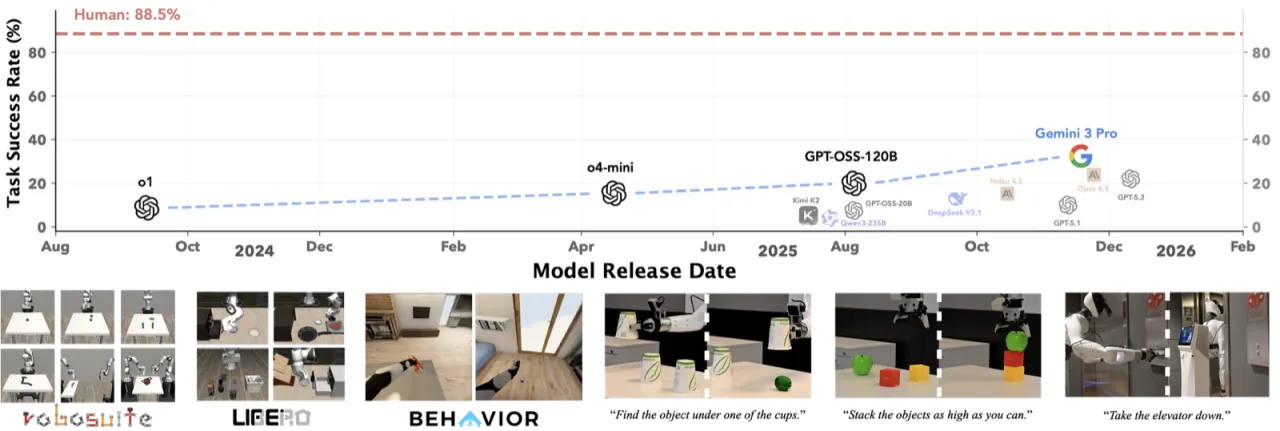
CaP-X 针对「代码即策略」(Code-as-Policy)在机器人操控中的系统化研究空白,提出了CaP-Gym交互环境、CaP-Bench多层次基准、训练无关的CaP-Agent0智能体框架,以及基于强化学习的CaP-RL方法。12个前沿语言/视觉语言模型在7个操控任务上与人类专家存在显著差距,但通过智能体框架与RL微调可大幅缩小这一差距。Addressing the lack of systematic study of Code-as-Policy for robot manipulation, CaP-X introduces the CaP-Gym interactive environment, the multi-tier CaP-Bench benchmark, the training-free CaP-Agent0 agent framework, and the reinforcement-learning-based CaP-RL method. Across 7 manipulation tasks, 12 frontier language / vision-language models still fall far short of human experts, yet the agent framework and RL fine-tuning substantially narrow that gap.
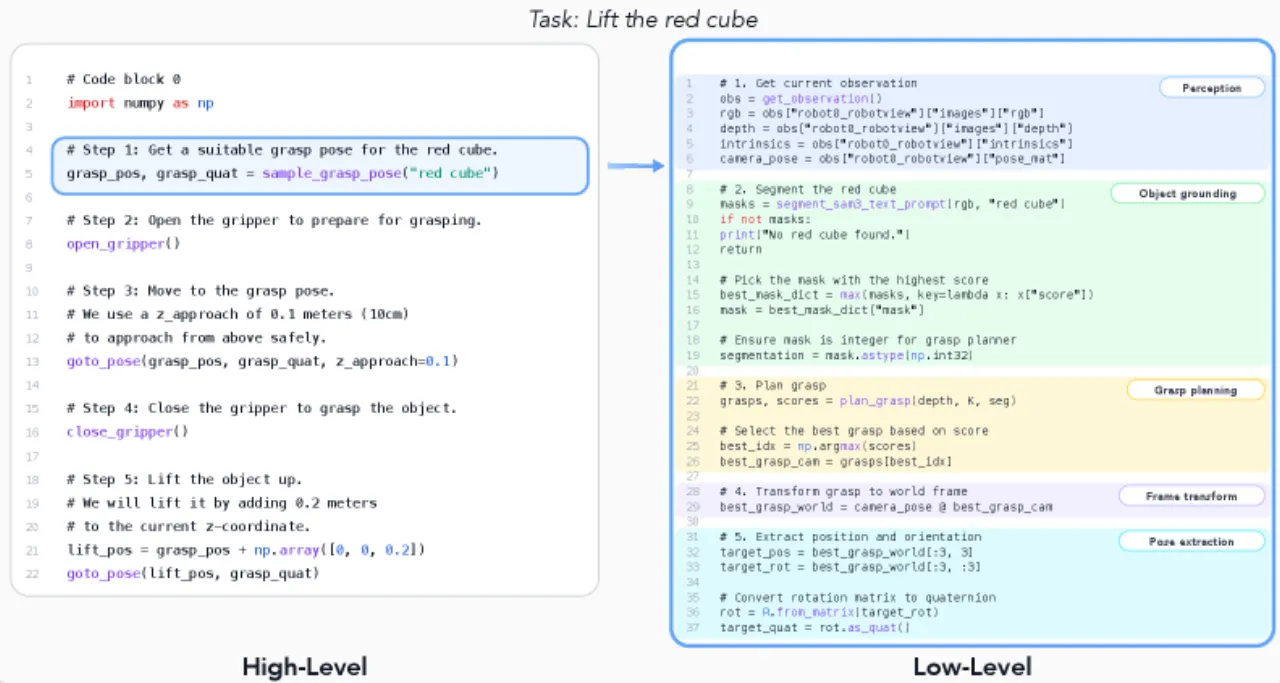
「代码即策略」(Code-as-Policy)被视为数据密集型 VLA 方法的有力补充,但其作为自主控制器在 embodied manipulation 场景中的有效性仍严重缺乏系统性研究。现有工作大多依赖高层原语(如 stack_objs_in_order()),使得模型性能究竟来自智能体本身还是原语封装的任务先验难以区分,且未回答:当抽象层级降低时性能如何变化?增加测试时计算量是否能弥补低层接口带来的挑战?Code-as-Policy is seen as a strong complement to data-intensive VLA methods, yet its effectiveness as an autonomous controller for embodied manipulation remains severely underexplored. Most existing work relies on high-level primitives (e.g. stack_objs_in_order()), making it hard to tell whether performance comes from the agent itself or from the task priors baked into those primitives; nor does it answer how performance changes as the abstraction level drops, or whether more test-time compute can offset the challenges of low-level interfaces.
"Code-as-Policy considers how executable code can complement data-intensive Vision-Language-Action (VLA) methods, yet their effectiveness as autonomous controllers for embodied manipulation remains underexplored."
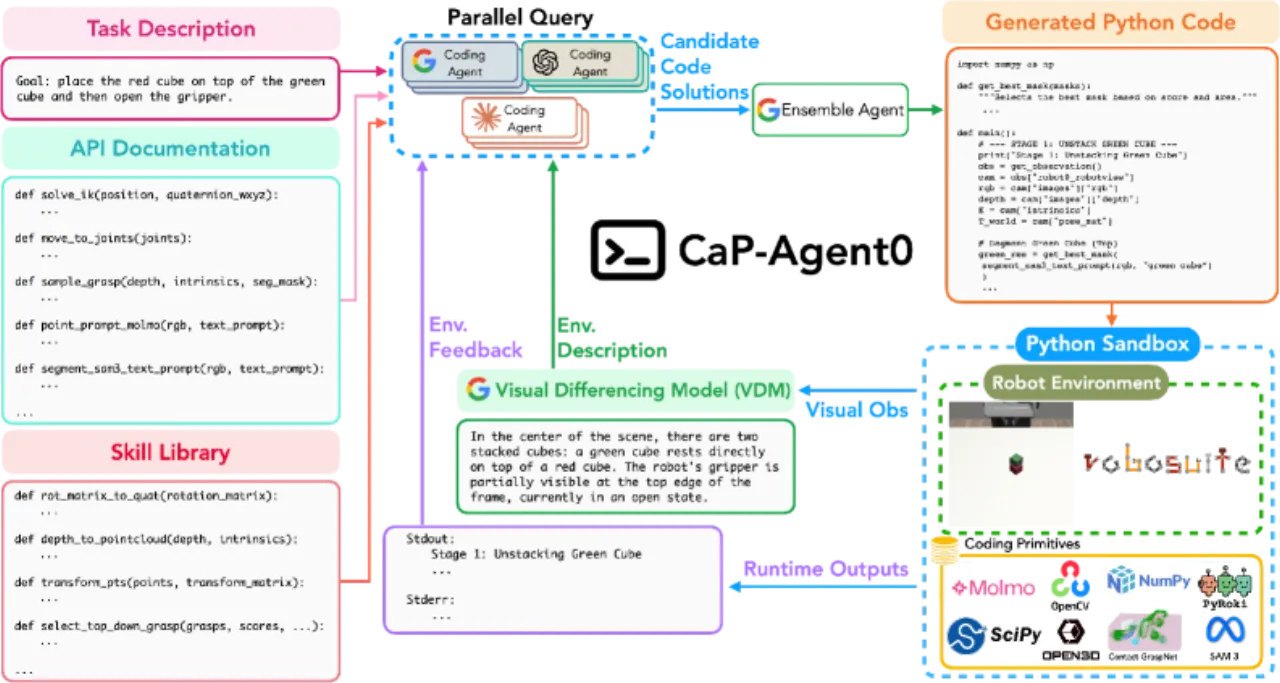
CaP-X 由三个核心模块构成:CaP-Gym(交互环境)、CaP-Bench(多层次基准)、以及两种提升智能体性能的方法——训练无关的 CaP-Agent0 与基于 RL 微调的 CaP-RL。CaP-X consists of three core modules: CaP-Gym (the interactive environment), CaP-Bench (the multi-tier benchmark), and two ways to improve agent performance — the training-free CaP-Agent0 and the RL-fine-tuned CaP-RL.
CaP-Gym 是一个建立在标准 Gymnasium 接口之上的分层控制框架,将低层物理仿真(或真实机器人)与有状态的代码执行器循环相绑定。感知原语包括语言条件分割(SAM3)、开放词汇定点(Molmo 2)以及OpenCV/Open3D等视觉库。控制原语调用运动规划器或逆运动学求解器(PyRoki),而非直接输出关节空间动作命令。任务涵盖7项核心操控:Cube Lift、Cube Stack、Spill Wipe、Peg Insertion、Cube Re-stack、Two-Arm Lift 和 Two-Arm Handover。CaP-Gym is a hierarchical control framework built on the standard Gymnasium interface, coupling low-level physics simulation (or a real robot) with a stateful code-executor loop. Perception primitives include language-conditioned segmentation (SAM3), open-vocabulary pointing (Molmo 2) and vision libraries such as OpenCV / Open3D. Control primitives call a motion planner or an inverse-kinematics solver (PyRoki) instead of emitting joint-space action commands directly. The tasks cover 7 core manipulations: Cube Lift, Cube Stack, Spill Wipe, Peg Insertion, Cube Re-stack, Two-Arm Lift and Two-Arm Handover.
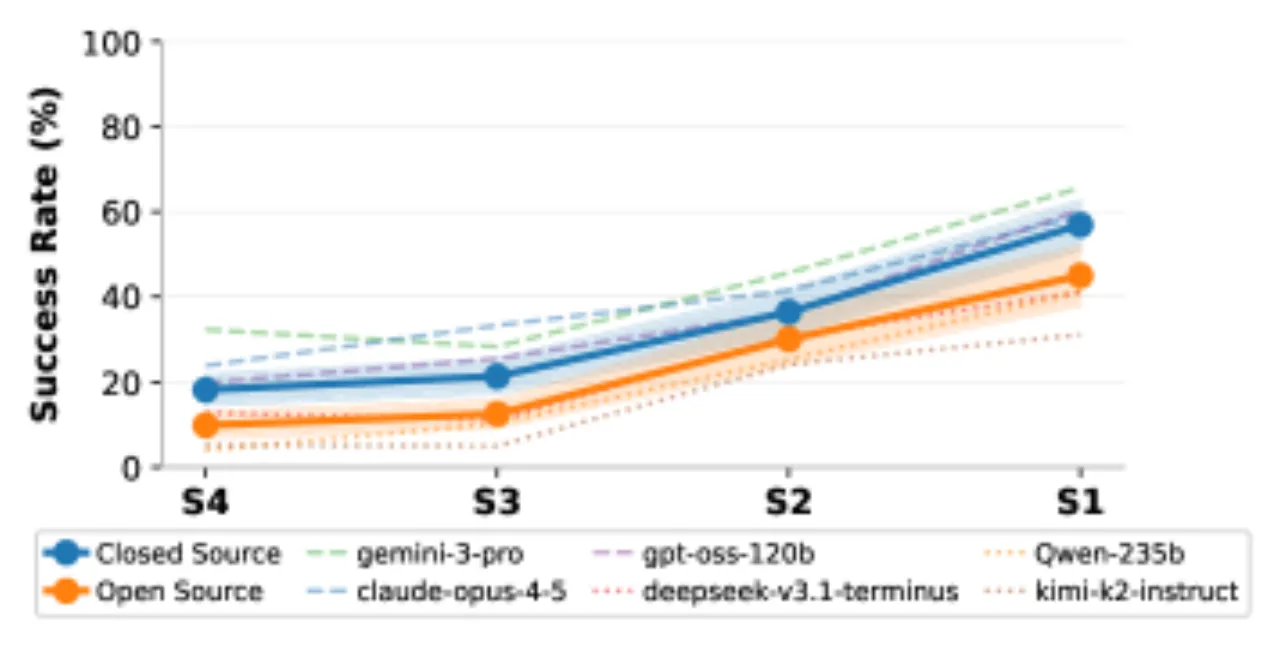
CaP-Bench 系统地在抽象层级与观测模态两个维度评测模型:CaP-Bench systematically evaluates models along two dimensions — abstraction level and observation modality:
CaP-Agent0 包含三个关键设计:CaP-Agent0 rests on three key designs:
CaP-Gym 支持在策略编程智能体上直接进行在线强化学习(RLVR,使用可验证环境奖励)。具体采用 Group Relative Policy Optimization(GRPO)对 Qwen2.5-Coder-7B-Instruct 进行后训练,训练信号直接来自机器人操控环境的任务完成奖励,无需人工标注。CaP-Gym supports online reinforcement learning directly on the policy-coding agent (RLVR, using verifiable environment rewards). Concretely, Group Relative Policy Optimization (GRPO) post-trains Qwen2.5-Coder-7B-Instruct, with the training signal coming straight from task-completion rewards in the robot manipulation environment, requiring no human annotation.
在RoboSuite仿真、LIBERO-PRO 和 BEHAVIOR(移动操控)三个平台上评测,对比 12 个模型与人类专家,并在真实 Franka Emika 机械臂上验证 CaP-RL。Evaluation spans three platforms — RoboSuite simulation, LIBERO-PRO and BEHAVIOR (mobile manipulation) — comparing 12 models against human experts, with CaP-RL further validated on a real Franka Emika arm.
| 基准 / 方法Benchmark / Method | OpenVLA | π₀ | π₀.₅ | CaP-Agent0 |
|---|---|---|---|---|
| libero-object (Pos / Task) | 0.00 / 0.00 | 0.00 / 0.00 | 0.17 / 0.01 | 0.22 / 0.18 |
| libero-goal (Pos / Task) | 0.00 / 0.00 | 0.00 / 0.00 | 0.38 / 0.00 | 0.26 / 0.17 |
| libero-spatial (Pos / Task) | 0.00 / 0.00 | 0.00 / 0.00 | 0.20 / 0.01 | 0.12 / 0.14 |
在 LIBERO-PRO 上,CaP-Agent0 在 Task Success 指标上全面超越 VLA 基线(包括 π₀.₅),无需任何任务专属训练数据。注意 Pos(Position Success)和 Task(Task Success)是不同评测指标,CaP-Agent0 在 Task 层面优势更为明显。On LIBERO-PRO, CaP-Agent0 beats every VLA baseline (including π₀.₅) on Task Success without any task-specific training data. Note that Pos (Position Success) and Task (Task Success) are different metrics; the advantage of CaP-Agent0 is clearer at the Task level.
| 任务Task | Human Expert | Qwen 2.5 Coder 7B(未微调)Qwen 2.5 Coder 7B (no fine-tuning) | Qwen w/ CaP-RL(仿真)Qwen w/ CaP-RL (simulation) | Qwen w/ CaP-RL(真实)Qwen w/ CaP-RL (real) |
|---|---|---|---|---|
| Cube Lift | 93% / 92% | 25% / 24% | 80% | 84% |
| Cube Stack | 73% / 84% | 4% / 12% | 44% | 76% |
| Spill Wipe | 100% / — | 30% / — | 93% | — |
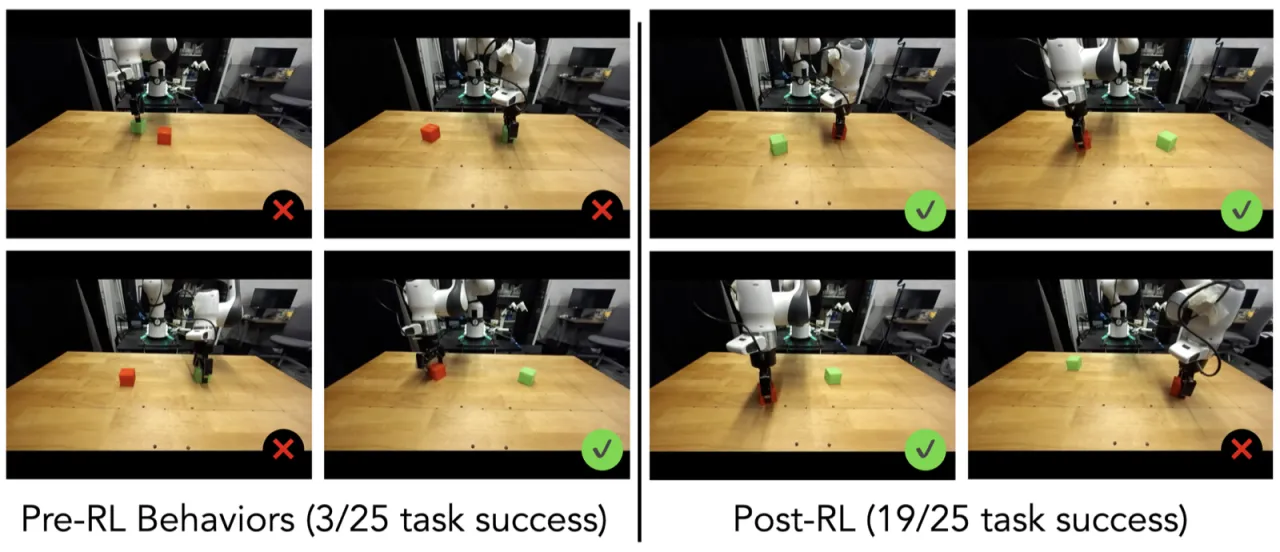
CaP-RL 将 Qwen2.5-Coder-7B 在 Cube Lift 上的仿真成功率从 25% 提升至 80%,在真实机器人上从 24% 提升至 84%;Cube Stack 从 4% 提升至 44%(仿真)和 76%(真实),展现出强泛化能力。CaP-RL lifts the Cube Lift success of Qwen2.5-Coder-7B from 25% to 80% in simulation and from 24% to 84% on the real robot; Cube Stack rises from 4% to 44% (simulation) and 76% (real), showing strong generalization.
| 任务(N=25)Task (N=25) | 指标Metric | Human Expert | S3(单轮低层)S3 (single-turn low-level) | CaP-Agent0 |
|---|---|---|---|---|
| Pick up Radio | Navigation Success | 88% | 72% | 80% |
| Pick up Radio | Task Success | 36% | 24% | 56% |
| Pick up Soda Can | Navigation Success | 80% | 52% | 84% |
| Pick up Soda Can | Task Success | 72% | 32% | 72% |
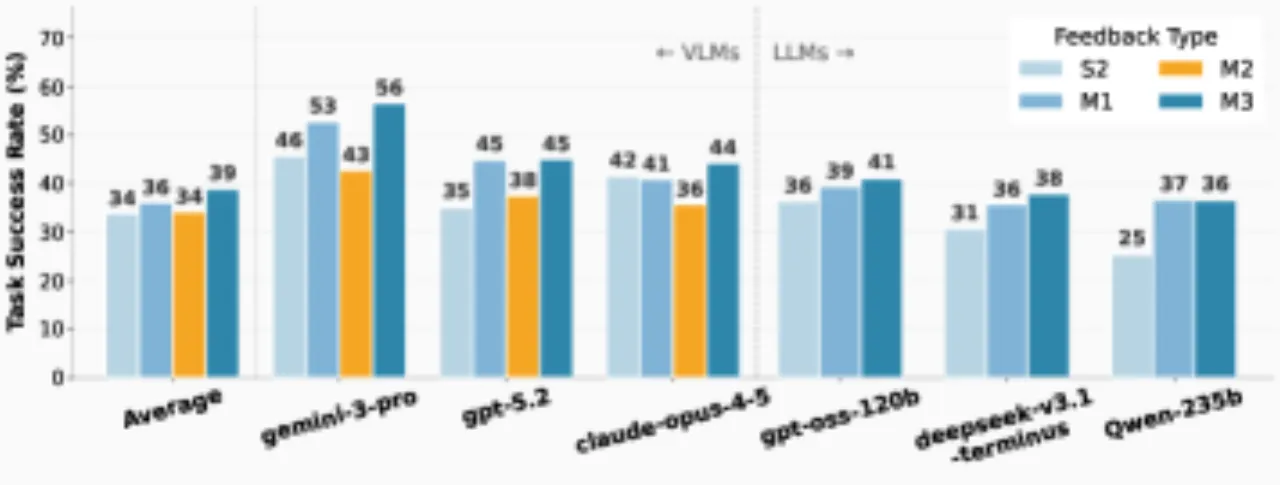
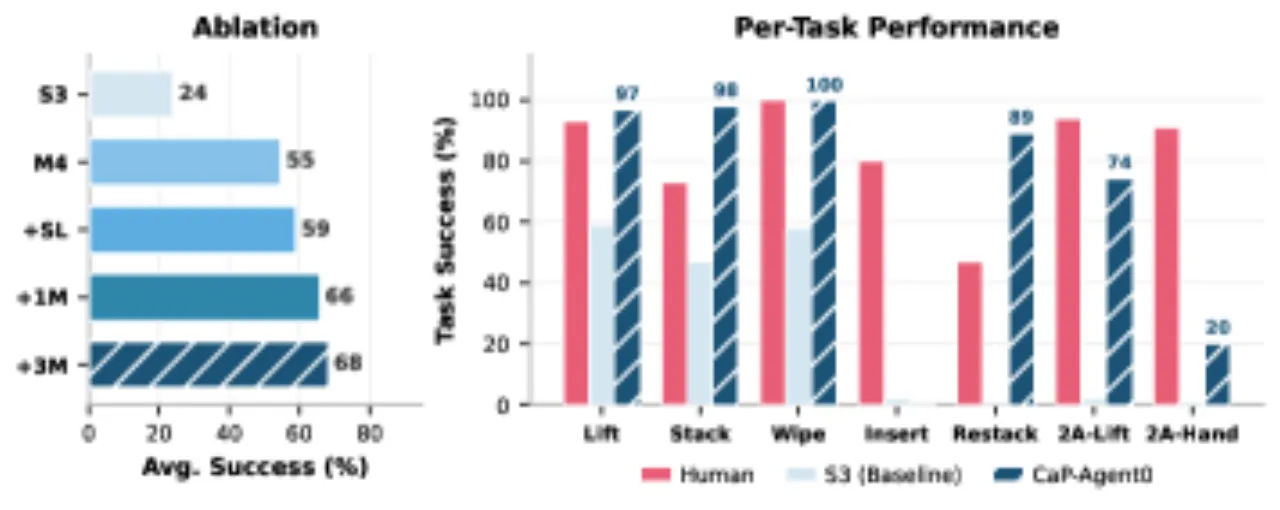
消融实验表明每个组件均有贡献:视觉差分(VDM)→ 技能库(+SL)→ 并行推理(+1M → +3M)逐步提升了任务成功率,其中多模型并行推理的增益最为显著。直接多模态输入(M2)会降低性能,说明视觉信息需经结构化转换(VDM)才能被模型有效利用。The ablations show that every component contributes: visual differencing (VDM) → skill library (+SL) → parallel reasoning (+1M → +3M) progressively raise task success, with multi-model parallel reasoning giving the largest gain. Feeding multimodal input directly (M2) degrades performance, indicating that visual information must be structurally converted (VDM) before models can exploit it.
作者明确指出:"Programmatic control performs well on long-horizon, reasoning-heavy tasks, but remains brittle for contact-rich behaviors that require tight visual servoing and continuous feedback (e.g., insertion or pouring)."——需要精细力控和连续视觉反馈的任务(如插孔、倒水)代码控制仍易失败。The authors state explicitly: "Programmatic control performs well on long-horizon, reasoning-heavy tasks, but remains brittle for contact-rich behaviors that require tight visual servoing and continuous feedback (e.g., insertion or pouring)." — code-driven control still fails easily on tasks that need fine force control and continuous visual feedback (such as peg insertion or pouring).
作者将"more effective grounding of task-relevant visual information into code generation"列为重要改进方向,说明当前视觉感知原语与代码生成之间的衔接仍是性能瓶颈,尤其在低层(S3/S4)和多模态(M2)层级表现明显。The authors list "more effective grounding of task-relevant visual information into code generation" as an important direction, indicating that the link between visual perception primitives and code generation remains a bottleneck, most visibly at the low-level (S3/S4) and multimodal (M2) tiers.
CaP-Agent0 的并行推理(最多3个前沿模型、每模型3次查询)虽然无需训练,但在每次执行时需调用多次昂贵的大模型API,测试时计算成本较高,可能限制其在资源受限场景中的实际部署。The parallel reasoning of CaP-Agent0 (up to 3 frontier models, 3 queries each) needs no training, but every execution issues many expensive large-model API calls, so test-time compute cost is high and may limit practical deployment in resource-constrained settings.
CaP-RL 目前仅在有限任务(Cube Lift、Cube Stack、Spill Wipe)上验证,且基座模型为 Qwen2.5-Coder-7B-Instruct(7B参数)。对更复杂任务或更大规模基座的扩展性尚未充分探索。CaP-RL has so far been validated only on a limited set of tasks (Cube Lift, Cube Stack, Spill Wipe), with Qwen2.5-Coder-7B-Instruct (7B parameters) as the base model. Scaling to more complex tasks or larger base models remains underexplored.