Learning to Act from Actionless Videos through Dense Correspondences
从无动作标签视频中学习机器人策略,通过稠密对应关系推导闭合形式动作Learning robot policies from actionless videos by deriving closed-form actions through dense correspondences
Po-Chen Ko · Jiayuan Mao · Yilun Du · Shao-Hua Sun · Joshua B. Tenenbaum | National Taiwan University & MIT CSAIL
本文提出 AVDC(Actions from Video Dense Correspondences):一种无需动作标注即可从 RGB 视频中学习机器人操控与导航策略的框架。系统利用视频扩散模型生成"想象执行"视频,再通过相邻帧间的稠密光流对应关系以闭合形式解算 SE(3) 变换,从而在无环境交互的情况下实现跨机器人平台的策略迁移。This paper presents AVDC (Actions from Video Dense Correspondences): a framework that learns robot manipulation and navigation policies from RGB videos without any action annotation. The system uses a video diffusion model to synthesize an "imagined execution" video, and then solves SE(3) transformations in closed form from the dense optical-flow correspondences between adjacent frames, thereby transferring policies across robot platforms without any environment interaction.
arXiv · Oct 2023操控 + 导航 · 3 平台Manipulation + navigation · 3 platforms4 GPUs · 1 天训练4 GPUs · 1 day of training📄 arXiv:2310.08576🌐 Project Page
actionless videodense correspondencesoptical flowvideo diffusionrobot manipulationSE(3) 变换SE(3) transformation无标签视频学习Actionless video learning跨实体迁移Cross-embodiment transfer
01动机 MotivationMotivation
机器人策略训练面临两大核心困难:其一,收集带动作标注的演示数据成本极高,且高度依赖特定平台;其二,仿真与真实环境的 sim-to-real gap 使得策略难以直接部署。互联网上已存在海量 RGB 视频,如果能直接从这些无动作标签的视频中学习策略,将大幅降低数据采集门槛并提升泛化能力。Training robot policies faces two core difficulties. First, collecting demonstration data with action annotations is extremely costly and highly platform-specific; second, the sim-to-real gap between simulation and the real world makes policies hard to deploy directly. Massive amounts of RGB video already exist on the internet, and being able to learn policies directly from such actionless videos would greatly lower the barrier to data collection and improve generalization.
"We present a method for training a robot policy capable of reliably executing diverse tasks across different robots and environments from RGB video demonstrations without any action annotation."
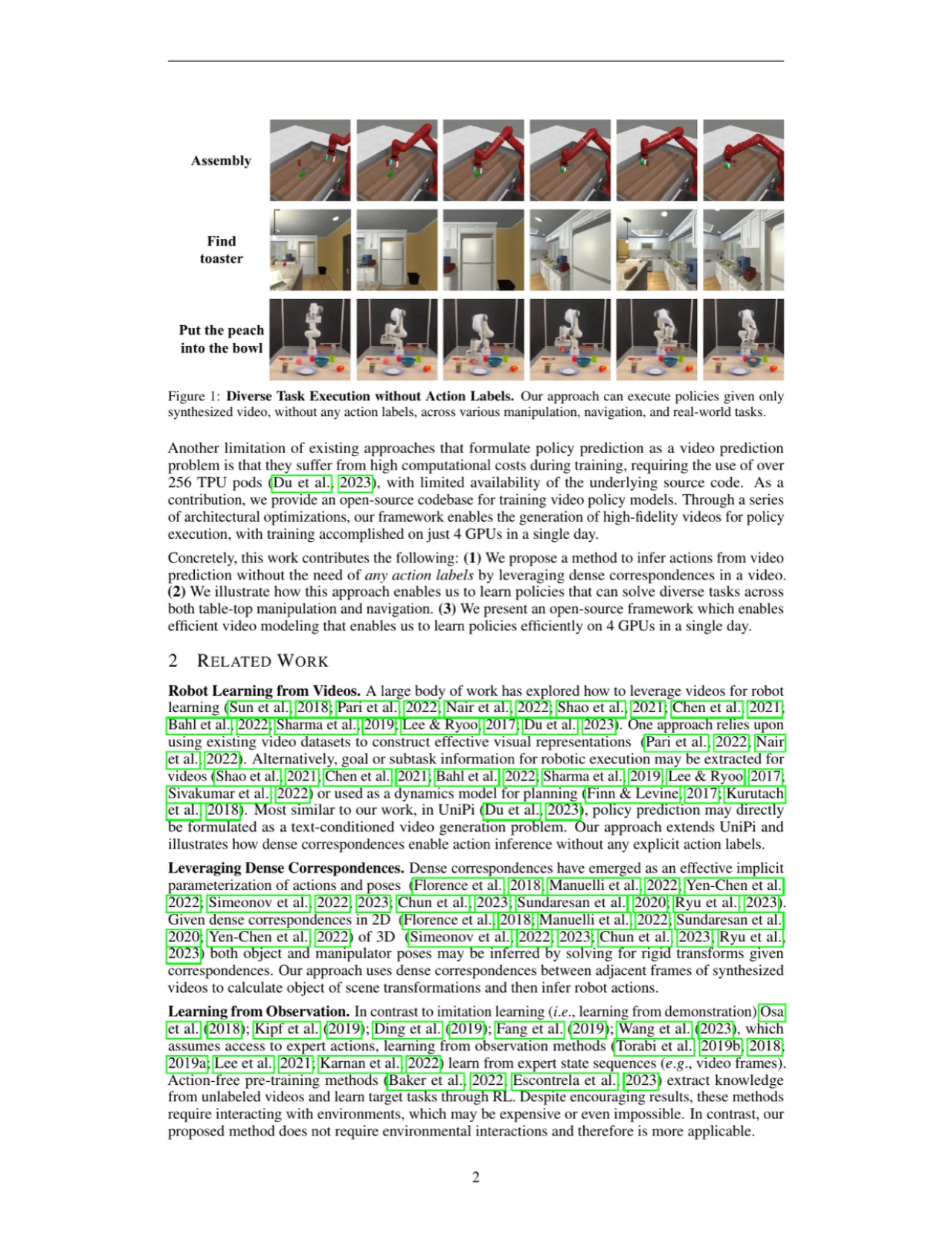
图 1:AVDC 的多任务执行演示。系统仅凭合成视频(无动作标签)即可控制机器人完成 Assembly(装配)、Find toaster(寻找烤面包机)、Put the peach into the bowl(抓放桃子)等多种操控与导航任务,跨越不同机器人与环境。Figure 1: Multi-task execution demo of AVDC. Using only synthesized videos (without action labels), the system controls robots to complete a variety of manipulation and navigation tasks such as Assembly, Find toaster and Put the peach into the bowl, across different robots and environments.
165Meta-World 训练视频数(11 任务)Meta-World training videos (11 tasks)
240iTHOR 训练视频数(12 类目标)iTHOR training videos (12 object categories)
4训练所用 GPU 数量,1 天完成GPUs used for training, done in 1 day
10DDIM 推理步数(替代标准 100 步)DDIM inference steps (replacing the standard 100)
先前方法的局限性主要体现在两方面:
(1)基于逆动力学模型的方法(如 UniPi)需要知道精确步数,且通常以模态方式预测动作,训练开销大(需超过 256 TPU-pods);
(2)行为克隆(BC)类方法依赖专家动作标注,无法直接利用互联网视频资源。
AVDC 的核心洞见是:图像本身即可同时编码状态与动作信息——相邻帧之间的稠密光流对应关系天然蕴含了物体运动轨迹,可以以闭合形式解算 SE(3) 变换,无需学习任何额外动作预测器。The limitations of prior methods lie mainly in two respects: (1) Inverse-dynamics-model based methods (such as UniPi) need to know the exact number of steps, usually predict actions in a modal fashion, and are expensive to train (more than 256 TPU-pods required); (2) Behavior cloning (BC) methods rely on expert action annotations and cannot directly exploit internet video resources. The key insight of AVDC is that images themselves already encode both state and action information — the dense optical-flow correspondences between adjacent frames naturally carry object motion trajectories, from which the SE(3) transformation can be solved in closed form, without learning any extra action predictor.
02方法 MethodMethod
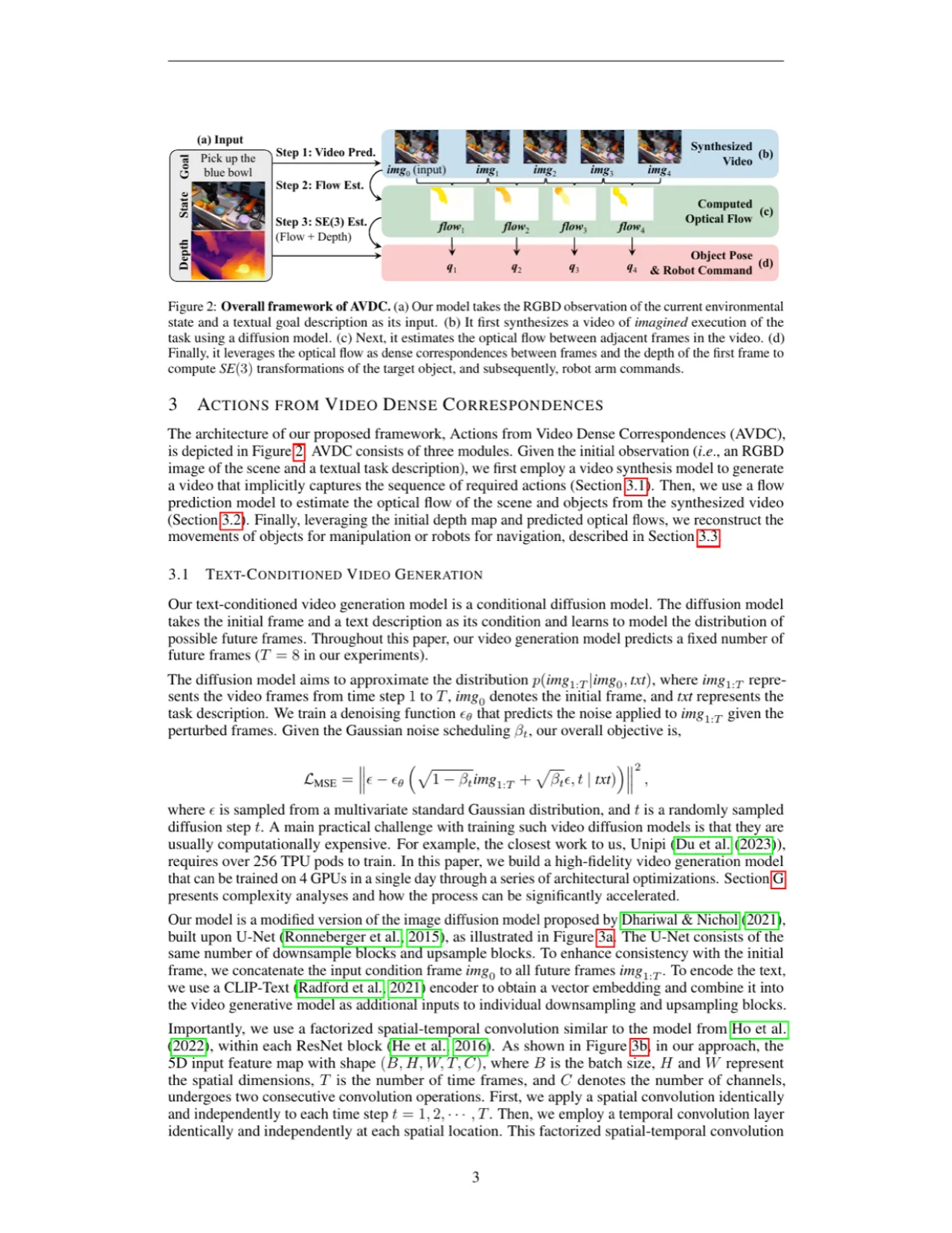
AVDC 将策略执行解耦为三个阶段:(a)条件视频生成——用扩散模型合成从当前状态到目标的想象执行视频;(b)稠密光流估计——计算相邻帧的稠密对应关系;(c)动作回归——结合深度信息,以闭合形式将光流对应关系转化为 SE(3) 刚体变换,指导机器人执行。AVDC decouples policy execution into three stages: (a) conditioned video generation — a diffusion model synthesizes an imagined execution video from the current state to the goal; (b) dense optical flow estimation — dense correspondences between adjacent frames are computed; (c) action regression — combined with depth information, the flow correspondences are turned in closed form into SE(3) rigid transformations that drive the robot.
图 2:AVDC 整体框架概览。输入为 RGBD 观测和文本目标描述;扩散模型生成未来帧序列;光流模块估计稠密对应关系;最终结合深度图计算 SE(3) 变换并驱动机器人执行,同时循环替换(replanning)以处理执行误差。Figure 2: Overview of the AVDC framework. The inputs are an RGBD observation and a text goal description; the diffusion model generates a sequence of future frames; the flow module estimates dense correspondences; finally, together with the depth map, the SE(3) transformation is computed and drives the robot, with replanning in a loop to handle execution error.
条件视频生成(Conditioned Video Generation)Conditioned Video Generation
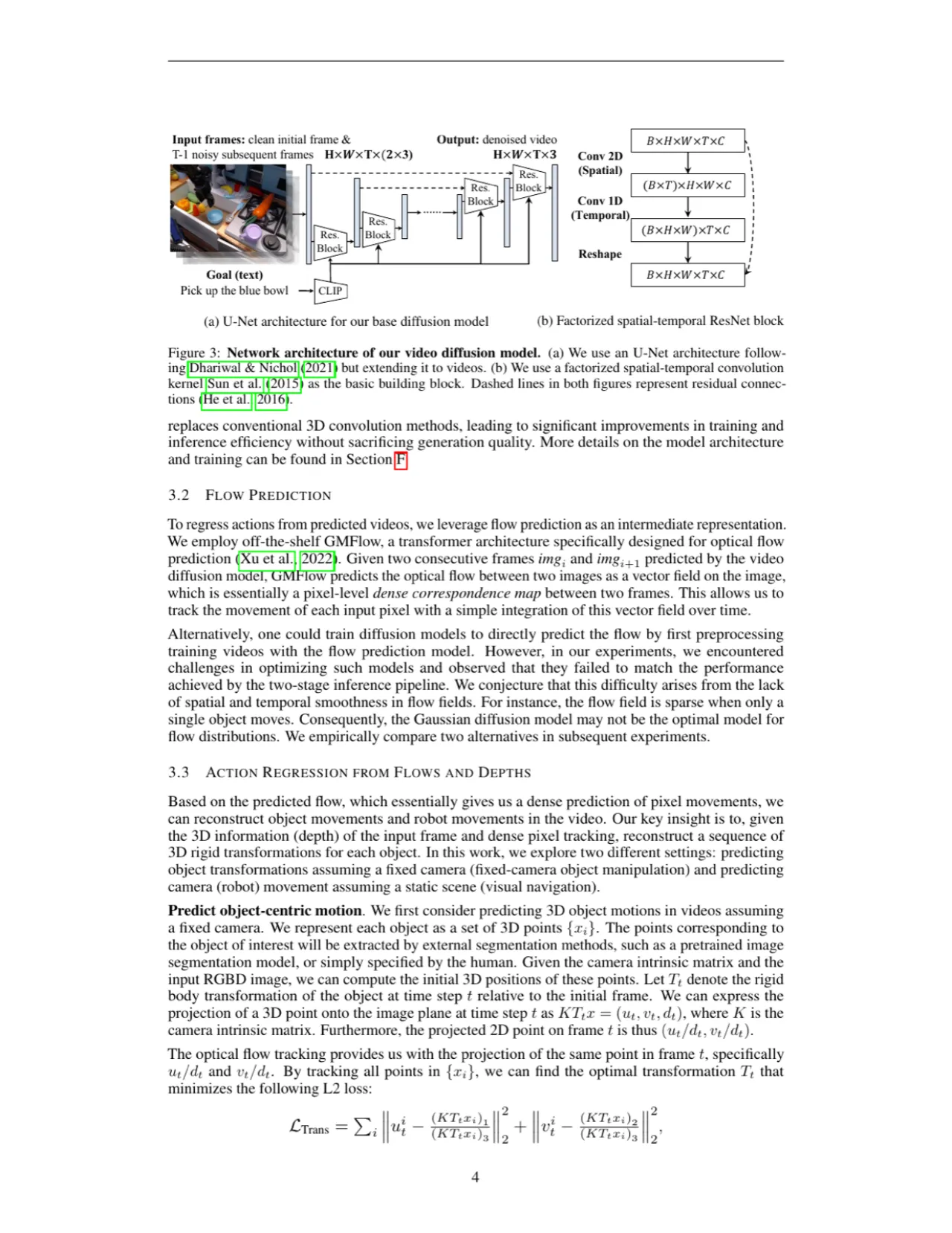
本文使用以 U-Net(基于 Ho et al. 2019)为骨干的条件扩散模型,输入当前帧 f0 和文本目标描述,预测未来 F 帧序列。为提升时间一致性,在空间注意力中引入factorized spatial-temporal convolution(参考 Ho et al. 2022),使每帧在自身空间范围内同时与时间维度交互。推理时采用 DDIM 加速,仅需 10 步即可生成高保真视频(标准需 100 步)。The paper uses a conditional diffusion model with a U-Net backbone (based on Ho et al. 2019), taking the current frame f0 and a text goal description as input and predicting a sequence of F future frames. To improve temporal consistency, factorized spatial-temporal convolution (following Ho et al. 2022) is introduced into the spatial attention, so that each frame interacts with the temporal dimension within its own spatial extent. At inference, DDIM acceleration yields high-fidelity videos in only 10 steps (the standard setting needs 100).
图 3:(左)以 U-Net 为基础的视频扩散模型网络架构,集成空间-时间卷积;(右)时空分离卷积(Factorized Spatial-Temporal ConvBlock)结构,两路卷积分别处理空间特征和时间序列特征后加权融合。Figure 3: (Left) network architecture of the U-Net based video diffusion model, integrating spatial-temporal convolution; (Right) the Factorized Spatial-Temporal ConvBlock, whose two convolution paths process spatial features and temporal-sequence features separately before a weighted fusion.
光流预测(Flow Prediction)Flow Prediction
给定合成视频中相邻帧对 (imgt, imgt+1),利用 off-the-shelf 光流估计器(如 RAFT)提取稠密对应关系。每个像素的光流向量编码了该点在下一时刻的位移,从而构成从当前帧到下一帧的稠密像素级映射。Given a pair of adjacent frames (imgt, imgt+1) from the synthesized video, an off-the-shelf optical flow estimator (such as RAFT) extracts dense correspondences. The flow vector of each pixel encodes the displacement of that point at the next time step, thus forming a dense pixel-level mapping from the current frame to the next one.
动作回归:从光流到 SE(3)(Action Regression from Flows and Depths)Action Regression from Flows and Depths
这是 AVDC 的核心创新。给定深度图和稠密光流,可以将每个 3D 点的对应关系 (xt, x̂t+1) 提取出来,从而以闭合形式(closed-form)求解刚体变换 T = (R, t) ∈ SE(3),最小化如下目标:This is the core innovation of AVDC. Given the depth map and the dense optical flow, the correspondence (xt, x̂t+1) of every 3D point can be extracted, so that the rigid transformation T = (R, t) ∈ SE(3) is solved in closed form by minimizing the following objective:
minR∈SO(3), t∈ℝ³ Σi ‖R·xt,i + t − x̂t+1,i‖²
对于操控任务(manipulation),系统先识别目标对象掩码,再仅在对象区域内计算变换,得到末端执行器的 pick-and-place 轨迹。对于导航任务(navigation),全帧光流被用来估计相机(即机器人底盘)的运动。整个动作推导无需学习任何参数,完全依赖几何约束,因此具有强大的跨平台迁移能力。For manipulation tasks, the system first identifies the mask of the target object and then computes the transformation only within the object region, obtaining the pick-and-place trajectory of the end effector. For navigation tasks, the full-frame optical flow is used to estimate the motion of the camera, i.e. of the robot base. The entire action derivation learns no parameters at all and depends purely on geometric constraints, which gives it strong cross-platform transferability.
Replanning 策略Replanning Strategy
在执行过程中,机器人每完成一个子目标后,以新的当前观测作为条件重新运行视频生成和动作回归流程(replanning),以应对执行误差或环境变化。实验表明随着 replanning 次数增加,任务成功率单调上升(图 5)。During execution, after the robot completes each subgoal it re-runs the video generation and action regression pipeline conditioned on the new current observation (replanning), so as to cope with execution error or environment change. Experiments show that the task success rate increases monotonically with the number of replanning rounds (Figure 5).
03实验 ExperimentsExperiments
在三大基准上验证 AVDC:Meta-World(桌面操控仿真,11 任务,165 视频)、iTHOR(室内导航仿真,12 类目标,240 视频)、Bridge / Franka Panda(真实机器人,zero-shot 迁移)。基线包括行为克隆(BC-Scratch、BC-R3M)、UniPi 及 AVDC 各变体。AVDC is validated on three benchmarks: Meta-World (tabletop manipulation simulation, 11 tasks, 165 videos), iTHOR (indoor navigation simulation, 12 object categories, 240 videos) and Bridge / Franka Panda (real robots, zero-shot transfer). Baselines include behavior cloning (BC-Scratch, BC-R3M), UniPi and the AVDC variants.
Meta-World 操控结果Meta-World Manipulation Results
方法Method
faucet-close
handle-pull
button-top
bin-picking
Overall
BC-Scratch
1.3%
0.0%
0.0%
0.0%
低Low
BC-R3M
4.0%
0.0%
0.0%
0.0%
低Low
UniPi
21.3%
6.7%
14.7%
0.0%
—
AVDC (Flow)
—
—
—
—
中Medium
AVDC (Full)
—
—
—
—
最优Best
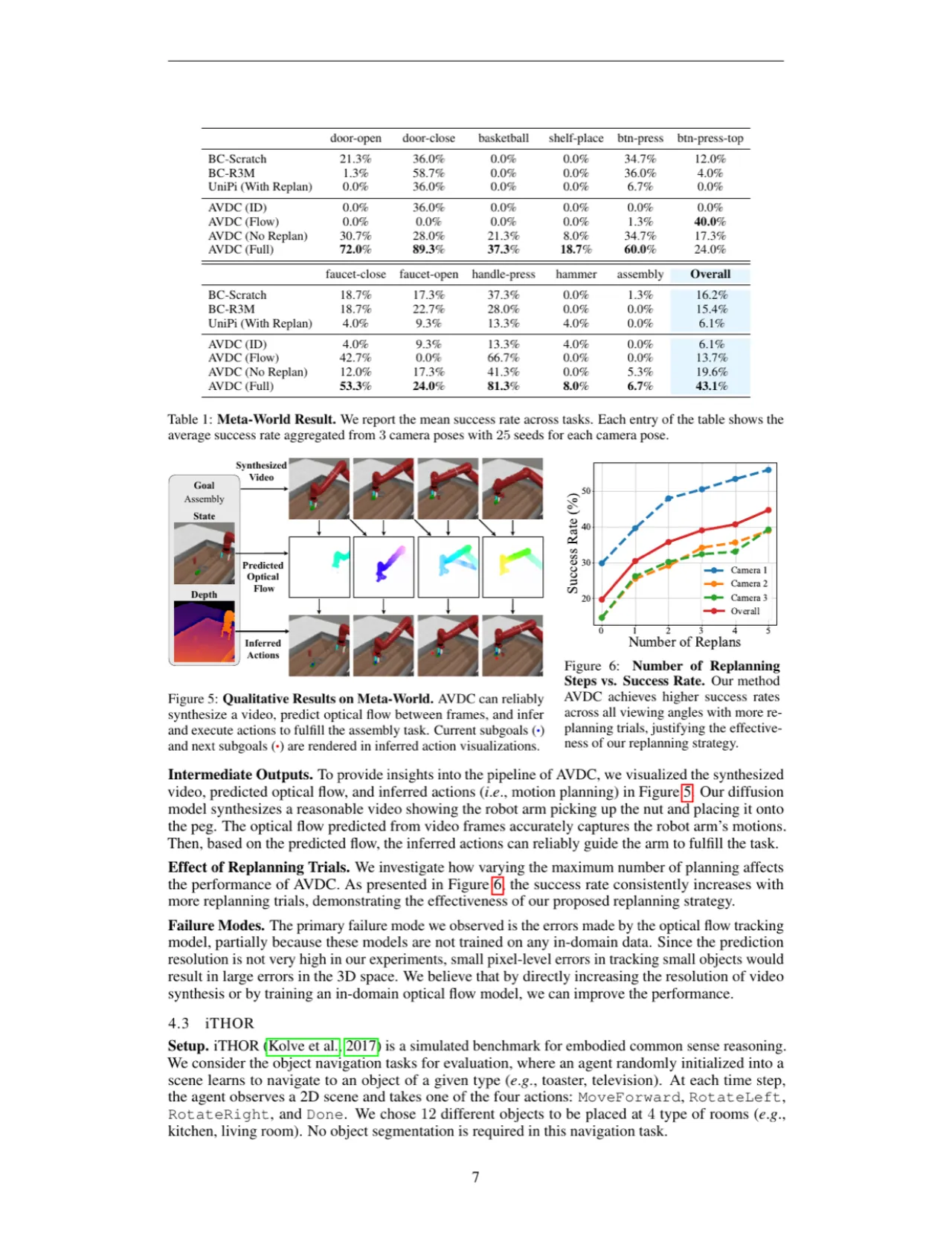
图 5(上):Meta-World 11 任务的平均成功率(每任务 3 个摄像机视角各 25 次试验)。AVDC (Full) 大幅超越所有基线,包括 BC-Scratch、BC-R3M 和 UniPi。(下)replanning 次数对任务成功率的影响——随次数增加,成功率单调提升,验证了闭环重规划策略的有效性。Figure 5 (top): average success rate over the 11 Meta-World tasks (25 trials for each of 3 camera views per task). AVDC (Full) surpasses all baselines by a large margin, including BC-Scratch, BC-R3M and UniPi. (bottom) Effect of the number of replanning rounds on task success rate — the success rate rises monotonically with more rounds, confirming the effectiveness of the closed-loop replanning strategy.
iTHOR 导航结果iTHOR Navigation Results
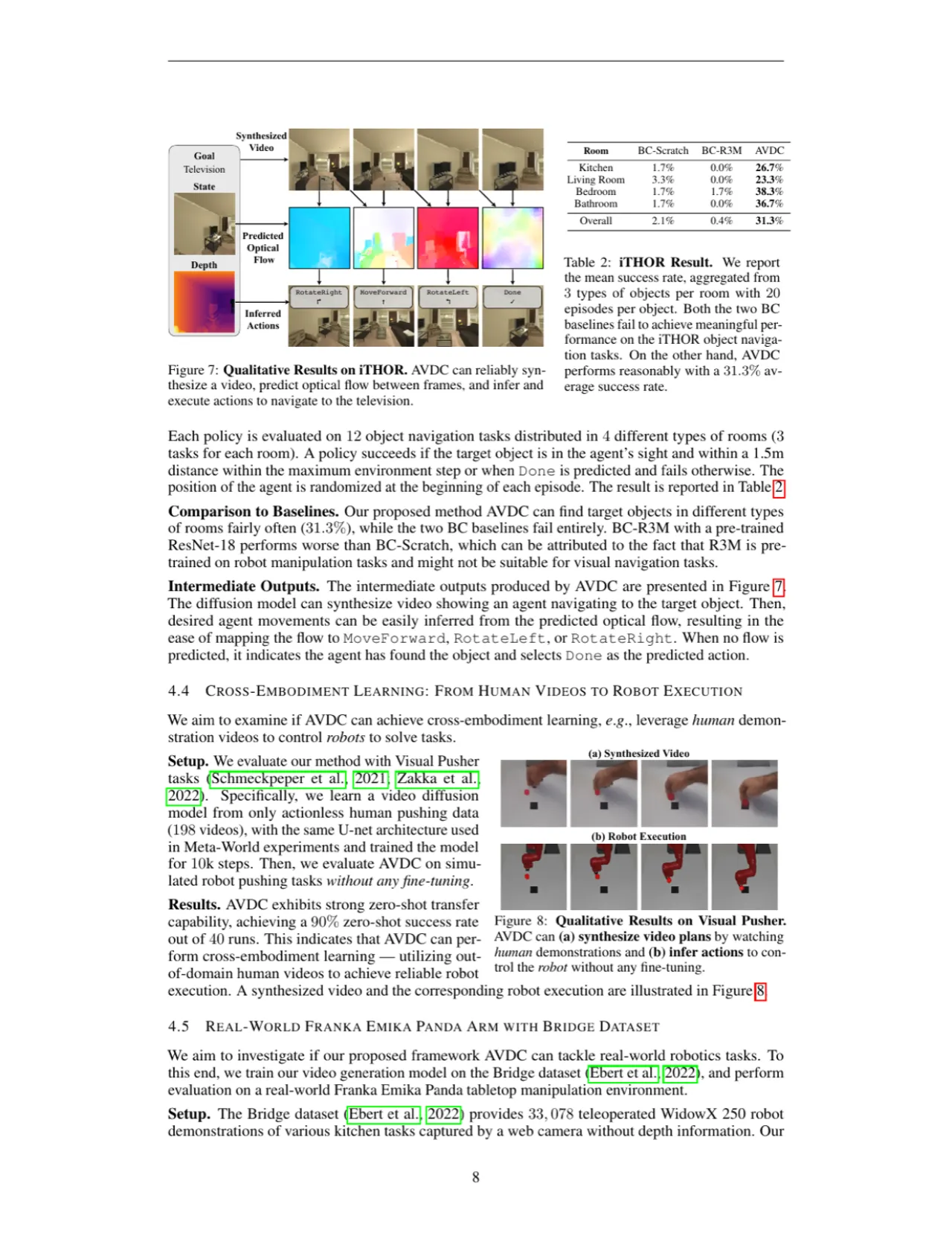
在 iTHOR 室内导航基准上,AVDC 在 12 类目标物体上均表现出合理的导航成功率。系统以当前 RGBD 帧和目标对象名称为输入,在合成视频中追踪全帧光流以估算摄像机运动,并循环执行 replanning 直到到达目标区域。On the iTHOR indoor navigation benchmark, AVDC attains reasonable navigation success rates on all 12 categories of target objects. Taking the current RGBD frame and the name of the target object as input, the system tracks the full-frame optical flow in the synthesized video to estimate camera motion, and keeps replanning in a loop until it reaches the target region.
图 7:iTHOR 定性结果(左):AVDC 可可靠地推断当前观测及子目标的光流,进而执行正确的导航动作。图 8(右):Visual Pusher 上的定性结果,AVDC 生成的光流准确反映了推动对象所需的末端执行器轨迹。Figure 7: iTHOR qualitative results (left): AVDC reliably infers the optical flow between the current observation and the subgoal, and thus executes the correct navigation action. Figure 8 (right): qualitative results on Visual Pusher, where the optical flow generated by AVDC accurately reflects the end-effector trajectory required to push the object.
在此实验中,AVDC 模型在包含 ~200 段人类手部推物视频的 Bridge 数据集上训练,然后零样本迁移到 Franka Emika Panda 机械臂。由于系统在动作推导上完全依赖几何对应关系而非具体动作标注,因此无需任何域适应即可直接部署。定性实验表明机械臂可以可靠跟随合成视频中的物体运动轨迹(图 9-10)。In this experiment the AVDC model is trained on the Bridge dataset, which contains ~200 videos of a human hand pushing objects, and is then transferred zero-shot to a Franka Emika Panda arm. Because the action derivation depends entirely on geometric correspondences rather than on concrete action annotations, it can be deployed directly without any domain adaptation. Qualitative experiments show that the arm reliably follows the object motion trajectories in the synthesized video (Figures 9-10).
消融实验(Ablations)Ablations
AVDC (Flow):仅用光流预测动作,无 replanning——在 faucet-close 等简单任务表现尚可,但在需要精确接触的任务上(如 button-top)明显下降。AVDC (Flow): actions predicted from optical flow only, without replanning — acceptable on simple tasks such as faucet-close, but a clear drop on tasks that require precise contact (such as button-top).
AVDC (No Replan):完整管线但不做 replanning——验证单次规划的上限,成功率明显低于 Full 版。AVDC (No Replan): the full pipeline but without replanning — it probes the ceiling of single-shot planning, and its success rate is clearly below that of the Full version.
AVDC (Full):完整两阶段(生成+重规划)管线,性能最优,在 Meta-World 上大幅超过 BC 和 UniPi 基线。AVDC (Full): the complete two-stage (generation + replanning) pipeline, the best performing variant, far exceeding the BC and UniPi baselines on Meta-World.
Replanning 次数分析(图 5 右图):成功率随次数增加单调上升,在约 10 次后趋于饱和。Analysis of the number of replanning rounds (Figure 5, right): the success rate rises monotonically with more rounds and saturates after about 10.
04局限性 LimitationsLimitations
说明:以下局限性由论文作者在 Discussion 节明确陈述(stated)。Note: The limitations below are explicitly stated by the authors of the paper in the Discussion section.
物体遮挡导致光流跟踪失败Occlusion makes optical flow tracking fail
当目标对象被机械臂自身或其他物体遮挡时,系统可能丢失对象的光流追踪,进而导致动作计算错误。论文指出:"it may lose track of objects when they are occluded by the robot arm."When the target object is occluded by the robot arm itself or by other objects, the system may lose the flow track of the object, which leads to erroneous action computation. The paper notes: "it may lose track of objects when they are occluded by the robot arm."
光流预测中的大物体运动困难Large object motion is hard for flow prediction
对于位移较大的物体或背景,光流预测精度下降,实际机器人执行时的 3D 变换解算误差会随之增大。论文提到 "the model can struggle in optical flow prediction under rapidly changing lighting conditions or large object movements in object poses."For objects or backgrounds with large displacements, the accuracy of flow prediction degrades, and the error of the 3D transformation solved during real robot execution grows accordingly. The paper mentions that "the model can struggle in optical flow prediction under rapidly changing lighting conditions or large object movements in object poses."
抓取动作规划依赖外部分割与接触点估计Grasp planning relies on external segmentation and contact-point estimation
当前实现中,对象掩码来自外部分割模型,抓取方向依赖预定义规则(top-grasp),尚不支持任意姿态抓取。集成更通用的操控模块(如抓取姿态预测、力传感器)是未来工作方向。论文指出集成 "various manipulation primitives such as grasp prediction modules (Sundermeyer et al., 2021) is important."In the current implementation the object mask comes from an external segmentation model and the grasping direction follows a predefined rule (top-grasp), so grasping at an arbitrary pose is not yet supported. Integrating more general manipulation modules, such as grasp pose prediction or force sensors, is a direction for future work. The paper notes that integrating "various manipulation primitives such as grasp prediction modules (Sundermeyer et al., 2021) is important."
视频生成质量限制了动作精度上限Video generation quality caps the accuracy of the actions
动作推导完全依赖合成视频的质量。若扩散模型生成的视频出现时间不一致或物理不合理的帧,下游光流估计和动作计算的质量也会受损。这是视频预测管线的固有局限,独立于动作回归模块。(inferred from the design)The action derivation depends entirely on the quality of the synthesized video. If the frames produced by the diffusion model are temporally inconsistent or physically implausible, the quality of the downstream flow estimation and action computation suffers as well. This is an inherent limitation of the video prediction pipeline, independent of the action regression module. (inferred from the design)