ATE 是一个即插即用的 VLA 适配框架:首先利用非对称 VAE 将不同机器人平台的动作空间对齐到统一隐空间,再通过 classifier guidance 将扩散/流式 VLA 的生成过程导向目标分布,从而以极少数据实现跨任务与跨机器人的高效迁移。在仿真 RoboTwin 与 ManiSkill 基准上平均提升 9.8%,在真实双臂 RealMan 机器人跨机器人场景中提升 32% 成功率。ATE is a plug-and-play adaptation framework for VLA models: it first uses asymmetric VAEs to align the action spaces of different robot platforms into a unified latent space, then applies classifier guidance to steer the generation process of diffusion / flow-based VLAs toward the target distribution, achieving data-efficient cross-task and cross-embodiment transfer with very little data. It brings an average gain of 9.8% on the RoboTwin and ManiSkill simulation benchmarks, and a 32% success-rate gain in the real-world cross-embodiment setting on a dual-arm RealMan robot.
大规模预训练的 Vision-Language-Action(VLA)模型在通用机器人控制上展现出巨大潜力,但将其适配到新机器人平台或新任务时面临两大核心挑战:动作空间异构(不同机器人的 DoF、动作量纲、频率均不同)与数据稀缺(现实中目标任务数据往往只有数十条轨迹)。直接在目标任务上 fine-tune 往往导致灾难性遗忘,丢失预训练阶段习得的视觉-运动先验。Large-scale pre-trained Vision-Language-Action (VLA) models show great promise for general-purpose robot control, yet adapting them to a new robot platform or a new task faces two core challenges: heterogeneous action spaces (robots differ in DoF, action scale and control frequency) and data scarcity (in practice the target task often provides only a few dozen trajectories). Fine-tuning directly on the target task tends to cause catastrophic forgetting, destroying the visual-motor priors acquired during pre-training.
"Unlike prior methods that directly fine-tune VLAs, ATE aligns disparate action spaces into a unified latent representation and steers the VLA's generation via guidance, enabling data-efficient cross-task and cross-embodiment adaptation."
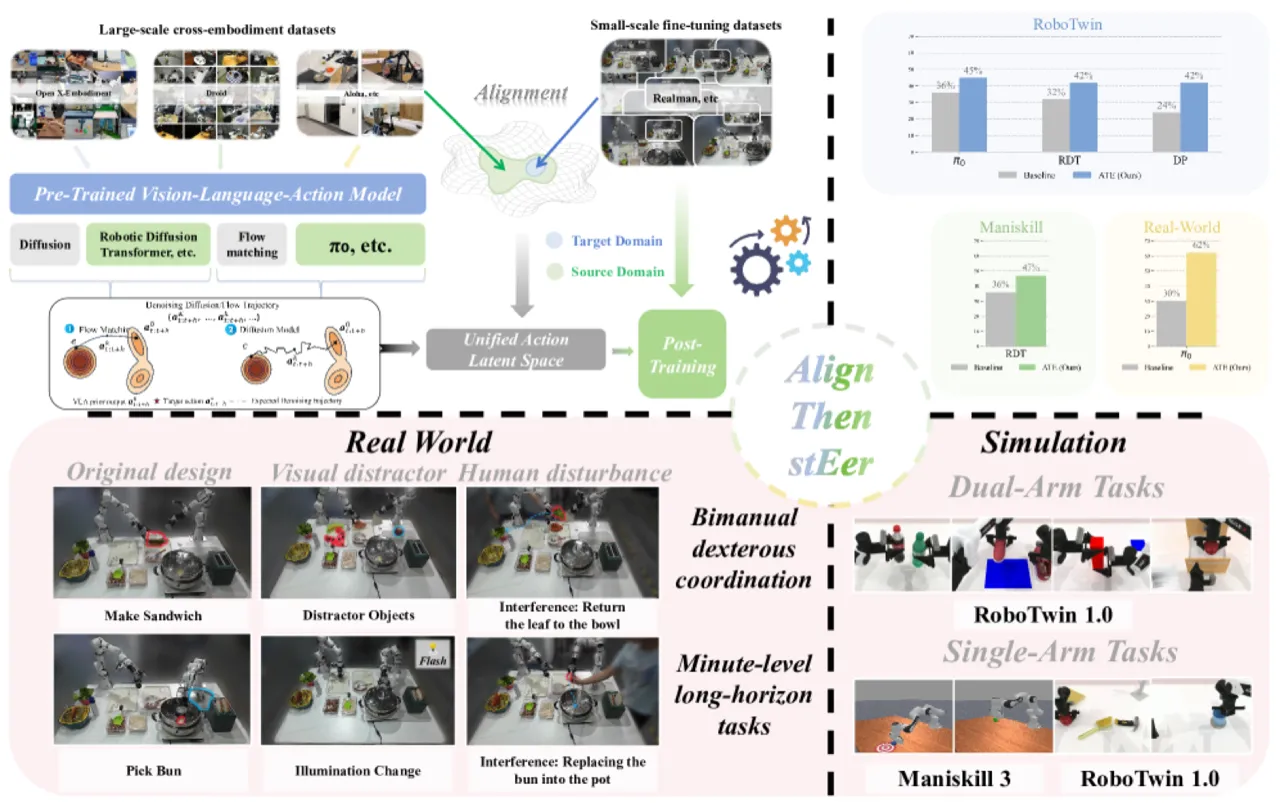
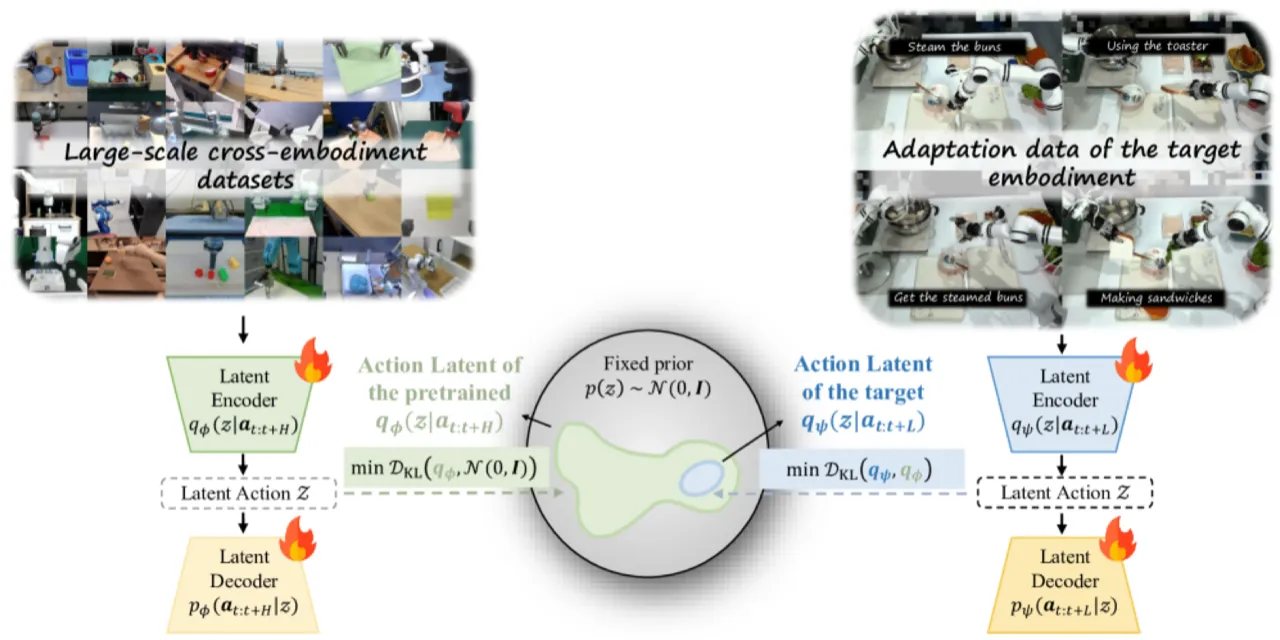
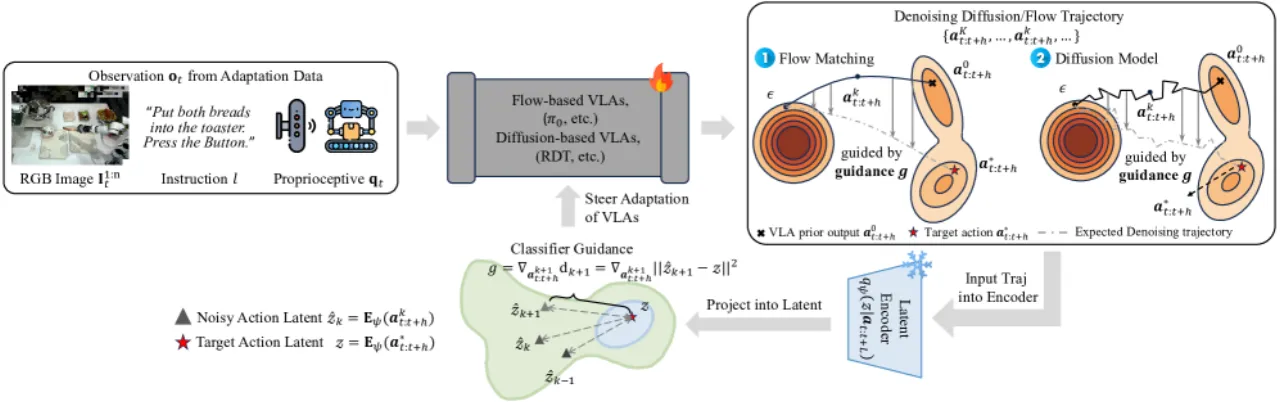
ATE 分两个阶段:Stage 1 利用非对称 VAE(Info-VAE)将预训练阶段与适配阶段的动作空间统一到同一隐空间;Stage 2 在 fine-tuning 时引入 classifier guidance,将扩散/流式 VLA 的去噪过程向目标隐空间的 mode 导引,同时保留预训练积累的视觉-运动先验。整个额外计算量仅来自两个轻量 VAE,对原始 VLA 架构零改动。ATE has two stages. Stage 1 uses asymmetric VAEs (Info-VAE) to unify the action spaces of the pre-training phase and the adaptation phase into a single latent space; Stage 2 injects classifier guidance during fine-tuning, steering the denoising process of diffusion / flow-based VLAs toward the mode of the target latent space while preserving the visual-motor priors accumulated in pre-training. All extra computation comes from the two lightweight VAEs alone, with zero change to the original VLA architecture.
第一阶段的关键设计在于使用反向 KL 散度(reverse KL)约束适配 VAE,令其具有 mode-seeking 行为。这确保适配动作的隐表示落在预训练隐空间的高密度区域,而非分散到各处,从而保证下游引导信号的有效性。两个 VAE 均为轻量结构,训练成本远低于 VLA 本身。The key design of the first stage is to constrain the adaptation VAE with a reverse KL divergence (reverse KL), giving it mode-seeking behaviour. This ensures the latent representations of the adaptation actions land in high-density regions of the pre-training latent space instead of scattering everywhere, which keeps the downstream guidance signal effective. Both VAEs are lightweight, and their training cost is far below that of the VLA itself.
在推理阶段,classifier guidance 梯度 g 无需目标动作标注(标注仅用于训练 VAE),因此推理过程与标准 VLA 相同,无额外延迟。这一设计对 diffusion policy 与 flow matching 两类生成框架均适用,与 backbone 选择无关。At inference time the classifier-guidance gradient g needs no target-action annotation (annotations are used only to train the VAE), so inference behaves exactly like a standard VLA with no added latency. The design applies to both diffusion policy and flow matching generative frameworks and is independent of the backbone choice.
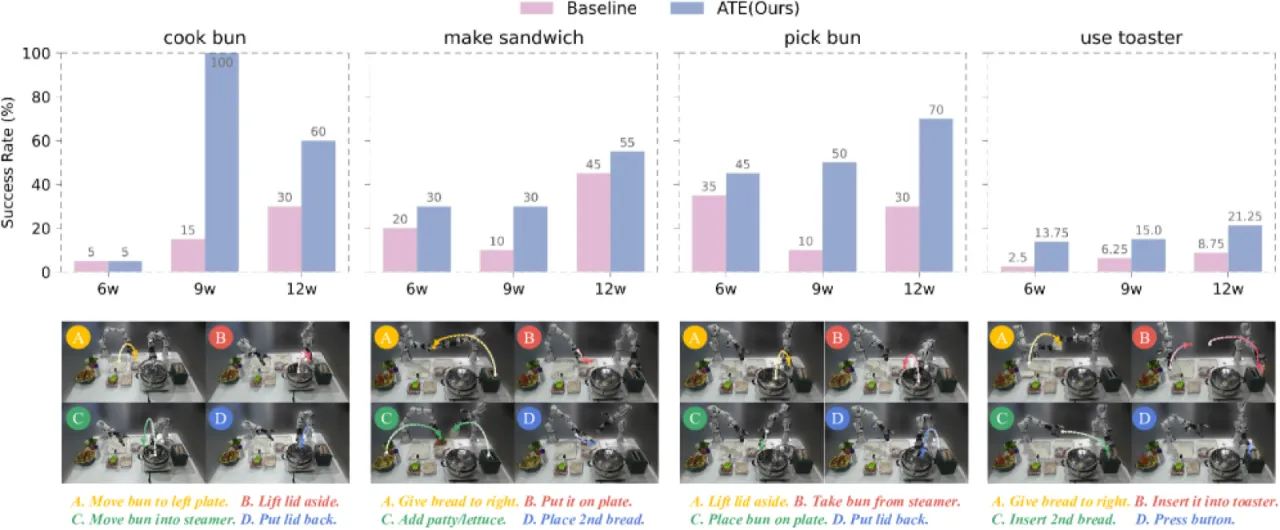
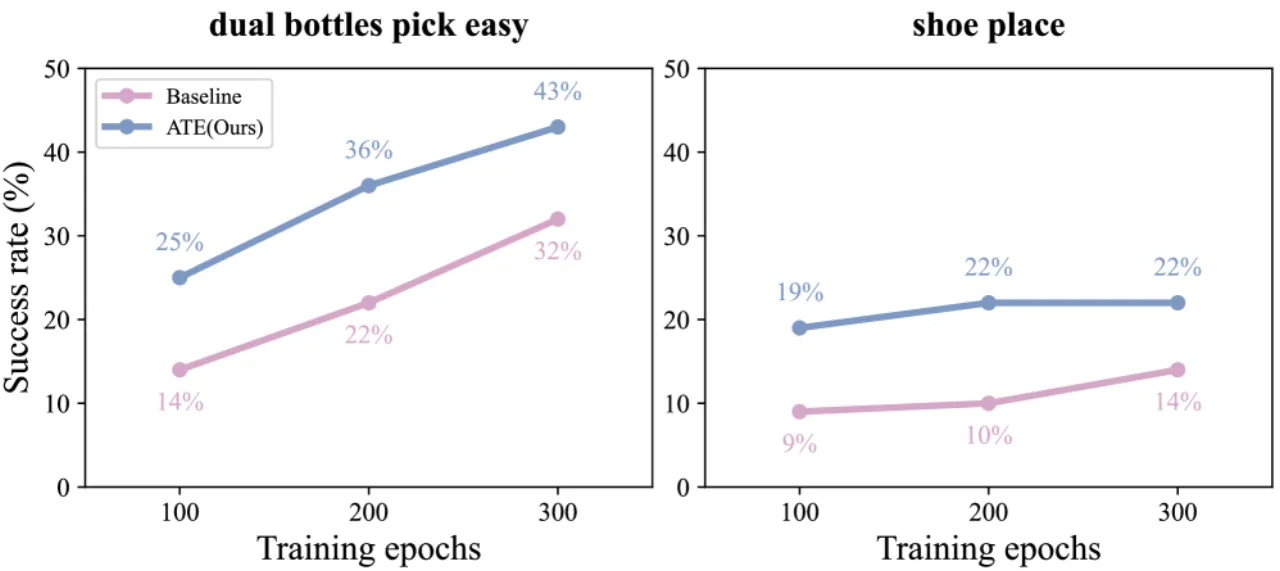
实验在三个层面验证 ATE:(1)仿真基准 RoboTwin 1.0(17 个任务)与 ManiSkill3(2 个任务);(2)真实双臂 RealMan 7-DoF 机器人(4 个任务);(3)鲁棒性测试(光照变化、视觉干扰、人工干预)。Backbone 选取 RDT-1B、π₀、Diffusion Policy。适配数据仅 50 条/任务(仿真)或 50 条/任务(真实)。The experiments validate ATE on three levels: (1) the simulation benchmarks RoboTwin 1.0 (17 tasks) and ManiSkill3 (2 tasks); (2) a real dual-arm RealMan 7-DoF robot (4 tasks); (3) robustness tests (lighting changes, visual distractors, human intervention). The backbones are RDT-1B, π₀ and Diffusion Policy. The adaptation data amount to only 50 demonstrations per task in simulation and 50 per task in the real world.
| 任务Task | RDT-1B | RDT+ATE | π₀ | π₀+ATE |
|---|---|---|---|---|
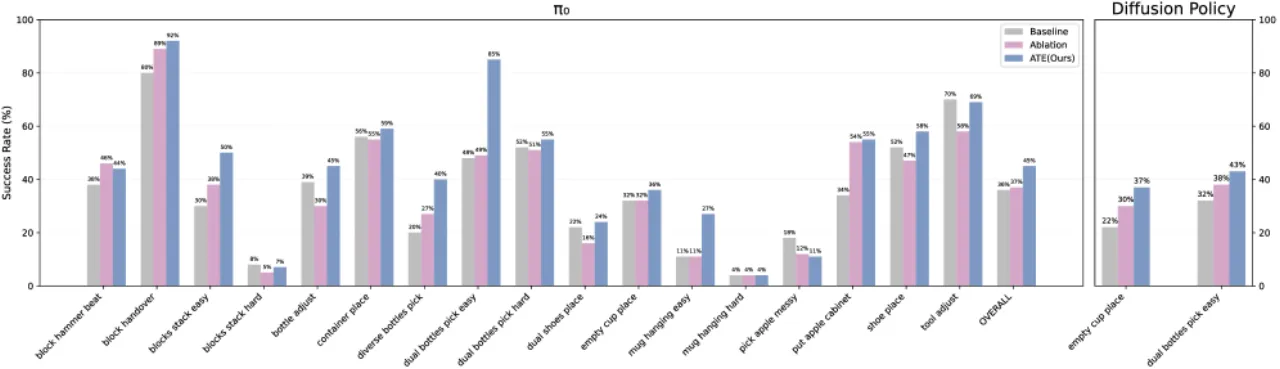
| Block Hammer Beat | 52% | 71% (↑19) | 38% | 44% (↑6) |
| Block Handover | 69% | 91% (↑22) | 80% | 92% (↑12) |
| Blocks Stack (Easy) | 10% | 31% (↑21) | 30% | 50% (↑20) |
| Dual Bottles Pick (Easy) | 76% | 87% (↑11) | 48% | 85% (↑37) |
| Empty Cup Place | 22% | 61% (↑39) | 32% | 36% (↑4) |
| Put Apple Cabinet | 20% | 45% (↑25) | 34% | 55% (↑21) |
| Bottle Adjust | 53% | 37% (↓16) | 39% | 45% (↑6) |
| 平均(17 任务)Average (17 tasks) | 31.8% | 41.6% (↑9.8) | 36.1% | 44.8% (↑8.7) |
| 任务Task | RDT-1B | RDT+ATE |
|---|---|---|
| Push Cube | 65.2% | 78.4% (↑13.2) |
| Pick Cube | 7.6% | 14.8% (↑7.2) |
| 平均Average | 36.4% | 46.6% (↑10.2) |
消融结果表明,两阶段 Info-VAE 设计是性能提升的核心:仅靠单阶段 VAE(缺乏与预训练隐空间的对齐约束)无法有效保留预训练先验,导致长时序任务和高难度任务的成功率显著下降。The ablation shows that the two-stage Info-VAE design is the core of the improvement: a single-stage VAE alone (lacking the alignment constraint toward the pre-training latent space) cannot effectively preserve the pre-training priors, which leads to a marked drop in success rate on long-horizon and high-difficulty tasks.
Stage 1 的预训练 VAE 需要访问预训练阶段的动作数据以构建统一隐空间。若预训练数据不可获取(如闭源 VLA),则无法复现完整的对齐流程。论文使用 OXE subset、DROID、Kuka、ALOHA 等公开数据集进行 VAE 训练(3000 episodes)。The pre-training VAE of Stage 1 needs access to the action data of the pre-training phase in order to build the unified latent space. If the pre-training data is not available (e.g. a closed-source VLA), the full alignment pipeline cannot be reproduced. The paper trains the VAEs on public datasets such as an OXE subset, DROID, Kuka and ALOHA (3000 episodes).
在 RoboTwin 1.0 上,少数任务出现性能下降:Bottle Adjust(RDT: 53% → 37%,↓16)、Blocks Stack Hard(π₀: 8% → 7%,↓1)、Tool Adjust(π₀: 70% → 69%,↓1)。这说明当目标任务动作分布与预训练隐空间的 mode 差异较大时,强制对齐可能带来负面效果。On RoboTwin 1.0 a few tasks degrade: Bottle Adjust (RDT: 53% → 37%, ↓16), Blocks Stack Hard (π₀: 8% → 7%, ↓1), Tool Adjust (π₀: 70% → 69%, ↓1). This suggests that when the action distribution of the target task differs greatly from the modes of the pre-training latent space, forced alignment can be harmful.
真实机器人实验仅在双臂 RealMan 7-DoF 平台上进行,任务局限于厨房场景(Cook Bun、Pick Bun、Make Sandwich、Use Toaster),鲁棒性测试每种条件仅 5 trials。跨平台(如不同 DoF 或移动底盘)的泛化能力尚未验证。The real-robot experiments are run only on the dual-arm RealMan 7-DoF platform, the tasks are confined to a kitchen scenario (Cook Bun, Pick Bun, Make Sandwich, Use Toaster), and the robustness tests use only 5 trials per condition. Generalization across platforms (e.g. a different DoF or a mobile base) has not been verified.
虽然论文声称 ATE 引入"可忽略的额外开销",但 Stage 2 的 classifier guidance 在每个去噪步骤 k 需要计算梯度 g,实时部署时可能对推理延迟产生影响,论文未给出量化延迟数据。Although the paper claims that ATE adds "negligible extra overhead", the classifier guidance of Stage 2 has to compute the gradient g at every denoising step k, which may affect inference latency in real-time deployment; the paper gives no quantitative latency numbers.