VLA 模型(Vision-Language-Action)在机器人操控中取得显著进展,但现有基于 flow matching 的方法采用统一时间步对所有 action token 同步去噪,缺乏对动作质量的自我感知与纠错能力。AsyncVLA 引入异步流匹配框架:先用同步 SFM 生成初始动作,再由置信度评估器识别低置信度 token,最后通过 AFM 有选择地重新生成这些 token,实现 VLA 模型的自校正能力,显著提升长程任务成功率。VLA (Vision-Language-Action) models have made remarkable progress in robotic manipulation, but existing flow matching based methods denoise all action tokens synchronously under a single unified timestep, and therefore lack any self-awareness of action quality or capacity for error correction. AsyncVLA introduces an asynchronous flow matching framework: a synchronous SFM pass first produces the initial actions, a confidence rater then identifies low-confidence tokens, and AFM finally regenerates those tokens selectively, endowing VLA models with self-correction and markedly raising success rates on long-horizon tasks.
VLAflow matching异步推理asynchronous inference机器人操作robot manipulationconfidence ratingaction refinement自校正self-correction机器人控制robot control
01动机Motivation
同步流匹配(SFM)对所有 action token 使用统一去噪时间步,既无法感知动作上下文,也缺乏自我纠错机制——一旦某个 token 产生偏差,长程任务中的错误会级联累积,导致任务失败。Synchronous flow matching (SFM) applies one unified denoising timestep to all action tokens, so it can neither perceive action context nor correct itself — once a token deviates, errors cascade and accumulate through a long-horizon task and the task fails.
"Conventional VLA models with synchronous flow matching use a rigid, monolithic denoising schedule that lacks action context awareness and self-correction mechanisms, making it unstable for long-horizon tasks where single errors cascade into failure."
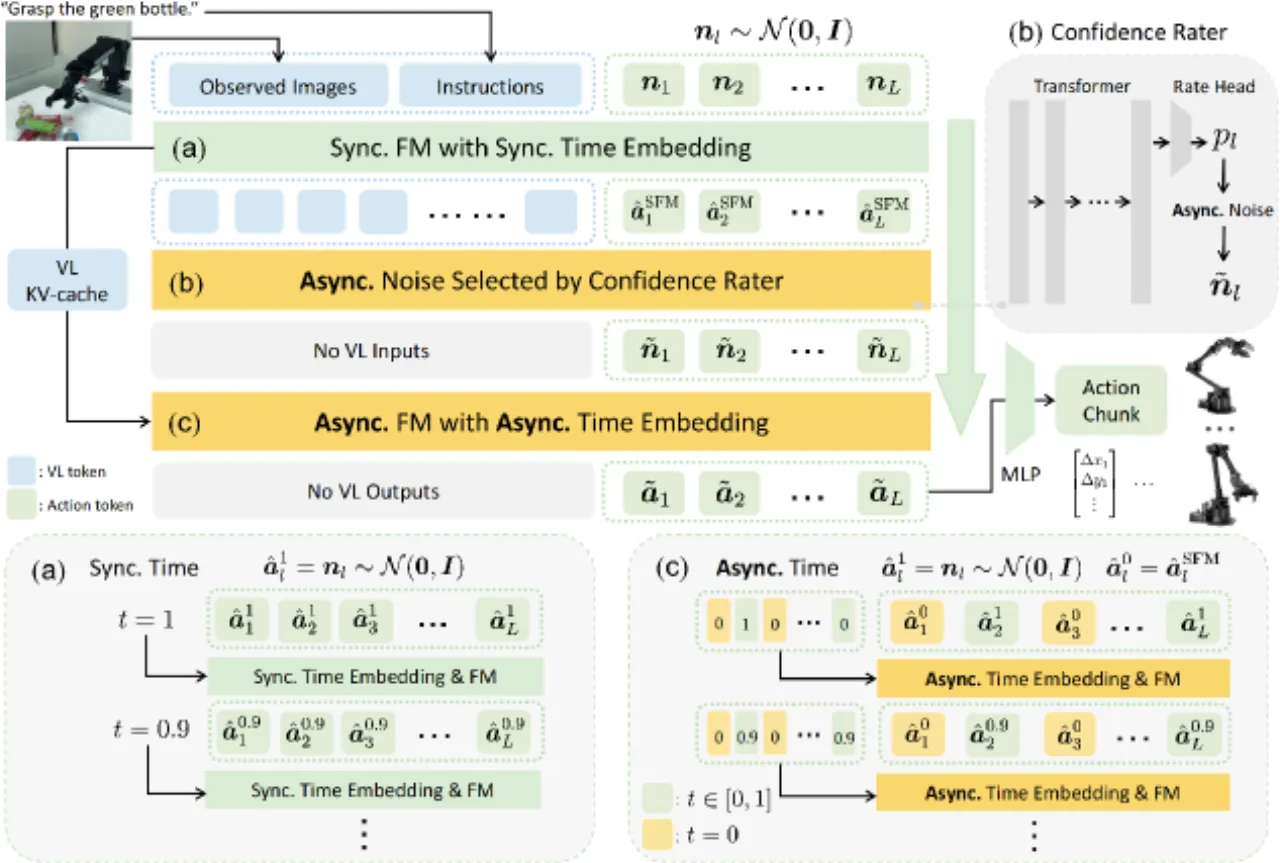
图 1:AsyncVLA 框架三组件概览。(a) SFM 对所有 action token 使用统一时间步 t,从噪声 (t=1) 同步生成动作 (t=0)。(b) Confidence rater 评估 token 级置信度,将低置信 token 掩码,为 AFM 选择异步噪声。(c) AFM 为每个 token 动态分配独立的 FM 时间步,依据置信度选择性地非均匀重新生成动作。SFM 与 AFM 共享同一个统一模型的参数。Figure 1: Overview of the three components of the AsyncVLA framework. (a) SFM applies a unified timestep t to all action tokens, generating actions (t=0) synchronously from noise (t=1). (b) The confidence rater assesses token-level confidence, masks the low-confidence tokens, and selects asynchronous noise for AFM. (c) AFM dynamically assigns an independent FM timestep to each token and regenerates actions selectively and non-uniformly according to confidence. SFM and AFM share the parameters of the same unified model.
95.9 ms单步推理时间(RTX 4090)Single-step inference time (RTX 4090)
02方法Method
AsyncVLA 采用两阶段推理:第一阶段,同步流匹配(SFM)从纯高斯噪声出发,经 10 步 Euler 积分生成初步动作序列;第二阶段,置信度评估器(Confidence Rater)对每个 token 打分,将低置信 token 重置为高斯噪声后,异步流匹配(AFM)仅对这部分 token 再次去噪,高置信 token 保持不变以提供上下文约束。整个框架使用单个统一模型,SFM 与 AFM 共享参数。AsyncVLA performs inference in two stages. In the first stage, synchronous flow matching (SFM) starts from pure Gaussian noise and produces a preliminary action sequence through 10 steps of Euler integration. In the second stage, the confidence rater scores every token; low-confidence tokens are reset to Gaussian noise and asynchronous flow matching (AFM) denoises only those tokens again, while high-confidence tokens stay unchanged to provide contextual constraints. The whole framework uses a single unified model, with SFM and AFM sharing parameters.
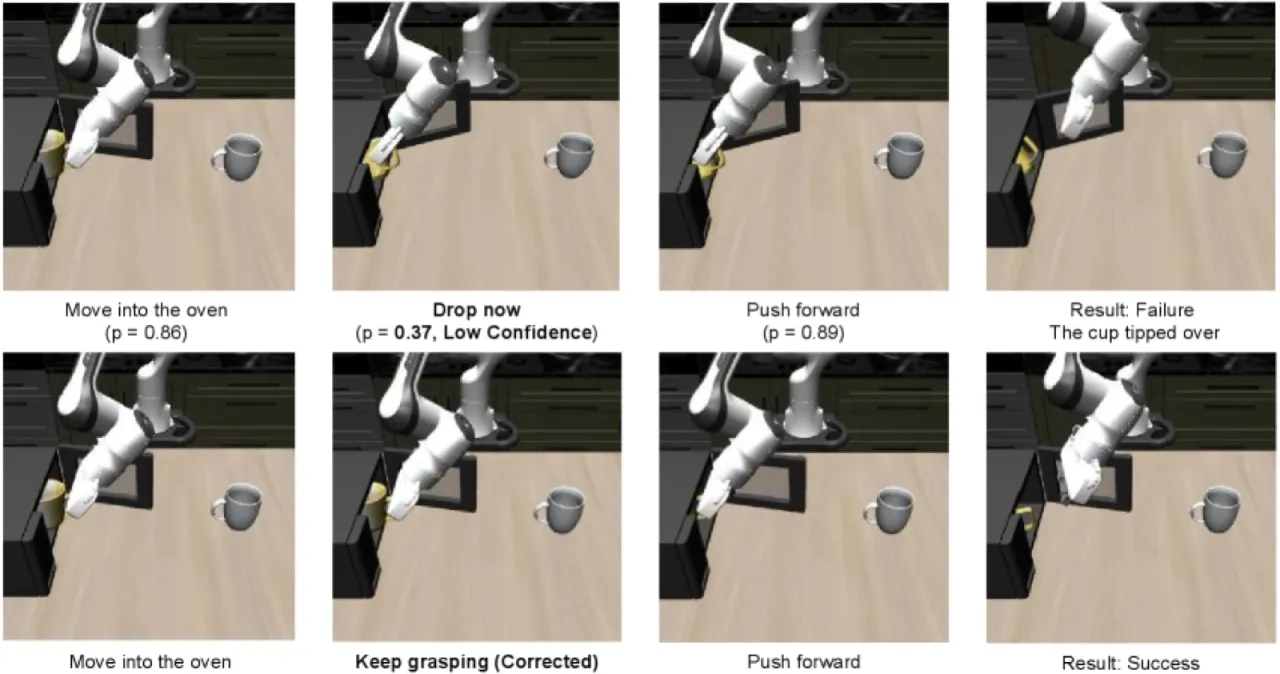
图 2:AsyncVLA 在 LIBERO-Long 任务上的自校正能力展示。上排为 SFM 第一轮生成的动作轨迹,下排为 AFM 重新生成后的修正轨迹——低置信度的偏差动作被识别并纠正。Figure 2: Demonstration of AsyncVLA's self-correction on LIBERO-Long tasks. The top row is the action trajectory produced by the first SFM round; the bottom row is the corrected trajectory after AFM regeneration — deviating actions with low confidence are identified and corrected.
Confidence Rater(置信度评估器)Confidence Rater
Confidence Rater 由 4 层 Transformer 加线性输出头组成(308M 参数,占总参数量 4.08B 的 7.56%),以视觉语言隐状态与 SFM 生成的动作为输入,输出每个 token 的置信度分数 q∈[0,1]。训练时使用基于相对 MSE 的伪标签:The confidence rater consists of a 4-layer Transformer plus a linear output head (308M parameters, 7.56% of the 4.08B total parameters). It takes the vision-language hidden states and the actions generated by SFM as input and outputs a confidence score q∈[0,1] for every token. Training uses pseudo-labels based on relative MSE:
参数 α=0.01,β=0.98,确保标签范围始终在 [0.01, 0.99] 之内。置信度低于阈值 T=0.5 的 token 被掩码,交由 AFM 重新生成。With the parameters α=0.01 and β=0.98, the label range always stays within [0.01, 0.99]. Tokens whose confidence falls below the threshold T=0.5 are masked and handed to AFM for regeneration.
AFM 推理时,未掩码 token(ml=0)直接保留 SFM 输出,掩码 token(ml=1)重新采样高斯噪声并执行 10 步 Euler 更新。为让 Transformer 同时处理混合去噪状态,引入异步时间嵌入:对 τ⊙m 进行 sinusoidal 编码,区分已完成去噪与仍需去噪的 token。通过复用 SFM 阶段的 vision-language KV-cache,AFM 阶段仅需 10.1 ms(vs. SFM 的 83.2 ms),效率极高。At AFM inference time, unmasked tokens (ml=0) directly retain the SFM output, while masked tokens (ml=1) resample Gaussian noise and run 10 steps of Euler updates. To let the Transformer handle mixed denoising states at once, an asynchronous time embedding is introduced: τ⊙m is encoded sinusoidally to distinguish tokens already denoised from tokens still to be denoised. By reusing the vision-language KV-cache of the SFM stage, the AFM stage takes only 10.1 ms (vs. 83.2 ms for SFM), which is extremely efficient.
统一训练策略Unified training strategy
以 SFM 为"全掩码 AFM 的特殊情况"进行统一训练:随机 Bernoulli 采样动作掩码,将 SFM 与 AFM 纳入同一训练过程,实现隐式数据增强。未掩码的上下文 token 加入小幅噪声扰动(σc=0.05),缩小训练与测试分布的差距;FM 时间步从 Beta(1.5, 1) 分布采样,重点覆盖噪声较多的步骤。Unified training treats SFM as "the special case of a fully masked AFM": action masks are sampled from a random Bernoulli distribution, folding SFM and AFM into one training process and realizing implicit data augmentation. Unmasked context tokens receive a small noise perturbation (σc=0.05) to narrow the gap between the training and test distributions; FM timesteps are sampled from a Beta(1.5, 1) distribution, concentrating on the noisier steps.
03实验Experiments
评估涵盖仿真 benchmark(LIBERO 4 套件、WidowX、Google Robot)与真实世界机器人(AgileX PiPER,4 项任务各 50 次试验)。骨干为 Qwen2.5-VL-3B-Instruct,SFM 与 AFM 各 10 步去噪。The evaluation spans simulation benchmarks (the 4 LIBERO suites, WidowX, Google Robot) and a real-world robot (AgileX PiPER, 4 tasks with 50 trials each). The backbone is Qwen2.5-VL-3B-Instruct, with 10 denoising steps each for SFM and AFM.
真实机器人(AgileX PiPER,50 次/任务)Real robot (AgileX PiPER, 50 trials per task)
图 4:AgileX PiPER 机器人真实世界评测的四项任务(从左到右):(1) 将胡萝卜放入碗中;(2) 从笔筒中取出钢笔;(3) 将水从杯中倒入碗中;(4) 将勺子放到盘子上。Figure 4: The four tasks of the real-world evaluation on the AgileX PiPER robot (left to right): (1) put the carrot into the bowl; (2) take the pen out of the pen holder; (3) pour water from the cup into the bowl; (4) place the spoon onto the plate.
任务Task
OpenVLA-OFT
π0.5
AsyncVLA(本文)AsyncVLA (ours)
Carrot→Bowl
72.0%
88.0%
94.0%
Pen Extraction
72.0%
84.0%
86.0%
Pour Water
60.0%
72.0%
82.0%
Spoon→Plate
58.0%
64.0%
86.0%
平均Average
65.5%
77.0%
87.0%
训练效率(仅用 25% LIBERO-Spatial 数据)Training efficiency (using only 25% of the LIBERO-Spatial data)
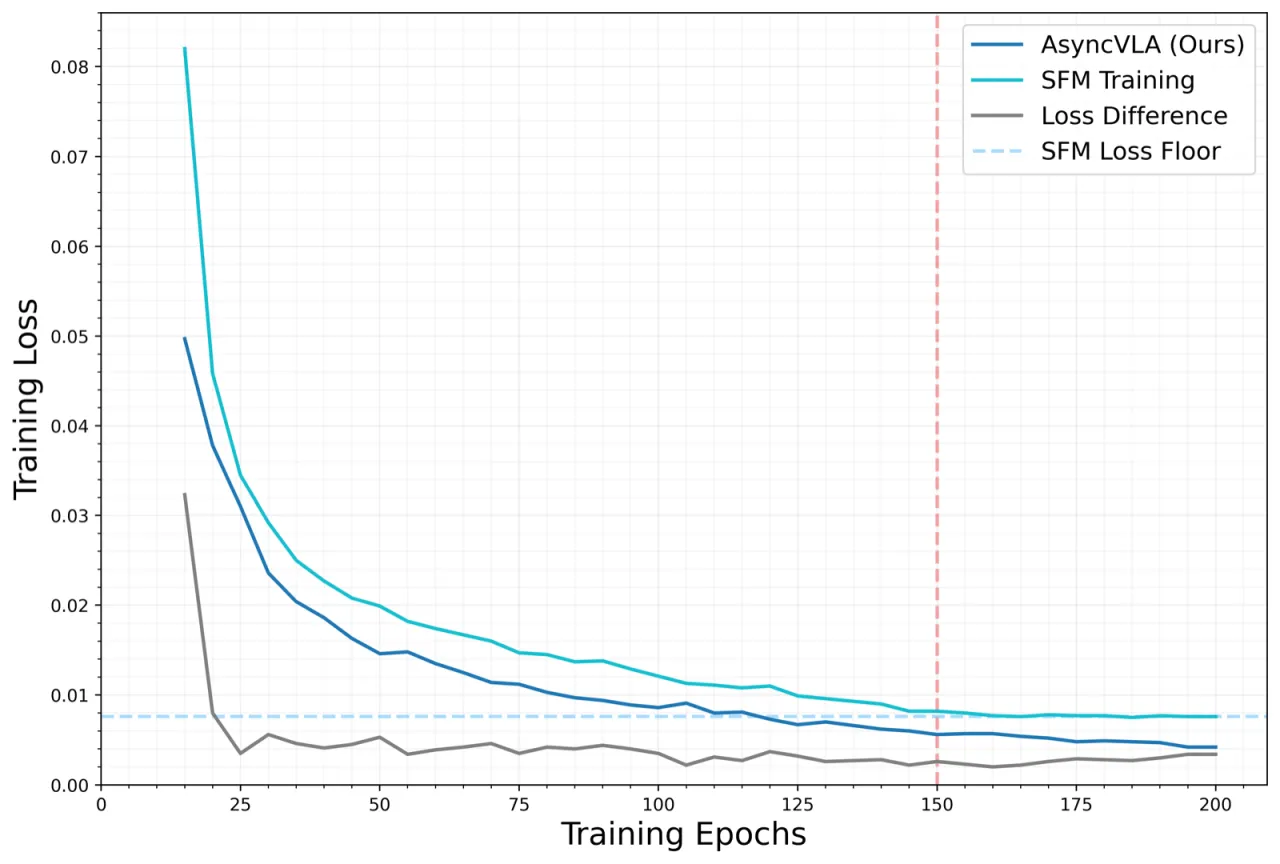
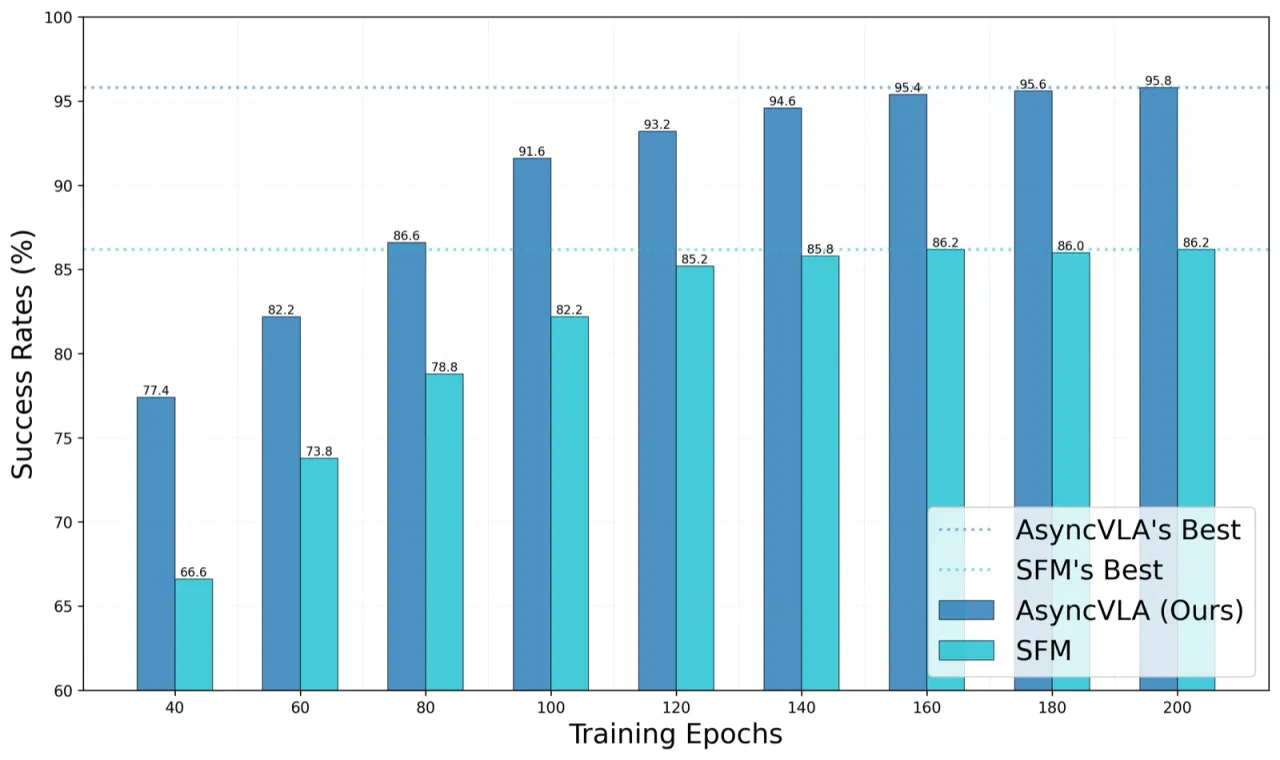
图 3a:使用四分之一 LIBERO-Spatial 数据时的训练损失曲线对比。AsyncVLA(0.0042)明显低于 SFM(0.0076)。Figure 3a: Comparison of training loss curves when only a quarter of the LIBERO-Spatial data is used. AsyncVLA (0.0042) is clearly lower than SFM (0.0076).图 3b:训练过程中 LIBERO-Spatial 测试集成功率对比。AsyncVLA 于 200 epoch 达 95.8%,SFM 在 140 epoch 后停止提升,仅到 86.2%。Figure 3b: Comparison of LIBERO-Spatial test success rate during training. AsyncVLA reaches 95.8% at 200 epochs, while SFM stops improving after 140 epochs and only attains 86.2%.
Ablation Study(WidowX 平均成功率)Ablation Study (WidowX average success rate)
配置Setting
WidowX 平均成功率WidowX average success rate
SFM only (10 steps)
47.9%
SFM only (20 steps)
51.1%
AFM without confidence rater
62.5%
With TSI labeling
64.6%
Delta refinement variant
61.5%
Direct refinement variant
62.5%
Without unified training
7.3%
Full AsyncVLA
70.8%
关键发现:基于 MSE 的置信度标签(70.8%)显著优于任务成功指示符标签(TSI,64.6%),表明稠密监督信号对 token 级精细校正至关重要。去掉统一训练策略后成功率骤降至 7.3%,说明该训练设计不可或缺。Key finding: MSE-based confidence labels (70.8%) clearly outperform task success indicator labels (TSI, 64.6%), showing that a dense supervision signal is essential for fine-grained token-level correction. Removing the unified training strategy makes the success rate plunge to 7.3%, which shows this training design is indispensable.
推理时间分解(RTX 4090,2 路相机)Inference time breakdown (RTX 4090, 2 cameras)
Note:以下局限性均由作者在论文中明确陈述(stated by authors)。All the limitations below are explicitly stated by the authors in the paper (stated by authors).
相对置信度标签在全局失效场景下可能崩溃Relative confidence labels may collapse when the whole prediction fails
置信度评估器使用的是 chunk 内相对 MSE 归一化伪标签。当整个 action chunk 的预测都存在较大误差时,相对排序仍能识别"相对较好"的 token,但无法感知绝对误差量级。作者指出需要结合绝对误差感知的校准方案解决此类 corner case。The confidence rater uses pseudo-labels normalized by relative MSE within a chunk. When every prediction in an action chunk carries a large error, the relative ranking can still identify the "relatively better" tokens, but it cannot perceive the absolute magnitude of the error. The authors point out that a calibration scheme aware of absolute error is needed to solve such corner cases.
经验验证局限于机器人动作生成领域Empirical validation is confined to robot action generation
AsyncVLA 的异步流匹配框架在设计上具有通用性,但当前实验验证仅覆盖机器人操控任务(LIBERO、WidowX、Google Robot、AgileX PiPER),尚未在语言生成、图像生成等其他序列任务上验证其有效性。The asynchronous flow matching framework of AsyncVLA is general by design, but the current experimental validation covers only robotic manipulation tasks (LIBERO, WidowX, Google Robot, AgileX PiPER); its effectiveness has not yet been verified on other sequence tasks such as language generation or image generation.
额外 AFM 推理阶段引入约 15% 延迟开销The extra AFM inference stage introduces about 15% latency overhead
尽管 AFM 通过 KV-cache 复用将额外延迟控制在 10.1 ms(总推理 95.9 ms),相比 SFM 单独推理(83.2 ms)仍增加约 15.3% 的延迟。在对实时性要求极高的场景(如高频控制)中,该开销需酌情权衡。(此条为从设计中推断,inferred from design。)Although KV-cache reuse keeps AFM's extra latency at 10.1 ms (95.9 ms of total inference), this still adds about 15.3% latency compared with SFM inference alone (83.2 ms). In scenarios with extremely strict real-time requirements (such as high-frequency control), the overhead has to be weighed accordingly. (This item is inferred from design.)