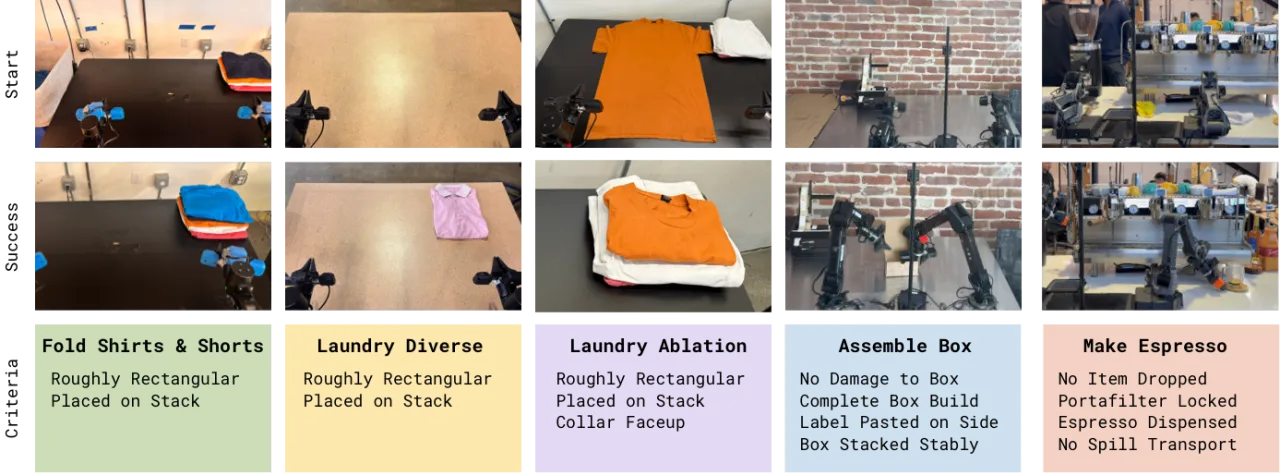
本文提出 Recap(Reinforcement Learning with Experience and Corrections via Advantage-conditioned Policies), 一种让大型视觉-语言-动作(VLA)模型通过真实世界部署经验持续自我提升的强化学习框架。 在洗衣折叠、盒子组装和咖啡制作等家庭任务上,π*₀.₆ 实现了任务吞吐量翻倍、失败率减半的显著改进, 并完成了连续 13 小时无人监督自动制作浓缩咖啡的实际部署。This paper introduces Recap (Reinforcement Learning with Experience and Corrections via Advantage-conditioned Policies), a reinforcement learning framework that lets large vision-language-action (VLA) models keep improving themselves from real-world deployment experience. On household tasks such as laundry folding, box assembly and coffee making, π*₀.₆ delivers marked gains — task throughput doubled and failure rate halved — and completes a real deployment in which it makes espresso autonomously and unsupervised for 13 hours straight.
机器人基础模型能否像人类一样"熟能生巧"——通过实际操作积累经验来持续提升技能? 现有 VLA 模型依赖大量人工示范进行模仿学习,但"示范数据永远无法覆盖真实环境的所有变化", 导致模型在部署时仍会遭遇大量失败。如何高效地利用机器人自主采集的轨迹数据(包括失败、成功和人工干预), 是迈向实用级机器人自主性的关键障碍。Can robot foundation models get better with practice the way people do — accumulating experience through actual operation and steadily improving their skills? Existing VLA models rely on large volumes of human demonstrations for imitation learning, but demonstration data can never cover every variation of a real environment, so deployed models still run into plenty of failures. Efficiently exploiting the trajectory data a robot gathers on its own (failures, successes and human interventions alike) is a key obstacle on the road to practical robot autonomy.
"Practice makes perfect — humans need many attempts at complex tasks to achieve mastery… We need methods that can learn from autonomous experience, can correct actual deployment mistakes, and can improve speed beyond human teleoperation."
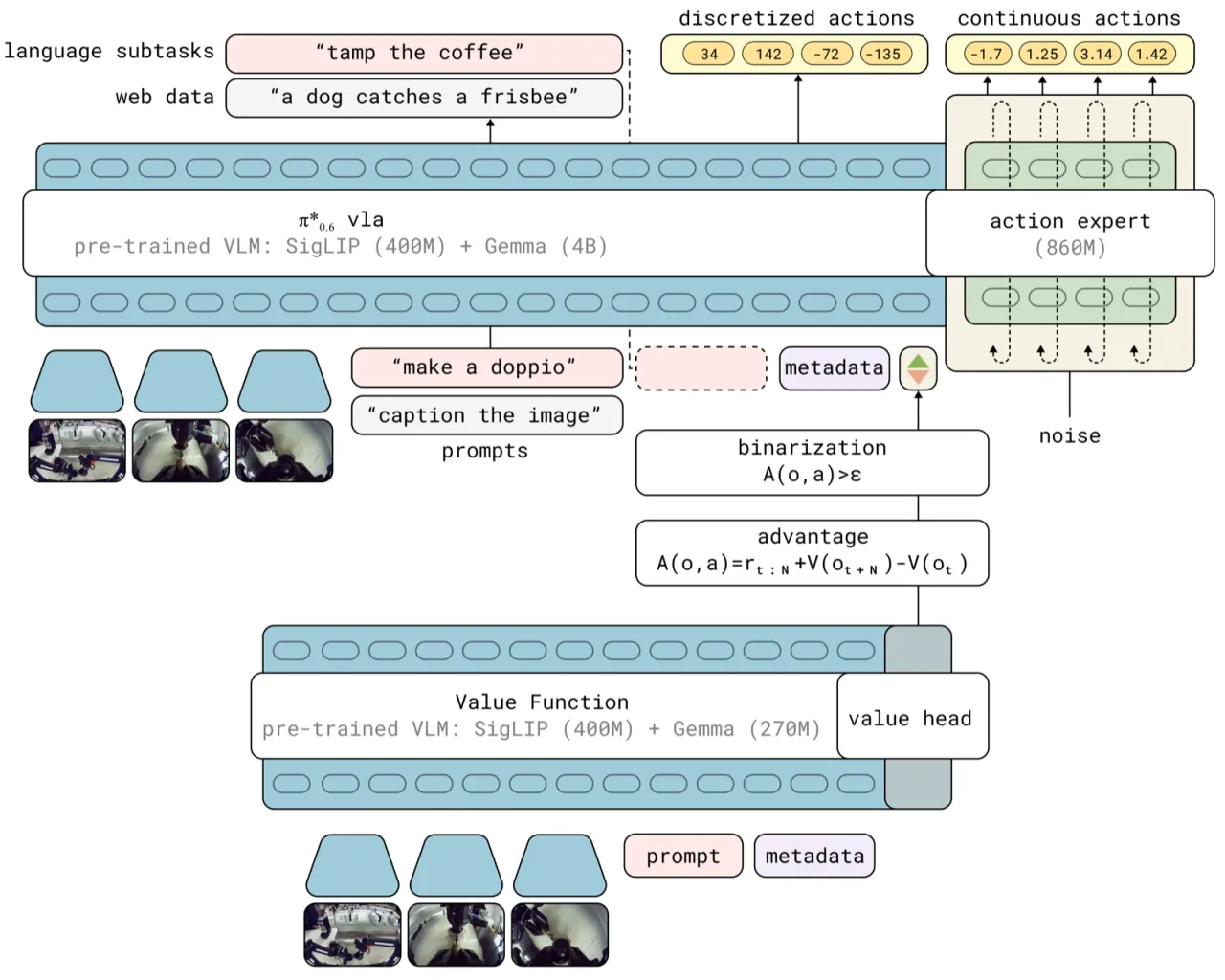
Recap 将异构数据(人工示范、自主采集轨迹、专家干预)统一纳入 VLA 的训练管线, 通过优势条件化策略(advantage-conditioned policy)实现策略提升—— 无需显式策略梯度,只需对成功动作与失败动作分别建模即可从经验中学习。Recap brings heterogeneous data (human demonstrations, autonomously collected trajectories, expert interventions) into a single VLA training pipeline and obtains policy improvement through an advantage-conditioned policy — no explicit policy gradient is required; modelling successful and failing actions separately is enough to learn from experience.
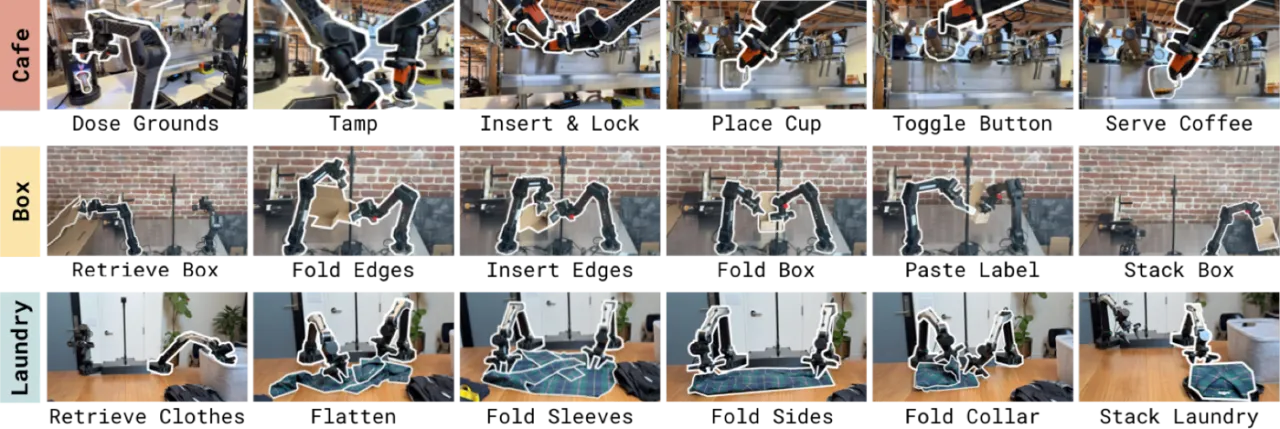
机器人自主执行任务,标注员在必要时远程干预并提供示范修正。干预轨迹的优势指示符强制置为 True, 为模型提供"改进性动作"样例。每次迭代采集约 300–600 条自主轨迹和 280–380 条干预轨迹。The robot executes the task autonomously while annotators teleoperate in when necessary and supply demonstrated corrections. The advantage indicator of an intervention trajectory is forced to True, giving the model examples of improving actions. Each iteration collects roughly 300–600 autonomous trajectories and 280–380 intervention trajectories.
训练一个分布式价值函数(distributional value function),以负剩余步数(归一化至 (-1,0))为目标。 优化目标:最小化 H(RBt(τ), pφ(V|ot,ℓ)), 即预测分布与真实返回的交叉熵。任务阈值 εℓ 设为预训练阶段价值预测的第 30 百分位数。A distributional value function is trained with the negative number of remaining steps (normalised to (-1,0)) as its target. The objective minimises H(RBt(τ), pφ(V|ot,ℓ)), i.e. the cross-entropy between the predicted distribution and the true return. The task threshold εℓ is set to the 30th percentile of the value predictions from the pre-training stage.
改进策略遵循:π̂(a|o,ℓ) ∝ πref(a|o,ℓ) · (πref(a|I,o,ℓ) / πref(a|o,ℓ))β。 训练目标(Eq.3)为最小化 E[−log πθ(at|ot,ℓ) − α log πθ(at|It,ot,ℓ)], 其中 It = 1(Aπref(ot,at,ℓ) > εℓ)。The improved policy follows π̂(a|o,ℓ) ∝ πref(a|o,ℓ) · (πref(a|I,o,ℓ) / πref(a|o,ℓ))β. The training objective (Eq.3) minimises E[−log πθ(at|ot,ℓ) − α log πθ(at|It,ot,ℓ)], where It = 1(Aπref(ot,at,ℓ) > εℓ).
在数万小时的多机器人数据上用 Recap 进行大规模离线 RL 预训练, 使 π*₀.₆ 获得广泛的"何时需要改进"先验知识,为下游任务特化提供更好的初始化。Large-scale offline RL pre-training with Recap on tens of thousands of hours of multi-robot data gives π*₀.₆ broad prior knowledge about when improvement is needed, and a better initialisation for downstream task specialisation.
针对具体部署任务,循环执行上述三步流程(通常 2 轮迭代), 利用任务特定的成功/失败奖励信号逐步消除失败模式并提升操作速度。For a concrete deployment task, the three-step loop above is run repeatedly (typically 2 iterations), using task-specific success/failure reward signals to progressively eliminate failure modes and raise operating speed.
任务奖励函数定义为:rt = 0(成功)、−Cfail(失败)、−1(每步惩罚)。 该稀疏奖励仅依赖人工标记的片段级成功/失败标签,无需设计复杂的密集奖励函数。The task reward is defined as rt = 0 (success), −Cfail (failure), −1 (per-step penalty). This sparse reward depends only on human-labelled episode-level success/failure flags, so no elaborate dense reward function has to be designed.
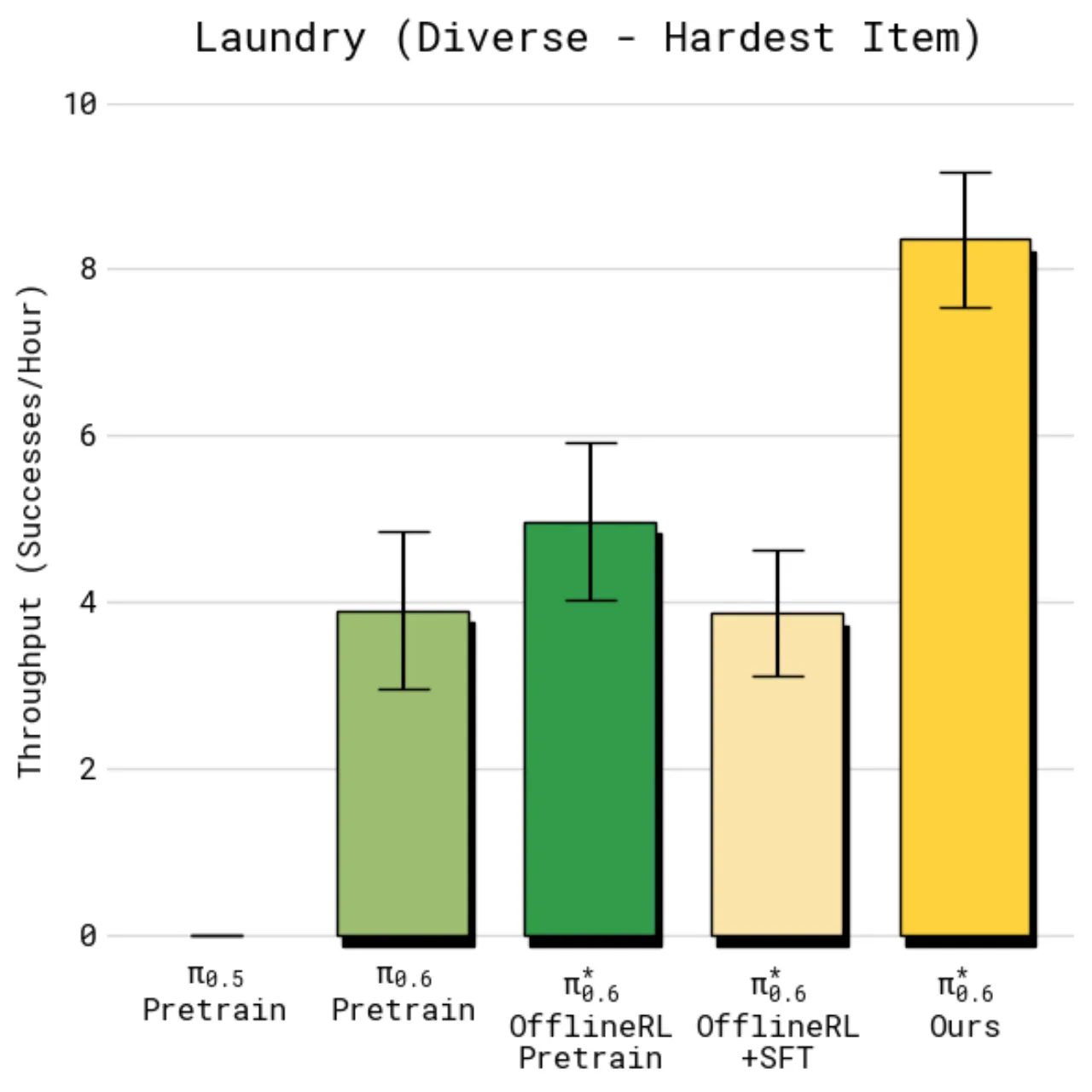
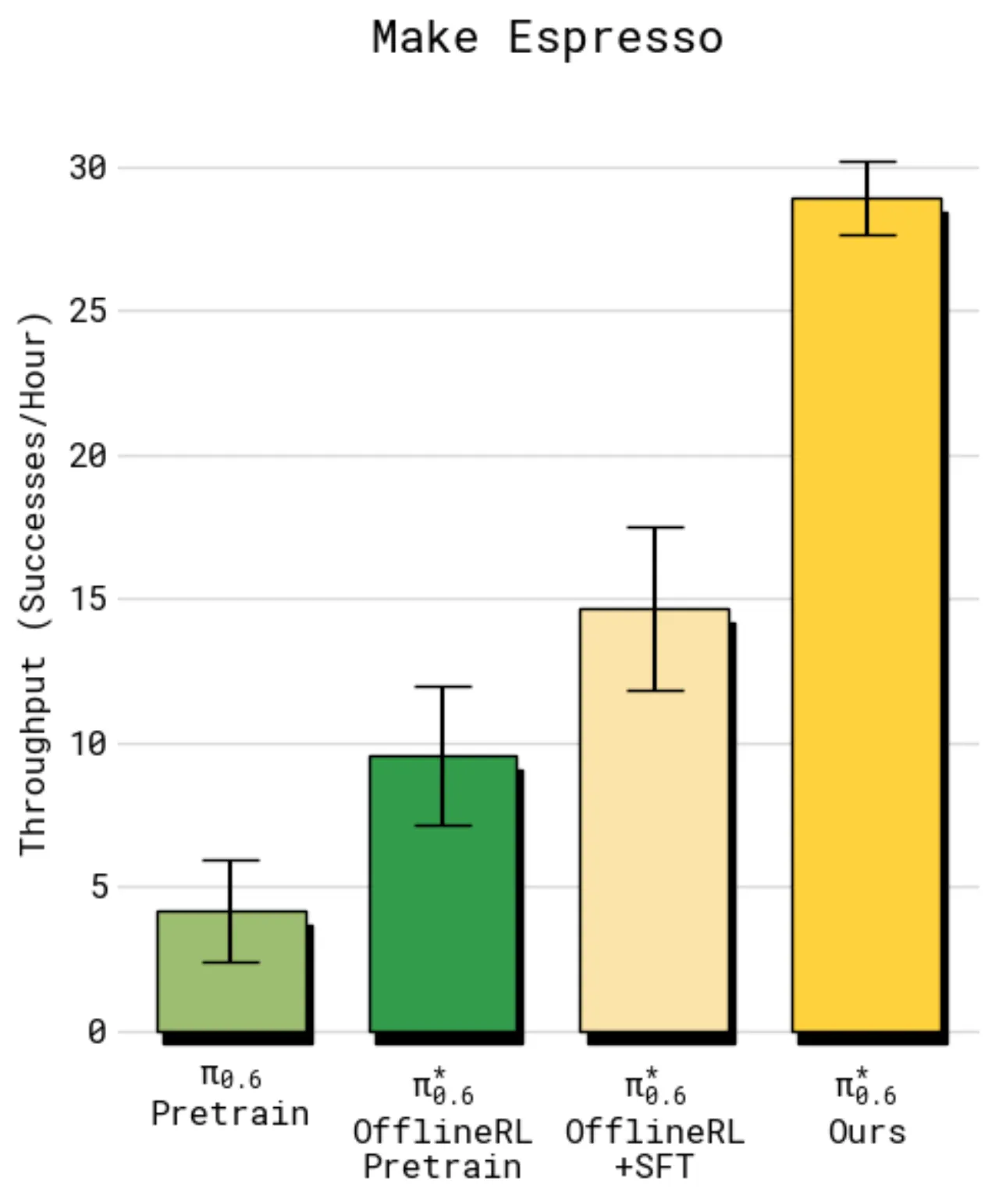
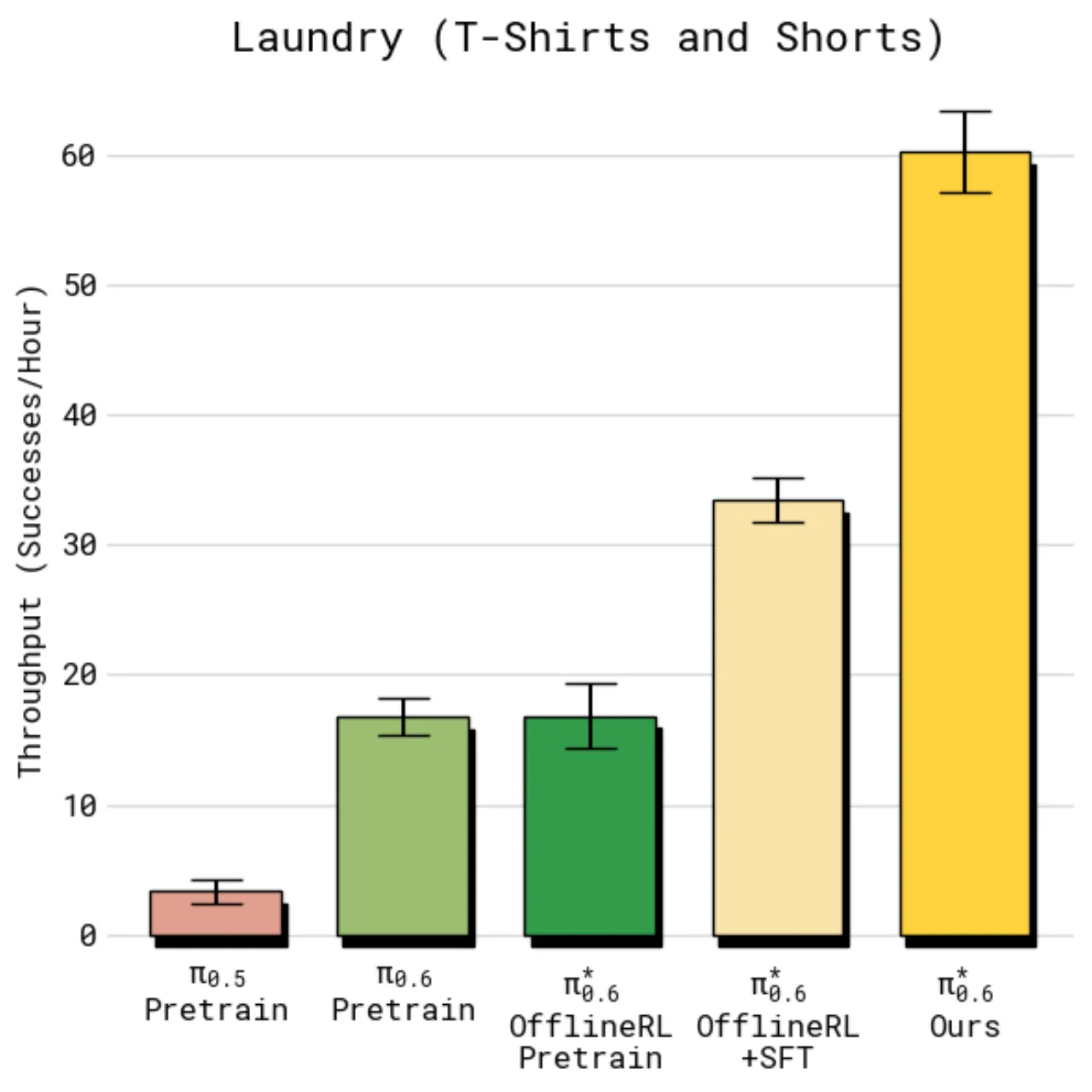
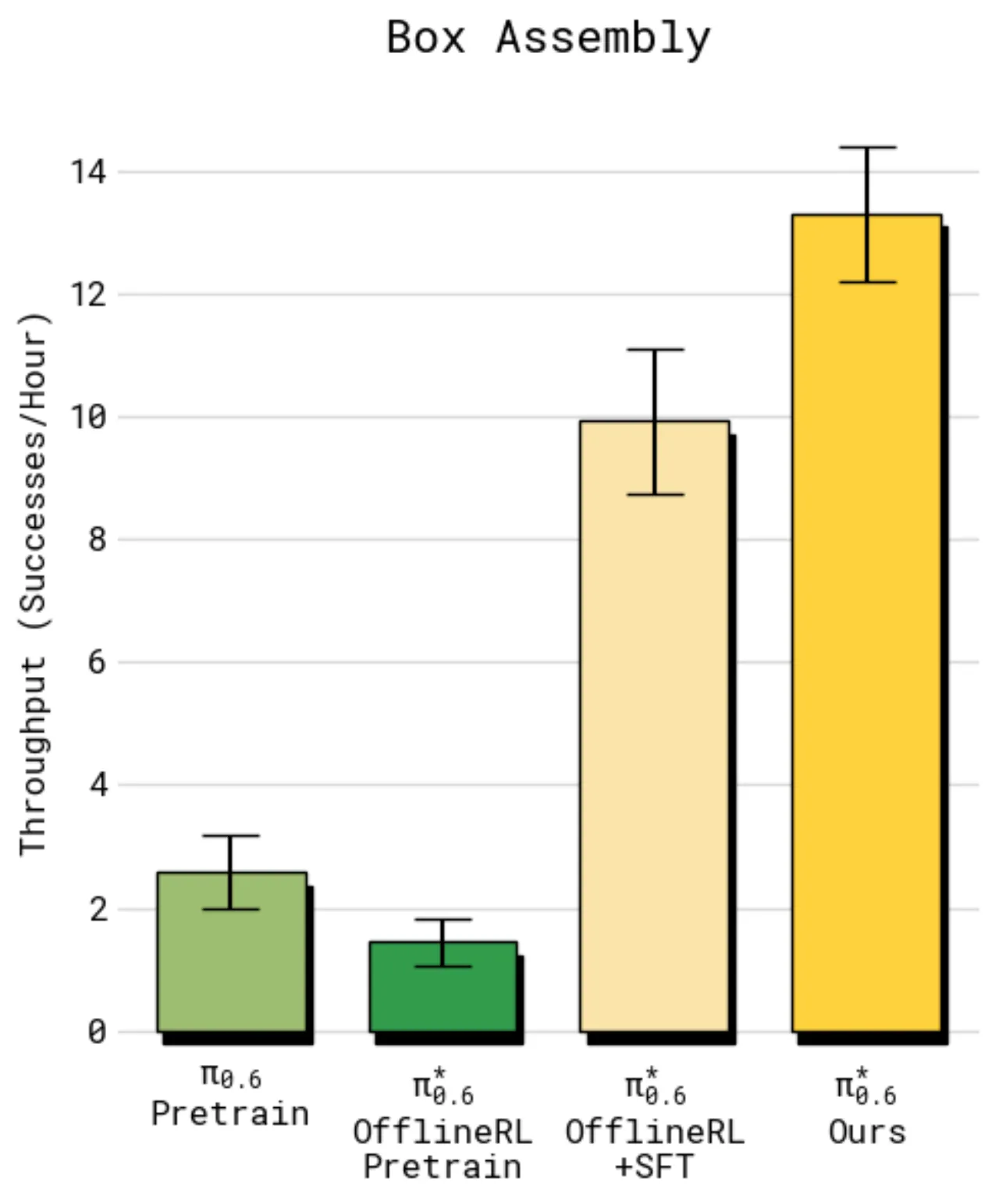
在 4 个真实机器人任务上对比 π*₀.₆(有/无 Recap)及多个基线方法, 主要指标为每小时成功完成任务数(throughput)和成功率(success rate)。π*₀.₆ (with and without Recap) is compared against several baseline methods on 4 real robot tasks; the main metrics are the number of tasks completed successfully per hour (throughput) and the success rate.
| 任务Task | 基线 π₀.₆(无RL)Baseline π₀.₆ (no RL) | π*₀.₆ + Recap | 提升Gain |
|---|---|---|---|
| 洗衣折叠(T恤/短裤)Laundry folding (T-shirt / shorts) | ~5.5 任务/时, ~90%~5.5 tasks/h, ~90% | ~8.5 任务/时, ~95%~8.5 tasks/h, ~95% | 吞吐量 +55%+55% throughput |
| 洗衣折叠(多样·最难物品)Laundry folding (diverse, hardest items) | ~3 任务/时, ~50%~3 tasks/h, ~50% | ~7 任务/时, ~75%~7 tasks/h, ~75% | >2× 吞吐量>2× throughput |
| 制作浓缩咖啡Pulling espresso | ~2 任务/时, ~45%~2 tasks/h, ~45% | ~5 任务/时, ~90%~5 tasks/h, ~90% | >2× 吞吐量>2× throughput |
| 盒子组装Box assembly | ~5 任务/时, ~75%~5 tasks/h, ~75% | ~9.5 任务/时, ~90%~9.5 tasks/h, ~90% | >2× 吞吐量>2× throughput |
| 方法Method | 类型Type | 表现Performance |
|---|---|---|
| π₀.₅ | 上一代通用模型,无RLPrevious-generation generalist model, no RL | 最低基线Lowest baseline |
| π₀.₆(SL baseline)π₀.₆ (SL baseline) | 监督学习,无优势条件化Supervised learning, no advantage conditioning | 中等Middling |
| Offline RL + SFT | 仅使用示范精调Fine-tuning on demonstrations only | 略高于SLSlightly above SL |
| AWR(优势加权回归)AWR (advantage-weighted regression) | 替代RL算法Alternative RL algorithm | 低于RecapBelow Recap |
| PPO(策略梯度)PPO (policy gradient) | 在线RLOnline RL | 显著低于RecapMarkedly below Recap |
| π*₀.₆ + Recap(本文)π*₀.₆ + Recap (this paper) | 离线优势条件化RLOffline advantage-conditioned RL | 最优Best |
消融实验验证了三个关键设计选择的必要性:The ablations confirm that three key design choices are necessary:
"Our system is not fully autonomous: it relies on human labeling and effort for reward feedback, interventions, and episode resets." ——系统并非完全自主,每轮迭代需要标注员提供片段级成功/失败标签,并在机器人卡死时进行重置或干预, 限制了大规模自动化部署的可行性。— The system is not fully autonomous: every iteration needs annotators to supply episode-level success/failure labels and to reset or intervene when the robot gets stuck, which limits the feasibility of large-scale automated deployment.
"Our system is relatively naïve in how it approaches exploration." ——Recap 的探索依赖策略自身的随机性和人工干预来访问新状态,缺乏主动探索(active exploration) 机制,对于需要大幅偏离当前策略才能改进的任务可能效率较低。— Recap's exploration relies on the stochasticity of the policy itself and on human intervention to visit new states; it has no active-exploration mechanism, so it may be inefficient on tasks that require a large departure from the current policy in order to improve.
"Recap performs iterated 'offline' updates rather than running a fully online RL loop." ——每次策略更新需要先收集一批数据再离线更新,而非实时在线强化学习, 导致样本效率低于理论最优的在线方法,且难以快速响应分布偏移。— Each policy update first collects a batch of data and then updates offline instead of running real-time online reinforcement learning, which makes sample efficiency lower than that of theoretically optimal online methods and makes it hard to react quickly to distribution shift.
推断(inferred):目前评估任务数量有限(4个),且均在 Physical Intelligence 内部场景测试, 对更广泛的任务类别(如动态环境、多物体复杂操作)的泛化能力尚未系统验证。 此外,预训练阶段需要"数万小时"多机器人数据,数据获取成本对外部研究者构成较大门槛。Inferred: the number of evaluation tasks is currently limited (4), and all of them are tested in Physical Intelligence's own settings, so generalisation to broader task categories (dynamic environments, complex multi-object manipulation) has not been systematically verified. In addition, the pre-training stage requires tens of thousands of hours of multi-robot data, and the cost of acquiring it is a considerable barrier for outside researchers.