本文提出 AGNOSTOS——首个系统性评估 VLA 模型跨任务零样本泛化能力的仿真基准(23 个未见任务,两个难度级别),并提出 X-ICM(Cross-Task In-Context Manipulation)方法:利用 LLM 在已见任务示例的上下文条件下预测未见任务的动作,配合动态引导示例选择模块,大幅超越现有 VLA 基线。This paper introduces AGNOSTOS, the first simulation benchmark that systematically evaluates the cross-task zero-shot generalization of VLA models (23 unseen tasks at two difficulty levels), together with X-ICM (Cross-Task In-Context Manipulation): an LLM predicts actions for unseen tasks conditioned on in-context demonstrations from seen tasks, and a dynamics-guided sample selection module lets it substantially outperform existing VLA baselines.
通用机器人操作的核心挑战在于:模型能否将学到的技能迁移到从未见过的任务上?现有 VLA 模型(包括 π0、OpenVLA、RDT 等)的跨任务泛化能力几乎未被系统研究,缺乏统一的评估框架。The core challenge of general-purpose robot manipulation is whether a model can transfer learned skills to tasks it has never seen. The cross-task generalization of existing VLA models (including π0, OpenVLA and RDT) has barely been studied systematically, and a unified evaluation framework is missing.
"The cross-task generalization capabilities of existing VLA models remain significantly underexplored."
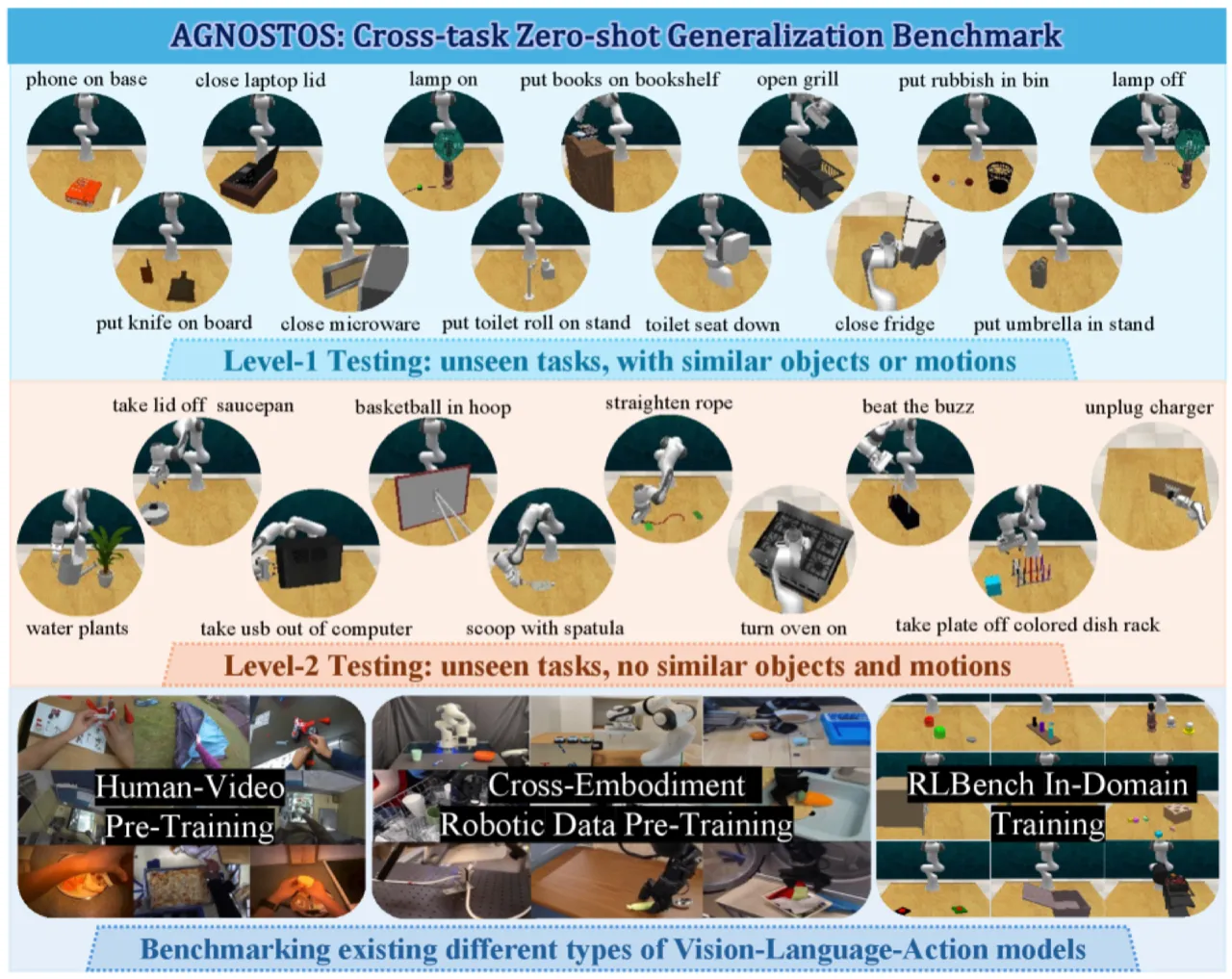
现有跨任务评估基准(如 Colosseum、GemBench)缺乏对 foundation model 与人类视频预训练模型的系统比较,且未区分难度级别。AGNOSTOS 通过双难度设计和多类别 VLA 评测,首次全面揭示了当前模型的跨任务能力边界。Existing cross-task evaluation benchmarks (such as Colosseum and GemBench) lack a systematic comparison between foundation models and models pre-trained on human videos, and do not separate difficulty levels. With its two-level design and its evaluation across VLA categories, AGNOSTOS is the first to reveal comprehensively where the cross-task ability of current models ends.
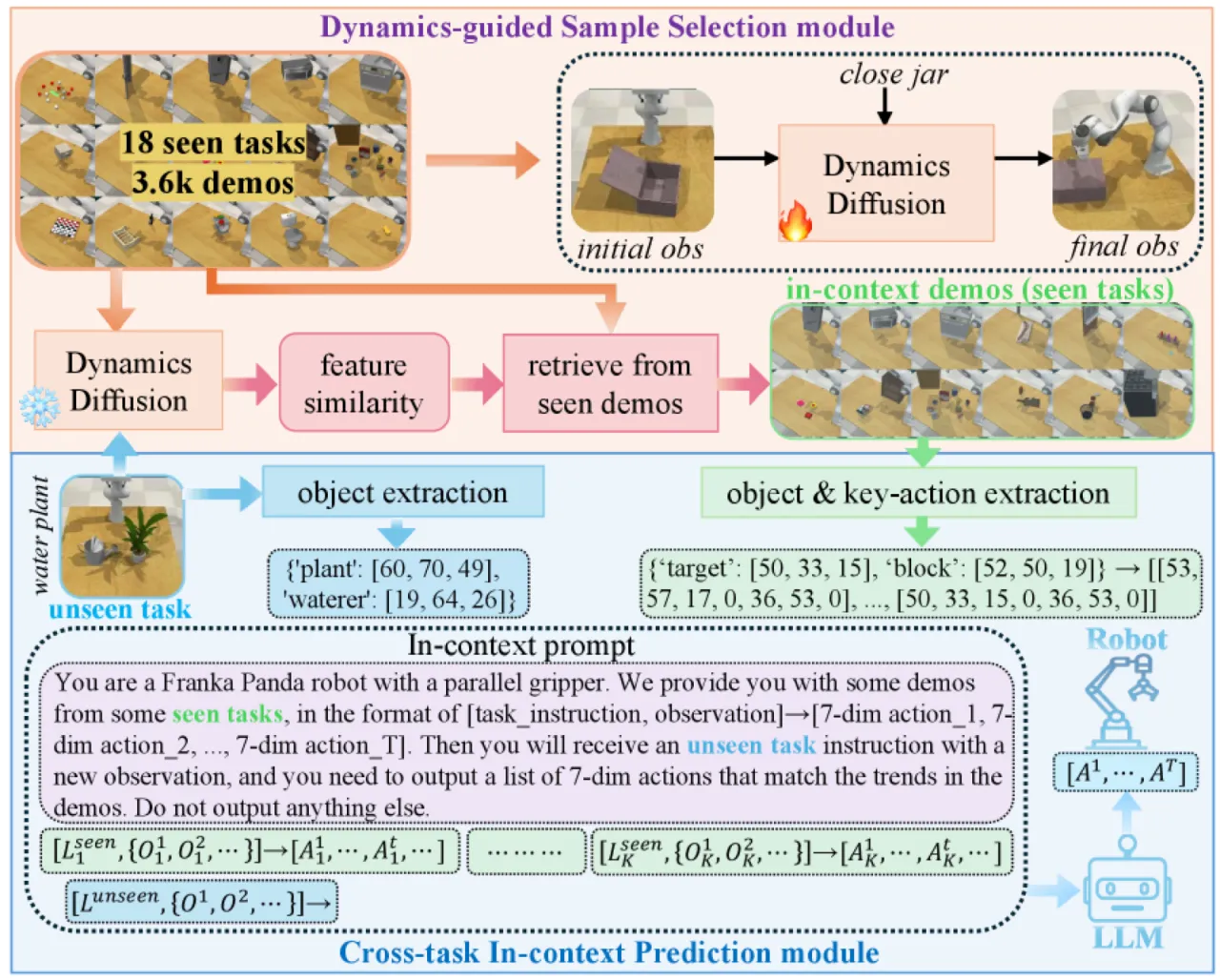
X-ICM(Cross-Task In-Context Manipulation)将跨任务泛化问题转化为 LLM 的上下文学习问题:将已见任务的示例"文本化"后作为 prompt,驱动大语言模型直接预测未见任务的动作序列。该方法无需对 VLA 进行额外微调,完全在推理阶段运行。X-ICM (Cross-Task In-Context Manipulation) recasts cross-task generalization as in-context learning for an LLM: demonstrations of seen tasks are "textualized" into a prompt that drives the large language model to directly predict action sequences for unseen tasks. The method needs no extra fine-tuning of the VLA and runs entirely at inference time.
直接用语义相似性选示例效果有限,因为跨任务的关键在于动作动态而非表面语义。X-ICM 训练一个基于 InstructPix2Pix 的 dynamics diffusion model(记为 𝒢),以初始视觉观测和语言描述为条件,预测任务完成时的最终视觉状态。提取其 language feature(flang)与 visual feature(fvis.in)的组合作为动态特征表示,然后通过余弦相似度从所有已见示例中检索 K=18 条最相关的跨任务演示。该模块显著提升了示例的相关性,降低了预测方差。Selecting demonstrations by semantic similarity alone works poorly, because what matters across tasks is action dynamics rather than surface semantics. X-ICM trains a dynamics diffusion model based on InstructPix2Pix (denoted 𝒢) that, conditioned on the initial visual observation and the language description, predicts the final visual state at task completion. The combination of its language feature (flang) and visual feature (fvis.in) serves as the dynamics feature representation, and cosine similarity then retrieves the K=18 most relevant cross-task demonstrations among all seen examples. This module markedly improves the relevance of the demonstrations and reduces prediction variance.
将选出的 K 条示例"文本化"为结构化 prompt:每条示例表示为(语言描述, 对象位置信息)→(归一化 3D 动作坐标序列)的映射。将 prompt 输入 LLM(Qwen2.5-7B 或 Qwen2.5-72B),要求其推断未见任务的动作模式并输出相应的动作坐标。整个流程不修改 VLA 模型权重,推理时间开销主要来自 LLM forward pass。The K selected demonstrations are "textualized" into a structured prompt: each one is written as a mapping (language description, object position information) → (normalized 3D action coordinate sequence). The prompt is fed to an LLM (Qwen2.5-7B or Qwen2.5-72B), which is asked to infer the action pattern of the unseen task and to output the corresponding action coordinates. The whole pipeline leaves the VLA model weights untouched; the inference-time cost comes mainly from the LLM forward pass.
在 AGNOSTOS 基准的 23 个未见任务上进行零样本跨任务评测,并在 5 个真实物理场景中验证 X-ICM 的迁移能力。所有成功率均为多次运行的均值 ± 标准差。Zero-shot cross-task evaluation is run on the 23 unseen tasks of the AGNOSTOS benchmark, and the transfer ability of X-ICM is further verified in 5 real physical scenarios. All success rates are means ± standard deviations over multiple runs.
| 方法Method | Level-1(13 任务)Level-1 (13 tasks) | Level-2(10 任务)Level-2 (10 tasks) | Overall(23 任务)Overall (23 tasks) |
|---|---|---|---|
| VoxPoser | 20.9% ± 0.3 | 8.0% ± 0.3 | 15.6% ± 0.2 |
| π0(prior best)π0 (prior best) | 21.7% ± 0.4 | 11.5% ± 0.5 | 17.5% ± 0.4 |
| SAM2Act | 14.4% ± 0.5 | 15.9% ± 1.3 | 15.1% ± 0.8 |
| X-ICM(7B)X-ICM (7B) | 28.6% ± 1.9 | 16.9% ± 1.3 | 23.5% ± 1.6 |
| X-ICM(72B)X-ICM (72B) | 37.6% ± 1.4 | 20.3% ± 1.7 | 30.1% ± 1.0 |
X-ICM(72B)在 Overall 上超越 π0 约 +6.0%,超越 VoxPoser 约 +7.9%。更重要的是,X-ICM(72B)是唯一在全部 23 个任务中均获得非零成功率的方法,而其他基线模型在 ≥8 个任务上完全失败。On Overall, X-ICM (72B) exceeds π0 by about +6.0% and VoxPoser by about +7.9%. More importantly, X-ICM (72B) is the only method with a non-zero success rate on all 23 tasks, whereas the other baselines fail completely on ≥8 tasks.
| 配置Configuration | Level-1 | Level-2 | Overall |
|---|---|---|---|
| X-ICM(72B)无选择模块X-ICM (72B) without the selection module | 30.7% ± 4.7 | 18.0% ± 2.2 | 25.2% ± 3.2 |
| X-ICM(72B)含选择模块X-ICM (72B) with the selection module | 37.6% ± 1.4 | 20.3% ± 1.7 | 30.1% ± 1.0 |
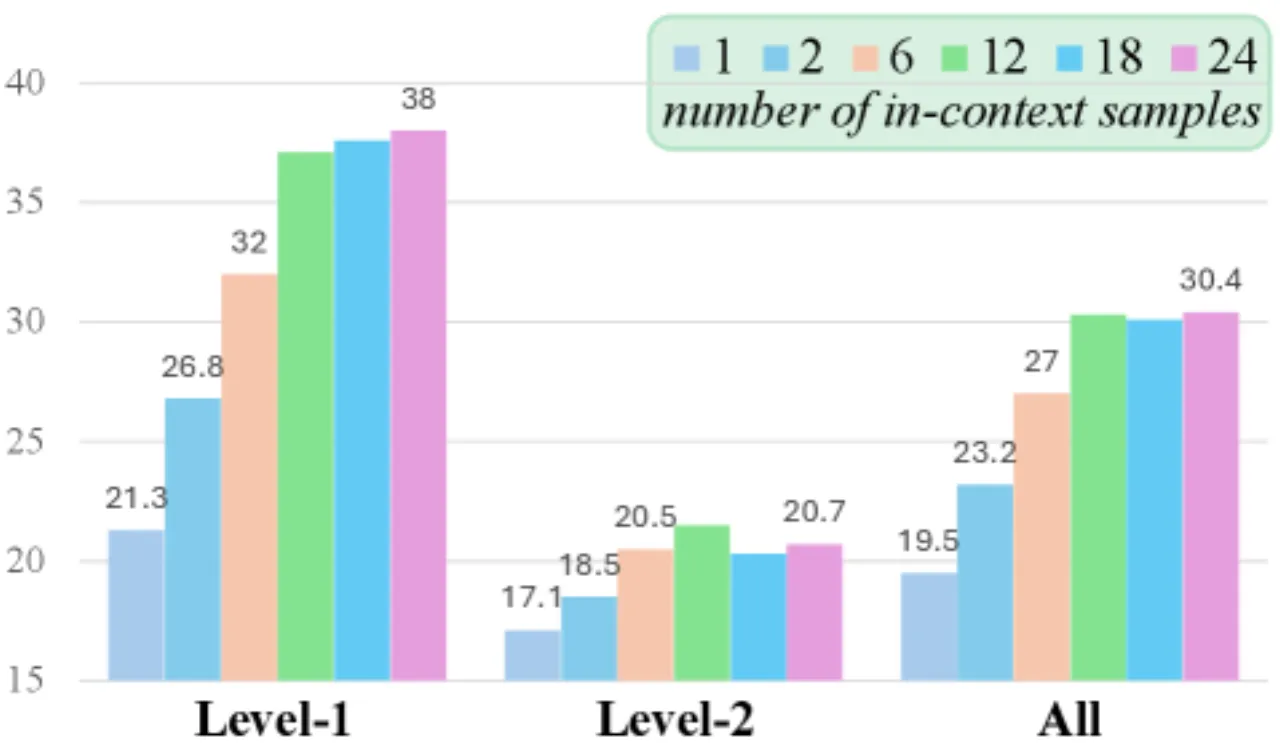
动态引导选择模块将 Overall 从 25.2% 提升至 30.1%(+4.9%),同时将标准差从 ±3.2 显著降至 ±1.0,表明该模块不仅提升了性能,还大幅增强了预测的稳定性。此外,上下文示例数量 K 在超过 12 条后性能趋于饱和。The dynamics-guided selection module raises Overall from 25.2% to 30.1% (+4.9%) and at the same time cuts the standard deviation markedly from ±3.2 to ±1.0, showing that it improves not only performance but also the stability of the predictions. Moreover, performance saturates once the number of in-context demonstrations K goes beyond 12.
X-ICM 将视觉信息压缩为对象坐标文本,原文指出 "the use of visual information is limited to textualizing object information, which may ignore important visual context in the raw data"。这意味着纹理、形状、场景上下文等精细视觉线索无法被 LLM 直接利用,对于需要精细视觉感知的任务(如区分相似外观物体)效果受限。X-ICM compresses visual information into object-coordinate text; the paper points out that "the use of visual information is limited to textualizing object information, which may ignore important visual context in the raw data". Fine-grained visual cues such as texture, shape and scene context therefore cannot be used directly by the LLM, which limits performance on tasks that require fine visual perception (for example telling apart objects with similar appearance).
原文指出 "X-ICM's performance on many unseen tasks...remains limited due to LLMs' challenges in extrapolating beyond pre-training data"。当未见任务的概念完全超出 LLM 的预训练分布时,其动作推断能力将显著退化,特别是 Level-2 中具有全新对象和动作原语的任务。The paper points out that "X-ICM's performance on many unseen tasks...remains limited due to LLMs' challenges in extrapolating beyond pre-training data". When the concepts of an unseen task fall entirely outside the pre-training distribution of the LLM, its action inference degrades markedly, especially for Level-2 tasks with brand-new objects and action primitives.
真实世界"clean the table"任务的整体成功率仅为 5%,原因是多步骤串联任务中各子步骤的错误相互叠加。这是 in-context 预测框架的固有缺陷:无法在线修正中间步骤的偏差。The overall success rate on the real-world "clean the table" task is only 5%, because the errors of the sub-steps in a multi-step chain pile onto one another. This is an inherent flaw of the in-context prediction framework: it cannot correct the deviations of intermediate steps online.
Level-2 中同时包含新对象与新动作原语的任务对所有方法均构成最大挑战。X-ICM(72B)在 Level-2 的 20.3% 成功率虽优于基线,但仍远低于 Level-1 的 37.6%,反映出当前 LLM 的跨任务外推能力边界。Tasks in Level-2 that contain both new objects and new action primitives are the hardest for every method. The 20.3% success rate of X-ICM (72B) on Level-2 beats the baselines but stays far below the 37.6% on Level-1, which reflects the boundary of the cross-task extrapolation ability of current LLMs.