← 论文海报合集← Paper Notes|
机器人 · Robotics · arXiv 2025Robotics · arXiv 2025

AgiBot World Colosseo

面向可扩展智能具身系统的大规模操作平台A Large-scale Manipulation Platform for Scalable and Intelligent Embodied Systems
AgiBot-World-Contributors & 51 位合作者(Qingwen Bu, Guanghui Ren, Chiming Liu … Yu Qiao, Hongyang Li, Bin Zhao 等)AgiBot-World-Contributors & 51 collaborators (Qingwen Bu, Guanghui Ren, Chiming Liu … Yu Qiao, Hongyang Li, Bin Zhao, et al.)

AgiBot World 汇集了超过 100 万条机器人操作轨迹,覆盖 217 项任务和五大部署场景, 并配套发布三阶段泛化策略模型 GO-1(Genie Operator-1)。 在域内与分布外(out-of-distribution)评估中,基于 AgiBot World 预训练的策略均比 Open X-Embodiment 基线提升约 30%AgiBot World brings together over one million robot manipulation trajectories, covering 217 tasks and five major deployment scenarios, and is released together with a three-stage generalist policy model GO-1 (Genie Operator-1). In both in-domain and out-of-distribution evaluations, policies pre-trained on AgiBot World outperform the Open X-Embodiment baseline by roughly 30%.

提交:2025-03-09Submitted: 2025-03-09 100 台双臂人形机器人100 dual-arm humanoid robots 217 项任务 · 5 大场景217 tasks · 5 scenarios 📄 arXiv:2503.06669 GitHub / Project
机器人操作robot manipulation 大规模数据集large-scale dataset latent action model diffusion policy VLA embodied AI 策略泛化policy generalization scaling law 人在环路数据human-in-the-loop data 长时序任务long-horizon tasks

01 动机Motivation

机器人学习在大规模基础模型建设上远落后于 NLP 与计算机视觉,根本原因在于高质量数据采集的困难。 现有数据集往往受限于实验室受控环境、短时序任务和异构硬件,导致策略难以迁移至真实世界的多样场景。Robot learning lags far behind NLP and computer vision in building large-scale foundation models, and the root cause lies in the difficulty of collecting high-quality data. Existing datasets are often confined to controlled laboratory environments, short-horizon tasks and heterogeneous hardware, which makes policies hard to transfer to the diverse scenes of the real world.

"existing robot learning datasets remain constrained by their reliance on short-horizon tasks in highly controlled laboratory environments"
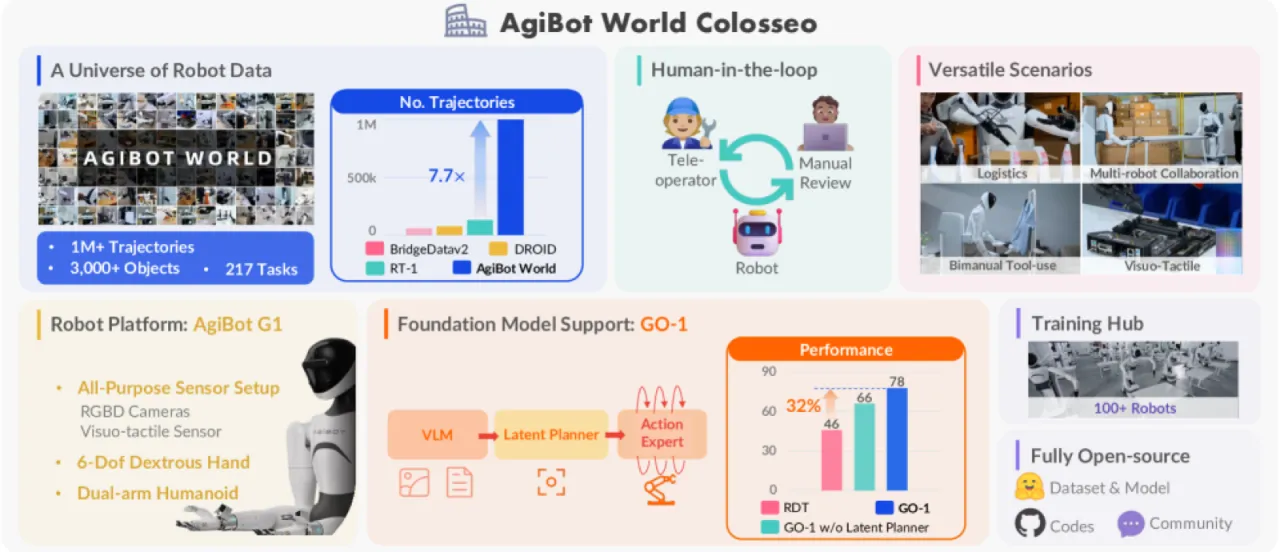
AgiBot World 平台总览
图 1:AgiBot World Colosseo 平台总览。 左侧展示 100 台双臂人形机器人组成的采集集群;中部对比 AgiBot World 与已有数据集在规模与任务覆盖上的差距;右侧展示 GO-1 策略在复杂操作任务中的成功率优势(较 RDT 提升 32%)。Figure 1: Overview of the AgiBot World Colosseo platform. Left: the collection fleet formed by 100 dual-arm humanoid robots; middle: a comparison between AgiBot World and existing datasets in scale and task coverage; right: the success-rate advantage of the GO-1 policy on complex manipulation tasks (a 32% improvement over RDT).
1M+操作轨迹总量Total manipulation trajectories
217覆盖任务数量Tasks covered
+30%vs. Open X-Embodiment 平均提升Average gain vs. Open X-Embodiment
+32%GO-1 vs. RDT 提升GO-1 gain vs. RDT

现有数据集的三大瓶颈Three bottlenecks of existing datasets

02 方法Method

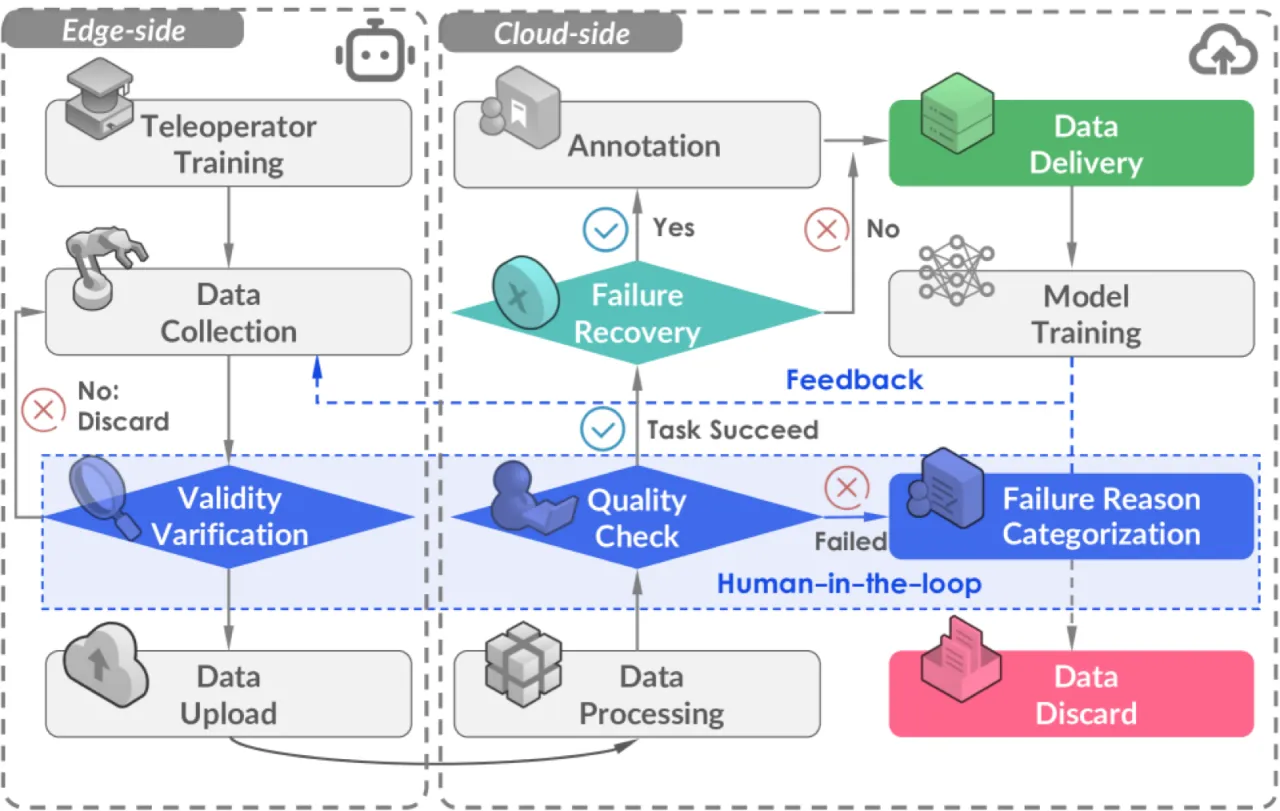
AgiBot World 从数据采集策略建模两个维度同时发力: 前者通过人在环路(human-in-the-loop)的三阶段流程保证数据质量; 后者提出 Vision-Language-Latent-Action(ViLLA)三阶段框架,将网络规模视觉语言预训练与高频扩散控制解耦。AgiBot World pushes forward along two dimensions at once, data collection and policy modelling: the former guarantees data quality through a three-stage human-in-the-loop pipeline; the latter proposes the three-stage Vision-Language-Latent-Action (ViLLA) framework, which decouples web-scale vision-language pre-training from high-frequency diffusion control.

数据采集:三阶段人在环路流程Data collection: a three-stage human-in-the-loop pipeline

数据采集流程
图 2:三阶段数据采集流程。 第一阶段:可行性验证与任务设计;第二阶段:熟练远程操控员执行示范;第三阶段:后处理标注与质量审核。 整个流程形成"采集→训练→部署→反馈"的迭代闭环,并收录约 1% 的失败恢复轨迹(failure recovery data)。Figure 2: The three-stage data collection pipeline. Stage one: feasibility validation and task design; stage two: demonstrations performed by skilled teleoperators; stage three: post-processing annotation and quality review. The pipeline forms an iterative closed loop of "collection → training → deployment → feedback", and includes about 1% failure recovery data.

GO-1:ViLLA 三阶段策略框架GO-1: the three-stage ViLLA policy framework

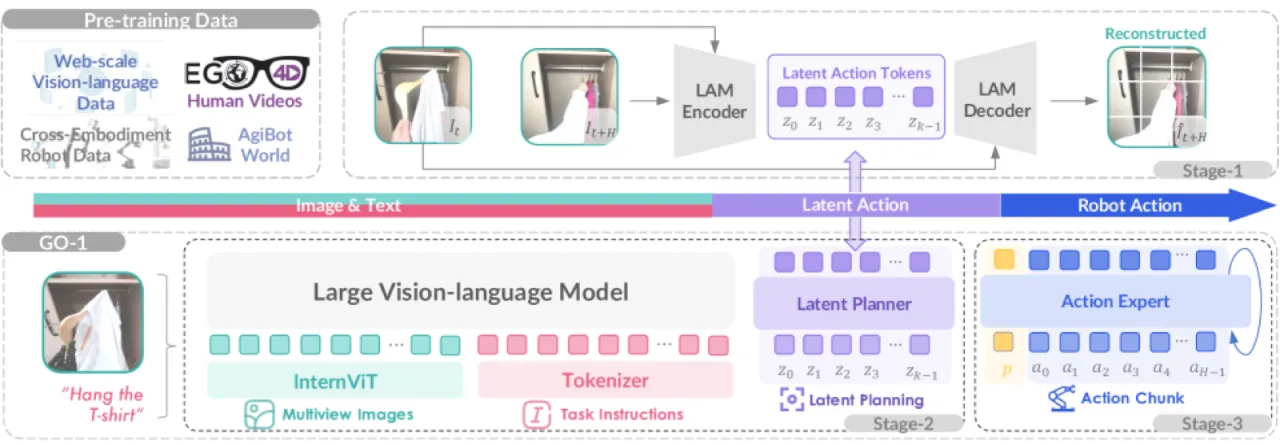
GO-1 架构图
图 3:GO-1(Genie Operator-1)架构。 三个阶段依次为:Latent Action Model(LAM)学习通用动作表征 → Latent Planner 利用预训练 VLM 进行高层规划 → Action Expert 通过扩散目标解码高频低层动作。Figure 3: The GO-1 (Genie Operator-1) architecture. The three stages are, in order: the Latent Action Model (LAM) learns general-purpose action representations → the Latent Planner performs high-level planning with a pre-trained VLM → the Action Expert decodes high-frequency low-level actions through a diffusion objective.

Stage 1 · Latent Action Model(LAM)

在互联网规模的异构视频数据上训练编码器-解码器式潜在动作模型: 编码器基于 inverse dynamics model 将相邻帧映射为潜在动作向量; 解码器基于 forward dynamics model 预测未来帧,从而学习与具身形式无关的通用动作表征。An encoder-decoder style latent action model is trained on internet-scale heterogeneous video data: the encoder, built on an inverse dynamics model, maps adjacent frames into a latent action vector; the decoder, built on a forward dynamics model, predicts future frames, so that embodiment-agnostic general-purpose action representations are learned.

Stage 2 · Latent Planner

InternVL2.5-2B 作为骨干(24 个 transformer 层),通过"逐层条件注入" (layer-by-layer conditioning)将视觉语言理解能力迁移至机器人规划,输出高层潜在规划信号, 实现跨具身的通用性。InternVL2.5-2B serves as the backbone (24 transformer layers); through "layer-by-layer conditioning" the vision-language understanding capability is transferred to robot planning, producing high-level latent planning signals and achieving cross-embodiment generality.

Stage 3 · Action Expert

利用扩散目标(diffusion objective)对低层连续动作分布进行建模, 以 action chunks(H = 30)输出高频关节控制指令,支持灵巧操作任务。A diffusion objective models the low-level continuous action distribution, emitting high-frequency joint control commands as action chunks (H = 30) to support dexterous manipulation tasks.

开源资源Open-source resources

数据集、采集工具链、GO-1 模型权重及评测协议均已公开发布, 旨在推动机器人基础模型研究的可复现与可扩展性。The dataset, the collection toolchain, the GO-1 model weights and the evaluation protocol have all been publicly released, with the aim of advancing the reproducibility and scalability of research on robot foundation models.

03 实验Experiments

所有评估均在真实世界场景中进行,覆盖域内(in-domain)和分布外(out-of-distribution)两类设置, 并与 Open X-Embodiment 预训练基线及 RDT 进行对比。All evaluations are carried out in real-world scenarios, covering both in-domain and out-of-distribution settings, and are compared against the Open X-Embodiment pre-training baseline and RDT.

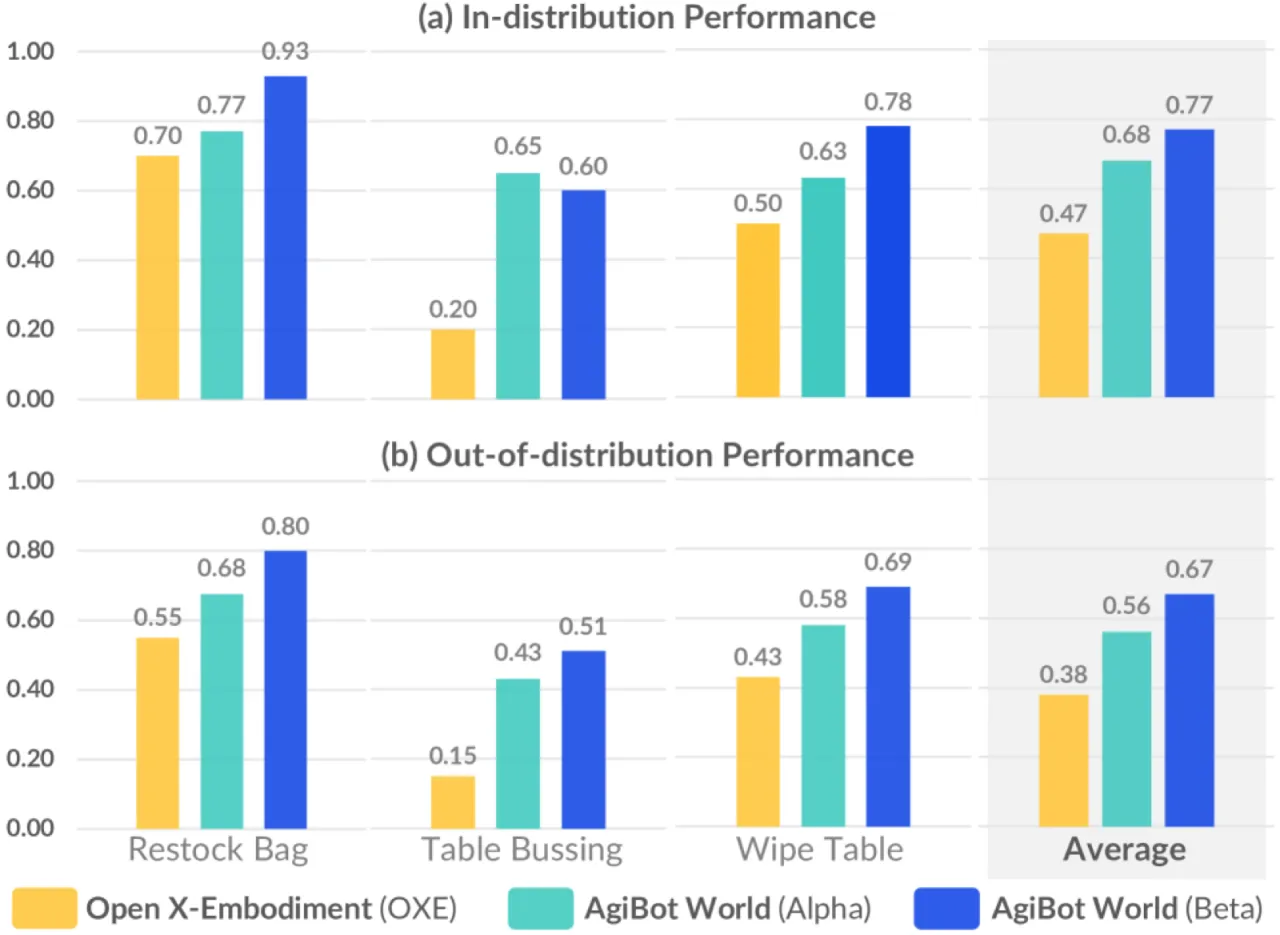
数据集对比:AgiBot World vs. Open X-EmbodimentDataset comparison: AgiBot World vs. Open X-Embodiment

评估设置Evaluation settingOpen X-Embodiment 预训练Open X-Embodiment pre-trainingAgiBot World 预训练AgiBot World pre-training提升Gain
域内(in-domain)In-domain0.470.77+0.30
分布外(out-of-distribution)Out-of-distribution0.380.67+0.29

基于 AgiBot World 预训练的策略在两类场景下均实现 "average performance improvement of 30% over those trained on Open X-Embodiment"Policies pre-trained on AgiBot World achieve, under both settings, an "average performance improvement of 30% over those trained on Open X-Embodiment".

GO-1 vs. RDT 对比GO-1 vs. RDT comparison

GO-1 与 RDT 性能对比
图 4:GO-1 与 RDT 在不同复杂操作任务中的成功率对比。 GO-1 在 "Fold Shorts"、"Restock Beverage" 等长时序灵巧任务中均优于 RDT,平均提升 0.12 任务完成得分; Latent Planner 的加入贡献了显著增益。Figure 4: Success-rate comparison between GO-1 and RDT on different complex manipulation tasks. GO-1 outperforms RDT on long-horizon dexterous tasks such as "Fold Shorts" and "Restock Beverage", raising the task completion score by 0.12 on average; adding the Latent Planner contributes a notable gain.
模型Model复杂任务成功率Success rate on complex tasks相对 RDT 提升Gain over RDT
RDT(prior best)
GO-1(ours)> 60%+32%

Scaling Law 与数据质量消融Ablations on scaling law and data quality

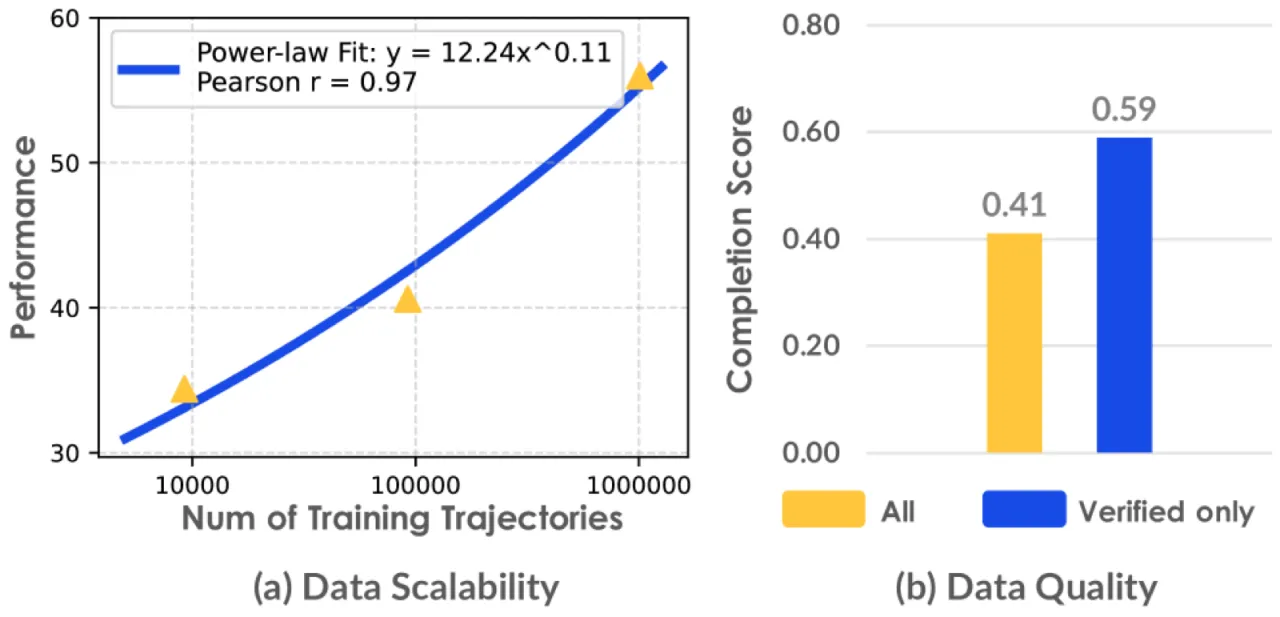
Scaling law 与质量消融
图 5:消融实验结果。 (a)数据集规模(9.2k → 1M 轨迹)与策略性能呈幂律关系,Pearson r = 0.97,验证了 scaling law 的存在。 (b)人工验证数据(528 条)相比未验证数据(482 条)提升策略得分 0.18,说明数据质量对策略性能的关键影响。Figure 5: Ablation results. (a) Dataset scale (9.2k → 1M trajectories) follows a power-law relation with policy performance, with Pearson r = 0.97, confirming the existence of a scaling law. (b) Human-verified data (528 trajectories) raises the policy score by 0.18 compared with unverified data (482 trajectories), showing the critical impact of data quality on policy performance.

04 局限性Limitations

注:以下第 1 点为作者在论文中明确陈述(stated);第 2、3 点为基于方法设计推断(inferred)。Note: item 1 below is explicitly stated by the authors in the paper; items 2 and 3 are inferred from the design of the method.
缺乏仿真评估环境(明确陈述)No simulation evaluation environment (stated)

论文明确指出:"All evaluations are conducted in real-world scenarios. We are currently developing the simulation environment to facilitate fast and reproducible evaluation." 目前所有指标均来自真实机器人测试,缺乏可快速重现的仿真基准,限制了社区对结果的独立验证。The paper states explicitly: "All evaluations are conducted in real-world scenarios. We are currently developing the simulation environment to facilitate fast and reproducible evaluation." All current metrics come from tests on real robots, and the lack of a quickly reproducible simulation benchmark limits independent verification of the results by the community.

硬件依赖性(推断)Hardware dependence (inferred)

整套系统依赖 100 台定制双臂人形机器人与专用灵巧手、视触觉传感器, 数据采集与策略复现的硬件门槛较高,难以被一般研究机构直接复制。The whole system relies on 100 customized dual-arm humanoid robots together with dedicated dexterous hands and visuo-tactile sensors; the hardware barrier for data collection and policy reproduction is high, and it is hard for ordinary research institutions to replicate it directly.

跨具身泛化的隐含假设(推断)Implicit assumptions of cross-embodiment generalization (inferred)

Latent Action Model 虽声称学习"具身无关"的表征,但预训练视频数据与目标机器人之间的域差异(embodiment gap) 尚未被系统分析;在形态差异较大的机器人平台上的迁移效果有待验证。Although the Latent Action Model claims to learn "embodiment-agnostic" representations, the domain difference between the pre-training video data and the target robot (the embodiment gap) has not been systematically analyzed; how well it transfers to robot platforms with markedly different morphologies remains to be verified.