← 论文海报合集← Paper Notes|
ICML 2026 · 生成模型ICML 2026 · Generative Models

Adversarial Flow Models

对抗流模型:将对抗训练与确定性最优传输相融合,实现单步高质量图像生成Adversarial Flow Models: uniting adversarial training with deterministic optimal transport for high-quality one-step image generation
Shanchuan Lin  ·  Ceyuan Yang  ·  Zhijie Lin  ·  Hao Chen  ·  Haoqi Fan  ·  ByteDance Seed

本文提出 Adversarial Flow Models (AFM),一种同时属于对抗生成网络(GAN)与流匹配(Flow Matching)两大家族的生成模型框架。 通过引入最优传输正则化损失,AFM 将随机噪声确定性地映射为真实数据,从而稳定对抗训练并保留模型容量。 在 ImageNet 256px 单步生成任务上,AFM-XL/2 达到 FID 2.38,超越所有已知的一致性模型; 扩展到 112 层深度架构后进一步取得 FID 1.94,创下新的单步生成最优记录。This paper introduces Adversarial Flow Models (AFM), a generative framework that belongs to both the adversarial network (GAN) family and the Flow Matching family. By adding an optimal-transport regularization loss, AFM maps random noise deterministically onto real data, thereby stabilizing adversarial training while preserving model capacity. On one-step generation over ImageNet 256px, AFM-XL/2 reaches FID 2.38, surpassing every known consistency model; scaled to a 112-layer deep architecture it further attains FID 1.94, a new best record for one-step generation.

ImageNet 256px 单步 FID 2.38 (XL/2)One-step FID 2.38 (XL/2) 112 层 FID 1.94112 layers, FID 1.94 📄 arXiv: 2511.22475 PDF 全文Full PDF
关键词Keywordsadversarial trainingflow matchingoptimal transport单步图像生成one-step image generationGANDiffusion TransformerFID生成模型generative modelsgradient normalizationclassifier guidance

01 动机Motivation

现有单步生成方法面临两类核心问题:GAN 训练不稳定,一致性模型(Consistency Models)引入中间时间步监督导致模型容量受限。 作者指出,对抗目标本身无法确定唯一的优化目标,噪声到数据之间存在无穷多条合法的传输路径,导致 GAN 学到任意映射而非确定性最优传输。Existing one-step generation methods face two core problems: GAN training is unstable, and consistency models introduce supervision at intermediate time steps, which limits model capacity. The authors point out that the adversarial objective alone cannot pin down a unique optimization target: infinitely many valid transport paths exist between noise and data, so a GAN learns an arbitrary mapping rather than deterministic optimal transport.

"The adversarial objective alone does not define a single optimization target, leaving infinitely many valid transport maps between noise and data distributions."
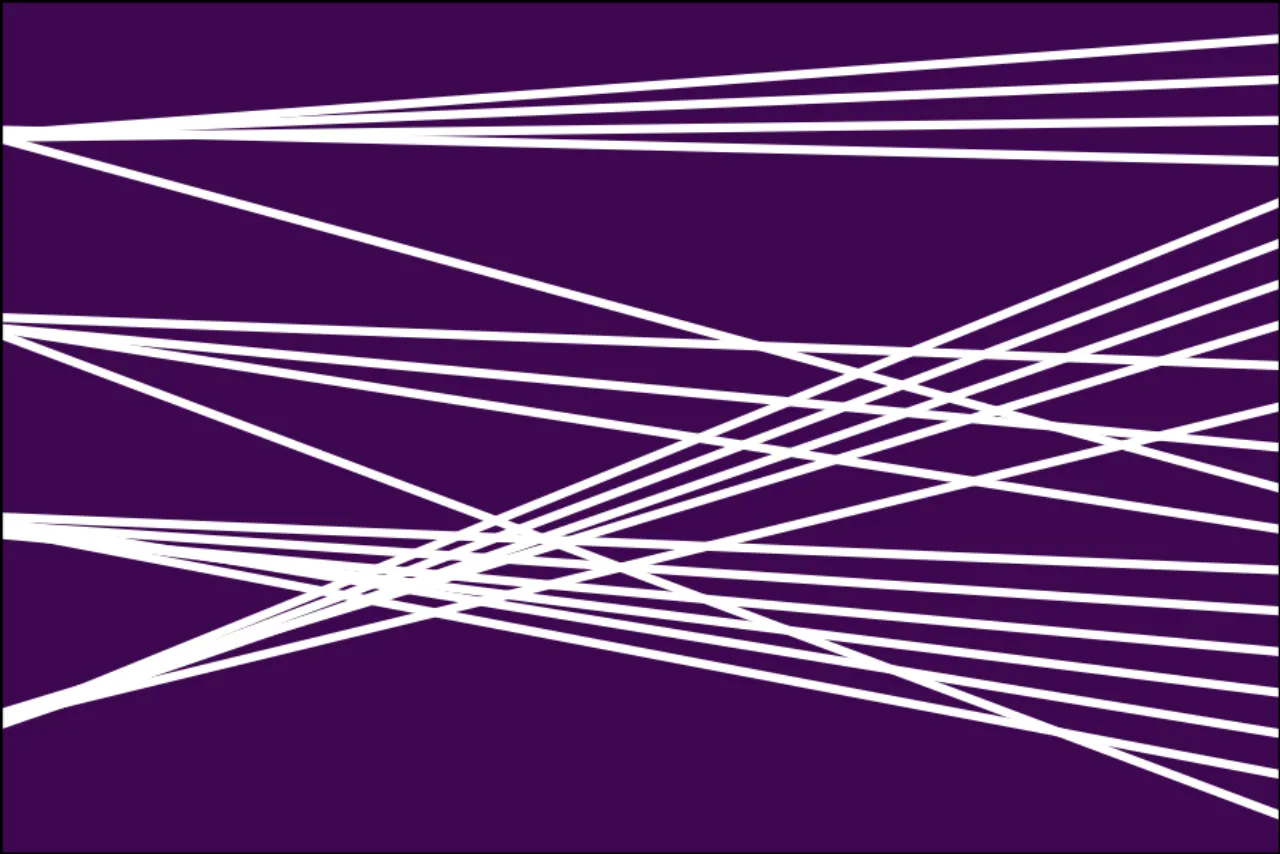
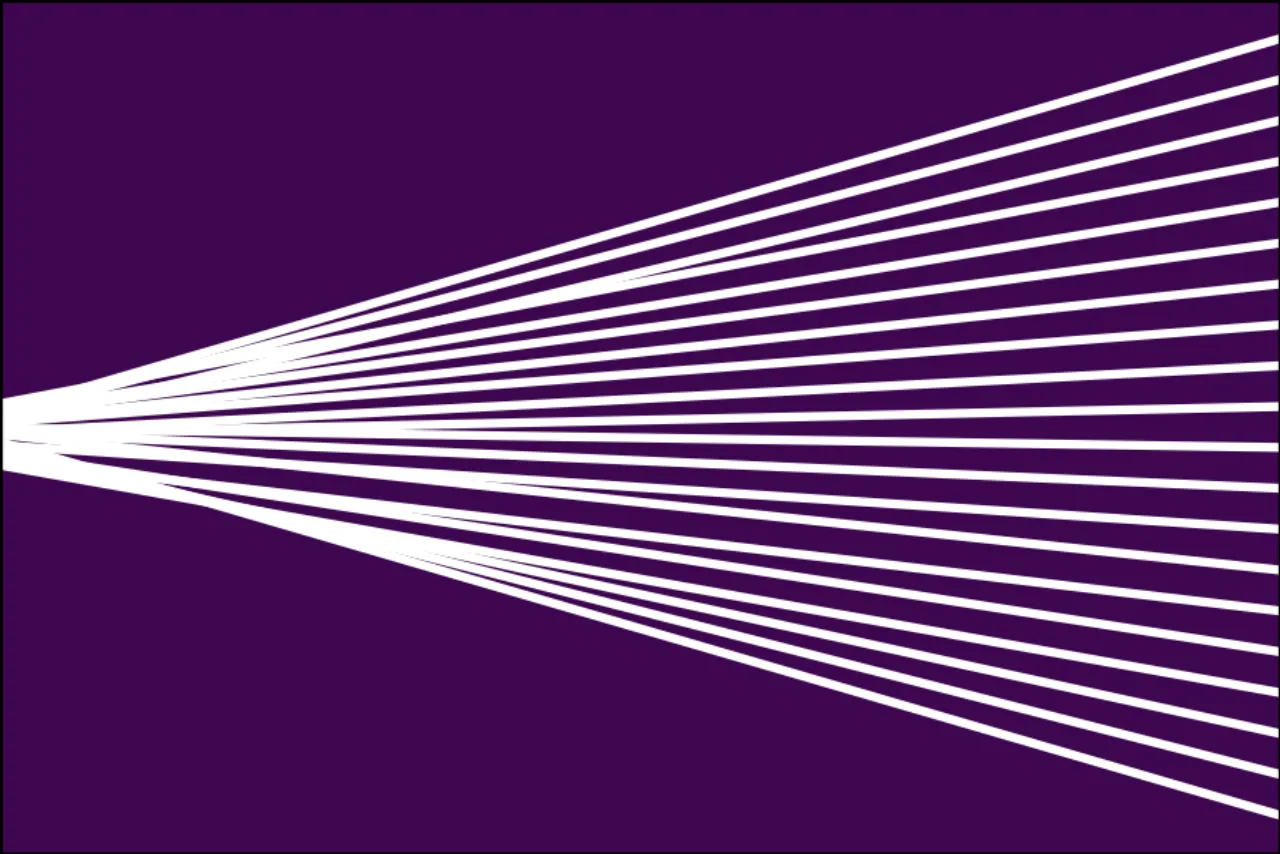
方法对比示意图 —— GAN vs Flow Matching vs AFM
图 1:在 1D 高斯混合数据上的行为对比。 左:GAN 学到任意传输映射(非确定性)。中:Flow Matching 学到确定性映射但低步数下存在离散化误差。右:AFM 同时支持任意步数训练,并通过最优传输约束引导生成确定性映射,兼具两者优点。Figure 1: Behavioral comparison on 1D Gaussian mixture data. Left: GAN learns an arbitrary transport map (non-deterministic). Middle: Flow Matching learns a deterministic map but suffers discretization error at low step counts. Right: AFM supports training with any number of steps and, through the optimal-transport constraint, is guided toward a deterministic map, combining the strengths of both.
2.38AFM-XL/2 单步 FID
(ImageNet 256px,带引导)
AFM-XL/2 one-step FID
(ImageNet 256px, with guidance)
1.94112 层深度架构
单步 FID 最优
112-layer deep architecture
best one-step FID
2.02AFM-XL/2 4 步 FID
(超过 MeanFlow/AlphaFlow)
AFM-XL/2 4-step FID
(beats MeanFlow/AlphaFlow)
3.98AFM-XL/2 单步 FID
(无引导,仍大幅优于 FM 250步 9.62)
AFM-XL/2 one-step FID
(unguided, still far ahead of FM at 250 steps, 9.62)

先前工作的不足Shortcomings of prior work

GAN 的问题Problems with GANs

  • 对抗目标无法唯一确定传输映射The adversarial objective cannot uniquely determine the transport map
  • 生成器学到随机/任意的噪声到数据映射The generator learns a random / arbitrary noise-to-data mapping
  • 训练在大型 Transformer 架构上不稳定Training is unstable on large Transformer architectures
  • 判别器损失在 ImageNet 等复杂数据上容易发散The discriminator loss easily diverges on complex data such as ImageNet

一致性模型的问题Problems with consistency models

  • 需要对每个中间时间步 t 进行监督(distillationconsistency trainingSupervision is required at every intermediate time step t (distillation or consistency training)
  • 单步生成时模型容量被中间步骤占用,质量受限In one-step generation the model capacity is taken up by intermediate steps, so quality is limited
  • 无法像单纯的 GAN 那样直接利用判别器的感知能力Cannot exploit the discriminator's perceptual ability as directly as a plain GAN
02 方法Method

AFM 的核心思想:在标准 GAN 对抗目标之上,叠加一个二次最优传输正则化损失,利用 Brenier 定理保证存在唯一最优传输映射作为优化目标。 同时引入梯度归一化技术,使大型 Transformer 架构下的训练保持稳定。The core idea of AFM: on top of the standard GAN adversarial objective, add a quadratic optimal-transport regularization loss, so that Brenier's theorem guarantees a unique optimal transport map as the optimization target. A gradient normalization technique is introduced at the same time to keep training stable under large Transformer architectures.

λ_ot 参数对生成质量的影响
图 2:最优传输系数 λ_ot 的消融实验(单步生成,1D 高斯混合)。 λ_ot=0(纯 GAN)时模型学到任意映射;λ_ot 过大时输出趋向恒等映射(identity); 适当的 λ_ot(如 0.05)引导模型学到接近最优传输的确定性映射,分布对齐最佳。Figure 2: Ablation on the optimal-transport coefficient λ_ot (one-step generation, 1D Gaussian mixture). With λ_ot=0 (pure GAN) the model learns an arbitrary mapping; when λ_ot is too large the output tends toward the identity mapping; a suitable λ_ot (e.g. 0.05) guides the model toward a deterministic mapping close to optimal transport, giving the best distribution alignment.

核心损失:最优传输正则化Core loss: optimal-transport regularization

根据 Brenier 定理,在二次代价下存在唯一的最优传输映射。AFM 以此为理论基础,对生成器添加 OT 正则化损失:By Brenier's theorem a unique optimal transport map exists under quadratic cost. AFM takes this as its theoretical basis and adds an OT regularization loss to the generator:

ℒ_ot^G = 𝔼_z [ (1/n) · ‖G(z) − z‖² ]

该损失最小化生成样本与输入噪声之间的总传输距离,将优化方向偏置向唯一最优传输解,而非任意一个 GAN 解。 完整生成器目标为:This loss minimizes the total transport distance between generated samples and input noise, biasing optimization toward the unique optimal transport solution rather than an arbitrary GAN solution. The full generator objective is:

ℒ_AF^G = ℒ_adv^G + λ_ot · ℒ_ot^G

梯度归一化(Gradient Normalization)Gradient Normalization

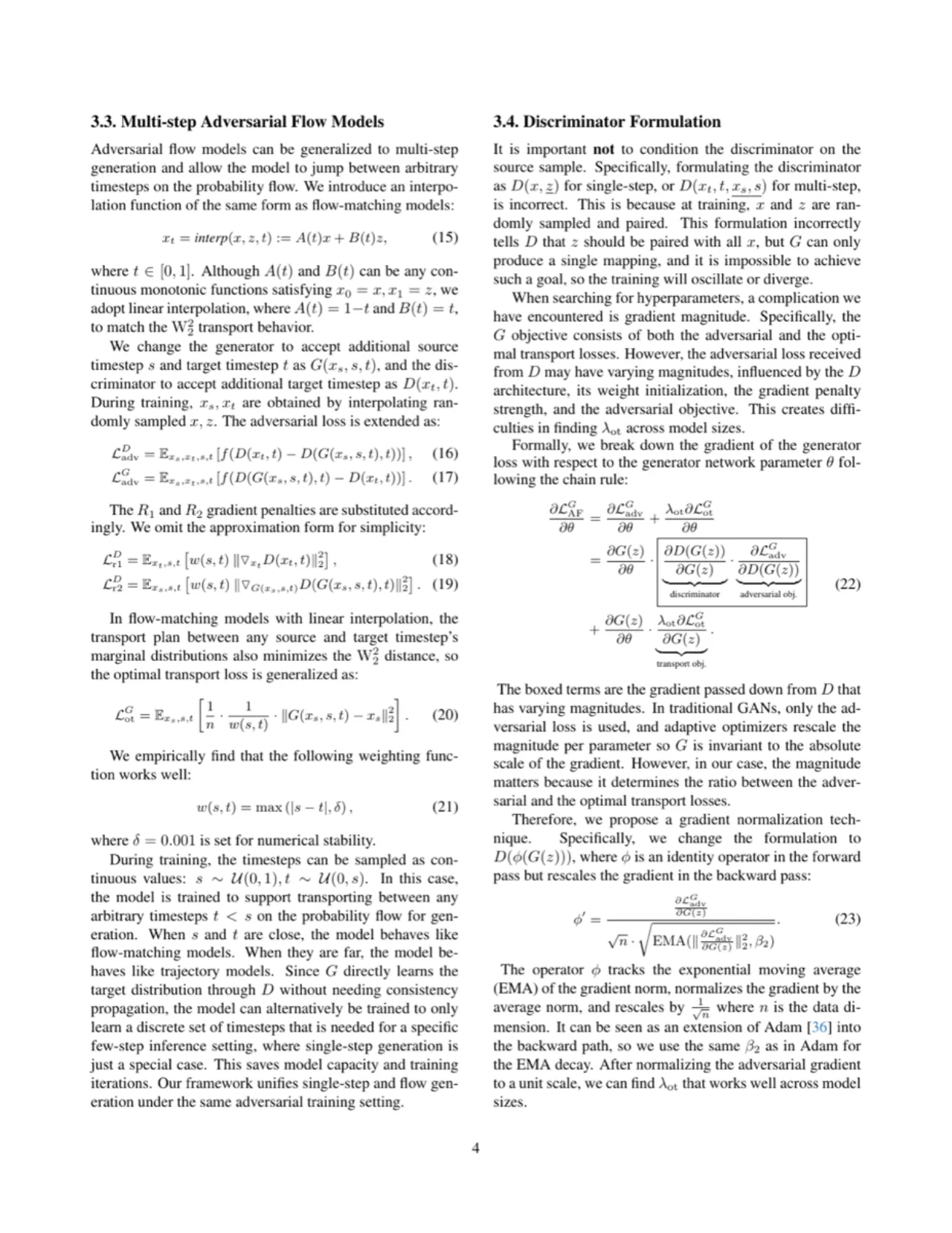
在大型 Transformer 架构中,不同模型尺寸下梯度幅度差异显著,导致 λ_ot 超参数难以跨模型复用。 AFM 引入一个恒等算子 φ,在反向传播中对对抗梯度进行归一化:In large Transformer architectures the gradient magnitude differs markedly across model sizes, making the λ_ot hyperparameter hard to reuse across models. AFM introduces an identity operator φ that normalizes the adversarial gradient during backpropagation:

φ'(G(z)) = (∂ℒ_adv^G / ∂G(z)) / (√n · √EMA(‖∂ℒ_adv^G / ∂G(z)‖², β₂))

该技术使对抗梯度的尺度与 OT 正则化梯度保持一致,无需针对每个模型尺寸手动调整超参数。This keeps the scale of the adversarial gradient consistent with that of the OT regularization gradient, removing the need to hand-tune the hyperparameter for every model size.

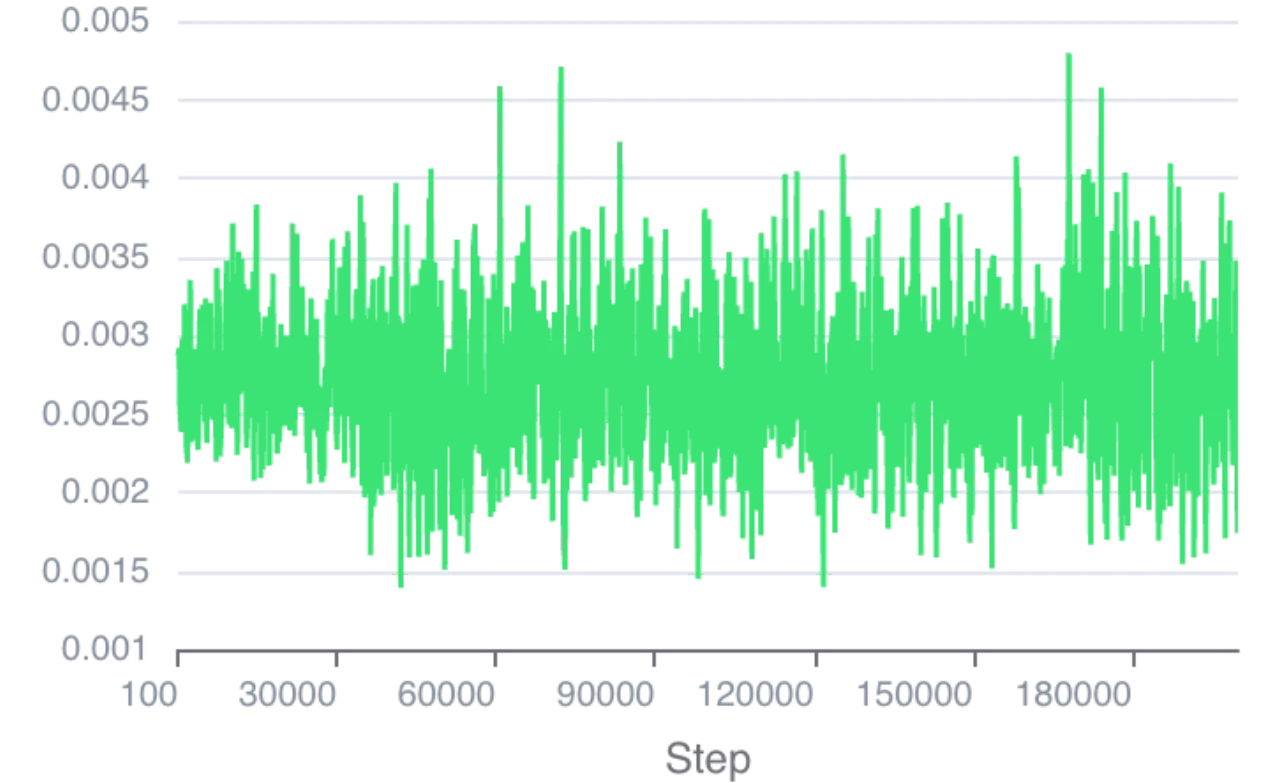
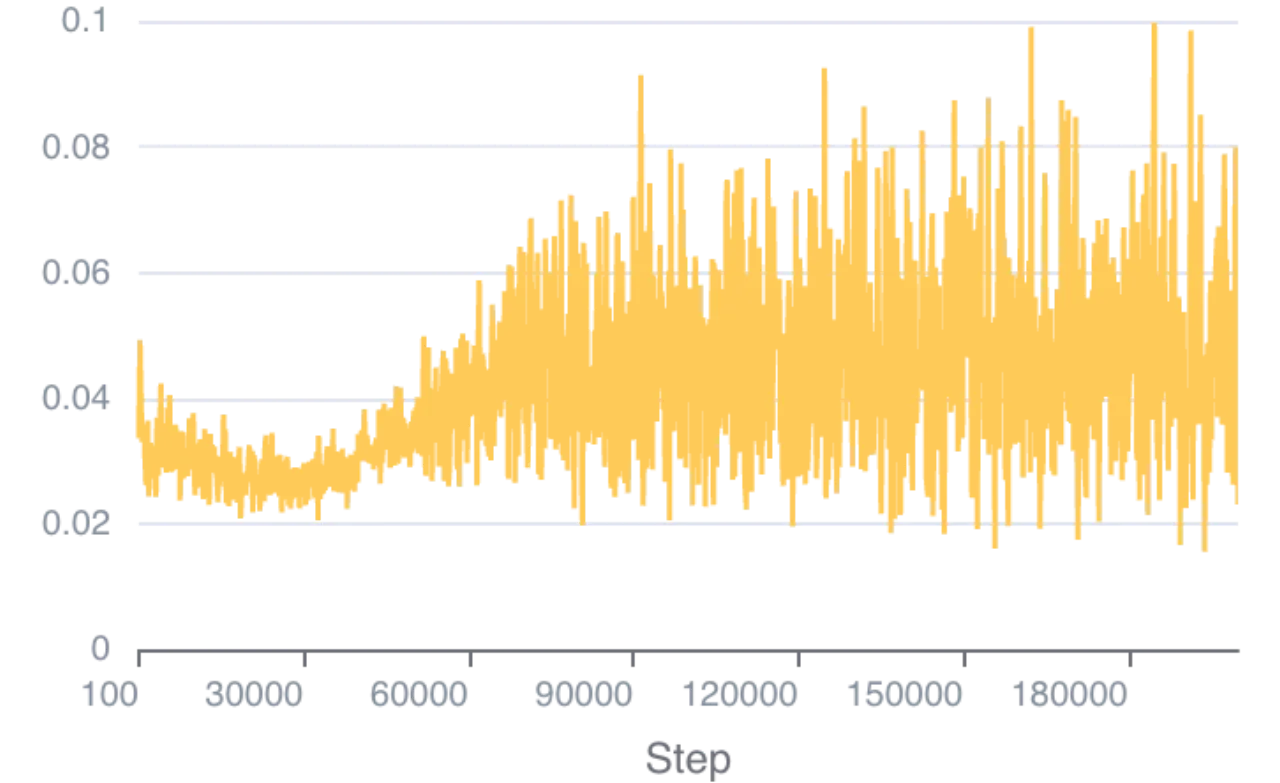
无梯度归一化时的训练曲线
无梯度归一化:对抗损失曲线剧烈震荡,训练不稳定。Without gradient normalization: the adversarial loss curve oscillates violently and training is unstable.
有梯度归一化时的训练曲线
有梯度归一化:训练曲线平滑收敛,大模型下同样稳定。With gradient normalization: the training curve converges smoothly and stays stable for large models.

多步扩展:任意时间步传输Multi-step extension: transport between arbitrary time steps

AFM 可扩展到多步生成:在时间步 t ∈ [0,1] 上做线性插值 x_t = (1−t)·x + t·z, 生成器 G(x_s, s, t) 学习从时间步 s 到 t 的传输,OT 损失相应加权:AFM extends to multi-step generation: linear interpolation over time steps t ∈ [0,1] via x_t = (1−t)·x + t·z, with the generator G(x_s, s, t) learning the transport from time step s to t and the OT loss weighted accordingly:

ℒ_ot^G = 𝔼 [ (1/n) · (1/w(s,t)) · ‖G(x_s, s, t) − x_s‖² ],w(s,t) = max(|s−t|, 0.001)

流引导(Flow-based Classifier Guidance)Flow-based Classifier Guidance

为条件生成提供引导,AFM 采用基于流的分类器引导——在随机时间步 t' ~ 𝒰(0, 0.1) 上对插值样本计算分类器梯度, 模拟 Classifier-Free Guidance 的行为,从而在单步模型中也能享受强引导效果:To provide guidance for conditional generation, AFM adopts flow-based classifier guidance: classifier gradients are computed on interpolated samples at random time steps t' ~ 𝒰(0, 0.1), mimicking the behavior of Classifier-Free Guidance so that even a one-step model enjoys strong guidance:

ℒ_cfg^G = 𝔼 [ −(1/n) · G(z,c)^T · ∇C(·, t', c) ]

架构:深度扩展(Deep Architecture)Architecture: deep scaling

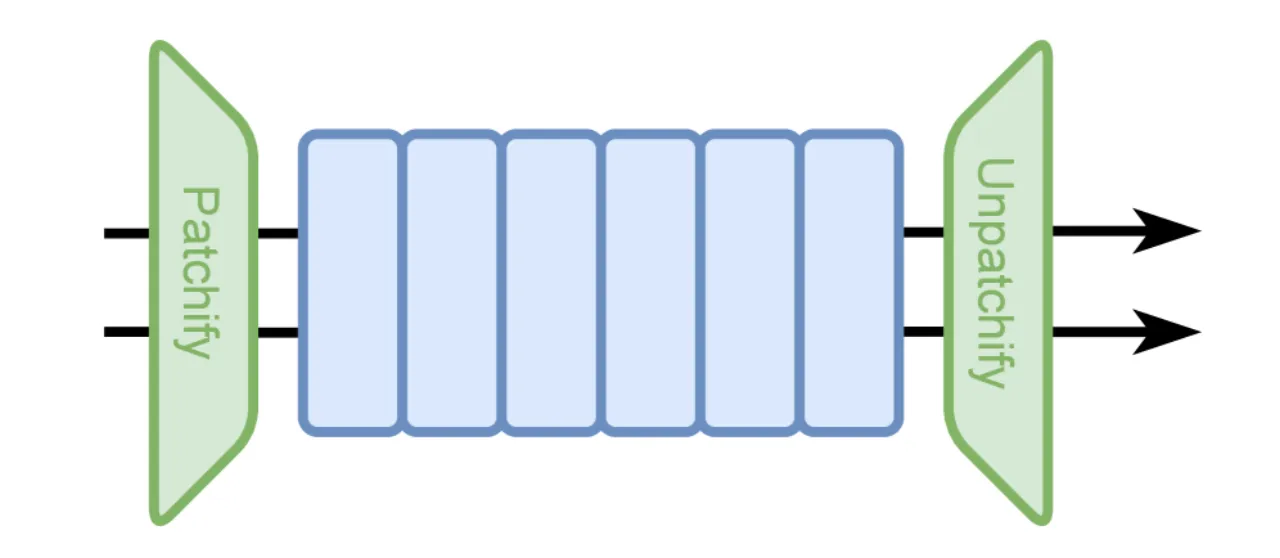
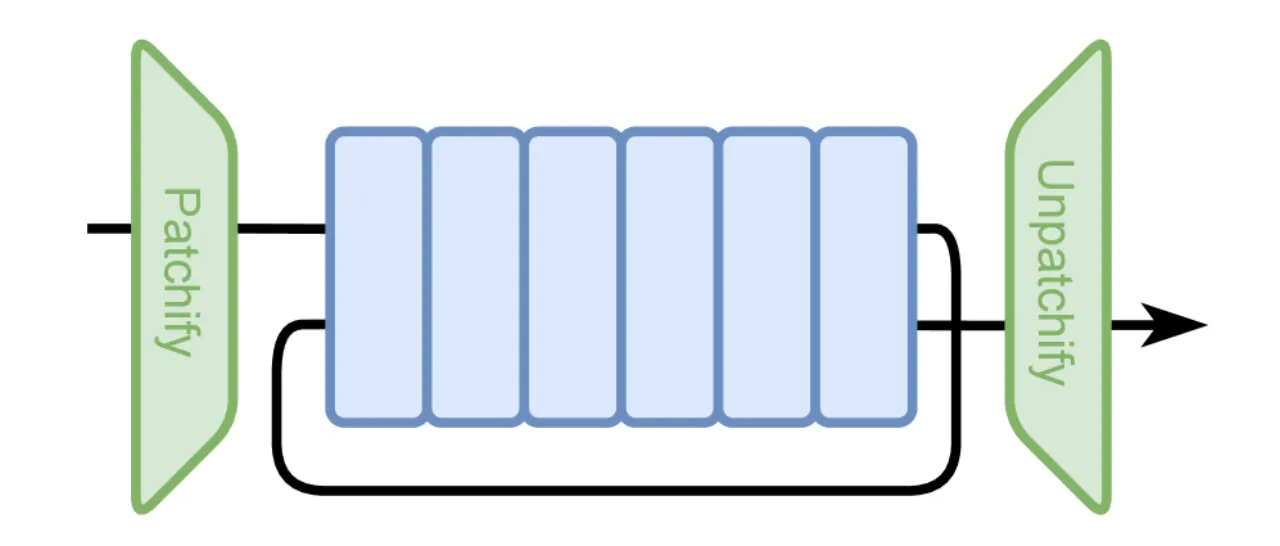
生成器和判别器均采用标准 Diffusion Transformer(DiT),判别器新增可学习的 [CLS] token 输出 logit。 为提升单步生成质量,作者通过 Transformer Block 重复扩展模型深度,构建 56 层(2×)和 112 层(4×)变体, 无需中间步骤监督即可端到端训练。Both generator and discriminator use a standard Diffusion Transformer (DiT); the discriminator adds a learnable [CLS] token that outputs the logit. To improve one-step generation quality, the authors scale model depth by repeating Transformer Blocks, building 56-layer (2×) and 112-layer (4×) variants that train end to end without supervision at intermediate steps.

深度架构示意图(来自论文 PDF 第 4 页)
深度架构(图 4):通过重复 DiT Block,构建 56 层和 112 层超深模型。 左:多步配置;右:单步超深配置。深度替代中间步骤监督,在等参数等计算量条件下显著提升生成质量。Deep architecture (Figure 4): repeating DiT Blocks builds ultra-deep models of 56 and 112 layers. Left: multi-step configuration; right: one-step ultra-deep configuration. Depth replaces supervision at intermediate steps and markedly improves generation quality at matched parameters and compute.

03 实验Experiments

所有实验在 ImageNet 256px 上进行,使用预训练 VAE 将图像编码至 32×32×4 潜在空间。 优化器为 AdamW(β₁=0, β₂=0.9),学习率 1×10⁻⁴,批大小 256。 主要评测指标为 FID(越低越好)。All experiments are run on ImageNet 256px, using a pretrained VAE to encode images into a 32×32×4 latent space. The optimizer is AdamW (β₁=0, β₂=0.9) with learning rate 1×10⁻⁴ and batch size 256. The main evaluation metric is FID (lower is better).

单步生成对比(Table 4,带引导)One-step generation comparison (Table 4, with guidance)

方法Method 参数量Params Epoch 引导方式Guidance NFE FID ↓
iCT-XL/2675MNone134.24
Shortcut-XL/2675M250CFG110.60
MeanFlow-B/2131M240CFG16.17
AlphaFlow-B/2†131M240CFG15.40
MeanFlow-XL/2676M240CFG13.43
TiM-XL/2†664M300CFG13.26
AlphaFlow-XL/2†676M240CFG12.81
GigaGAN569M480Match-loss13.45
GAT-XL/2+REPA†602M40DA+cGAN12.96
StyleGAN-XL166MCG+cGAN12.30
AFM-B/2130M200CG+DA13.05
AFM-M/2306M120CG+DA12.82
AFM-L/2457M120CG+DA12.63
AFM-XL/2673M125CG+DA12.38

"our B/2 model surpasses many XL/2 consistency-based models"——AFM-B/2(FID 3.05)超越 MeanFlow-XL/2(FID 3.43), 以不足五分之一的参数量取得更优结果。"our B/2 model surpasses many XL/2 consistency-based models" — AFM-B/2 (FID 3.05) beats MeanFlow-XL/2 (FID 3.43), reaching a better result with fewer than one fifth of the parameters.

少步生成对比Few-step generation comparison

方法Method步数(NFE)Steps (NFE)FID ↓
AFM-XL/212.38
AFM-XL/222.11
AFM-XL/242.02

无引导生成对比(Table 6)Unguided generation comparison (Table 6)

方法MethodNFEFID ↓
DiT-XL/2(标准流匹配)DiT-XL/2 (standard flow matching)2509.62
AFM-XL/213.98
AFM-XL/222.36

即使没有分类器引导,AFM-XL/2 单步推理(FID 3.98)也显著优于标准 Flow Matching 250 步推理(FID 9.62), 说明判别器的感知损失能更好地捕捉数据流形结构。Even without classifier guidance, one-step inference with AFM-XL/2 (FID 3.98) is markedly better than standard Flow Matching with 250 steps (FID 9.62), showing that the discriminator's perceptual loss captures the structure of the data manifold better.

深度架构扩展(Table 7)Deep architecture scaling (Table 7)

深度Depth参数量ParamsEpoch引导GuidanceNFEFID ↓
28 层(1×基准)28 layers (1× baseline)675M95CG+DA22.11
56 层(2×)56 layers (2×)675M95CG+DA12.08
28 层(1×基准)28 layers (1× baseline)675M145CG+DA42.02
112 层(4×)112 layers (4×)675M120CG+DA11.94

"surpasses their 28-layer 2-step and 4-step counterparts"——112 层单步模型(FID 1.94)超越 28 层 4 步模型(FID 2.02), 表明深度可以取代多步骤监督,为提升单步生成质量提供了新方向。"surpasses their 28-layer 2-step and 4-step counterparts" — the 112-layer one-step model (FID 1.94) beats the 28-layer 4-step model (FID 2.02), showing that depth can replace multi-step supervision and opening a new direction for improving one-step generation quality.

定性结果Qualitative results

GAN 单步生成结果
GAN(纯对抗):单步生成,分布不一致,细节模糊。GAN (purely adversarial): one-step generation; the distribution does not match and details are blurry.
Flow Matching 单步生成结果
Flow Matching:单步推理时离散化误差明显,质量下降。Flow Matching: discretization error is obvious under one-step inference and quality drops.
AFM 单步生成结果
AFM(本文方法):λ_ot=0.05,单步生成质量明显提升,分布对齐最佳。AFM (this paper): λ_ot=0.05; one-step generation quality improves markedly, with the best distribution alignment.

消融实验Ablation studies

04 局限性Limitations

说明:以下前两点为论文原文明确陈述(stated),后两点为根据方法设计的推断(inferred)。 论文未设独立"Limitations"章节,相关内容散布于结论与附录中。Note: the first two points below are explicitly stated in the paper; the last two are inferred from the method design. The paper has no separate "Limitations" section; the relevant content is scattered through the conclusion and the appendix.
训练计算开销较高(stated)High training compute cost (stated)

判别器网络大幅增加显存占用,每次迭代需要多次前向传播。 训练时间约为一致性模型的 1.88 倍(相对于 AlphaFlow 的计算量对比)。 这限制了在资源受限环境下的可扩展性。The discriminator network substantially increases memory usage, and each iteration requires several forward passes. Training time is about 1.88 times that of consistency models (measured against the compute of AlphaFlow). This limits scalability in resource-constrained settings.

依赖分类器引导,未支持 Classifier-Free Guidance(stated)Depends on classifier guidance; Classifier-Free Guidance not supported (stated)

当前方法采用外部分类器引导(Classifier Guidance, CG)而非 Classifier-Free Guidance(CFG)。 论文指出这是方法的一个技术约束,但同时表明 AFM 的流引导机制在单步模型中模拟了 CFG 的行为。The current method uses external classifier guidance (CG) rather than Classifier-Free Guidance (CFG). The paper notes this as a technical constraint of the method, while also showing that AFM's flow guidance mechanism mimics CFG behavior inside a one-step model.

梯度消失问题需额外处理(stated)Vanishing gradients need extra handling (stated)

论文附录详细说明了深度架构训练中存在梯度消失问题,需要专门的梯度归一化(Gradient Normalization)技术加以缓解。 这增加了实现复杂度。The appendix explains in detail that vanishing gradients arise when training deep architectures and require a dedicated Gradient Normalization technique to mitigate. This adds implementation complexity.

目前仅为离散时间公式化,缺乏连续时间扩展(inferred)Only a discrete-time formulation so far, with no continuous-time extension (inferred)

当前框架基于离散时间步,论文结论中提到"continuous-time flow modeling extension"是未来工作方向, 说明当前方法尚不支持连续时间建模,限制了与连续时间流模型的直接对比和融合。The current framework is built on discrete time steps, and the conclusion mentions "continuous-time flow modeling extension" as future work, which indicates that the method does not yet support continuous-time modeling and limits direct comparison and integration with continuous-time flow models.

仅在 ImageNet 256px 上验证,其他任务/分辨率未知(inferred)Validated only on ImageNet 256px; other tasks/resolutions unknown (inferred)

所有定量实验均在 ImageNet 256px 类条件生成任务上进行,未包含文本到图像、视频生成等其他生成任务, 方法在这些场景下的适用性有待验证。All quantitative experiments are on class-conditional generation over ImageNet 256px, and do not cover text-to-image, video generation or other generative tasks, so the applicability of the method in those settings remains to be verified.