Action-Conditional Video Prediction using Deep Networks in Atari Games
首个在高维 Atari 游戏画面上实现超 100 步动作条件长期预测的深度网络框架The first deep network framework to achieve action-conditional long-term prediction beyond 100 steps on high-dimensional Atari game frames
Junhyuk Oh · Xiaoxiao Guo · Honglak Lee · Richard Lewis · Satinder Singh | University of Michigan, Ann Arbor
本文针对视觉强化学习问题提出两种深度神经网络架构——基于 feedforward(前馈)编码和 recurrent(循环)编码——用于预测依赖动作变量的未来游戏帧。实验表明,模型能在 Atari 游戏中生成视觉逼真、可用于控制的超 100 步预测帧,并可通过"知情探索(informed exploration)"策略改善 DQN 的训练效率。This paper proposes two deep neural network architectures for visual reinforcement learning — one based on feedforward encoding and one on recurrent encoding — to predict future game frames conditioned on action variables. Experiments show that the models generate visually realistic, control-usable predictions beyond 100 steps in Atari games, and that an "informed exploration" strategy built on them improves the training efficiency of DQN.
在视觉强化学习(RL)中,智能体观察到的画面不仅取决于历史帧,还受当前动作的支配。如何在高维图像空间中建立精确的动作条件转移模型,是 model-based RL 的核心挑战之一。In visual reinforcement learning (RL), the frames an agent observes depend not only on past frames but also on the current action. Building an accurate action-conditional transition model in a high-dimensional image space is one of the core challenges of model-based RL.
"To the best of our knowledge, this paper is the first to make and evaluate long-term predictions on high-dimensional video conditioned by control inputs."
Atari 游戏提供了极具挑战性的场景:画面分辨率达 210×160 像素 RGB,场景中可能存在数十个对象,部分对象由动作直接控制,其余受间接影响;对象可随时进入或离开画面,且存在深度局部可观测性。之前的视频预测研究(如 RTRBM、LSTM 等)仅处理弹跳球或小图像块等简单情形,且忽略动作变量。本文要解决的核心问题是:Atari games provide highly challenging scenes: frames are 210×160 pixel RGB images, a scene may contain dozens of objects, some of them directly controlled by the action and the rest indirectly affected; objects can enter or leave the frame at any time, and there is deep partial observability. Earlier video prediction work (e.g. RTRBM, LSTM) handled only simple settings such as bouncing balls or small image patches, and ignored action variables. The core questions this paper addresses are:
如何将动作变量有效融入深度编码-解码架构,实现长期精确的帧预测?How can action variables be effectively integrated into a deep encoding-decoding architecture to achieve accurate long-term frame prediction?
预测帧是否足够真实,可直接替代 game emulator 供 DQN 使用?Are the predicted frames realistic enough to directly replace the game emulator for DQN?
预测模型能否用于改善 DQN 的探索效率?Can the prediction model be used to improve the exploration efficiency of DQN?
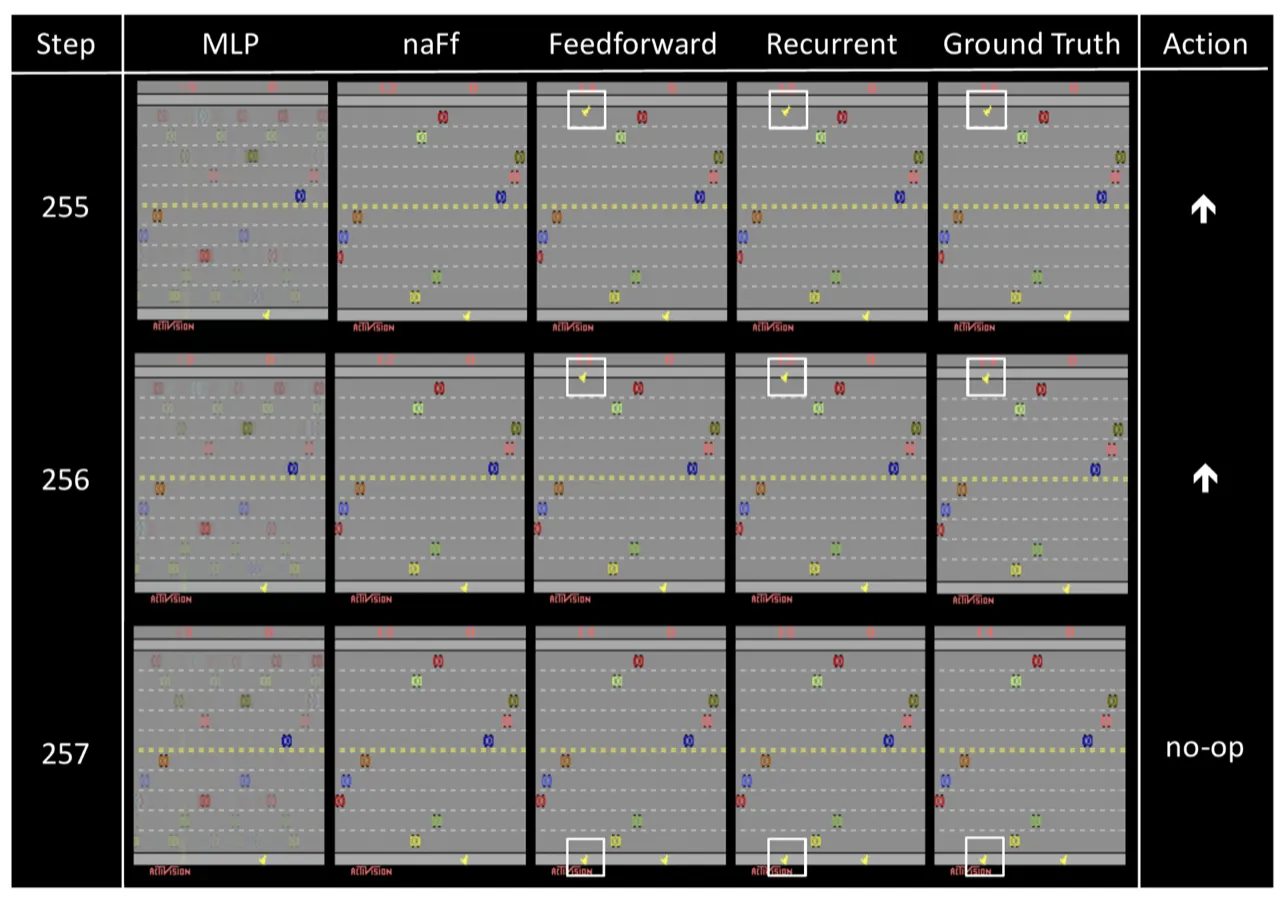
图 1:Freeway 游戏中超过 250 步的动作条件预测示例。"Step"列为预测步数,"Action"列为动作。白框标出智能体控制的对象。预测步 256→257 时,被控对象越过上边界后从底部重现——本文两种架构均能正确预测这一非线性跳变,而 MLP 和 naFf 基线则无法预测。Figure 1: An example of action-conditional prediction over more than 250 steps in the Freeway game. The "Step" column gives the prediction step and the "Action" column the action. White boxes mark the object controlled by the agent. At prediction steps 256→257 the controlled object crosses the top boundary and reappears from the bottom — both architectures proposed here predict this nonlinear jump correctly, whereas the MLP and naFf baselines fail to.
100+可用于控制的预测步数Prediction steps usable for control
5Atari 游戏域(Seaquest / S.Invaders / Freeway / QBert / Ms Pacman)Atari game domains (Seaquest / S.Invaders / Freeway / QBert / Ms Pacman)
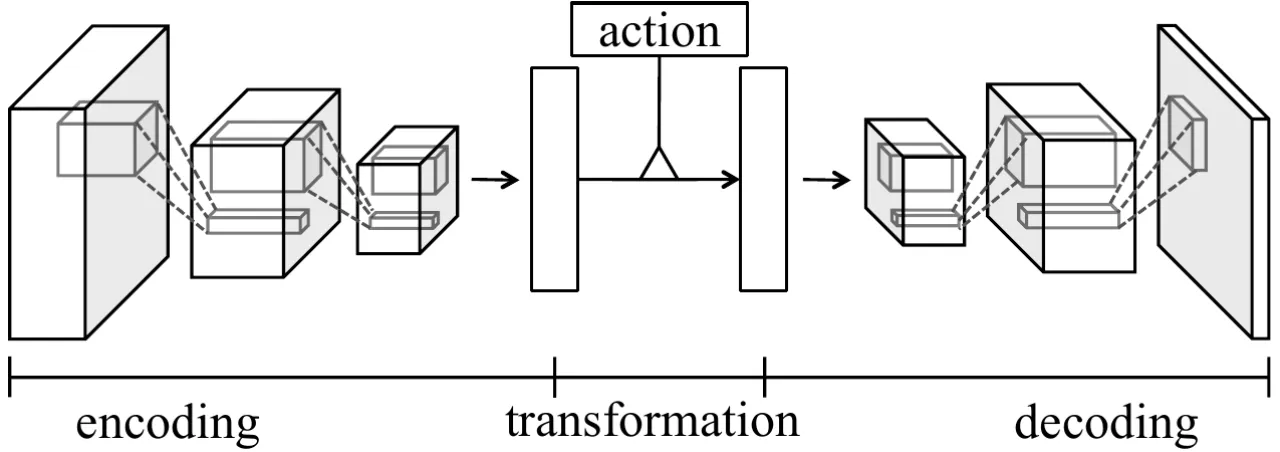
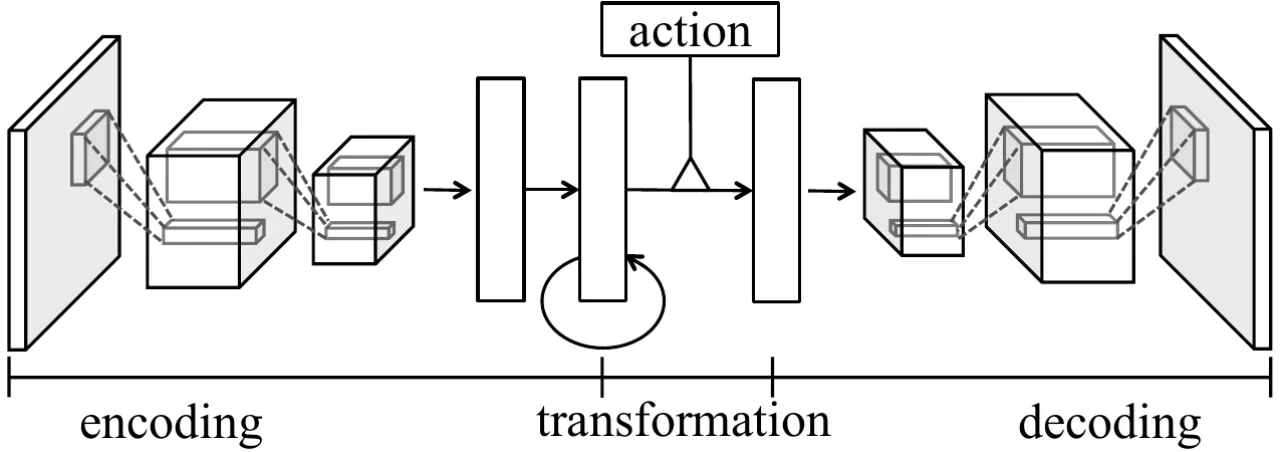
两种架构均由三个模块组成:编码层(Encoding)从输入帧提取时空特征,动作条件变换层(Action-Conditional Transformation)将特征依动作变换为下一帧的预测特征,解码层(Decoding)将高层特征反卷积回像素空间。Both architectures consist of three modules: an encoding layer (Encoding) that extracts spatio-temporal features from the input frames, an action-conditional transformation layer (Action-Conditional Transformation) that transforms those features according to the action into the predicted features of the next frame, and a decoding layer (Decoding) that deconvolves the high-level features back into pixel space.
图 2a:Feedforward encoding 架构。将最近 4 帧拼接为多通道输入,经 4 层卷积 + 全连接层提取特征向量 henc,再通过乘性变换层和反卷积解码器输出预测帧。Figure 2a: The feedforward encoding architecture. The most recent 4 frames are concatenated into a multi-channel input; 4 convolutional layers plus a fully connected layer extract the feature vector henc, which then passes through the multiplicative transformation layer and a deconvolutional decoder to output the predicted frame.图 2b:Recurrent encoding 架构。每次只输入一帧,由 CNN + LSTM 联合编码时序特征;LSTM 的记忆细胞保留长历史依赖,再经相同的变换层和解码器输出预测帧。Figure 2b: The recurrent encoding architecture. Only one frame is fed in at a time, and a CNN together with an LSTM jointly encodes the temporal features; the LSTM memory cells retain long-range historical dependencies, and the same transformation layer and decoder output the predicted frame.
Feedforward Encoding(前馈编码)Feedforward Encoding
将最近 m 帧(本文取 m=4)按通道拼接后输入 CNN,直接从像素提取时空特征:The most recent m frames (m=4 in this paper) are concatenated channel-wise and fed into a CNN, which extracts spatio-temporal features directly from pixels:
henct = CNN(xt−m+1:t)
卷积层使用 64×(8×8)、128×(6×6)、128×(6×6)、128×(4×4) 滤波器,步幅均为 2;后接全连接层输出 2048 维特征向量。该方案类似"early-fusion",可精确建模局部像素级时空关系,但难以捕获超出输入窗口的长期依赖。The convolutional layers use 64×(8×8), 128×(6×6), 128×(6×6) and 128×(4×4) filters, all with stride 2; a following fully connected layer outputs a 2048-dimensional feature vector. This design is akin to "early-fusion": it models local pixel-level spatio-temporal relations precisely, but has difficulty capturing dependencies beyond the input window.
Recurrent Encoding(循环编码)Recurrent Encoding
每步输入单帧,先用 CNN 提取空间特征,再送入 LSTM(2048 个隐藏单元)捕获任意长度时序依赖:A single frame is fed in at each step; a CNN first extracts spatial features, which are then passed to an LSTM (2048 hidden units) to capture temporal dependencies of arbitrary length:
[henct, ct] = LSTM(CNN(xt), henct−1, ct−1)
LSTM 的记忆细胞 ct 保留来自深层历史的信息,能处理 9 步以上的长期事件(如 Space Invaders 敌人的周期性移动)。The LSTM memory cell ct retains information from the deep history and can handle long-term events spanning more than 9 steps (such as the periodic movement of the enemies in Space Invaders).
动作变量通过乘性交互注入特征空间,避免简单拼接导致的加法独立性问题。为降低参数量,对三阶张量进行因式分解(因子数 f=2048):The action variable is injected into the feature space through a multiplicative interaction, avoiding the additive independence that simple concatenation induces. To reduce the number of parameters, the third-order tensor is factorized (factor count f=2048):
hdect = Wdec(Wenc·henct ⊙ Wa·at) + b
当动作为 one-hot 向量时,该乘性变换等价于为每个动作使用独立的权重矩阵,能够建模不同动作对应的不同变换。When the action is a one-hot vector, this multiplicative transformation is equivalent to using a separate weight matrix for each action, and can therefore model the distinct transformation associated with each action.
变换后的特征向量经全连接层 reshape 为 128×11×8 的特征图,再经 4 层反卷积(滤波器:128×(4×4)、128×(6×6)、128×(6×6)、3×(8×8),步幅均为 2)还原为全分辨率 RGB 图像(210×160)。反卷积比先上采样再卷积的方案更高效。The transformed feature vector is reshaped by a fully connected layer into a 128×11×8 feature map, and then restored to a full-resolution RGB image (210×160) by 4 deconvolutional layers (filters: 128×(4×4), 128×(6×6), 128×(6×6), 3×(8×8), all with stride 2). Deconvolution is more efficient than upsampling followed by convolution.
Curriculum Learning with Multi-Step Prediction(课程式多步预测训练)Curriculum Learning with Multi-Step Prediction
为避免 1 步预测误差在长期滚动推理中累积,采用课程学习策略,依次以 K=1、3、5 步为目标函数训练,学习率分别为 10−4、10−5、10−5:To keep 1-step prediction error from accumulating during long-horizon rollouts, a curriculum learning strategy is adopted: the objective is trained successively with K=1, 3 and 5 steps, at learning rates 10−4, 10−5 and 10−5 respectively:
每阶段迭代次数分别为 1.5×10⁶、106、106;RMSProp(momentum=0.9)优化,batch size feedforward 网络为 32/8/8,recurrent 网络为 4/4/4。The stages run 1.5×10⁶, 106 and 106 iterations respectively; optimization uses RMSProp (momentum=0.9), with batch size 32/8/8 for the feedforward network and 4/4/4 for the recurrent network.
03实验Experiments
在 5 个 Atari 游戏(Seaquest、Space Invaders、Freeway、QBert、Ms Pacman)上进行评估,训练集约 500,000 帧,测试集约 50,000 帧,使用 DQN ε-greedy 策略(ε=0.3)采集数据。图像为全分辨率 210×160 RGB,每 4 帧执行一次动作(60fps → 15fps)。对比基线:MLP(4 隐层,约同等参数量)和 naFf(无动作输入的前馈网络)。Evaluation is carried out on 5 Atari games (Seaquest, Space Invaders, Freeway, QBert, Ms Pacman), with a training set of about 500,000 frames and a test set of about 50,000 frames, collected under a DQN ε-greedy policy (ε=0.3). Images are full-resolution 210×160 RGB, and an action is executed every 4 frames (60fps → 15fps). The comparison baselines are MLP (4 hidden layers, roughly the same parameter count) and naFf (a feedforward network without action input).
量化评估:100 步均方误差Quantitative evaluation: 100-step mean squared error
本文两种架构在所有游戏域的 100 步 MSE 上均优于两个基线。其中与 naFf 的差距在 Seaquest 最为明显(被控对象占图像面积更大);Space Invaders 等游戏中差距较小,原因是被控对象仅占图像的一小部分。Both architectures proposed here outperform the two baselines on 100-step MSE in every game domain. The gap over naFf is most pronounced on Seaquest (the controlled object occupies a larger image area); in games such as Space Invaders the gap is smaller, because the controlled object covers only a small part of the image.
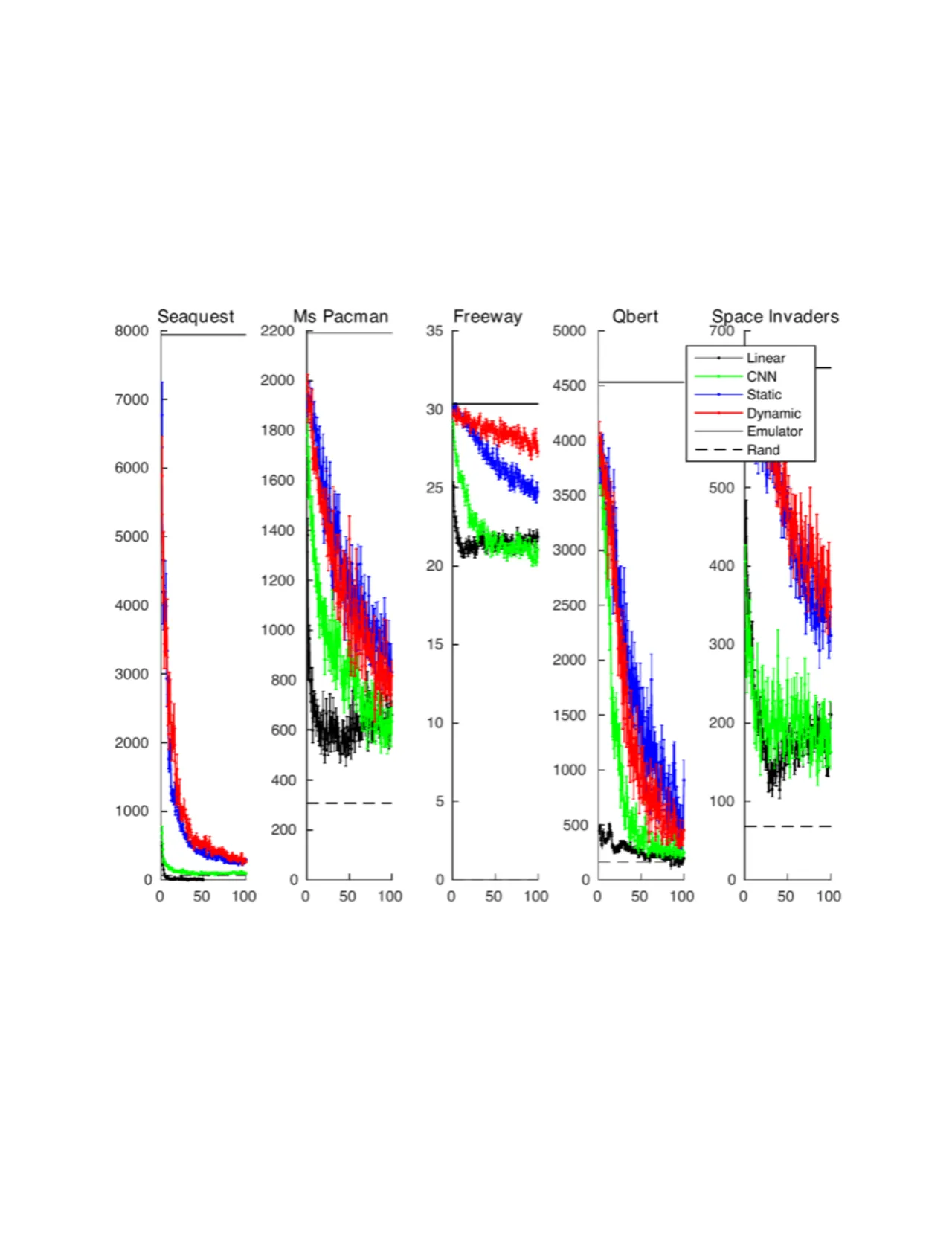
图 3:将预测模型替代 game emulator 后的游戏得分。x 轴为每次重置前连续预测的步数(1–100),y 轴为 30 局平均得分。"Emulator"为使用真实帧的 DQN 基准,"Rand"为随机策略。本文两种架构(蓝/绿曲线)显著优于 MLP 和 naFf 基线,在 3/5 个游戏中即使预测 100 步后得分仍远高于随机策略。Figure 3: Game scores obtained after replacing the game emulator with the prediction model. The x-axis is the number of consecutive predicted steps before each reset (1–100) and the y-axis the average score over 30 episodes. "Emulator" is the DQN baseline running on real frames and "Rand" is a random policy. The two architectures proposed here (blue/green curves) clearly outperform the MLP and naFf baselines, and in 3/5 games the score after 100 predicted steps remains far above that of the random policy.
知情探索(Informed Exploration)改善 DQN 训练Informed Exploration improves DQN training
利用预测模型为 ε-greedy 策略中的探索动作提供信息:在随机动作选择时,改为选择预测帧与最近 d 帧轨迹记忆中最少出现相似帧的动作(用 Gaussian kernel 估计访问频率)。训练了专用的灰度/下采样(84×84)前馈网络提升计算效率。The prediction model supplies information for the exploratory actions of the ε-greedy policy: instead of picking an action at random, the agent picks the action whose predicted frame appears least often among the frames in the memory of the most recent d trajectory frames (visit frequency is estimated with a Gaussian kernel). A dedicated grayscale / downsampled (84×84) feedforward network is trained to improve computational efficiency.
模型Model
Seaquest
S. Invaders
Freeway
QBert
Ms Pacman
DQN - Random exploration
13119 (538)
698 (20)
30.9 (0.2)
3876 (106)
2281 (53)
DQN - Informed exploration
13265 (577)
681 (23)
32.2 (0.2)
8238 (498)
2522 (57)
知情探索在 3/5 个游戏中提升了 DQN 性能,QBert 提升最显著(3876→8238)。括号内为标准误差,数据来自 100 局游戏。Informed exploration improves DQN performance in 3/5 games, most markedly on QBert (3876→8238). Values in parentheses are standard errors, computed over 100 episodes.
表征分析:动作相似性与受控/非受控对象分离Representation analysis: action similarity and separation of controlled / uncontrolled objects
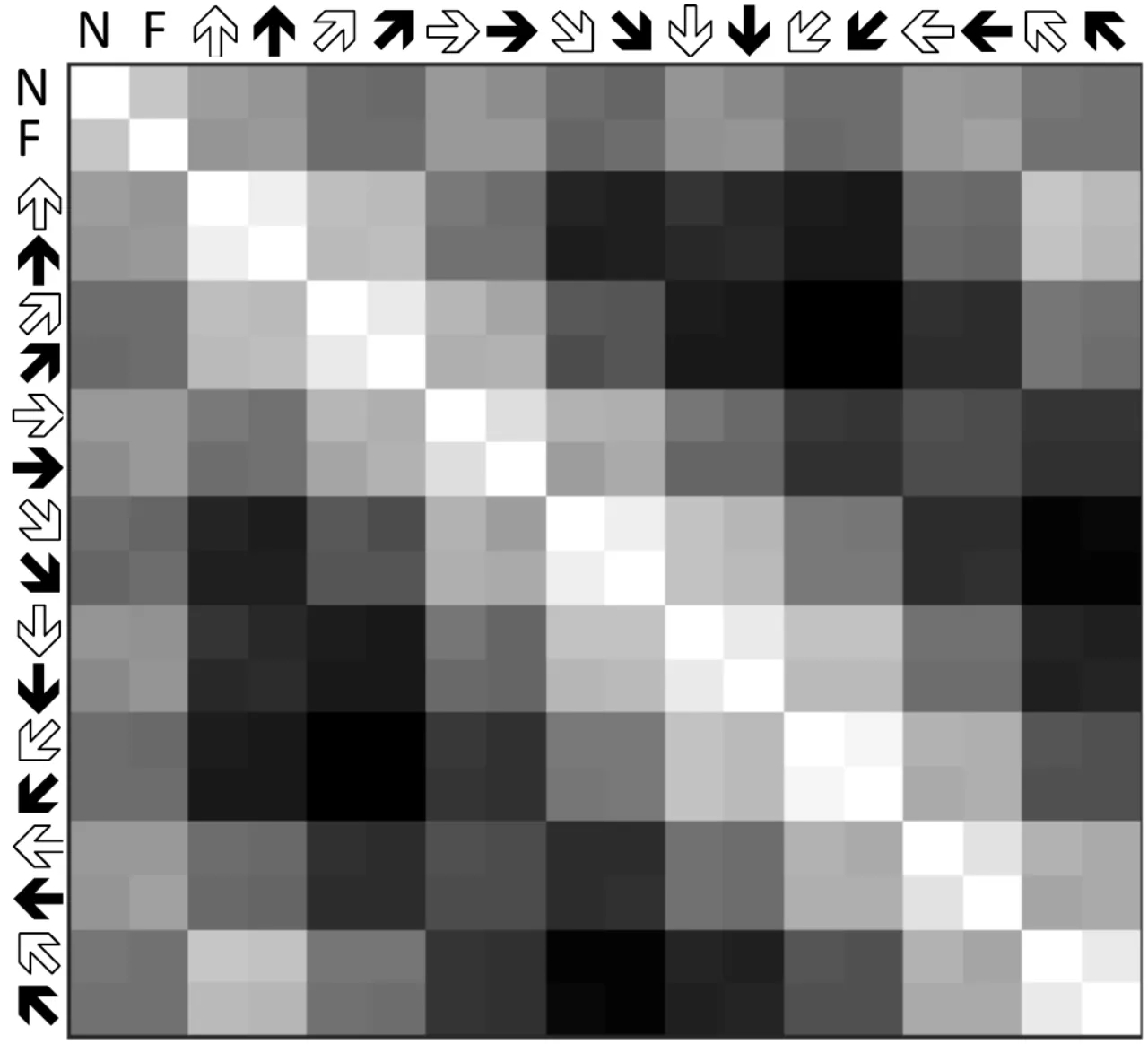
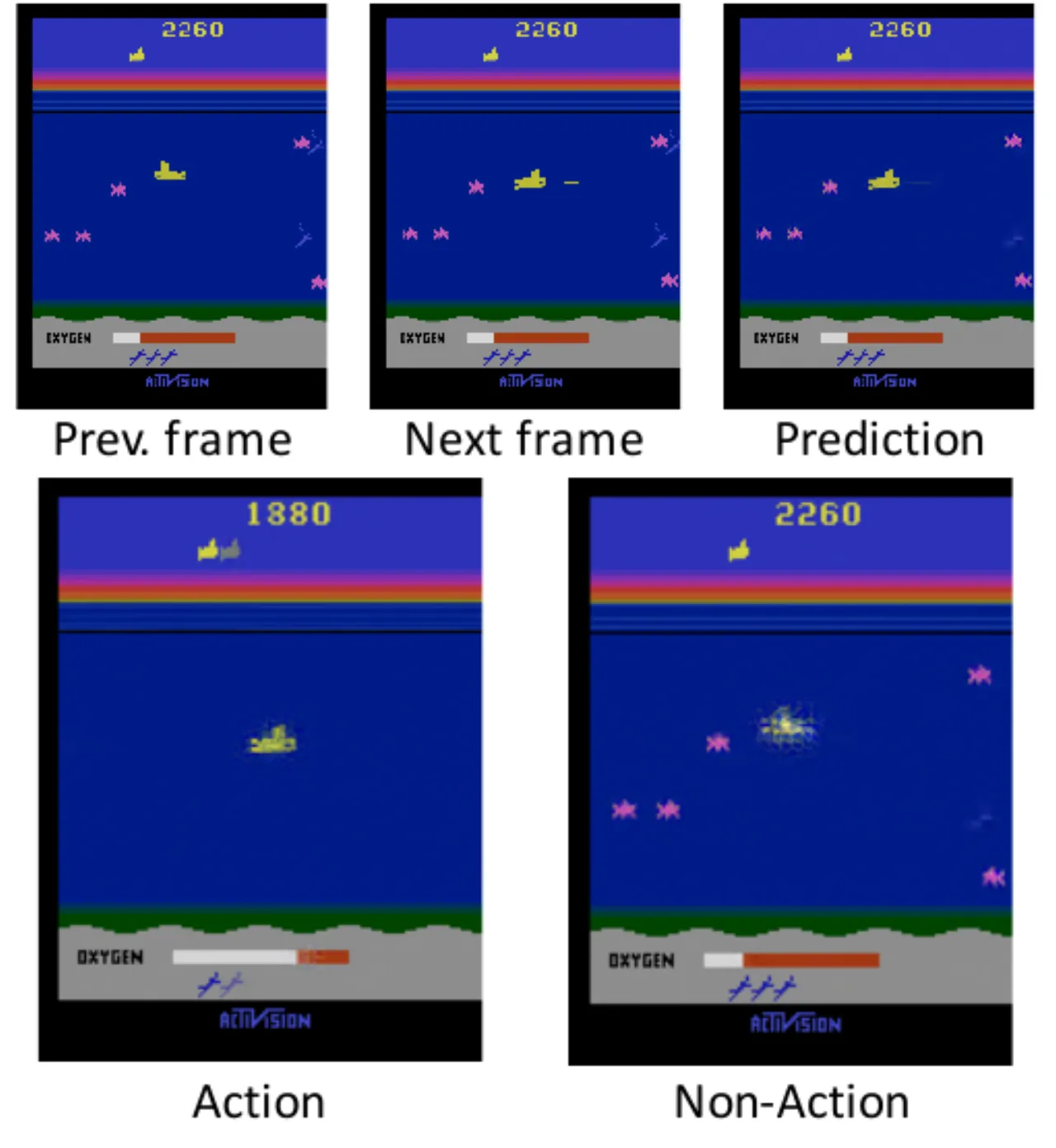
图 4:Seaquest 训练后动作因子(Wa·a)的两两余弦相似度。方向相同的动作(如"up"与"up+fire")呈正相关,方向相反的动作(如"up+right"与"down+left")呈负相关,体现了模型自动学习到的合理动作语义结构。"N"="no-operation","F"="fire"。Figure 4: Pairwise cosine similarity of the action factors (Wa·a) after training on Seaquest. Actions in the same direction (e.g. "up" and "up+fire") are positively correlated, while actions in opposite directions (e.g. "up+right" and "down+left") are negatively correlated, reflecting the sensible action semantics the model learns automatically. "N" = "no-operation", "F" = "fire".图 5:分离受控与非受控对象的可视化。给定同一输入帧,仅激活高方差因子(Action 图)时,模型准确预测被动作控制的对象的移动,背景为均值像素;仅激活低方差因子(Non-Action 图)时,模型预测其他对象和背景的运动,被控对象停留在原位。Figure 5: Visualization separating controlled from uncontrolled objects. Given the same input frame, activating only the high-variance factors (Action panel) makes the model predict accurately the movement of the object controlled by the action, with the background set to mean pixels; activating only the low-variance factors (Non-Action panel) makes it predict the motion of the other objects and the background, while the controlled object stays in place.
04局限性Limitations
Note:以下局限性由作者在论文正文中明确陈述(stated),最后一条为从设计中推断(inferred)。The limitations below are explicitly stated by the authors in the body of the paper (stated); the last one is inferred from the design (inferred).
小对象预测困难(stated)Difficulty predicting small objects (stated)
"Both of our models have difficulty in accurately predicting small objects, such as bullets in Space Invaders. The reason is that the squared error signal is small when the model fails to predict small objects during training."——以 MSE 为损失函数时,小对象的像素误差对总损失贡献极小,导致模型缺乏充足的学习信号。"Both of our models have difficulty in accurately predicting small objects, such as bullets in Space Invaders. The reason is that the squared error signal is small when the model fails to predict small objects during training." — when MSE is the loss function, the pixel error of small objects contributes very little to the total loss, so the model lacks a sufficient learning signal.
"In Seaquest, e.g., new objects appear from the left side or right side randomly, and so are hard to predict. Although our models do generate new objects with reasonable shapes and movements…the generated frames do not necessarily match the ground-truth."——随机出现的对象(如敌方潜水艇)无法被确定性模型精确预测,生成结果在形状和运动方向合理,但位置不一定与真实帧吻合。"In Seaquest, e.g., new objects appear from the left side or right side randomly, and so are hard to predict. Although our models do generate new objects with reasonable shapes and movements…the generated frames do not necessarily match the ground-truth." — randomly appearing objects (such as enemy submarines) cannot be predicted exactly by a deterministic model; the generated results have plausible shapes and directions of motion, but their positions do not necessarily agree with the ground-truth frames.
"[Feedforward architecture] is not suitable for long-term dependencies because it requires more memory and parameters as more frames are concatenated into the input."——在 Freeway 等游戏中,当智能体进入新阶段后动作被忽略 9 步,前馈架构因输入窗口仅为最近 4 帧而无法建模这一长期状态,导致在该场景下发生错误预测(diverge)。"[Feedforward architecture] is not suitable for long-term dependencies because it requires more memory and parameters as more frames are concatenated into the input." — in games such as Freeway, the action is ignored for 9 steps after the agent enters a new stage; because its input window covers only the most recent 4 frames, the feedforward architecture cannot model this long-term state and diverges in that situation.
尚未延伸至 reward 预测与完整 model-based RL(stated)Not yet extended to reward prediction or full model-based RL (stated)
论文结论中指出:"In future work we will learn models that predict future reward in addition to predicting future frames and evaluate the performance of our architectures in model-based RL."——当前架构仅预测像素帧,尚未整合奖励信号预测,因此不能直接支撑完整的 model-based RL 规划。The conclusion of the paper notes: "In future work we will learn models that predict future reward in addition to predicting future frames and evaluate the performance of our architectures in model-based RL." — the current architecture predicts only pixel frames and does not yet integrate reward-signal prediction, so it cannot directly support full model-based RL planning.
未扩展到更大自然场景视频(inferred)Not extended to larger natural-scene video (inferred)
所有实验均限于 Atari 游戏(非自然场景,分辨率 210×160)。更高分辨率、更复杂动态(如自动驾驶第一视角)中的泛化能力未经验证。All experiments are confined to Atari games (non-natural scenes at a resolution of 210×160). Generalization to higher resolutions and more complex dynamics (such as the first-person view in autonomous driving) has not been verified.