← 论文海报合集← Paper Notes|
机器人 · Robotics · arXiv 2026Robotics · arXiv 2026

ABot-M0

VLA Foundation Model for Robotic Manipulation with Action Manifold Learning
Yandan Yang, Shuang Zeng, Tong Lin, Xinyuan Chang, Dekang Qi, Junjin Xiao, Haoyun Liu, Ronghan Chen, Yuzhi Chen, Dongjie Huo, Feng Xiong, Xing Wei, Zhiheng Ma, Mu Xu

ABot-M0 是一个通用机器人操作基础模型,核心创新为 Action Manifold Learning(AML)——将动作预测约束在低维流形上,显著提升推理速度与策略稳定性;同时构建了 UniACT 大规模统一数据集(600 万条轨迹、9500+ 小时、20+ 形态机器人),在 LIBERO、RoboTwin 2.0 等主流基准上刷新最优性能。ABot-M0 is a general-purpose robotic manipulation foundation model. Its core innovation is Action Manifold Learning (AML)—constraining action prediction to a low-dimensional manifold, which markedly improves inference speed and policy stability. It also builds UniACT, a large-scale unified dataset (six million trajectories, 9500+ hours, 20+ robot embodiments), setting new state-of-the-art results on mainstream benchmarks such as LIBERO and RoboTwin 2.0.

arXiv 2026-02 Qwen3-VL 4B + 0.16B DiT 6M+ trajectories · 9500h+ 📄 arXiv:2602.11236
VLA 机器人操作Robotic Manipulation Action Manifold Learning 具身智能Embodied AI 扩散策略Diffusion Policy 多形态机器人Cross-Embodiment Robots UniACT 数据集UniACT Dataset LIBERO 前馈推理Feed-Forward Inference diffusion transformer

01 动机Motivation

构建真正通用的机器人智能体面临两大核心挑战:数据稀缺(跨形态、跨任务的高质量轨迹匮乏)与动作表示低效(高维噪声预测在速度和稳定性方面均有瓶颈)。现有 VLA 模型往往依赖单一数据源或特定硬件平台,泛化能力有限。Building a truly general-purpose robotic agent faces two core challenges: data scarcity (high-quality trajectories across embodiments and tasks are scarce) and inefficient action representation (high-dimensional noise prediction is bottlenecked in both speed and stability). Existing VLA models often rely on a single data source or a specific hardware platform, and their generalization remains limited.

"effective robot actions lie not in the full high-dimensional space but on a low-dimensional, smooth manifold"
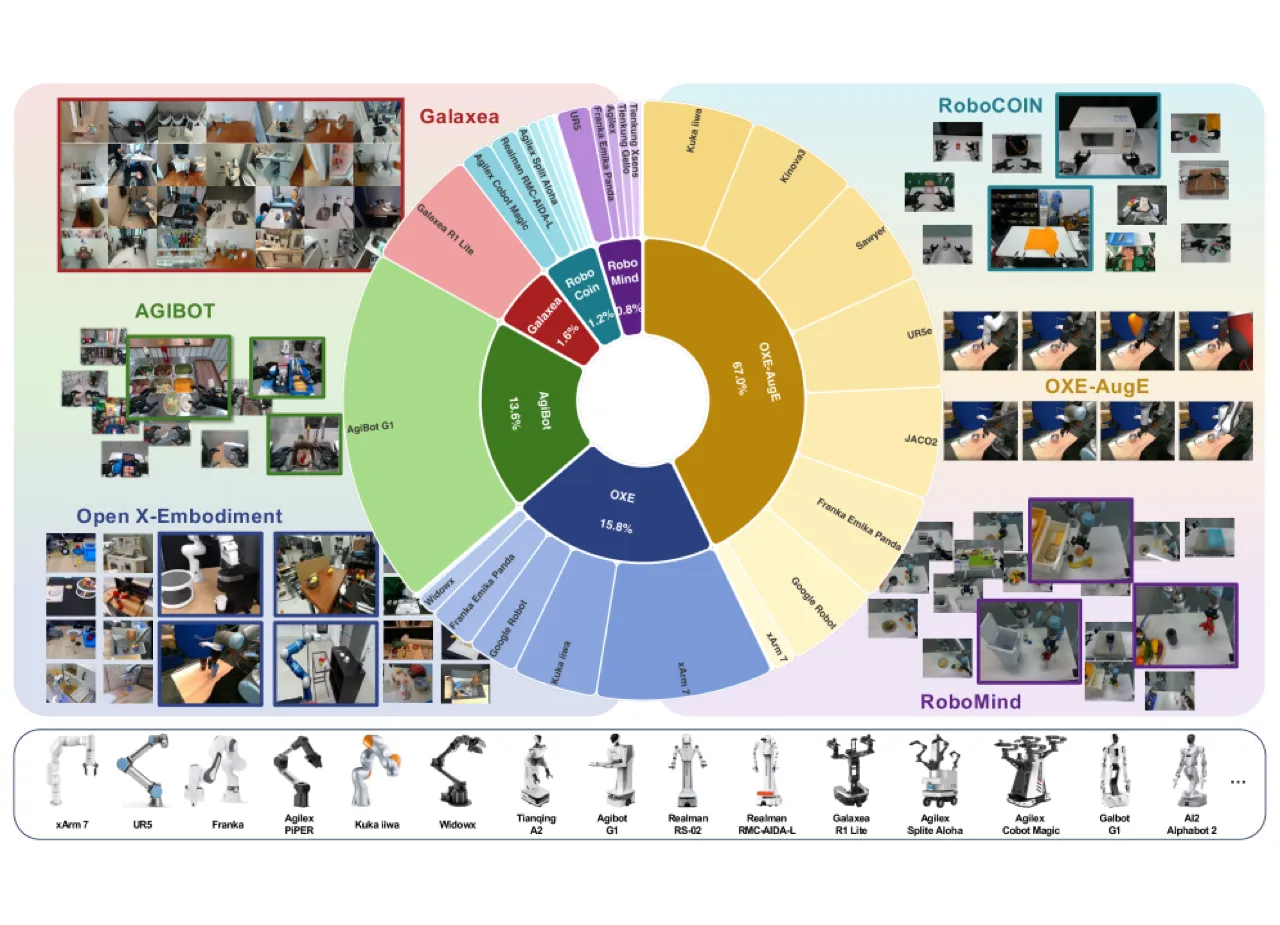
UniACT 数据集组成概览
Fig. 2:UniACT 数据集组成概览。汇聚六个开源数据集,覆盖 600 万条轨迹、9500+ 小时、20+ 种机器人形态,提供统一的动作表示与标注规范。Fig. 2: Overview of the UniACT dataset composition. It aggregates six open-source datasets covering six million trajectories, 9500+ hours and 20+ robot embodiments, and provides a unified action representation and annotation standard.
6M+UniACT 轨迹数UniACT trajectories
98.6%LIBERO 平均成功率LIBERO average success rate
86.06%RoboTwin 2.0 成功率RoboTwin 2.0 success rate
80.5%LIBERO-Plus 零样本泛化LIBERO-Plus zero-shot generalization
02 方法Method

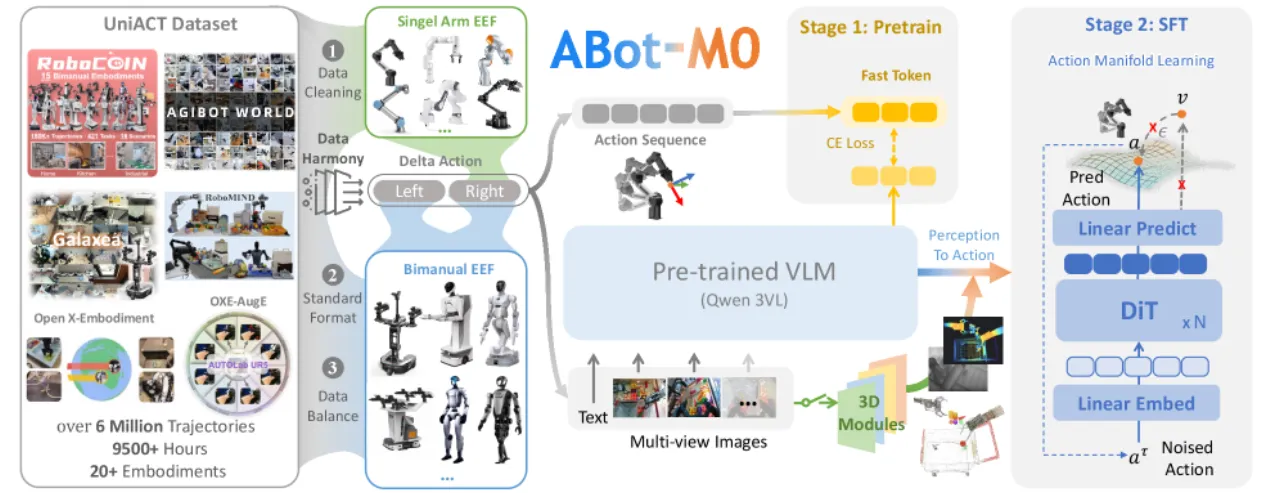
ABot-M0 由两个核心模块组成:Qwen3-VL(4B)视觉语言主干负责语义理解,0.16B Diffusion Transformer(DiT)动作专家负责动作生成。两者通过 cross-attention 融合,并可选配 3D 几何感知模块。ABot-M0 comprises two core modules: a Qwen3-VL (4B) vision-language backbone responsible for semantic understanding, and a 0.16B Diffusion Transformer (DiT) action expert responsible for action generation. The two are fused through cross-attention, with an optional 3D geometric perception module.

ABot-M0 整体架构
Fig. 3:ABot-M0 完整架构。左侧 Qwen3-VL 提取视觉语义特征,右侧 DiT 动作专家通过 cross-attention 注入 VLM 特征与可选 3D 信息,输出去噪动作序列。Fig. 3: The complete ABot-M0 architecture. On the left, Qwen3-VL extracts visual-semantic features; on the right, the DiT action expert injects VLM features and optional 3D information through cross-attention and outputs the denoised action sequence.

Action Manifold Learning(AML)

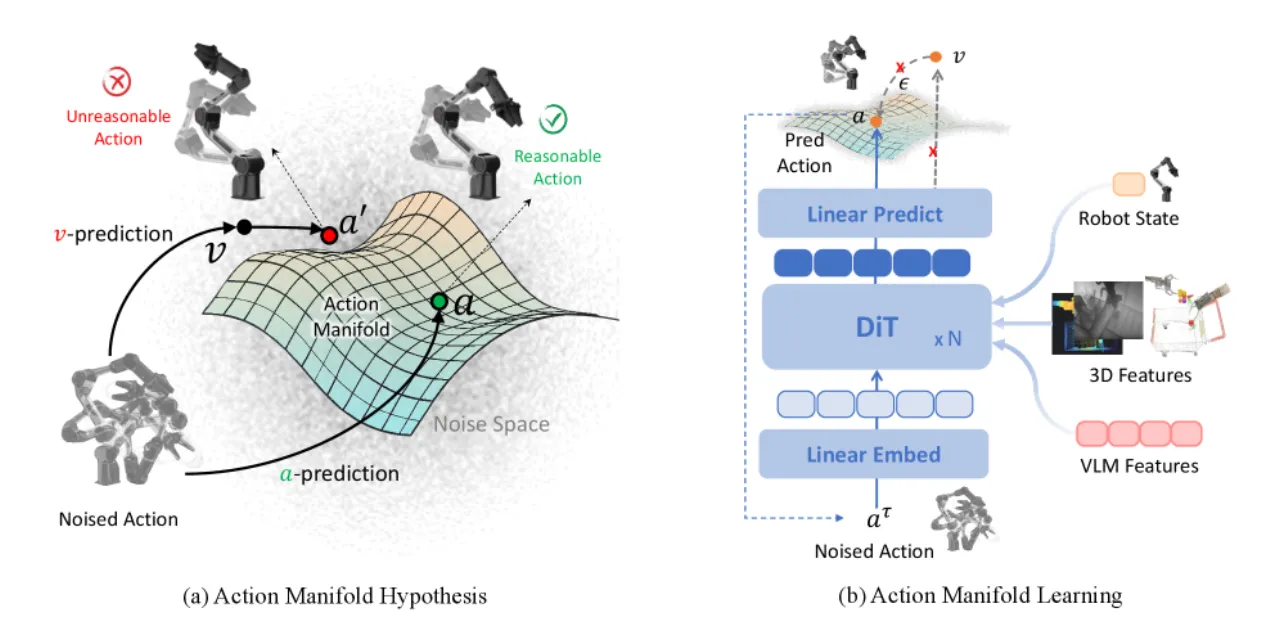
传统扩散策略预测噪声(epsilon-prediction)或速度,AML 直接在低维流形上预测去噪后的干净动作序列。具体而言,DiT 主干计算去噪预测 Â_t = V_θ(φ_t, A_t^τ, q_t),但损失函数施加在速度上并带有重权重因子 w(τ) = 1/(1−τ)²。推理时通过 ODE 求解从纯噪声迭代生成动作块。该设计使模型在极少去噪步数(2 步)及超大动作块(chunk size 30)下仍能保持稳定性能,而基线 GR00T 在同等条件下性能大幅下降。Conventional diffusion policies predict noise (epsilon-prediction) or velocity, whereas AML directly predicts the clean, denoised action sequence on a low-dimensional manifold. Concretely, the DiT backbone computes the denoising prediction Â_t = V_θ(φ_t, A_t^τ, q_t), while the loss is imposed on the velocity with a reweighting factor w(τ) = 1/(1−τ)². At inference, action chunks are generated iteratively from pure noise by solving an ODE. This design keeps performance stable even with very few denoising steps (2 steps) and very large action chunks (chunk size 30), whereas the GR00T baseline degrades sharply under the same conditions.

Action Manifold Learning 概念图
Fig. 4:AML 概念对比。左:传统噪声/速度预测,动作分布散落于高维空间;右:AML 将有效动作约束在低维平滑流形,预测更直接,路径更短。Fig. 4: Conceptual comparison for AML. Left: conventional noise/velocity prediction, where the action distribution is scattered over a high-dimensional space. Right: AML constrains effective actions to a low-dimensional smooth manifold, so prediction is more direct and the path shorter.

UniACT 数据集与多形态统一UniACT Dataset and Cross-Embodiment Unification

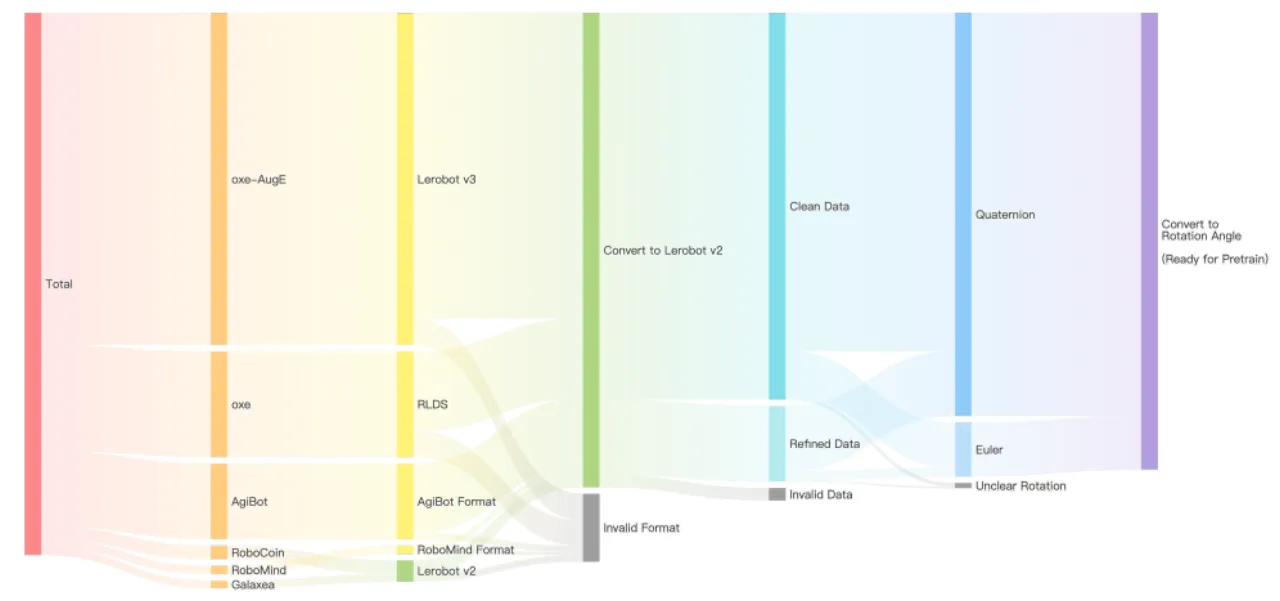
UniACT 汇聚六个开源数据集,关键工程包括:UniACT aggregates six open-source datasets; the key engineering includes:

UniACT 数据清洗流程
Fig. 1:UniACT 数据清洗与预处理流程,涵盖数据质量治理的各个环节,从异构来源构建统一高质量数据集。Fig. 1: The UniACT data cleaning and preprocessing pipeline, covering every stage of data quality governance and building a unified high-quality dataset from heterogeneous sources.

双流感知与 3D 信息注入Dual-Stream Perception and 3D Information Injection

模型支持可选的 3D 感知增强:使用 VGGT 从单张图像重建 3D 特征,或使用 Qwen-Image-Edit 合成多视角图像提供几何先验。消融实验显示,cross-attention 融合优于 concatenation 与 Q-Former 方案;多视角(2 视图)配置在 LIBERO-Plus 上达到 70.2%,高于单视角的 68.0%。The model supports optional 3D perception enhancement: VGGT reconstructs 3D features from a single image, or Qwen-Image-Edit synthesizes multi-view images to provide geometric priors. Ablations show that cross-attention fusion outperforms concatenation and Q-Former designs; the multi-view (2-view) configuration reaches 70.2% on LIBERO-Plus, above the 68.0% of the single-view setting.

不同采样策略的形态分布
Fig. 5:三种采样策略(Trajectory-Uniform、Task-Uniform、Embodiment-Uniform)在 OXE、AgiBot-Beta、RoboCoin 上的形态分布对比。Task-Uniform 在技能多样性与形态覆盖之间取得最佳平衡。Fig. 5: Comparison of the embodiment distributions produced by three sampling strategies (Trajectory-Uniform, Task-Uniform, Embodiment-Uniform) on OXE, AgiBot-Beta and RoboCoin. Task-Uniform strikes the best balance between skill diversity and embodiment coverage.

03 实验Experiments

在 LIBERO、LIBERO-Plus(零样本泛化)、RoboCasa GR1、RoboTwin 2.0 四大基准上与主流方法对比,ABot-M0 在所有基准上均取得最优或接近最优的成绩。Compared with mainstream methods on four benchmarks—LIBERO, LIBERO-Plus (zero-shot generalization), RoboCasa GR1 and RoboTwin 2.0—ABot-M0 attains the best or near-best results on all of them.

LIBERO 标准基准LIBERO Standard Benchmark

方法MethodL-SpatialL-ObjectL-GoalL-LongAverage
Diffusion Policy78.587.573.564.876.1
OpenVLA84.788.479.253.776.5
π₀98.096.894.488.494.4
π₀.₅98.898.298.092.496.9
OpenVLA-OFT97.698.497.994.597.1
ABot-M0(ours)98.899.899.096.698.6%

LIBERO-Plus 零样本泛化(OOD)LIBERO-Plus Zero-Shot Generalization (OOD)

LIBERO-Plus 测试相机视角、机器人形态、语言指令、光照、背景、噪声、布局等七种扰动下的零样本泛化能力。LIBERO-Plus evaluates zero-shot generalization under seven kinds of perturbation: camera viewpoint, robot embodiment, language instruction, lighting, background, noise and layout.

方法MethodCameraRobotLanguageLightBGNoiseLayoutTotal
OpenVLA0.83.523.08.134.815.228.515.6
UniVLA1.846.269.669.081.021.231.942.9
π₀13.86.058.885.081.479.068.953.6
RIPT-VLA55.231.277.688.491.673.574.268.4
ABot-M0(ours)60.467.986.496.291.686.482.680.5%

RoboCasa GR1 与 RoboTwin 2.0RoboCasa GR1 and RoboTwin 2.0

RoboCasa GR1(24 个桌面任务)RoboCasa GR1 (24 tabletop tasks)

方法Method平均成功率Average success rate
GR00T-N1.647.6%
Qwen3GR00T47.8%
Qwen3OFT48.8%
ABot-M058.3%

RoboTwin 2.0(50+ 任务)RoboTwin 2.0 (50+ tasks)

方法MethodCleanRandomized
π₀.₅42.98%43.84%
X-VLA72.80%72.84%
ABot-M086.06%85.08%

消融实验:AML 的优势Ablation: the advantage of AML

与 Qwen3-VL-GR00T 基线相比,AML 在各种极限条件下均表现出明显优势:Compared with the Qwen3-VL-GR00T baseline, AML shows a clear advantage under a range of extreme settings:

VLM 特征交互消融显示,直接使用最终层原始特征(71.0%)优于中间层或 action-query 增强方案。The ablation on VLM feature interaction shows that using the raw final-layer features directly (71.0%) outperforms intermediate-layer features or action-query enhanced variants.

04 局限性Limitations

Note:论文无独立 Limitations 章节,以下限制部分为作者在 Future Work 与讨论中明确陈述(标注 stated),部分为设计层面合理推断(标注 inferred)。Note: The paper has no standalone Limitations section. Some of the limitations below are explicitly stated by the authors in the Future Work and discussion (marked stated), while others are reasonable inferences at the design level (marked inferred).
数据规模尚未达到临界质量(stated)Data scale has not yet reached critical mass (stated)

作者指出 "data scale remains below critical mass" for truly general embodied agents,当前 600 万轨迹在任务多样性和覆盖密度上仍有明显缺口,尤其缺乏人体示范(UMI 等)数据。The authors point out that "data scale remains below critical mass" for truly general embodied agents; the current six million trajectories still leave clear gaps in task diversity and coverage density, and human demonstration data (such as UMI) is especially lacking.

跨数据集动作表示异构性(stated)Heterogeneous action representations across datasets (stated)

"action representations, coordinate systems, and control frequencies differ across datasets",统一标准化虽有效但不可避免地引入近似误差,在高精度任务中影响更明显。"action representations, coordinate systems, and control frequencies differ across datasets": unified normalization is effective but inevitably introduces approximation error, whose impact is more pronounced in high-precision tasks.

VLM 空间感知能力有限(stated)Limited spatial perception of the VLM (stated)

"vision-language models demonstrate strong capabilities in parsing natural language…Nevertheless, their spatial perception typically remains qualitative",在精细位置判断和高精度操控场景下存在固有瓶颈。"vision-language models demonstrate strong capabilities in parsing natural language…Nevertheless, their spatial perception typically remains qualitative": an inherent bottleneck remains for fine-grained position estimation and high-precision manipulation.

高精度场景中误差积累(stated)Error accumulation in high-precision scenarios (stated)

预训练模型在高精度操控场景下 "exhibit accumulated errors and unstable spatial alignment",长时序任务中策略漂移问题有待解决。In high-precision manipulation, pretrained models "exhibit accumulated errors and unstable spatial alignment"; policy drift in long-horizon tasks remains to be solved.

仅限桌面/双臂操控形态(inferred)Restricted to tabletop / dual-arm manipulation embodiments (inferred)

实验以桌面机械臂为主。作者在 Future Work 中明确提出将扩展至腿式机器人、无人机和类人形机器人,说明当前版本对这些形态的支持尚未验证。The experiments are dominated by tabletop manipulators. In Future Work the authors explicitly propose extending to legged robots, drones and humanoid robots, which indicates that support for these embodiments is not yet validated in the current version.